India Summons Pakistan Diplomat After Naval Collision

NEW DELHI — India has summoned Pakistan’s top diplomat in New Delhi and lodged a strong protest following a collision between an Indian Navy vessel and a Pakistani naval ship in international waters of the Arabian Sea.

India’s Ministry of External Affairs said the incident occurred on Tuesday, September 15, and described the conduct of the Pakistani naval units involved as “unacceptable and unprofessional.” The ministry said the collision did not cause any major damage.

According to Indian officials, the Pakistani naval vessel approached an Indian Navy warship operating on a routine surveillance mission in the northern Arabian Sea. Indian sources said the Pakistani vessel approached at high speed and manoeuvred in an unsafe manner before the collision.

India said the incident took place in international waters and raised concerns over compliance with a 1991 bilateral agreement between India and Pakistan. The agreement includes provisions intended to promote safety and prevent incidents involving military vessels.

The Pakistani Charge d’Affaires was asked to convey to Islamabad the need for military units to exercise due care at sea and respect bilateral agreements to prevent similar incidents in the future. India also instructed its Charge d’Affaires in Islamabad to lodge a corresponding protest with Pakistan’s Foreign Ministry.

There was no immediate public response from the Pakistani government to India’s protest, according to the latest reports. The incident comes against the backdrop of already strained relations between the two nuclear-armed neighbours.


Dhaka, Beijing Discuss Economic Corridor

DHAKA – Bangladesh and China today discussed cooperation on the Bangladesh-China-Myanmar Economic Corridor alongside a wide range of bilateral areas, including infrastructure, energy, human-resource development and economic cooperation.

The issues came up when Chinese Ambassador to Bangladesh Yao Wen paid a courtesy call on State Minister for Foreign Affairs Shama Obaed Islam, MP, at her office here, according to a foreign ministry press release.

During the meeting, the two sides exchanged views on areas of mutual interest and cooperation, particularly the Bangladesh-China-Myanmar Economic Corridor, the Chinese Economic Zone and development of Mongla Port.

They also discussed the proposed 1,000-bed hospital in Rangpur, education and human-resource development, people-to-people exchanges, energy cooperation, including renewable energy, and women’s empowerment.

Shama recalled Prime Minister Tarique Rahman’s successful visit to China and appreciated Beijing’s continued support for Bangladesh’s development, particularly in infrastructure, human development and capacity building.

Ambassador Yao reaffirmed China’s commitment to Bangladesh as a trusted partner and friend and highlighted the significant progress made in bilateral relations in recent years. During the meeting, the Chinese envoy also invited the state minister to visit China at a mutually convenient time, leading a delegation of women entrepreneurs from Bangladesh. Shama welcomed the invitation and expressed appreciation for the initiative.


Guterres Calls for New Global Order as Power Shifts

Shibbir Ahmed, New York — UN Secretary-General António Guterres has called for a major overhaul of the international system, saying the institutions created after the Second World War must change to reflect the growing economic and geopolitical influence of emerging economies. Speaking to leaders at the 18th BRICS Summit in New Delhi on Sunday, Guterres said the world of today is fundamentally different from that of 1945 and that global institutions must reflect current economic, demographic and geopolitical realities.

“Today’s economic, demographic and geopolitical realities are not those of 1945,” Guterres said. “Our institutional structures must reflect it.”

He said the countries represented at the summit reflected the changing balance of global power and pointed to the emergence of an increasingly multipolar world. Guterres argued that multipolarity can bring greater balance and equity to international institutions, but said that would require reforms to bodies including the UN Security Council and the Bretton Woods institutions.

The UN chief outlined four priorities for what he described as inclusive global growth: financing, technology, climate justice and peace. On development financing, Guterres said developing countries need substantial international support to achieve the Sustainable Development Goals. He urged multilateral development banks to become “bigger, better and bolder” to help meet the scale of financing required. Turning to artificial intelligence, he warned that the benefits of the technology remain concentrated among a relatively small number of companies and countries.

“Unchecked, the AI divide will widen every other divide — in income, in opportunity, in security, and in sovereignty,” Guterres warned.

Climate change was another major focus of his address. Guterres pointed to extreme heat, melting glaciers, wildfires and devastating floods as signs of the worsening climate crisis and warned that a stronger El Niño could make conditions even more difficult as the world approaches the 1.5-degree Celsius threshold above pre-industrial levels.

He called on wealthy nations to honor existing climate-finance commitments, including increased adaptation financing and stronger support for countries facing loss and damage. He also criticized the exploitation of critical minerals, calling for an end to what he described as “plundering.”

On peace and security, Guterres highlighted conflicts and crises in Gaza, the wider Middle East, Ukraine and Sudan. He urged countries to uphold the UN Charter, including the principles of sovereign equality, territorial integrity and the peaceful settlement of disputes. Guterres said reforming the international system should be viewed as a shared responsibility rather than a concession to emerging powers.

“As we move irreversibly to a multipolar world, all countries must work to strengthen and safeguard a multilateral system that delivers for all with the United Nations at its centre,” he said.

The BRICS summit, hosted by India, brought together leaders of major emerging economies and senior international officials as discussions focused on global governance, economic cooperation, development, technology, climate change and international peace and security.


President calls for resolving all outstanding issues with India

DHAKA – President Mirza Fakhrul Islam Alamgir today laid emphasis on quick resolving the outstanding issues between Bangladesh and India through discussions to further strengthen and sustain the existing relations between the two countries. “Mutual trust and confidence between the peoples of the two countries would increase further if matters of mutual interest were resolved through fair and mutually acceptable solutions,” he said.

He made the remarks when Indian High Commissioner to Bangladesh Dinesh Trivedi paid a courtesy call on the President at Bangabhaban here this morning. President’s Press Secretary Md Sarwar Alam said during a briefing after the meeting. The President urged India to take effective measures to ensure a fair share of the waters of common rivers, including the Ganges and the Teesta.

Indian High Commissioner to Bangladesh Dinesh Trivedi informed the President that his government was taking positive measures in this regard. The President said Bangladesh attaches special importance to its relations with India as its closest neighbour and an important trade and development partner. President Alamgir said Bangladesh is interested in building a respectful, forward-looking, mutually respectful and mutually beneficial partnership with India while upholding sovereign equality, national interests and dignity, and the welfare of the people.

During the meeting, the Indian High Commissioner congratulated Mirza Fakhrul Islam Alamgir on assuming office as President. Mentioning that India attaches great importance to its relations with Bangladesh, High Commissioner Trivedi reiterated his country’s commitment to further expanding cooperation between the two countries in various fields, including bilateral relations.

He said his country is keen to further consolidate, improve and strengthen relations between the two countries based on mutual respect, trust and cooperation. The President thanked the High Commissioner for his congratulations and requested him to convey his sincere gratitude and greetings to the President of India.

“There is immense scope for further expanding cooperation in various fields, including trade, water resources management, technology, connectivity, culture and people-to-people relations between the two countries,” the president said.

India and Bangladesh can work more closely to achieve common peace, development and prosperity by utilizing the capabilities and potential of the peoples of both countries, he added. The Indian High Commissioner expressed hope that the two countries would continue to work together and sought the President’s cooperation in discharging his responsibilities.

The President wished him a successful tenure and expressed hope that relations between the two countries would become more fruitful, positive and people-oriented in his tenure. Senior officials from the President’s Office, the Ministry of Foreign Affairs and the Indian High Commission were present during the meeting.


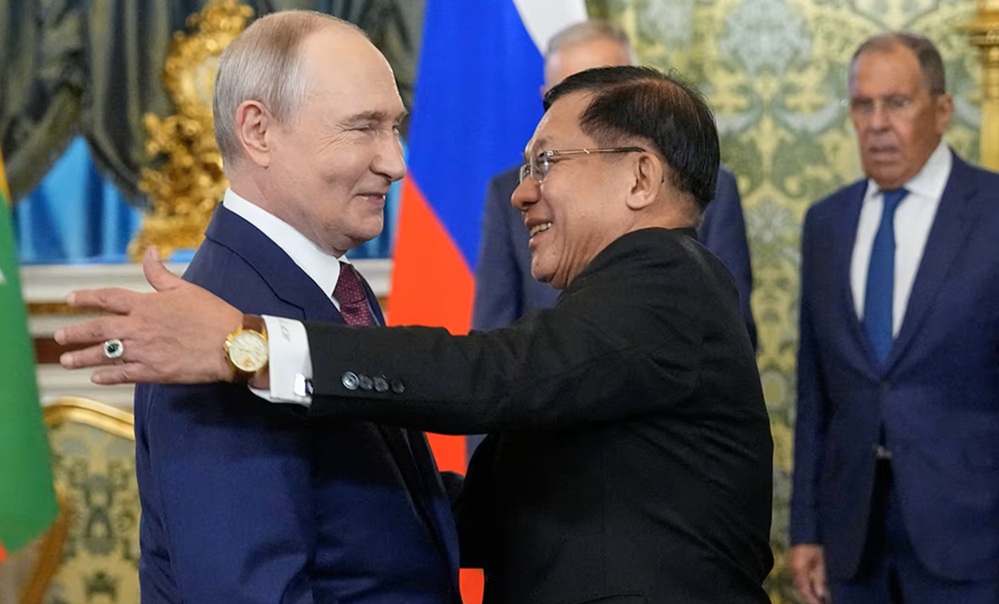
Russia Deepens Role in Myanmar’s Dawei Deep-Sea Port Project

Shibbir Ahmed, New York — Russia is deepening its involvement in Myanmar’s long-delayed Dawei deep-sea port and special economic zone project, as the two countries seek to revive the strategic development in the country’s southern Tanintharyi Region.

The Dawei project, which includes a deep-sea port, industrial zone and major energy facilities, has returned to the center of Myanmar-Russia economic cooperation after years of delays over financing and implementation.

During a meeting in Vladivostok on September 1, Myanmar Vice President U Nyo Saw and Russian Deputy Prime Minister Yury Trutnev discussed the Dawei project along with energy, trade and tourism cooperation. No new financing agreement, project value or construction timetable was announced following the meeting.

Russia’s interest in Dawei has become more concrete in recent months. In June, Myanmar’s Launglon Economic Development Company and Russia’s state-controlled Inter RAO signed a memorandum of understanding for a power plant linked to the Dawei deep-sea port project.

At a Russia-Myanmar business forum in Moscow in August, Russian Economic Development Minister Maxim Reshetnikov said Moscow was seeking majority stakes for Russian companies investing in projects within the Dawei special economic zone during the investment payback period. The planned development includes a deep-water port, a 660-megawatt power plant, an oil refinery and industrial and warehouse facilities.

Strategic location

Dawei is located on Myanmar’s Andaman Sea coast in Tanintharyi Region. Supporters of the project say its location could provide an alternative trade route between the Indian Ocean and Southeast Asia, potentially reducing dependence on the Strait of Malacca.

Myanmar officials have promoted the project as a potential gateway linking the Indian Ocean with Thailand and other parts of the region. The proposed transport connections could eventually link Dawei with Thailand’s eastern economic areas and the wider Southern Economic Corridor.

The project was originally developed with Thai participation but stalled after difficulties securing financing and implementing the required infrastructure. Myanmar’s official port authority records show that the earlier agreement with Italian-Thai Development was terminated after the developer failed to secure the required funding.

Military campaign around project area

The renewed push to revive Dawei has coincided with an intensified military campaign in areas surrounding the proposed development. Reuters reported in August that Myanmar’s military had deployed hundreds of troops to clear areas designated for the Russia-backed Dawei special economic zone. The operation involved fighting with local resistance groups and the displacement of civilians.

Human rights organization Fortify Rights separately reported allegations of killings, torture and forced displacement during military operations around the project area. The organization said the operations were taking place against the backdrop of accelerating Myanmar-Russia cooperation over Dawei.

Despite renewed political support from Moscow and Naypyidaw, major questions remain over financing, security and the feasibility of completing the multibillion-dollar project amid Myanmar’s continuing conflict.

If successfully revived, Dawei could become one of the most strategically significant infrastructure projects on Myanmar’s Andaman Sea coast, with potential implications for trade routes connecting Southeast Asia and the Indian Ocean.


Nepal Flood Disaster: UN Seeks $49.6 Million to Help 84,000 People

KATHMANDU — The United Nations and humanitarian partners have launched a $49.6 million emergency appeal to provide life-saving assistance to more than 84,000 people affected by catastrophic flash floods and landslides in northern Nepal.

The disaster, which struck on August 26, devastated communities across the region, destroying homes, roads and other critical infrastructure and leaving thousands of people in urgent need of humanitarian assistance. The UN humanitarian community said the appeal is aimed at supporting those most severely affected by the disaster.

The emergency response is focused on providing essential supplies and services, including food, clean water, emergency shelter, healthcare and protection assistance for affected communities.

The scale of the disaster has also placed enormous pressure on Nepal’s search-and-rescue operations. According to Nepalese authorities cited by Reuters, more than 1,294 people have been killed, while thousands remain missing following the floods and landslides.

The disaster caused particularly severe damage along the Trishuli River, where floodwaters, rocks, mud and debris swept through communities and infrastructure. Hydropower facilities and access roads were also heavily damaged.

Rescue teams have continued searching for survivors in areas cut off by the disaster. In a dramatic development, two workers were rescued alive from a hydropower tunnel nine days after the disaster struck.

The humanitarian crisis is compounded by the destruction of homes and basic infrastructure. Nepalese officials have estimated that thousands of houses will need to be rebuilt, while overall property, housing and infrastructure losses have reached billions of dollars.

The UN and its humanitarian partners say the immediate priority is to reach people who have lost their homes and livelihoods and to prevent further suffering as recovery efforts begin.

The emergency appeal will support relief operations in the hardest-hit communities and help humanitarian agencies deliver assistance to people who urgently need it.

The disaster is among the most serious natural emergencies Nepal has faced in recent years, with the effects extending beyond immediate loss of life to homes, livelihoods, transportation networks and vital infrastructure.

As search-and-rescue operations continue, the United Nations is urging international support for the emergency response and emphasizing the urgent humanitarian needs of tens of thousands of survivors.


Nepal Floods Leave 22,000 Children Without Safe Water, UNICEF Warns

KATHMANDU — At least 22,000 children in Nepal urgently need safe drinking water, sanitation and hygiene assistance more than a week after devastating flash floods swept through the Bhotekoshi-Trishuli river basin, UNICEF said. The floods damaged water-supply systems across affected districts and destroyed or severely damaged toilets and other sanitation facilities, increasing the risk of waterborne and infectious disease outbreaks.

Families displaced by the disaster are also crowded into host households and temporary holding centres, making it increasingly difficult to maintain basic hygiene and access clean water.

“Every parent in these districts is now making the same calculation several times a day,” said Alice Akunga, UNICEF Representative in Nepal, referring to families’ urgent need to determine where they can obtain water and whether it is safe for their children.

UNICEF expands emergency response

UNICEF has already delivered water, sanitation and hygiene supplies for approximately 19,000 people in Rasuwa and Nuwakot, two of the districts hardest hit by the floods. The emergency supplies include more than 3,800 hygiene kits, 3,300 collapsible 10-litre jerrycans, 3,500 buckets, 3,500 one-litre mugs and 4,000 bottles of water-treatment solution. More than 1,000 tarpaulin sheets have also been distributed.

UNICEF teams are working with Nepalese authorities and humanitarian partners on disease surveillance, hygiene awareness and outbreak prevention as the risk of infectious diseases rises.

Schools also heavily affected

The floods have also disrupted children’s education. UNICEF estimates that at least 19 schools have been damaged, including eight that were completely destroyed and another eight that suffered partial destruction. More than 10,000 school-age children are in need of immediate psychosocial support and access to safe learning spaces.

The damage to water infrastructure, homes and schools has left thousands of families facing an uncertain recovery while emergency teams continue providing essential assistance. Humanitarian agencies say restoring access to clean water and sanitation is particularly urgent because prolonged displacement and overcrowded living conditions can accelerate the spread of disease.

The latest warning comes as Nepal continues to recover from one of its most destructive recent flood disasters, with communities across the affected river basin struggling to rebuild homes, infrastructure and essential services. UNICEF said it will continue working with the Nepalese government and partners to provide life-saving water, sanitation, hygiene and child-protection support to affected communities.