Bangabandhu’s ‘The Unfinished Memoirs’ Published in 14 Languages

Staff Correspondent: The autobiography of Bangabandhu Sheikh Mujibur Rahman, The Unfinished Memoirs, has been translated into several foreign languages, reaching readers in Asia, Europe and the Middle East.

Alongside the original Bengali edition and its English translation, the book has been translated into Urdu, Japanese, Chinese, Arabic, French, Hindi, Turkish, Nepali, Spanish, Assamese, Russian and Thai.

At an event marking the publication of the Braille edition of The Unfinished Memoirs on October 7, 2020, then Prime Minister Sheikh Hasina said the book had been translated into 14 languages and that permission had been sought to translate it into several more languages.

However, reports published around that time did not provide a complete list of all 14 languages.

The Unfinished Memoirs was first published in June 2012. The English edition was published alongside the Bengali version. The English translation was done by Dr Fakrul Alam, professor of English at the University of Dhaka.

Bangabandhu began writing his memoirs while in prison between 1967 and 1969. Four handwritten notebooks were recovered later and were used as the basis for editing and publishing the book.

The memoir contains accounts of Bangabandhu’s childhood, family background, education, political activities, the Bengal famine of 1943, communal riots in Calcutta and Bihar, the partition of India, the Language Movement, the formation and activities of the Awami Muslim League and Awami League, the United Front election, and political developments during the Pakistan period.

The early foreign-language editions included English, Chinese, Japanese and Urdu. The Japanese edition was translated by Kazuhiro Watanabe of the Bengali section of Japan Broadcasting Corporation (NHK) and published by Asahi Shoten.

The Urdu edition was published under the title Adhoori Yaadein (ادھوری یادیں). A 2013 edition published by Oxford University Press in Pakistan lists Yaowar Aman as the translator.

The Arabic edition was published in 2016 with an initiative from Palestine. On December 11 that year, Palestinian Foreign Minister Dr Riyad N. A. Malki handed a copy of the Arabic edition of The Unfinished Memoirs to then Prime Minister Sheikh Hasina at Ganabhaban in Dhaka.

Contemporary reports said Palestine had translated and published the book in Arabic and had taken steps to distribute it in other Arab countries.

The Arabic edition was translated by Palestinian translator Mohammad Dibaja (محمد ديباجة). Dr Syed Abdullah Al-Maruf, a professor of Arabic at the University of Dhaka, edited the translation.

According to published comments by Al-Maruf, the initial Arabic translation was based on the English edition. He later edited and revised the translation.

The Arabic edition is listed in an academic source from the University of Dhaka with the Arabic title Seeratun Zatiyyatun Lam Taktamil (سيرة ذاتية لم تكتمل) and Mohammad Dibaja as the translator.

Published reports have also mentioned Kuwait in connection with the publication or printing of the Arabic edition.

The French edition was published in 2017 by French publishing house Ginkgo Éditeur. It was translated by Professor France Bhattacharya, professor emeritus at the National Institute for Oriental Languages and Civilisations (INALCO) in Paris. The French edition was also presented at the Salon du Livre in Paris.

The book was subsequently translated into Hindi, Spanish, Turkish, Nepali, Assamese and Russian.

On October 11, 2018, Sheikh Hasina formally unveiled the Spanish edition of The Unfinished Memoirs at Ganabhaban. The edition was published through the Embassy of Spain in Dhaka. Reports from the time said the book was then available in 10 languages, including Bengali, English, Hindi, Chinese, Japanese, French, Urdu, Arabic and Spanish.

The Nepali edition was published under the title Ti Adhura Sansmaranharu (ती अधुरा संस्मरणहरु). Former Nepali foreign secretary and former SAARC secretary general Arjun Bahadur Thapa and Professor Mahesh Poudel were associated with the translation.

At the October 7, 2020 event marking the unveiling of the Braille edition, Sheikh Hasina said The Unfinished Memoirs had been translated into 14 languages and that permission had been sought for translations into several other languages.

The complete list of those 14 languages was not provided in the reports published at the time. Different government and media reports mentioned English, Urdu, Japanese, Chinese, Arabic, French, Hindi, Turkish, Nepali, Spanish, Assamese and Russian.

A Thai edition was published in August 2022. The South Asia Studies Center of Chulalongkorn University and the Bangladesh Embassy in Bangkok jointly organised the unveiling ceremony.

The Thai translation team was led by Assistant Professor Dr Jirayut Sinthuphan, director of the South Asia Studies Center at Chulalongkorn University.

Information released at the time of the Thai edition stated that the book had previously been translated into English, Urdu, Japanese, Chinese, Arabic, French, Hindi, Turkish, Nepali, Spanish, Assamese and Russian.

With the addition of Thai, the number of foreign languages became 13. Including Bengali, the original language, the total became 14.

A Marathi edition was also published later. The Marathi edition, titled Apurna Atmakatha, was unveiled in Mumbai on October 12, 2021, at an initiative of the Bangladesh Deputy High Commission. The translation was done by writer and journalist Aparna Velnkar, while Anand Limaye was the publisher.

Various lists published at different times have also mentioned other languages, including Persian, Italian, Malay and Korean. The publication dates, publishers and translation details of all such editions, however, are not consistently available in the published sources.

The publication of the Braille edition added another format to the book’s editions. On October 7, 2020, Sheikh Hasina unveiled the six-volume Braille edition of The Unfinished Memoirs.

The book, first published in Bengali in 2012 and translated into English in the same year, has since been published in multiple languages. The Arabic edition was handed over to Sheikh Hasina by Palestinian Foreign Minister Riyad Al-Malki in 2016.

By the time the Thai edition was unveiled in 2022, information released by the organisers listed 13 foreign languages—English, Urdu, Japanese, Chinese, Arabic, French, Hindi, Turkish, Nepali, Spanish, Assamese, Russian and Thai—in addition to Bengali. :::


‘The Unfinished Memoirs’ Not Banned, Yet UPL Outlet Locked in Banglabazar

DHAKA: A controversy has emerged after the Banglabazar sales outlet of University Press Limited (UPL) was locked and two of its employees were taken to a police outpost following a dispute over the sale of Sheikh Mujibur Rahman’s The Unfinished Memoirs. UPL says the book is not banned and that it has received no government or court order restricting its sale. A senior police official has also said there is no restriction on the sale of the book.

According to a statement issued by UPL, two men went to the publisher’s Banglabazar outlet at around 5:30pm on September 28, 2026, and asked to buy The Unfinished Memoirs. After the employees produced the book, the men objected to its sale and claimed that the book was banned.

According to UPL, the men were told that the book was not banned. They nevertheless created a disturbance and gathered people around the outlet. At one point, the shutter of the sales outlet was pulled down and locked. Two UPL employees, Aminul Islam and Humayun Kabir, were also taken to the Faridabad Police Outpost. They were later released. Faridabad Police Outpost in-charge Shuvo Baroi said the matter had been settled between the two sides and the sales outlet was subsequently reopened.

No government order or court directive banning the book has been publicly identified. UPL has also said that it is not aware of any government or court decision banning the book. The publisher said any decision to ban a book must follow a specific legal process and that it would comply if a competent authority formally imposed such a restriction.

A senior official of the Lalbagh division, speaking on condition of anonymity, said The Unfinished Memoirs is not banned and there is no restriction on its sale. The official also said that if the employees had been released on the condition that they would no longer sell the book, such a condition would not have been appropriate.

Sutrapur Police Station Officer-in-Charge Matiur Rahman said the two UPL employees were not taken to the police station but to the Faridabad Police Outpost, from where they were later released. He also said that The Unfinished Memoirs had not been reprinted after 2024. According to him, the employees were released on the condition that the book would no longer be sold. He also said no complaint had been filed with the police station over the incident.

UPL said it has faced pressure over different books during different governments. The publisher, however, said it had not compromised its professional standards and publishing policies. It also said that expert assessment is taken into consideration when publishing or marketing books.

According to UPL, The Unfinished Memoirs is an important book for understanding Bangladesh’s history and the context of the Liberation War. The publisher said it would comply with the law if a competent government authority or court formally banned the book through due process.

Following the incident, the Bangladesh Legal Aid and Services Trust (BLAST) called for an investigation. The organisation said several individuals behaved aggressively at UPL’s Banglabazar showroom on September 28 while demanding that the sale of the book be stopped. They allegedly pulled down the shutter and harassed two sales employees. BLAST also called for an investigation into the role of police over allegations that the employees were taken to and detained at the police outpost. It also called for the safety of UPL employees, publishers and booksellers to be ensured.

BLAST said that anyone who disagrees with, objects to or criticises the content of a book has the right to express those views peacefully, reasonably and through lawful means. No individual or group should obstruct the publication, circulation or sale of a book through threats, pressure or force, it said. Any decision to ban, withdraw or restrict a publication should be based on a clear legal basis and follow due process, according to the organisation.

The incident has raised questions about what legal basis an individual or group would have to demand that the sale of a book be stopped if the book has not been formally banned. Questions have also been raised over why the two UPL employees were taken to the police outpost and whether any condition was imposed on their release preventing them from selling the book. It remains unclear whether those who claimed that the book was banned were acting on the basis of any government notification, court order or other legal document.

Writer Asif Bin Ali has analysed the incident in one of his articles as an example of how the circulation of a book can be obstructed without a formal ban. He argues that even when a book remains legally available, publishers or sellers may stop stocking or selling it because of pressure or fear of possible trouble, potentially creating a situation of self-censorship. This is the writer’s analysis and not the finding of any government investigation.

The Unfinished Memoirs is an autobiographical work by Sheikh Mujibur Rahman. UPL was involved in publishing the Bengali edition, which was first published in 2012. Recent reports say the book was last reprinted in 2024. Based on publicly available information, no government order or court directive banning The Unfinished Memoirs has so far been identified.


Children’s Writer Amirul Islam Dies at 62

DHAKA: Prominent Bangladeshi children’s writer Amirul Islam, whose literary career spanned several decades and included more than 200 published books, has died at the age of 62. Islam died at 1:07 a.m. on Saturday while undergoing treatment at a private hospital in Dhaka, according to Mazharul Islam, chief executive of Anannya Prokash, a publishing house. Inna lillahi wa inna ilayhi raji’un.

Details of his funeral prayer and burial had not been finalised at the time of filing this report. His family and Channel i, where he had been associated for many years, are expected to decide on the arrangements. Born on April 7, 1964, in Dhaka’s Lalbagh area, Amirul Islam became a recognised name in Bangla children’s literature through his extensive body of work for young readers.

He wrote stories, rhymes and other forms of creative literature for children and went on to publish more than 200 books during his literary career. His work formed part of a long tradition of Bangla children’s literature aimed at combining entertainment with creativity and encouraging young readers to engage with books.

Islam’s contribution to children’s literature was formally recognised when he received the Bangla Academy Literary Award in 2006. The award is one of Bangladesh’s major literary honours and marked an important recognition of his contribution to the country’s literary landscape.

A career in literature and media

Islam’s professional life extended beyond writing. He remained associated with the mass media for many years and worked with Channel i, one of Bangladesh’s leading television networks. His involvement in both literature and media placed him within two closely connected areas of Bangladesh’s cultural life. While his books reached children and young readers, his work in the media connected him with the country’s broader cultural and communications sector.

His literary output was particularly notable for its volume. With more than 200 published books, Islam left behind a substantial body of work written primarily for children. Stories and rhymes formed an important part of his writing, alongside other creative works. Over the years, his books helped make him a familiar name among readers of Bangla children’s literature.

Recognition and legacy

The Bangla Academy Literary Award in 2006 provided national recognition for Islam’s contribution to children’s literature. His work subsequently remained part of Bangladesh’s wider literary and cultural landscape. The death of a writer with such an extensive body of work represents a loss not only to his family and colleagues but also to the children’s literary community.

For generations of young readers, children’s literature has served as an introduction to reading, imagination and creative expression. Writers working in this field therefore occupy an important place in the development of a country’s literary culture.

Islam’s more than two hundred books constitute the principal legacy of his long literary career. His stories, rhymes and other writings will continue to be available to readers as part of the country’s children’s literature.

His death also marks the passing of a professional who maintained a long association with Bangladesh’s media industry alongside his work as an author. As of the time of filing, arrangements for his funeral and burial had yet to be announced. His family and Channel i are expected to provide further details.

Amirul Islam is survived by his literary works, including more than 200 published books, and a career that connected Bangladesh’s children’s literature with its broader media and cultural sphere.


World Awami League Releases Seven Songs on YouTube Channel During Mourning Month of August

NEW YORK: To mark the month of national mourning in August, the World Awami League has launched an initiative to release seven songs over seven consecutive days, highlighting Bangabandhu Sheikh Mujibur Rahman, Bangladesh’s history, and various contemporary political themes.

According to the organization, the songs are being released sequentially during the first seven days of August on its official YouTube channel @worldawamileague.

The seven songs featured in the special musical arrangement are: “Shokaboh August” (Mourning August), “Ponero August” (August 15), “Mukhosh Vangar Gaan” (Song of Breaking the Mask), “Neel Nokshar Kalo Jal” (The Black Web of a Blueprint), “Itihasher Rajkannya Sheikh Hasina” (Sheikh Hasina: The Princess of History), “Amar Jonno Kendo Na Bangladesh” (Bangladesh, Do Not Cry for Me), and “Itihasher Bari Dhanmondi 32” (Dhanmondi 32: The House of History).

Organizers said the songs portray different aspects of Bangabandhu Sheikh Mujibur Rahman’s life and ideals, the tragic events of August 15, and various chapters of Bangladesh’s history and national consciousness. The initiative also aims to present historical events to the younger generation through music.

The World Awami League said one song is being released each day on its YouTube channel, making the musical collection accessible to Bengali-speaking audiences around the world.

The organization has invited viewers and listeners to follow the official YouTube channel @worldawamileague and join the special musical tribute commemorating Bangabandhu Sheikh Mujibur Rahman and the martyrs of August 15 during the month of mourning.


PM suggests organizing Ekushey Book Fair as int’l event

DHAKA – Prime Minister Tarique Rahman emphasized considering whether the Amar Ekushey Book Fair can be organized as an international fair in future, saying it would contribute to introducing citizens to world literature and encouraging interest in learning and understanding multiple languages and cultures. “The Amar Ekushey Book Fair is one of the key creative initiatives of Bangla Academy inspired by the aspirations of the language martyrs.

“However, in view of the time, I would like to request all of you to consider whether there is a scope to organize the Amar Ekushey Book Fair as the Amar Ekushe International Book Fair in the coming years,” he said.

Noting that recalling the martyrs of the 1952 Language Movement in establishing the dignity of the mother tongue, the nation observes the Amar Ekushe with pride each year, the premier said but the day is no longer only Bangladesh’s, rather the Amar Ekushey is now observed worldwide as International Mother Language Day.

“So, as a political activist, I believe that if the Amar Ekushey International Book Fair is organized, it would play a positive role to make our citizens familiar with world literature and encourage them to learn and understand multiple languages and cultures,” Tarique Rahman said.

The Prime Minister made the remarks while addressing the inaugural ceremony of the Amar Ekushey Book Fair on the Bangla Academy premises here this afternoon. Cultural Affairs Minister Nitai Roy Chowdhury and State Minister Ali Newaz Mahmud Khaiyam spoke at the function as special guests with Bangla Academy President Professor Abul Quasem Fazlul Huq in the chair. On the occasion, the premier also distributed the Bangla Academy Literary Award-2025 to eight distinguished personalities for their significant contributions to the fields of Bangla literature.

Tarique Rahman said, in today’s global village, it is essential to become acquainted with multiple languages in addition to the mother tongue. “To survive with prosperity and dignity in a competitive world, there is no alternative to establishing a knowledge- and merit-based state and society. Thus, we need to enrich ourselves with knowledge, science, technology, and talent,” he said. The premier added: “Simultaneously, I think, we should start working to secure recognition of Bangla as an official language of the United Nations”.

Noting that a democratic government has started its journey being elected by the direct votes of the people in a fascism-free Bangladesh, he said this accountable government wants to enlighten the country through knowledge. The Amar Ekushey Book Fair, initiated in 1978 under the arrangement of Bangla Academy, is not merely a venue for selling books; it has now become a symbol of national intellect and creativity, the premier said, putting emphasis on making the fair as the center for education and cultural development.

Noting that although the fair traditionally begins at the start of February, the month of language, this year there was some deviation from the usual schedule due to the prevailing political realities of the country, he said, adding, however, it formally started today after some delay. The month-long discussions, cultural events, and competitions in art, music and recitation for children and adolescents organized around the fair provide opportunities for the new generation to develop their latent talents, the Prime Minister said.

Expressing hope that the book fair would become a meeting place of hearts and minds for all, Tarique Rahman suggested that book fairs should not remain confined to Bangla Academy and Suhrawardy Udyan premises during a single month, but it could be organized throughout the year across all divisions, districts and upazilas of the country. Stating that publishers could play an entrepreneurial role in this regard, he said, if there is scope for cooperation, the government will extend support.

The Ministry of Cultural Affairs, the premier said, is ready to provide necessary assistance to this end. While book fairs are organized in many countries around the world, Tarique Rahman noted that Bangladesh’s book fair is different. It is rooted in the struggle to establish the rights of the mother language and to recognize Bangla as a state language, he said.

The Prime Minister observed that although the size and scale of the fair increase every year, there is room to reflect on whether research-based books are being published in proportion and whether people’s reading habits are increasing accordingly. Quoting the German philosopher Marcus Tullius Cicero, he said, “A room without books is like a body without a soul”, adding that scientists and researchers also say that books are not only companions for education or leisure but that reading is a kind of exercise for the brain.

However, Tarique Rahman pointed out that in the present time, information technology appears to be a major obstacle to reading habits, particularly internet addiction, which is gradually distancing the younger generation from books. Referring to researchers, he said that although books can be read on the internet, the depth of knowledge derived from reading printed text on paper may not be the same as that obtained from prolonged immersion in computer screens, which may also have side effects on the body and mind.

Researchers from universities in the United Kingdom and Canada have indicated that internet addiction poses a significant risk of diminishing students’ interest in studies, the premier said.

While the internet may be an unavoidable component of modern life, Tarique Rahman said, “We must be aware of its negative aspects and raise awareness about them. In particular, ways must be found to increase young people’s interest in books”.

Citing a global survey conducted across 102 countries on reading habits, he said that according to CEO World Magazine, citizens of the United States rank highest in reading. The country at the bottom of the list is Afghanistan, the premier said, adding unfortunately, Bangladesh ranks 97th among the 102 countries surveyed.According to the survey, on average, a person in Bangladesh reads about three books per year and spends approximately 62 hours annually on reading, Tarique Rahman said.

Therefore, he said, the Amar Ekushey Book Fair should not be regarded merely as a festival. Rather, it should serve as a platform to inspire greater love for books and encourage regular reading habits.Highlighting the role of Bangla Academy as a symbol of the nation’s intellect, the Prime Minister said the academy has taken various initiatives such as research fellowships, young writers’ training programmes and international seminars to flourish the talents of youth.

“Such efforts to connect future generations with the roots of Bangla language and indigenous culture will be expanded further, InshaAllah,” he said, adding, the Bangla Academy is also translating Bangladesh’s rich literature into English and other foreign languages. He expressed hope that this work will be geared up, strengthening ties between Bangladesh and world literature, saying, “Therefore, we say, Bangladesh first”.

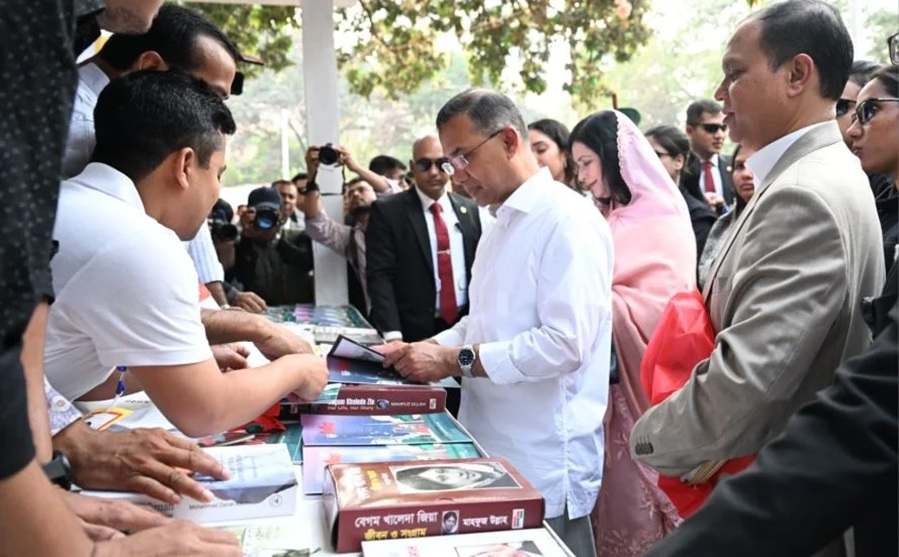
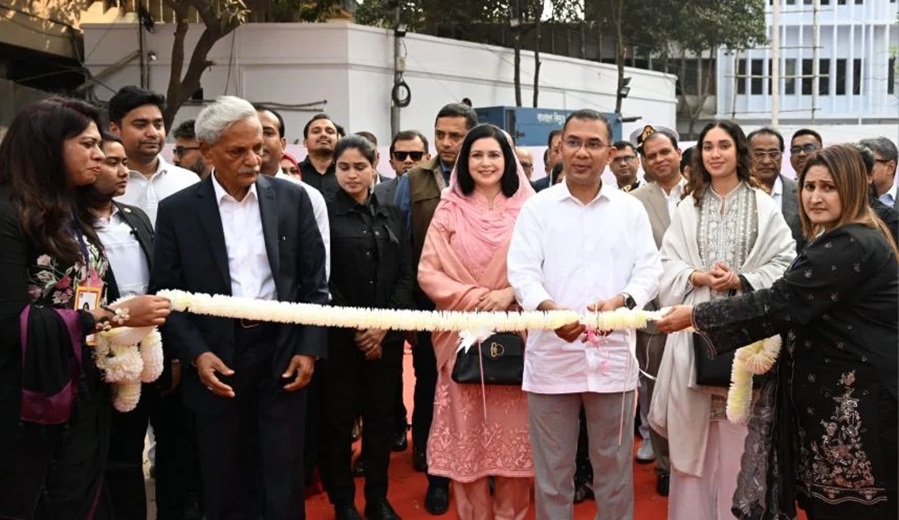
The Prime Minister sought cooperation from all to build a safe, humane and democratic Bangladesh for all—regardless of party, opinion, religion or race—free from darkness and backwardness. Tarique Rahman concluded his speech declaring the opening of the Amar Ekushey Book Fair. Later, along with his wife Dr Zubaida Rahman and daughter Barrister Zaima Rahman and other guests, the Prime Minister formally inaugurated the fair by cutting a ribbon.

He also visited different stalls on the Bangla Academy premises. At the inaugural ceremony, Cultural Affairs Secretary Md. Mofidur Rahman, Bangladesh Book Publishers and Sellers Association President Md Rezaul Karim Badsha and Bangla Academy Director General Professor Mohammad Azam delivered the welcome address.

Prime Minister Tarique Rahman’s wife Dr Zubaida Rahman and their daughter Barrister Zaima Rahman, cabinet members, members of parliament, foreign diplomats, senior civil and military officials and dignitaries were present at the function.


Shibbir Ahmed’s New Storybook ‘Bishorjon’ to be Released at Amar Ekushey Book Fair

Dhaka: Renowned writer and journalist Shibbir Ahmed’s new storybook Bishorjon is set to be released at the Amar Ekushey Book Fair. This marks the author’s 41st book. The book is being published by one of the country’s leading publishing houses, Ananya. Bishorjon is a novel accompanied by four additional short stories, carefully compiled to create a compelling collection. While the characters in the book are fictional, they are inspired by real-life events, making it possible for readers to recognize shades of reality in the stories.

The longing of a mother for her child and the desire to become a mother is a natural and profound instinct for most women. However, when a woman learns that she cannot conceive, it can trigger immense emotional and psychological distress. Since motherhood is often seen as a symbol of feminine fulfillment, this news can deeply affect her sense of identity and future dreams.

The story becomes even more complex when the husband is the primary reason for childlessness. In such cases, a woman faces a strong inner conflict between her longing for motherhood and her loyalty to her marital relationship. Birsorjon is a sensitive, realistic, and emotionally rich story that explores the sacrifices a woman may make to fulfill her deepest desires.

Shibbir Ahmed hails from Panchpukuria village in Monohorgonj Upazila, Comilla District. He holds a Master of Commerce (M.Com) and a Master of Software Systems (MSS) degree. He has also completed Hajj. With 40 books already published, Shibbir Ahmed has received multiple awards for his contributions to literature and has also composed numerous songs.

Walking the path of love, some people easily forget their past, while others never do. Shibbir Ahmed belongs to the latter. He lives a quiet life in a small world of his own creation, dwelling in a personal circle of solitude. Some may mistake it for pride, but he is unfazed by such perceptions. Without anger, hatred, or resentment, he moves forward carrying only a heart full of love and silent feelings within his private world.