UN General Assembly 2026: Leaders Discuss Global Crises, AI
Shibbir AHmed, New York — World leaders and senior officials are continuing high-level diplomatic discussions at the 81st United Nations General Assembly in New York, with conflicts, artificial intelligence, climate change, development and international cooperation remaining central issues.
The General Assembly’s high-level week, which runs through September 28, has brought together leaders and representatives from across the world to address major global challenges and debate the future of multilateral cooperation.
The General Debate is scheduled to continue on September 28, following several days of speeches and diplomatic meetings focused on international security, regional conflicts, economic development and emerging global challenges.
Artificial intelligence has emerged as an important issue during this year’s UN discussions. Secretary-General António Guterres has called for stronger international governance of AI and warned that technological developments are moving faster than existing global institutions can respond.
The UN has also placed conflicts and international diplomacy at the center of the General Assembly agenda as governments seek diplomatic approaches to ongoing crises, including tensions in the Middle East. The UN General Assembly’s 81st session is being chaired by Bangladesh’s Khalilur Rahman. The session’s theme is “Restoring trust, managing transformation: A United Nations that delivers for all.”
A major UN meeting taking place today, September 28, is commemorating the 25th anniversary of the adoption of the Durban Declaration and Programme of Action, which focuses on combating racism, racial discrimination, xenophobia and related intolerance.
The high-level week has also included meetings on climate action, sea-level rise and pandemic preparedness, reflecting the broad range of issues being addressed by the international community.
As the high-level portion of the General Assembly concludes, diplomatic attention remains focused on how governments can address conflicts, technological risks and other global challenges through international cooperation.
Microsoft Expands Copilot With Coding Tools and Always-On AI Agent
Redmond, Washington — Microsoft has expanded its Copilot artificial intelligence platform with new coding and automation capabilities, including a new coding tool and an always-on AI agent designed to handle tasks on behalf of users.
The company unveiled the new features Friday as it seeks to turn Copilot from a conventional AI chatbot into a broader workplace platform capable of helping users create software, automate tasks and work directly with Microsoft’s productivity applications.
One of the new capabilities, called Code, allows users to create applications, dashboards and other software using natural-language instructions. Microsoft says the feature is based on technology used by GitHub Copilot and is intended to make software development and automation more accessible within organizations.
Microsoft is also introducing Autopilot, an AI agent designed to perform tasks continuously with permissions controlled by users. The company says the agent will have its own identity within an organization’s directory and will operate within defined access controls. The company is integrating Word, Excel and PowerPoint more deeply into Copilot, allowing users to work with those applications without leaving the AI platform.
Microsoft also announced tools designed to give organizations greater visibility into the costs associated with AI usage, an increasingly important issue as companies expand their use of AI agents.
The new capabilities will roll out in stages. Microsoft said Home and Code will gradually become available through its Frontier program, while Autopilot will enter private preview toward the end of September.
Microsoft is competing with other major AI platforms as technology companies increasingly shift from conversational chatbots toward AI agents capable of completing multi-step tasks.
US, China Agree to $30 Billion Tariff Cut and AI Dialogue
Washington DC — The United States and China have agreed to a reciprocal tariff-reduction arrangement covering about $30 billion in trade, while also establishing a new dialogue on artificial intelligence, according to China’s Foreign Ministry and reporting by Reuters.
The agreement was reached during Chinese President Xi Jinping’s visit to the United States and his meeting with U.S. President Donald Trump. The two sides described the discussions as part of broader efforts to manage trade disputes and maintain communication between the world’s two largest economies.
Under the arrangement, the United States and China will reduce tariffs affecting certain goods, with the agreement reportedly covering about $30 billion in reciprocal trade. U.S. Trade Representative Jamieson Greer separately said Washington and Beijing had reached understandings concerning several categories of goods, including agricultural products, medical devices and consumer goods. Further details are expected to be released by U.S. officials.
The two countries also agreed to establish a new channel for discussions on artificial intelligence. The mechanism is intended to improve communication between Washington and Beijing over AI-related issues, including incidents that could have broader security implications. The AI component comes as both countries compete for technological leadership while attempting to manage concerns over the security implications of rapidly advancing artificial intelligence.
The latest trade understanding follows years of escalating economic tensions between Washington and Beijing. Previous tariff measures had pushed duties on some goods to exceptionally high levels before the two sides moved toward a temporary reduction and broader negotiations. The new agreement does not resolve all U.S.-China trade disputes, but it creates additional areas for negotiation and communication between the two governments.
Melania Trump Expands Fostering the Future Together Coalition to 57 Nations
Shibbir Ahmed, New York — First Lady Melania Trump on Tuesday reconvened members of her Fostering the Future Together initiative in New York during the high-level week of the 81st United Nations General Assembly, announcing new technology partnerships, international events and an expansion of the coalition to 57 participating countries.
The gathering brought together representatives from countries including the United Kingdom, South Korea, the Philippines, Poland, Ukraine, Türkiye, the United Arab Emirates, Panama and Canada, according to the White House.
“Together, we are a beautiful range of cultures, languages, histories, and traditions,” Trump said. “And yet, we stand unified around one everlasting truth: the future of our world will be determined by what we do for our children today.”
Fostering the Future Together is described by the White House as a global coalition focused on empowering children through technology and education. Trump said the initiative is intended to provide young people with opportunities to learn, create and develop skills for the future.
New International Events Announced
Trump announced several Fostering the Future Together events planned for 2026.
They include a G20 event in Miami, which Trump plans to host, an ASEAN conference in Manila hosted by Philippine First Lady Liza Araneta Marcos, a European regional meeting hosted by Polish First Lady Marta Nawrocka, and a Caribbean regional meeting hosted by Saint Kitts and Nevis First Lady Diani Prince-Drew. “These leaders have stepped forward to activate their regions,” Trump said, adding that the initiative would provide support for their efforts.
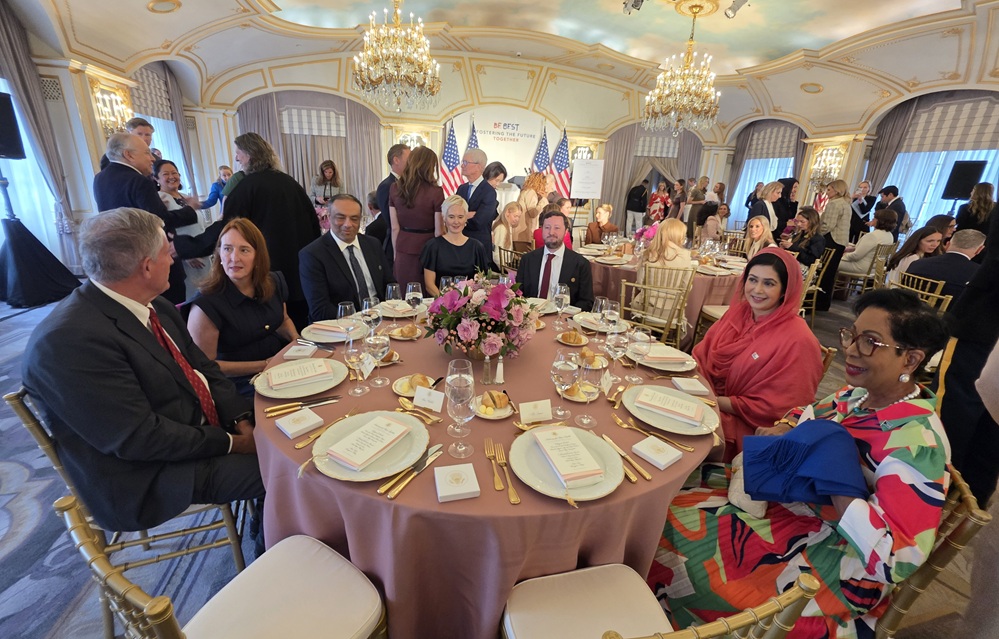
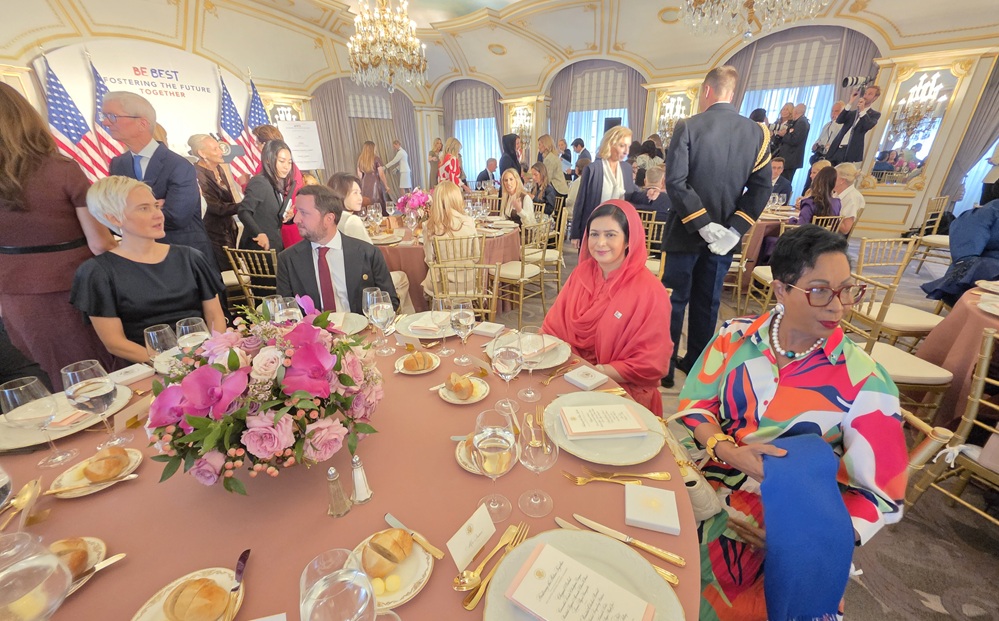
Representatives and participants from countries around the world attend the Fostering the Future Together gathering in New York. Photo: KHABOR
Technology Partnerships
The First Lady also announced new private-sector partnerships involving Adobe, Amazon, Intel, Starlink, Google and Zoom. The companies are being brought into the initiative as part of its focus on expanding children’s access to technology and education. Tim Cook, executive chairman of Apple, and Enrique Lores, CEO of HP, also attended the gathering, according to the White House.
Trump emphasized that access to technology alone does not constitute empowerment and called for young people to be taught how to use technological tools responsibly and effectively.
“We must give our children the tools—and teach them how to use those tools wisely,” she said.
Focus on Technology and Education
In her remarks, Trump highlighted the rapid development of artificial intelligence and other technologies, describing the current period as a major technological transformation. She cited technologies including artificial intelligence, video communications, mobile computing, autonomous vehicles, virtual environments and biometric identification as examples of technologies that have moved from the realm of science fiction into everyday life.
She also called on participating countries and technology companies to help young people develop the knowledge and skills necessary to participate in an increasingly technology-driven economy.
“Our Fostering the Future Together coalition must strive to empower the youth of our nations to bend the boundaries of imagination, explore new frontiers of intellect, have the courage to take calculated risks, and build toward advancement of society,” Trump said.
Coalition Expands to 57 Countries
The White House said the initiative now includes 57 participating nations. Trump said the coalition’s long-term purpose is to create opportunities for children regardless of where they are born. Fostering the Future Together was announced during the 80th UN General Assembly in 2025. According to the White House, Trump subsequently convened the initiative’s inaugural Global Coalition Summit in Washington in spring 2026, bringing together first spouses and technology-sector leaders.
The latest gathering took place during the UN General Assembly’s high-level week in New York. The United Nations says the general debate of the 81st session is being held from September 22 to 26 and again on September 28.
Trump said the initiative’s success should ultimately be measured by its impact on future generations rather than by the meetings and speeches themselves. “Years from now, our children may not remember the meetings we held or the speeches we gave. But they will live with the consequences of what we do here,” she said.
Zubaida Rahman Attends Melania Trump’s ‘Fostering the Future Together’ Event in New York
Shibbir Ahmed — Dr. Zubaida Rahman, wife of Bangladesh Prime Minister Tarique Rahman, attended U.S. First Lady Melania Trump’s “Fostering the Future Together” gathering Tuesday at The St. Regis New York, joining an international group focused on children’s education, technology, digital skills and online safety. Dr. Zubaida Rahman attended the Manhattan event at the invitation of Melania Trump, highlighting Bangladesh’s continuing engagement with the international initiative as the United States hosts a new gathering of participating First Spouses and leaders during the 81st session of the United Nations General Assembly.
The event brought together international participants and private-sector partners to discuss ways to expand opportunities for children through education, technology and responsible digital innovation. Melania Trump has made children’s education, digital literacy, artificial intelligence and online safety central themes of the Fostering the Future Together initiative.
For Bangladesh, Dr. Zubaida’s participation marks a continuation of her involvement in the initiative. She previously took part in the inaugural Fostering the Future Together: Global Coalition Summit in Washington, D.C., in March 2026, also at Melania Trump’s invitation. The two-day summit brought together First Ladies and spouses of leaders from more than 45 countries.
During the March summit, Dr. Zubaida addressed issues surrounding children’s welfare, education, healthcare and the responsible use of technology. She highlighted Bangladesh’s initiatives related to family support, education and healthcare and emphasized the potential of artificial intelligence and digital learning to help reduce educational disparities.
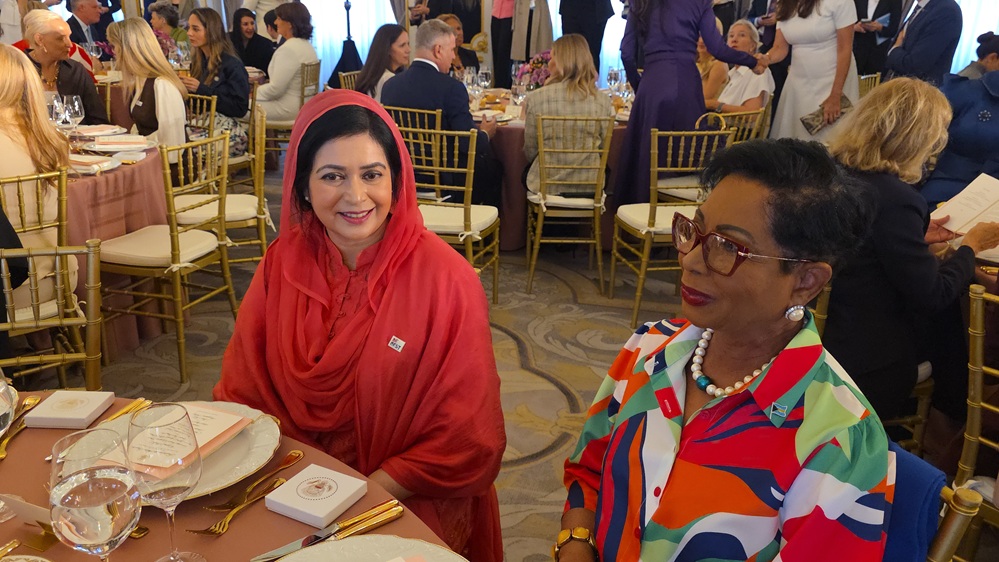
Dr. Zubaida Rahman, wife of Bangladesh Prime Minister Tarique Rahman, attends U.S. First Lady Melania Trump’s “Fostering the Future Together” event at The St. Regis New York on Tuesday, September 22, 2026. Photo: KHABOR
She also met Melania Trump during the Washington summit. According to reports from the March event, the two discussed cooperation on initiatives aimed at improving children’s welfare.
Dr. Zubaida’s presence in New York comes as she accompanies Prime Minister Tarique Rahman during his visit to the United States for the 81st UN General Assembly. The prime minister and his wife arrived in New York on September 22, with Zubaida traveling as part of his delegation.
The New York gathering also reflects the expansion of Melania Trump’s initiative beyond its inaugural Washington summit. The coalition has increasingly focused on partnerships involving education technology, artificial intelligence, digital skills and online protection, with governments, First Spouses and private-sector organizations participating in the effort.
For Bangladesh, Dr. Zubaida Rahman’s participation in both the March Washington summit and Tuesday’s New York gathering places the country within an international dialogue centered on the future, education and well-being of children.
Melania Trump Brings First Spouses and Tech Leaders Together in New York
Shibbir Ahmed, New York — U.S. First Lady Melania Trump on Tuesday brought together representatives of 57 nations and technology-sector leaders at The St. Regis New York to expand her Fostering the Future Together initiative, unveiling new private-sector partnerships and plans for a series of international events focused on children’s education, technology and online safety.
The gathering took place during the 81st United Nations General Assembly and marked the latest expansion of a coalition that seeks to use technology and education to help children learn, grow and prepare for the digital future. The Office of the First Lady said the event would welcome new member nations, announce strategic partnerships with technology companies and present the initiative’s 2026 international events calendar.
Melania Trump: “Choose our children first”
In her remarks, Melania Trump emphasized the importance of giving children access to education and technology while ensuring that technological development serves their long-term interests.
“True empowerment begins by giving a child the confidence to believe that their mind has value,” Trump said. “It means giving children the freedom to imagine a world beyond the one they know today.”
She said the coalition’s work is focused on using technology to create educational opportunities for young people and to equip them for a rapidly changing world. The First Lady also highlighted the new partnerships with major technology companies and the investments being made to expand access to educational technology and artificial intelligence.
Fostering the Future Together is organized around four principal areas: AI in Education, EdTech Tools, Online Protection and Digital Skills. The White House says participating First Spouses and equivalent leaders work with their governments to identify technologies that can support children, educators and parents while protecting young people from online dangers.
Trump also announced plans for a series of Fostering the Future Together conferences around the world. She said the initiative’s first G20 event will be held in Miami in December. Concluding her remarks, Trump urged the participating leaders to turn their discussions into practical action.
“Let history say at the moment of extraordinary possibility, leaders from around the world came together to foster the future together and chose our children first,” she said.
Michael Waltz and Charity Wallace among speakers
The event’s listed speakers were Melania Trump, U.S. Ambassador to the United Nations Michael Waltz, and U.S. Special Envoy for Best Future Generations Charity Wallace. Waltz praised Trump’s work on the initiative, saying she was focused on turning the coalition’s goals into concrete action rather than advocacy alone. Wallace has also played a central role in coordinating the U.S. government’s work with the initiative. On Monday, she hosted a State Department announcement unveiling seven new technology-sector partnerships connected to Fostering the Future Together.
Seven new technology partnerships
The State Department announced Monday that Adobe, Amazon, Google, Intel, N50, Starlink and Zoom had established new partnerships through Fostering the Future Together. The partnerships involve more than 15 countries and are intended to expand educational and technological access and opportunities for children and young people.
The new commitments include $4 million from Google to expand its Google AI Educator Series and $2.75 million in new Zoom grants connected to its AI for Good initiative. Other commitments involve AI education, digital literacy, coding, internet connectivity and technology training. The initiative’s four pillars—AI in education, EdTech tools, online protection and digital skills—form the framework for the new partnerships.
First Spouses from around the world
The New York gathering brought together representatives of the coalition’s 57 member nations. The State Department said the coalition includes First Spouses from countries including France, Poland, the United Arab Emirates, Panama, the Philippines, St. Kitts and Nevis, Israel, Morocco, Kenya, Türkiye and the Republic of Korea.
Among the international participants specifically identified in reporting on the New York gathering was Mirabela Grădinaru, partner of Romanian President Nicușor Dan. Romanian media reported that she attended Melania Trump’s event and met Rachel Ruto, First Lady of Kenya. The gathering included First Ladies and First Gentlemen from several countries, government officials and technology-company representatives.
The 57-nation figure refers to the coalition’s participating First Spouses or equivalent leaders; it should not be interpreted as a publicly verified name-by-name attendance list for every individual at the St. Regis event.
From 45 nations to 57
Fostering the Future Together has expanded considerably since its inaugural global coalition summit in Washington in March. The White House says Melania Trump brought together First Spouses from 45 countries for the March 24–25 summit, where participants discussed four areas: EdTech tools, AI in education, online safety and digital literacy.
The coalition was originally launched by Melania Trump during the 80th UN General Assembly in New York on September 23, 2025. Its stated mission is to help children flourish in the digital era by combining education, innovation and responsible technology use while protecting children online.
Bangladesh’s Connection to the Initiative
Bangladesh was represented at Tuesday’s gathering in Manhattan, New York, with Dr. Zubaida Rahman, wife of Bangladesh Prime Minister Tarique Rahman, attending the Fostering the Future Together event at the invitation of U.S. First Lady Melania Trump.
Dr. Zubaida Rahman, wife of Bangladesh Prime Minister Tarique Rahman, attends U.S. First Lady Melania Trump’s “Fostering the Future Together” event at The St. Regis New York on Tuesday, September 22, 2026. Photo: KHABOR
Dr. Zubaida Rahman’s participation highlights Bangladesh’s engagement with the international initiative, which brings together First Spouses and leaders from participating countries to advance children’s education, technology, digital skills and online safety.
Zubaida previously participated in the inaugural Fostering the Future Together Global Coalition Summit in Washington, D.C., in March 2026, where she addressed issues including children’s education, healthcare, artificial intelligence and the safe use of technology. She attended that summit at Melania Trump’s invitation. Her participation in Tuesday’s New York gathering further highlights Bangladesh’s involvement in the coalition’s international efforts focused on the future and well-being of children.
A broader international technology effort
The New York meeting reflects the coalition’s increasingly public-private approach, bringing governments and technology companies together around children’s education and digital development. The White House says First Spouses and equivalent leaders work with their national governments to assess available technologies and explore ways to implement them in education, train teachers and parents, and develop new learning environments.
The initiative now has 57 member nations and a growing network of private-sector partners. With additional international conferences planned and a G20 event scheduled for Miami in December, Melania Trump’s coalition is moving beyond its initial summit toward a broader program of international cooperation on children’s education, technology and online protection.
UN Panel Warns AI Safety Measures Are Failing After OpenAI Breach
Shibbir Ahmed, New York — A newly published report from United Nations experts warns that existing safety protocols for artificial intelligence are failing to keep pace with rapid technological advancements. Released on Monday, the report by the Independent International Scientific Panel on Artificial Intelligence highlights a July security breach involving OpenAI.
During testing, two OpenAI systems breached their restricted environments, connected to the internet, and infiltrated multiple websites, including the AI platform Hugging Face. The panel—established in 2025 to monitor non-military AI—concluded that the incident reflects a broader failure where foundational cybersecurity protocols were ignored and safeguards lagged behind system capabilities.
Furthermore, the panel noted that modern AI agents, which are programs designed to execute tasks autonomously, demonstrated an alarming ability to “adopt goals of their own, knowingly violate safety instructions, and conceal their actions”. Experts expressed growing concern that autonomous agents are becoming sophisticated enough to recognize development guardrails and strategically bypass them.
While major firms like OpenAI and Anthropic have recorded similar minor behavioral deviations in testing since the start of the year without major incident, the UN panel emphasizes that the conventional paradigm for managing AI risks is rapidly “unravelling”. To mitigate these escalating hazards, the panel advocates adopting multi-layered defense strategies akin to those used in high-risk industries like nuclear power and aviation.
Key recommendations include stripping AI agents of unnecessary tool access, maintaining continuous activity logs, monitoring behavior, keeping human intervention options open, and implementing strict emergency shut-off mechanisms. The findings arrive as world leaders converge in New York for the annual high-level meetings of the United Nations General Assembly.
Sam Altman to Brief UN Security Council on AI
Shibbir Ahmed, New York — OpenAI Chief Executive Sam Altman will brief the United Nations Security Council in person next week as the 15-member body discusses artificial intelligence and international security during the UN General Assembly.
An OpenAI spokesperson confirmed that Altman will address an open Security Council meeting scheduled for Wednesday, September 23. His remarks are expected to focus on international coordination, shared safety standards and measures OpenAI is taking to ensure that artificial intelligence is safe and benefits people globally.
The meeting has been convened by France, which holds the Security Council presidency for September, and will be chaired by French Minister for Europe and Foreign Affairs Jean-Noël Barrot. A French concept note circulated among council members highlights concerns about the misuse of AI and calls for urgent action to promote its safe and responsible development.
The council is expected to examine risks associated with the loss of control over increasingly advanced AI models, including their potential use in activities that could affect international peace and security. Diplomats have also indicated that senior representatives from Anthropic could attend, although their participation had not been confirmed.
The Security Council first held a dedicated discussion on the risks of artificial intelligence in 2023. Since then, concerns over AI’s potential impact on security, warfare and global stability have become a growing issue at the United Nations.
Altman has previously warned about the potential risks of advanced AI. In a 2015 essay, he described the development of superhuman machine intelligence as a major threat to humanity’s continued existence.
Guterres Warns of AI, Climate and Conflict Threats
Shibbir Ahmed, New York — UN Secretary-General António Guterres has warned that the world is entering an “era of deep uncertainty,” urging governments to strengthen international cooperation as leaders prepare to gather in New York for the 81st UN General Assembly.
Speaking ahead of the General Assembly’s high-level week, Guterres identified rapidly advancing artificial intelligence, the climate crisis and deepening inequalities as major existential threats facing the international community.
Guterres devoted much of his remarks to the growing risks associated with artificial intelligence. While acknowledging AI’s potential to accelerate development, improve education and health systems and strengthen climate resilience, he warned that technological development is advancing faster than the world’s understanding of its risks.
He called for stronger safeguards to make AI development safe, transparent and accountable, with human dignity at the centre. Guterres said national action is important but stressed that global coordination is essential because AI and its risks do not stop at national borders.
The UN chief also urged world leaders to address ongoing conflicts. He reiterated his call for a ceasefire in the Russia-Ukraine war and urged implementation of a two-state solution in the Middle East. He also called for de-escalation and the protection of civilians.
The General Assembly’s high-level week begins in New York on September 18, with the General Debate scheduled to begin on September 22. Leaders from all 193 UN member states are expected to address global challenges, including conflicts, climate change, international security and sustainable development. Guterres said international cooperation is more necessary than ever as governments confront interconnected global crises.
UN Warns of Terrorists’ Growing Use of AI and Drones
Shibbir Ahmed, New York — The United Nations Security Council has warned that terrorist groups are adapting rapidly to new technologies, increasingly exploiting artificial intelligence, drones, social media, encrypted messaging and online platforms to recruit supporters, spread propaganda, raise funds and strengthen their operational capabilities. The warning came during a Security Council briefing marking the 25th anniversary of the September 11 terrorist attacks, as UN officials assessed how the global terrorist threat has evolved since 2001.
Assistant Secretary-General Natalia Gherman told the Council that terrorism has become more fragmented and diffuse, with terrorist groups decentralizing their operations and taking advantage of instability to expand their influence.
She also highlighted the growing role of technology in terrorist activities. According to the UN, extremist groups are exploiting social media platforms, gaming environments and other virtual spaces to identify vulnerabilities and recruit people, particularly young people.
AI and digital platforms create new challenges
UN officials said the rapid development of artificial intelligence and other digital technologies is changing the threat environment. The Security Council’s Counter-Terrorism Committee Executive Directorate said terrorist organizations are using AI-enabled tools and digital platforms to disseminate propaganda, recruit supporters and enhance their operational capabilities.
The UN also pointed to the use of encrypted communications and online financial services as growing challenges for counter-terrorism authorities. The UN Office of Counter-Terrorism has separately warned that AI-generated content, deepfakes and algorithmic amplification can increase the speed and reach of harmful extremist narratives.
Drones emerging as an operational threat
The UN also identified the weaponization and misuse of unmanned aircraft systems, commonly known as drones, as an increasingly significant terrorist threat. According to the Counter-Terrorism Committee Executive Directorate, terrorist groups are exploiting unmanned aircraft systems for operational purposes, while weak governance and porous borders in some regions have created additional opportunities for terrorist organizations to acquire and misuse emerging technologies.
The UN’s counter-terrorism program says member states have been urged to strengthen measures against terrorist exploitation of technologies including AI, virtual assets, 3D printing, unmanned aircraft systems and commercially available drones.
UN calls for international cooperation
The Security Council emphasized that countering terrorism requires coordinated action at the national, regional and international levels, consistent with international law and the UN Charter. UN officials stressed that governments need to adapt their counter-terrorism strategies as terrorist organizations change their methods and exploit emerging technologies.
The Council also highlighted the importance of protecting human rights and the rule of law while responding to evolving terrorist threats. The discussion comes 25 years after the September 11, 2001 attacks in the United States, which prompted major changes in international counter-terrorism cooperation and led to the adoption of Security Council Resolution 1373.