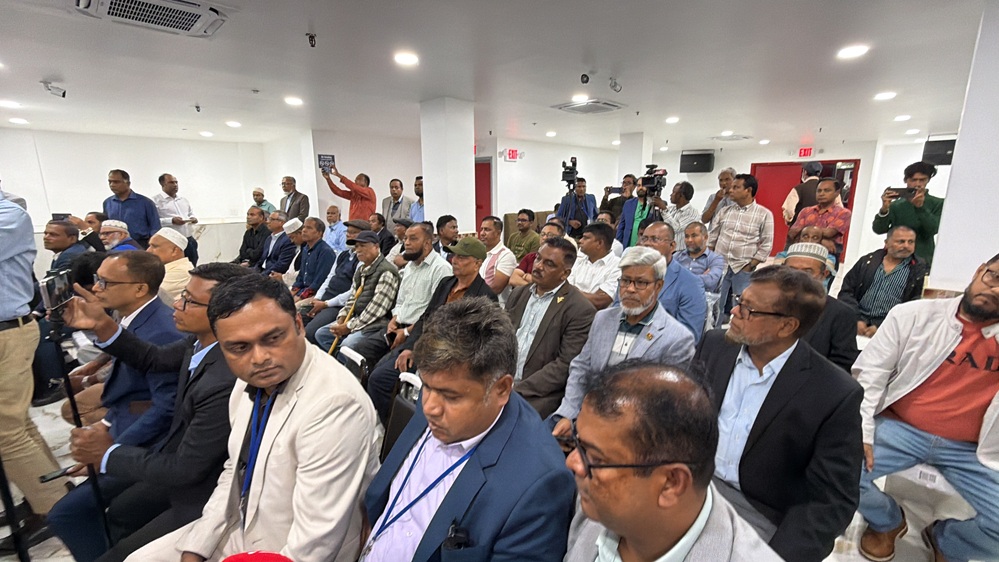
Bangladesh Sramik League Holds Protest Outside UN Headquarters in New York
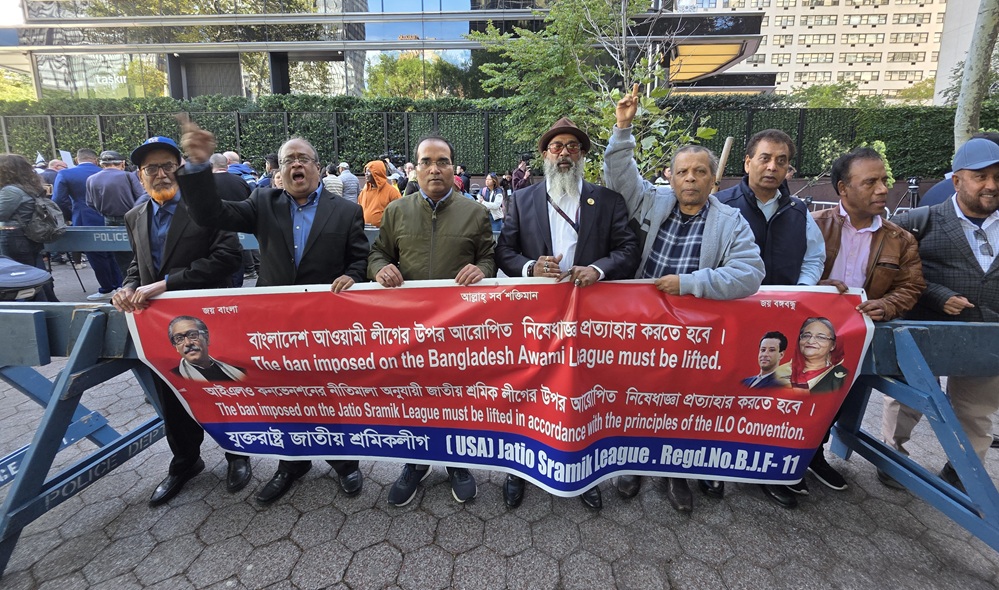
NEW YORK: A protest rally was held outside the United Nations headquarters in New York on Wednesday, with the Bangladesh Sramik League USA chapter calling for the withdrawal of the ban imposed on the Bangladesh Awami League and the Sramik League. The protest was organized at 2 p.m. during the ongoing United Nations General Assembly session. Organizers said the demonstration was aimed at drawing international attention to their demands, including the withdrawal of restrictions on the Sramik League in accordance with the principles of International Labour Organization (ILO) conventions.
Nazmul Alam Romen, an executive member of the central committee of the Bangladesh Sramik League, addressed the rally as the chief guest. The event was chaired by Kazi Azizul Haque Khokon, president of the Sramik League USA, and moderated by Jewel Ahmed, general secretary of the organization. Speakers alleged that following August 5, 2024, the activities of the Bangladesh Awami League and its affiliated and associated organizations were banned through an executive order. They further claimed that the activities of the Bangladesh Sramik League, which they described as affiliated with the International Labour Organization (ILO) and the International Trade Union Confederation (ITUC), were also prohibited in violation of labour laws.
The speakers said the right to form and join trade unions is recognized by the ILO as a fundamental labour right. They said protecting trade union rights is important for ensuring democratic conditions in the workplace and allowing workers to pursue their legitimate demands.
Referring to ILO conventions, the speakers said Convention No. 87 protects freedom of association and the right to organize, while Convention No. 98 provides protection against anti-union discrimination. They alleged that the ban on the Sramik League’s activities through an executive order violates these principles.
The speakers also alleged that the headquarters of the Bangladesh Awami League and the Sramik League at 23 Bangabandhu Avenue in Dhaka had been burned and destroyed, while offices of various trade unions affiliated with the Sramik League had been closed.
They further claimed that thousands of Sramik League activists had lost their jobs and that workers had been killed or injured in attacks, while others were being harassed through what they described as false cases.
The rally called for the withdrawal of the restrictions on the Bangladesh Awami League and the immediate lifting of the ban on the Sramik League’s activities, which the speakers said should be done in accordance with ILO conventions. The speakers also called on the ILO, ITUC, international human rights organizations and the broader international community to take notice of their concerns.
Among those attending the rally were Sramik League USA leaders M.A. Alam Biplob, Laskar Moyzur Rahman Jewel, Abdur Razzak Anwar, Md. Motaleb Hossain and Saidul Islam, among others.
US Awami League Holds Protest Outside UN Headquarters in New York
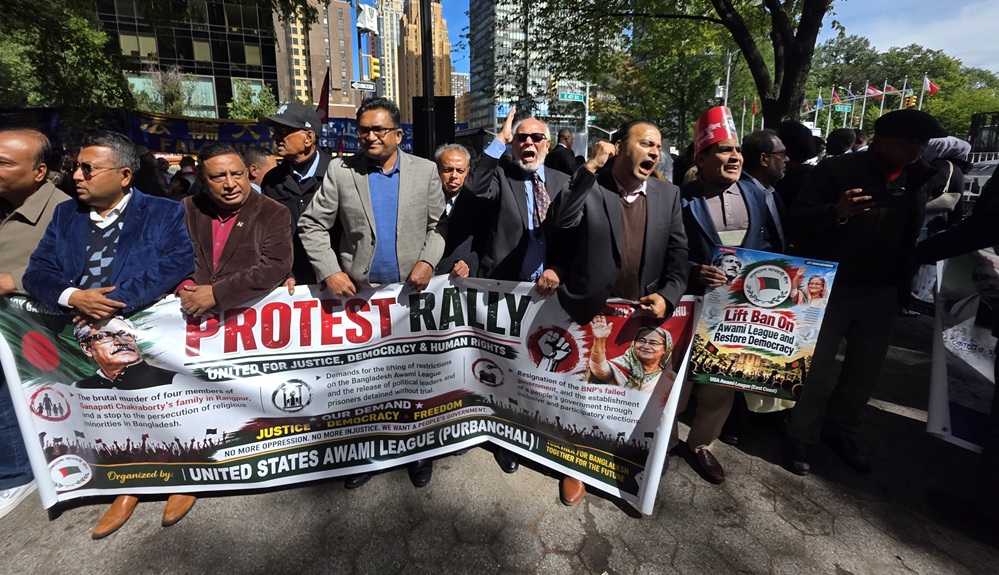
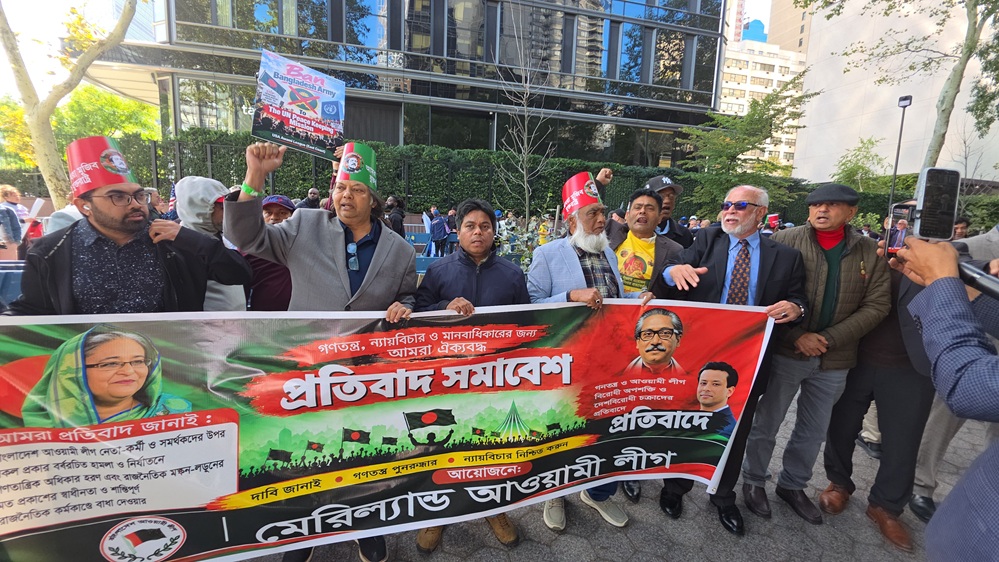
NEW YORK CORRESPONDENT: The US Awami League, Awami family members, and affiliated and associate organizations held a protest rally outside the United Nations headquarters in New York on Thursday, September 24, protesting the ban on all activities of the Bangladesh Awami League, death sentences against former Prime Minister Sheikh Hasina and other senior party leaders, and what they described as moves to hand over Saint Martin’s Island, ports and transit corridors to foreign interests.
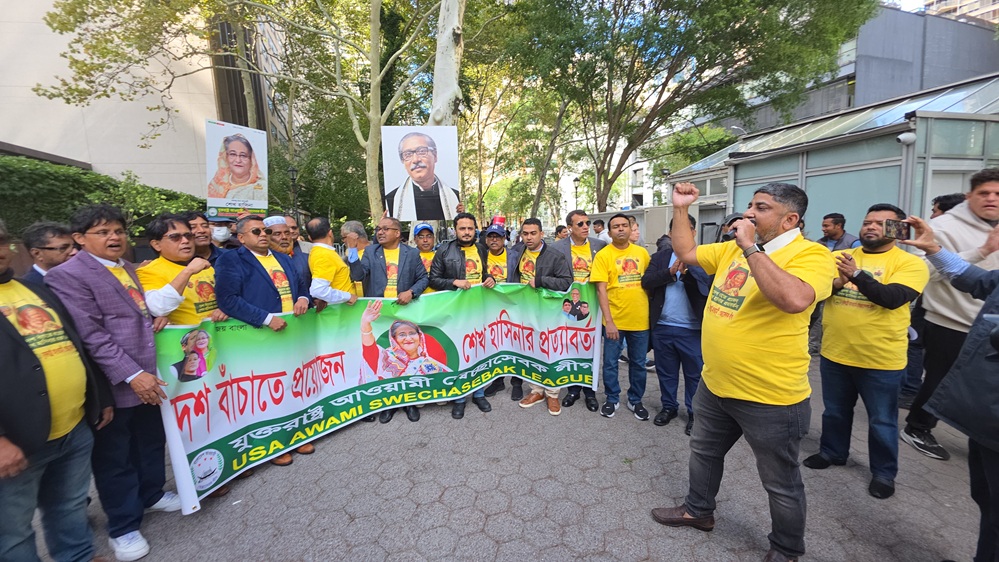
The rally was held at noon outside the UN headquarters, with Awami League leaders and activists arriving from different states across the United States. Participants included leaders and activists from the US Awami League, US Jubo League, US Mohila League, US Chhatra League, US Sramik League, US Swechhasebak League, Michigan Awami League, Virginia State Awami League, Metro Washington Awami League, Maryland State Awami League, New York State Awami League, New York City Awami League, US Awami League South, US Awami League East, US Awami League West, and the organization Amra Mujib Sainik, among others.
Awami League supporters hold a protest outside the United Nations headquarters in New York on Thursday, September 24. Photo: KHABOR
The protesters chanted a range of slogans, including “Go Back Tarique,” “Terrorist Tarique,” “Khamba Tarique,” “No gas, no electricity—this government is not needed,” “No food, no clothing—this government is not needed,” “There are poles, but no electricity—this government is not needed,” “Police killer Tarique—go back, go back,” and “Grenade Tarique—go back, go back.”
Addressing the rally, speakers said the Awami League played a leading role in the establishment of Bangladesh as an independent and sovereign country. They alleged that banning the party’s political activities undermines the values, ideals and spirit of the country’s Liberation War. The speakers called for the immediate withdrawal of the ban, arguing that it would create political space for what they described as anti-liberation and extremist forces.
Awami League supporters hold a protest outside the United Nations headquarters in New York on Thursday, September 24. Photo: KHABOR
They also criticized the government over the country’s economic and social situation, citing rising prices, shortages of gas and electricity, problems in the education sector and what they described as a growing “mob culture.” They also alleged that Awami League leaders and activists were being killed and harassed.
The speakers made a number of allegations against BNP Acting Chairman Tarique Rahman. They questioned government decisions concerning aircraft purchases, arguing that greater attention should first be given to essential services and economic challenges inside Bangladesh.
Describing the situation in Bangladesh as a “major crisis,” the speakers alleged that domestic and foreign actors were conspiring over the country’s political and economic future. They claimed that factories and garment industries were facing difficulties and that the country’s production system was being adversely affected.
Awami League supporters hold a protest outside the United Nations headquarters in New York on Thursday, September 24. Photo: KHABOR
The speakers also raised concerns about child safety, public health and law and order, alleging that the government was not giving sufficient attention to these issues and was using political retaliation against its opponents.
Speakers further said that banning the Awami League would not end the party’s political existence. Referring to the party’s history, they said the Awami League had returned to politics after facing previous periods of political adversity and expressed confidence that it would again return as a stronger political force.
They also claimed that the ban had left people in Bangladesh and members of the diaspora shocked and angry. Some speakers described the current government as a “black government,” a characterization made by the speakers at the rally.
Among those attending the protest were US Awami League President Dr. Siddiqur Rahman, General Secretary Abdus Samad Azad, adviser Masudul Hasan, former BAKSU General Secretary and freedom fighter Dr. Pradip Ranjan Kar, Organizing Secretary Abul Hasib Mamun, former General Secretary Shamim Chowdhury, founding General Secretary of the US Awami League and mainstream political figure M.A. Salam, journalist Hakikul Islam Khokon, Ramesh Nath, Organizing Secretary Mohiuddin Dewan, freedom fighter Shawkat Akbar Ritchie, Legal Affairs Secretary Advocate Shah Md. Bokhtiar Ali, Education Affairs Secretary M.A. Karim Jahangir, and Dr. Masudul Hasan, president of the US chapter of Sheikh Kamal Parishad.
Awami League supporters hold a protest outside the United Nations headquarters in New York on Thursday, September 24. Photo: KHABOR
Also present were Awami League leader and Sheikh Hasina Mancha President freedom fighter Jalal Uddin Jalil, Organizing Secretary Sheikh Selim, Executive Member Shahanara Rahman, Awami League leader and former Union Parishad Chairman Iqbal Hossain, Awami League leaders Akhtar Hossain and Ali Hossain Ghaznavi, among others.
New York State Awami League President and freedom fighter Mujibur Rahman Mia, Vice Presidents Sheikh Atikul Islam and Abul Kashem Bhuiyan, Bangladesh Awami League Foundation Chairman Abdul Kader Mia, New York City Awami League President Rafiqul Rahman Rafiq and General Secretary Emdad Chowdhury also attended.
Others included Connecticut State Awami League General Secretary Humayun Ahmed Chowdhury, Mohila Awami League Joint General Secretary Rumana Akter, Awami League leader A.K. Chowdhury, Jubo League leaders Mizanur Rahman and Mizanur Rahman Chowdhury, US Chhatra League Vice President Shahidul Islam, and US Jubo League leader Khandaker Zahedul Islam.
Virginia State Awami League President G.I. Russell and member Jeba Russell, Metro Washington Awami League President M. Nabi Baki, Vice President Nurul Amin, General Secretary Mohammad Azam and Women’s Affairs Secretary Mohsina Jannat Rimi, as well as Maryland State Awami League President Moinul Majumdar Tapas, Mosharraf Hossain Dulal and Sramik League President Azizul Khokon were also among those present.
The rally concluded with demands for the restoration of the Awami League’s political rights and the return of Sheikh Hasina to Bangladesh, along with calls for a fresh election.
Banned AL to be deal with both politically and administratively: Anee
CHATTOGRAM – Water Resources Minister and BNP Joint Secretary General Shahiduddin Chowdhury Anee described Awami League (AL) as a banned political organization, asserting that the party is endeavoring to destabilize society through organizing ‘flash processions’ across multiple locations. Such activities will be dealt with both political and administrative measures, he said.
“Efforts by the banned Awami League to provoke civil unrest via flash processions in Chattogram will be handled through political and administrative channels. It is imperative that we prevent them from engaging in any form of unlawful conducts, anarchic behavior, or terrorist activities,” he stated. He told journalists following a special consultation meeting on the district’s law and order situation at the Chattogram Circuit House this afternoon.
Emphasizing the significance of the meeting on the law and order, Shahiduddin Chowdhury Anee said, “This is precisely why today’s gathering—a session of the District Law and Order Coordination Committee—proved to be so vital. We engaged in comprehensive discussions and formulated decisions in collaboration with administrative officials and elected public representatives to mitigate concerns including theft, mugging, robbery, snatching, illegal firearms, and narcotics trafficking. Our objective is to guarantee that the district maintains effective coordination and stability in the forthcoming period.”
Matters such as illegal firearms, narcotics trafficking, hill cutting, and unauthorized sand extraction are receiving equal attention alongside general law and order concerns, the Water Resources Minister said, “Currently, we find ourselves obligated to implement certain stringent measures”.
“For the people’s welfare and to fulfill their requirements, we are directing our efforts toward particular initiatives—especially the confiscation of illegal firearms, the elimination of narcotics operations, and the prevention of hill cutting and sand extraction activities. We have recognized that these practices frequently contribute to the deterioration of law and order conditions. We have thoroughly examined these issues and are implementing suitable interventions,” he said.
He further stated, “With profound dedication to our responsibilities, and guided by the leadership of Prime Minister Tarique Rahman, we have implemented targeted measures to resolve the situation and strengthen law and order—particularly throughout Chattogram city and the surrounding district. InshaAllah, the residents of this region will shortly witness the positive outcomes of these endeavors.”
Earlier, Water Resources Minister Md. Shahiduddin Chowdhury Anee joined a view exchanging meeting on law and order circumstances as the chief guest. Deputy Commissioner Mohammad Jahidul Islam Mian presided over the event.
Ershad Ullah, MP, Sarwar Jamal Nizam, MP, Abu Sufian, MP, and Humam Quader Chowdhury, accompanied by Chattogram Divisional Commissioner Dr. Md. Ziauddin, Chattogram Range DIG Md. Abdul Quddus Chowdhury, and Chattogram Metropolitan Police (CMP) Commissioner Hasan Md. Shawkat Ali, among others, spoke at the programme.
JCD General Secretary Nasir Uddin Nasir Honored in Washington, DC
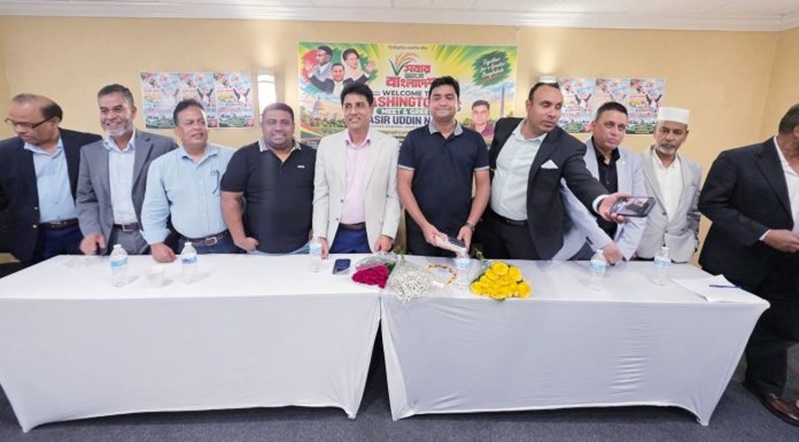
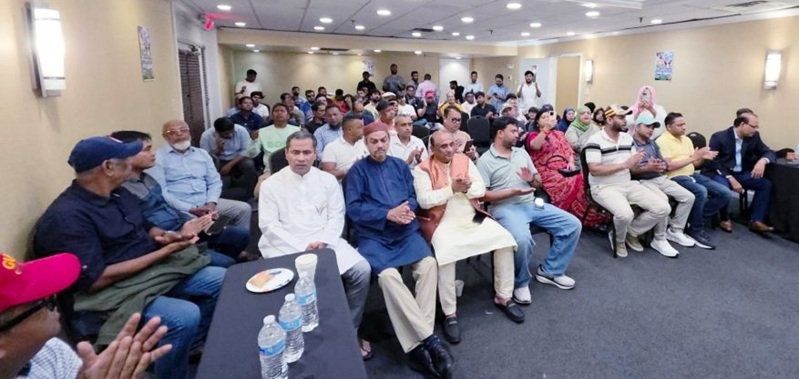
WASHINGTON, D.C.: Bangladesh Jatiyatabadi Chhatra Dal (JCD) General Secretary Nasir Uddin Nasir was accorded a reception by BNP leaders and activists from the Washington, D.C., Virginia and Maryland areas. The reception was held on September 16 at the Comfort Inn in Springfield, Virginia. The event also included a preparatory meeting ahead of Nasir Uddin Nasir’s New York visit, with BNP leaders and activists from different levels in Washington, Virginia and Maryland taking part.
AJM Hossain, former general secretary of Greater Washington, D.C. BNP and a BNP leader, presided over the program. Former joint secretaries of Greater Washington, D.C. BNP Zakir Hossain Zakir and Mohammad Hossain moderated the event. Among those attending were Virginia BNP President Mohammad Zahir, General Secretary Tofail Ahmed, former vice president of Greater Washington, D.C. BNP and former general secretary of New Jersey BNP Shamsuddin Mahmud, former vice president Obaidul Haque Ovi, and former vice presidents Masudur Rahman, Harunur Rashid, Harun Bhuiyan, Elias Bhuiyan Liton and Munir Hossain.
A large number of BNP leaders and activists from the Greater Washington area also attended the reception, including Nur Mohammad Liton, Shahriar Rahman, Kamal Pasha, Faruk Hossain, Firoz Alam, Tayyubur Rahman, Md. Moktar Khan, Sohrab Hossain, Imam Hossain, Ibrahim Bhuiyan, Imran Bhuiyan, Laskar Sohel Rana, Al Amin Hawladar, Md. Abdul Kader Bacchu, Nurul Amin, Sanaul Haque Bhuiyan, Md. Nasim Ferdous, Riyad Hossain, Sumaiya Islam, Masud Rana, Ibrahim Khalil, Mahabubur Rahman, Belal Hossain, Md. Hossain (Biplob), Ahmed Islam Ripon, Sohel Hossain (Ripon), Zaker Hossain Mintu, Mizanur Rahman, Mohammad Alam (Milon), Taslima Rahman, Jahanara Bhuiyan, Sabina Hossain Polly, Laila Jannat and Maksuda Bhuiyan Happy.
Also present were former chief election commissioner of Virginia BNP Abdul Qayyum, former president of Maryland BNP Nesar Ahmed, Virginia BNP leader Kamrun Nahar Kona, Maryland BNP leader Kabirul Islam, Maryland BNP Vice President Mizanur Rahman and Washington BNP Vice President Mosharraf Hossain, among others.
Addressing the gathering as the chief guest, Nasir Uddin Nasir called on BNP leaders and activists to remain united and work to strengthen the party. He also urged expatriate Bangladeshis to focus on providing quality education and opportunities for the next generation.
Nasir said that late President Ziaur Rahman had worked throughout his life for the development of the people of Bangladesh. He also spoke about the contributions of the Zia family to the country and called on BNP supporters to work together to strengthen the leadership of BNP Acting Chairman Tarique Rahman.
In his presidential remarks, AJM Hossain said BNP leaders and activists from Washington, D.C., would remain actively engaged during Tarique Rahman’s New York visit. He urged party members to remain vigilant in the evolving political environment and said BNP activists in the Washington area would continue working together in the days ahead. The event concluded with participants welcoming Nasir Uddin Nasir to the United States and emphasizing greater coordination and participation among expatriate BNP leaders and activists.
Sheikh Hasina to Address US Awami League Press Meet Sept. 24
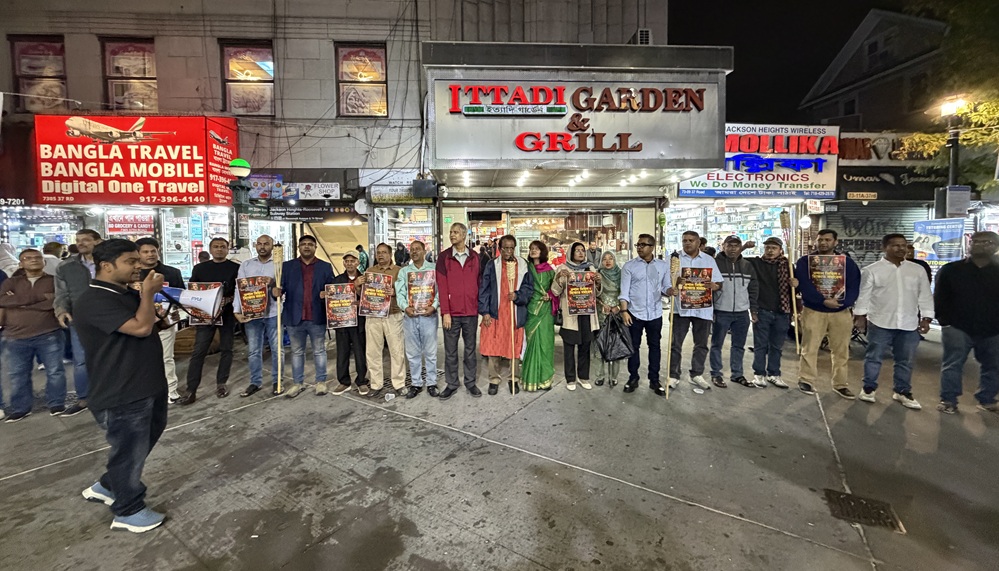
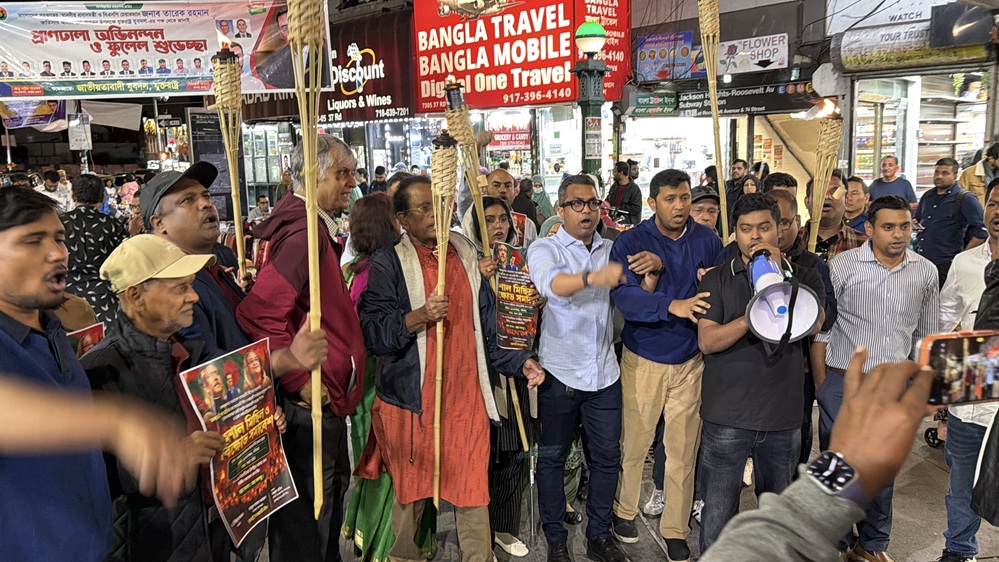
New York — The US Awami League is scheduled to hold a press conference in New York at 8 p.m. on September 24, with Bangladesh Awami League President and former Prime Minister Sheikh Hasina expected to participate as the chief guest, according to the organization. The announcement was made by US Awami League President Dr. Siddiqur Rahman during a torchlight procession and protest rally organized by the party at Diversity Plaza in Jackson Heights, New York, on Saturday, September 19.
According to Dr. Siddiqur Rahman, Sheikh Hasina will deliver what the organization described as a guideline-setting address on the future of Bangladesh. He also said she would make an important decision concerning her planned return to Bangladesh in December. Sheikh Hasina said in a Reuters interview published in July that she planned to return to Bangladesh in December, despite facing legal proceedings and a death sentence. She has been living in India since leaving Bangladesh in August 2024.
Torchlight rally in Jackson Heights
The September 19 rally brought together leaders and activists from the US Awami League and its affiliated organizations, including the Jubo League, Sramik League, Swechchhasebak League, Mohila Awami League and Chhatra League. Participants chanted slogans including “Go back, go back, Tarique, Tarique” and “Step down, step down, Tarique, Tarique” during the procession and rally.
The program was chaired by US Awami League President Dr. Siddiqur Rahman and moderated by the organization’s General Secretary Abdus Samad Azad. According to the organizers, the protest was held in response to court verdicts involving Sheikh Hasina and leaders of the Awami League and its affiliated organizations, the situation surrounding the lockdown in Dhaka, and the planned visit of BNP Chairman and Prime Minister Tarique Rahman to the United States.
Addressing the gathering, Dr. Siddiqur Rahman said the US Awami League would organize protest and resistance programs wherever Tarique Rahman is present between September 21 and 25. He also called on Awami League supporters living in the United States to participate in programs organized by the US Awami League.
Sheikh Hasina’s planned December return
Sheikh Hasina has publicly said she intends to return to Bangladesh in December. In an interview with Reuters published in July, she said she planned to return from India despite the legal consequences she could face. In August, she again said she intended to return to Bangladesh and that the exact date would be announced when the time was appropriate, while indicating that she wanted the return to take place in December.
The issue has gained renewed attention following recent court proceedings involving former Awami League officials. On September 15, a Bangladesh tribunal sentenced seven former aides of Sheikh Hasina to death in absentia in cases connected to the 2024 crackdown, according to Al Jazeera. The report said the defendants were convicted of crimes including murder and inciting killings.
Political activity intensifies in New York
Tarique Rahman’s visit to New York for the 81st session of the United Nations General Assembly has prompted increased political activity among Bangladeshis in the United States.
The US Awami League leadership said it has planned a series of demonstrations, protests and other programs in New York and elsewhere in the United States throughout the period of Tarique Rahman’s stay for the UN General Assembly. According to party leaders, Awami League supporters from different US states and other countries have begun arriving in the United States to participate in the planned programs.
The BNP’s US organization has also been holding programs ahead of Tarique Rahman’s visit, including a “Meet the Press” event in New York, where the party called on expatriate Bangladeshis to support its activities surrounding the prime minister’s UNGA visit.
With competing political groups preparing separate programs around the UN General Assembly, the period is expected to bring increased political activity within the Bangladeshi-American community in New York.
The US Awami League says Sheikh Hasina’s September 24 address will focus on Bangladesh’s future and will include an announcement concerning her planned return to the country. The details of that announcement remain to be seen.
Tarique Rahman to Address UNGA; US BNP Seeks Diaspora Support
New York — Prime Minister and BNP Chairman Tarique Rahman is scheduled to travel to New York on September 21 to attend the 81st session of the United Nations General Assembly and is expected to deliver Bangladesh’s national statement on September 24. It will be his first address to the UN General Assembly as prime minister. Bangladesh’s government has said his visit will include high-level meetings and diplomatic engagements alongside participation in the UNGA.
Ahead of the visit, the US unit of the Bangladesh Nationalist Party (BNP) has called on expatriate Bangladeshis in the United States to participate in programs surrounding the prime minister’s visit and support the government’s reconstruction and development initiatives. The appeal was made through a written statement issued at a “Meet the Press” program organized ahead of Tarique Rahman’s visit to New York.
The event was attended by BNP Central International Affairs Secretary Anwar Hossain Khokon, BNP Executive Committee members Abdul Latif Samrat, Zillur Rahman Zillu, Gias Ahmed, Mizanur Rahman Bhuiyan Milton, Sharafat Hossain Babu, Kamal Pasha Babul, Anwar Hossain, Niaz Ahmed Jewel, Anwarul Islam, Akhter Hossain Badal, Kazi Azam, Firoz Alam, Sabur Khan, Mosharraf Hossain Sobuj, Gias Uddin, Shah Alam, Saidul Haque, Zahirul Islam Molla, Jasim Bhuiyan, Syeda Mahmuda Shirin, Golam Faruk Shahin, Shafiqul Rahman Dulal, Syed A.R. Faruk, Baset Rahman, Dr. Abdus Sabur, Shahjahan Sheikh, Nur Mohammad, Rafiqul Islam, Faruk Hossain Majumdar, Rafiqul Islam Dalim, Syed Morshedul Hasan Reza, Mohammad Mohsin, Mazharul Islam Miru, Golam Haider Mukut, Mohammad Masud Rana and Zakir Howlader, among others.
Bangladesh holds UNGA presidency
The written statement described Bangladesh’s participation in the 81st UN General Assembly as significant for the country. It also highlighted the election of Bangladesh’s Foreign Minister Dr. Khalilur Rahman as president of the 81st session of the General Assembly. Khalilur Rahman was elected on June 2, 2026, defeating Cyprus’s Andreas Kakouris by 99 votes to 91 in a secret-ballot election. The 81st session opened on September 8, and Rahman is serving a one-year term as president of the General Assembly.
The United Nations has identified the theme of the 81st session as “Restoring Trust, Managing Transformation: A United Nations That Delivers for All.” The US BNP statement noted that Bangladesh’s presidency of the General Assembly comes four decades after former Foreign Minister Humayun Rashid Chowdhury served as president of the 41st session in 1986-87.
Appeal to expatriate Bangladeshis
According to the statement, Tarique Rahman’s participation in the UN General Assembly will provide an opportunity to present Bangladesh’s democratic transition, development priorities and future plans before the international community. The US BNP also emphasized the role of expatriate Bangladeshis in the country’s reconstruction and development, particularly through investment, expertise, experience and international connections.
The statement called on expatriate Bangladeshis to contribute to the country’s development and remain cautious about what the party described as misinformation and propaganda concerning Bangladesh. The party also expressed condolences to the families of those killed during last year’s political unrest and wished a speedy recovery to those injured. The figures and descriptions regarding the unrest contained in the BNP statement represent the party’s claims.
Government initiatives highlighted
The statement also highlighted several initiatives attributed to the government, including Krishak Card, Family Card and Sports Card programs. It said a Probashi Card would also be introduced for Bangladeshi expatriates. The US BNP said expatriate Bangladeshis are an important part of the country’s development and stressed the importance of utilizing their investment, skills and international networks.
BNP leaders and affiliated organizations in North America are also preparing various programs around Tarique Rahman’s New York visit. According to the party, a rally and other programs are being planned near the United Nations headquarters on September 24. Meanwhile, New York is preparing for the arrival of world leaders and senior government representatives for the 81st UN General Assembly. The UNGA high-level week will bring delegations from countries around the world to New York.
Tarique Rahman is scheduled to leave Dhaka for New York on September 21 and deliver his first UN General Assembly address on September 24. According to current reports, he is expected to leave New York on September 25 after completing his UNGA engagements.
UN Chief Deeply Regrets US Visa Denial to Mahmoud Abbas
Shibbir Ahmed, New York: United Nations Secretary-General António Guterres has expressed “deep regret” over the United States’ decision to deny a visa to Palestinian Authority President Mahmoud Abbas for the second consecutive year, preventing him from attending the upcoming UN General Assembly in person. UN spokesperson Stéphane Dujarric said Friday that Guterres was concerned about the impact of the decision on the ability of the State of Palestine to participate fully in the work of the United Nations.
“The full participation of all delegations in the work of the Organization is essential to its proper functioning,” Dujarric said in a statement. The U.S. State Department announced that visas would not be issued to Abbas and other Palestinian officials seeking to attend the high-level UN General Assembly session, which begins in New York on Tuesday. Members of the Palestinian mission to the United Nations will continue to participate.
Guterres has urged the United States, as the host country, to ensure that visas are issued to members of all delegations in accordance with its obligations. Dujarric said the secretary-general would continue engaging with U.S. authorities on the issue.
Abbas to Address UNGA Virtually
The U.S. decision marks the second consecutive year that Abbas has been unable to attend the General Assembly in person. Last year, he addressed the gathering by video after the Trump administration denied visas to members of the Palestinian delegation. On Thursday, the UN General Assembly voted 152-3 to allow Abbas to address this year’s high-level debate virtually. The United States, Israel and Paraguay voted against the measure, while four countries abstained.
US Cites Palestinian Policies
Washington has defended the visa restrictions by citing what it describes as the Palestinian Authority’s failure to meet commitments related to peace efforts and reforms. The U.S. State Department has also cited Palestinian efforts to pursue the Israeli-Palestinian conflict through international institutions, including the International Criminal Court (ICC) and the International Court of Justice (ICJ). Washington has argued that such moves seek to bypass negotiations through international legal and diplomatic mechanisms.
The United States and Israel have also criticized the Palestinian Authority’s former policy of providing payments to families of imprisoned or killed Palestinians, including individuals accused of carrying out attacks against Israelis. The Palestinian Authority has since reformed the system, saying assistance would be based on families’ financial needs rather than political affiliation or prisoner status.
Continuing Tensions Over Palestinian Representation
The visa dispute comes amid continuing tensions over Palestinian representation at the United Nations and the broader Israeli-Palestinian conflict. The United States has opposed efforts to internationalize the conflict through international courts and has also disagreed with the position of the majority of UN member states that recognized Palestine at the United Nations last year. According to AFP, 142 UN member states recognized a Palestinian state in 2025.
Despite the visa restrictions, Palestinian diplomats accredited to the United Nations will continue to represent the State of Palestine at UN meetings, while Abbas is expected to address the General Assembly remotely. Guterres has maintained that the participation of all delegations is important to the functioning of the United Nations and said he would continue discussions with Washington over the issue.
Zafar Iqbal, Maksud Kamal Among 8 Facing ICT Charges
DHAKA: The prosecution of the International Crimes Tribunal (ICT) has filed formal charges against eight people, including former Dhaka University Vice-Chancellor Prof. ASM Maksud Kamal and writer and academic Dr. Muhammad Zafar Iqbal, over alleged crimes against humanity linked to attacks on students during the 2024 July Uprising.
The formal charges were submitted to the registrar’s office of International Crimes Tribunal-1 (ICT-1) on Wednesday, September 16. The other accused are Dhaka University Professor AKM Jamal Uddin, retired Appellate Division Justice AHM Shamsuddin Chowdhury Manik, former Bangladesh Chhatra League President Saddam Hossain, General Secretary Sheikh Wali Asif Enan, former Dhaka University Chhatra League President Mazharul Kabir Shayan and General Secretary Tanbir Hasan Shaikat.
Manik, Jamal Uddin and Shaikat are currently in custody, while the other five have been reported as absconding. Speaking to journalists after the charges were filed, ICT Prosecutor Gazi Monawar Hossain Tamim said the accused face allegations of incitement, conspiracy, attempt and provocation in connection with attacks on protesting students at Dhaka University during the July Uprising.
The prosecutor alleged that Maksud Kamal made provocative statements and was involved in a conspiracy that led to attacks on protesters by Chhatra League, Jubo League activists and police. “We have submitted a formal charge in this regard,” he said.
According to the prosecution, the charges were prepared on the basis of information and documents collected during the investigation. The tribunal will now consider the formal charges and determine the next stage of the legal proceedings.
Awami League Protest in New York Over Death Sentences for 7 Leaders
New York Correspondent: The US Awami League and its affiliated organisations staged a protest rally and procession in New York on Tuesday evening against the death sentences handed down by Bangladesh’s International Crimes Tribunal-2 against seven Awami League and affiliated-organisation leaders, including Awami League General Secretary and former minister Obaidul Quader.
The protest was held at Diversity Plaza in Jackson Heights on Tuesday (September 15). Following the rally, protesters marched through nearby streets carrying banners and placards. Leaders and activists of the US Awami League, US Chhatra League, Volunteer League, Labour League, Mohila Awami League, New York State Awami League and New York Metropolitan Awami League took part in the programme.
Several national-level Awami League leaders and former lawmakers were also present, according to organisers. They included former Water Resources Minister and former Awami League Organising Secretary Enamul Haque Shamim, Awami League Publicity and Social Welfare Secretary Aminul Islam Amin, former State Minister and former lawmaker Mohammad Zahid Ahsan Russel, and former lawmaker and former Bangladesh Chhatra League General Secretary Nazrul Islam Babu.
US Awami League President Dr. Siddiqur Rahman and General Secretary Abdus Samad Azad, along with leaders from different levels of the organisation, also attended the programme.
The protesters carried banners and placards rejecting the tribunal’s verdict. The organisers described the cases against the party leaders as politically motivated and characterised the verdict as an act of political retaliation and a predetermined judicial process. These are the political claims of the US Awami League and the protesters.
At the rally, speakers expressed their opposition to the tribunal’s verdict and called for its cancellation. They also called for due legal process and justice, arguing that political disputes should not determine judicial outcomes.
Seven Sentenced to Death by Tribunal
Earlier on Tuesday, International Crimes Tribunal-2 sentenced seven people to death in a crimes-against-humanity case related to the July-August 2024 mass uprising in Bangladesh.
Those sentenced to death are Awami League General Secretary and former minister Obaidul Quader; Awami League Joint General Secretary AFM Bahauddin Nasim; former State Minister for Information and Broadcasting Mohammad Ali Arafat; Jubo League Chairman Sheikh Fazle Shams Parash; Jubo League General Secretary Md Mainul Hossain Khan Nikhil; Bangladesh Chhatra League President Md Saddam Hossain; and its General Secretary Sheikh Wali Asif Inan.
The three-member tribunal, headed by Justice Nazrul Islam Chowdhury, delivered the verdict on Tuesday. The seven accused were tried in absentia and remain at large, according to Bangladesh Sangbad Sangstha (BSS).
The prosecution had accused the seven of involvement in crimes against humanity during the July 2024 mass uprising, including murder, attempted murder, torture, incitement, conspiracy and other acts. The tribunal ruled that the charges against the accused had been proved beyond reasonable doubt. Chief Prosecutor Md Aminul Islam also said after the verdict that most of the charges had been proved beyond reasonable doubt.
The tribunal also ordered the confiscation of 50 percent of the movable and immovable properties of Obaidul Quader, AFM Bahauddin Nasim, Mohammad Ali Arafat, Sheikh Fazle Shams Parash and Mainul Hossain Khan Nikhil. It directed that proceeds from the sale of the confiscated properties be used to compensate people killed or injured during the July-August 2024 uprising or their families.
The defence had previously argued before the tribunal that the prosecution failed to prove the charges beyond reasonable doubt.
The New York protest came hours after the tribunal announced its verdict in Dhaka, bringing the latest political and judicial developments in Bangladesh into the streets of Jackson Heights, home to a large Bangladeshi-American community.
Quader, six others sentenced to death over July uprising
DHAKA: The International Crimes Tribunal-2 (ICT-2) today sentenced Awami League General Secretary and former minister Obaidul Quader and six others to death for crimes against humanity committed during the July-August 2024 mass uprising. A three-member tribunal headed by Justice Nazrul Islam Chowdhury delivered the verdict this afternoon.
The six other convicts are Awami League Joint General Secretary AFM Bahauddin Nasim, former State Minister for Information and Broadcasting Mohammad Ali Arafat, Jubo League Chairman Sheikh Fazle Shams Parash, Jubo League General Secretary Md Mainul Hossain Khan Nikhil, Bangladesh Chhatra League President Md Saddam Hossain and its General Secretary Sheikh Wali Asif Inan.
All seven were tried in absentia and remain at large, according to reports on the verdict. The tribunal also ordered the confiscation of 50 percent of the movable and immovable properties of Quader, Nasim, Arafat, Parash and Nikhil. The proceeds from the sale of the confiscated assets are to be used to provide compensation to those killed and injured during the July-August uprising, through the July Foundation or another statutory institution.
Charges against Quader
According to the prosecution, Quader, as Awami League general secretary and a former cabinet minister, exercised command and control over law enforcement agencies and armed cadres of the Awami League and its affiliated organisations during the suppression of the student-led movement.
The prosecution alleged that he issued instructions to party and student leaders to confront protesters, helped coordinate the mobilisation of armed cadres and was involved in decisions concerning the use of force, curfew measures and restrictions on communications. The prosecution also alleged that the violence during the July-August uprising resulted in more than 1,400 deaths and over 25,000 serious injuries.
Bahauddin Nasim
The tribunal also sentenced AFM Bahauddin Nasim to death. The prosecution accused him of participating in high-level party decision-making concerning the response to the student protests and of helping organise and facilitate measures to suppress the movement.
The prosecution further alleged that Nasim was involved in coordinating the implementation of the government’s crackdown and that statements made by him contributed to the mobilisation of party activists and law enforcement personnel against protesters.
Mohammad Ali Arafat
Former State Minister for Information and Broadcasting Mohammad Ali Arafat was also sentenced to death. The prosecution accused Arafat of involvement in efforts to control media coverage of the violence and suppress reports concerning killings and attacks during the uprising. It also alleged that he participated in decisions concerning the government’s response to the protests and supported the use of force against demonstrators.
Sheikh Fazle Shams Parash
Jubo League Chairman Sheikh Fazle Shams Parash was convicted of crimes against humanity and sentenced to death. According to the prosecution, Parash exercised command responsibility over Jubo League activists mobilised to suppress the student movement. Prosecutors linked the organisation’s cadres to violent incidents in several parts of the country during July and August 2024.
Mainul Hossain Khan Nikhil
Jubo League General Secretary Md Mainul Hossain Khan Nikhil was also handed the death sentence. The prosecution accused Nikhil of mobilising Jubo League activists and participating directly in operations against protesters. It alleged that he was involved in armed attacks in Dhaka and played a role in coordinating Jubo League activities during the uprising.
Saddam Hossain
Bangladesh Chhatra League President Md Saddam Hossain was convicted and sentenced to death for his alleged role in organising and mobilising armed cadres against student protesters. The prosecution alleged that Saddam issued threats against demonstrators and helped organise BCL activists during attacks on Dhaka University and other locations. Prosecutors also linked the organisation’s activities to violence that resulted in deaths and injuries during the uprising.
Sheikh Wali Asif Inan
BCL General Secretary Sheikh Wali Asif Inan was the seventh person sentenced to death. The prosecution accused Inan of receiving operational instructions and funds, mobilising BCL activists and participating in attacks against protesters. It also alleged that he coordinated activities with senior party leaders during the violence.
Trial proceedings
The investigation into the case began in June 2025, and the investigation agency submitted its report to the prosecution in December that year. ICT-2 formally took cognisance of the charges in December 2025 and framed charges in January 2026.
The trial began in February 2026, with 29 prosecution witnesses giving testimony. The prosecution and defence concluded their closing arguments in August, after which the tribunal kept the case awaiting judgment. The defence had rejected the allegations and sought acquittal, according to reports on the proceedings.