World Still Far From Fulfilling Pledge to End Racial Discrimination: Irene Khan

Shibbir Ahmed, New York: The world remains far from fulfilling the commitments made 25 years ago to end racial discrimination, Bangladesh’s Permanent Representative to the United Nations, Ambassador Irene Khan, said Monday. Khan made the remarks at a high-level event at the United Nations marking the 25th anniversary of the Durban Declaration and Programme of Action (DDPA).

The ambassador said the Durban Declaration and Programme of Action adopted 25 years ago made a clear commitment that no person should face discrimination on the basis of race, colour, descent, or national or ethnic origin. However, she said the world remains far from fully implementing that commitment.

Khan reaffirmed Bangladesh’s strong commitment to the full and effective implementation of the DDPA. She called for greater efforts in justice, education, development and international cooperation to address structural discrimination rooted in slavery, colonialism and other historical injustices. She also stressed the need to strengthen protection of the rights of migrants, refugees, forcibly displaced people, minorities, women, children and others in vulnerable situations.

Addressing the issue of artificial intelligence, Khan said emerging technologies should be used to advance sustainable development rather than spread hatred and incitement to violence. She also stressed the need to ensure that human rights, equality and non-discrimination are protected in the development of artificial intelligence.

“Bangladesh is committed to building a world where the diversity and dignity of all people are upheld, both online and offline,” Khan said.


Khalilur Rahman’s UN Role, Salary and Allowances!

NEW YORK: Bangladesh Foreign Minister Dr. Khalilur Rahman is carrying out his responsibilities in New York as President of the 81st session of the United Nations General Assembly, with questions emerging over the reported cost of his accommodation, daily allowances, transportation and other expenses during his assignment.

A Sept. 26 report by journalist Chandan Nandy in Northeast News said Bangladesh’s Ministry of Foreign Affairs had approved a monthly housing budget of up to $20,000 for Rahman’s residence in Manhattan. The report said the ministry had arranged accommodation for him during his assignment in New York. It also cited a monthly official housing allowance of $12,000 for Bangladesh’s Permanent Representative to the United Nations in New York.

According to the report, a Bangladesh Foreign Ministry order dated Aug. 30, 2026, covered Rahman’s assignment from Aug. 31 through Oct. 21. The report said the government order also provided for a Mercedes-Benz vehicle for his official local transportation in New York.

The same report said Rahman, as a full Cabinet minister of Bangladesh, is entitled to a daily allowance of $420 while on official foreign duty. Based on that rate, the report calculated that an eight-month period of official duties would result in approximately $100,800 in daily allowances.

That eight-month figure is a calculation based on the reported $420 daily rate and should not be treated as a confirmed final government payment. The exact amount ultimately paid would depend on the applicable government rules, the actual number of eligible days and the official accounting records.

The United Nations separately states that the President of the General Assembly is not a UN employee and does not receive a UN salary. The UN’s guidance says the salary of the PGA is generally a matter for the government of the country that nominates the President. It also states that accommodation in New York is usually provided by the Permanent Mission of the sponsoring country.

Rahman was elected President of the 81st General Assembly on June 2, 2026. UN records show that he subsequently assumed the presidency when the 81st session opened in September. The UN election record shows that Rahman received 99 votes against 91 for Cyprus’s Andreas Kakouris.

The reported expenses therefore need to be distinguished from the operating costs of the Office of the President of the General Assembly. The two are not necessarily the same source of expenditure.

The Office of the President of the General Assembly has funding from the UN regular budget as well as a trust fund supported by Member States. The office uses those resources for activities connected to the presidency, including certain official travel and operational requirements.

Bangladesh has also pledged funds to the trust fund supporting the Office of the President of the General Assembly. However, such contributions should not automatically be interpreted as payments for Rahman’s personal salary, accommodation or daily allowance. The funding categories of the office and the personal entitlements of the PGA are separate matters.

UN guidance also indicates that travel costs for the President of the General Assembly can, depending on the circumstances, be supported either by the host country or by the regular budget of the Office of the President of the General Assembly.

The composition of Rahman’s office also involves several Bangladeshi officials. The UN’s staff profile for the 81st session lists 40 colleagues representing 29 nationalities. It distinguishes between regular-budget positions, staff seconded by Member States and positions supported through the Office of the President’s Trust Fund.

The Northeast News report said Rahman is supported in New York by six Bangladeshi officials, five of whom were drawn from Bangladesh’s Ministry of Foreign Affairs. It said their salaries and overseas allowances remain linked to their respective government positions. Those details are based on the report and would require the underlying government records for independent verification.

The reported $20,000 monthly accommodation figure, $420 daily allowance and Mercedes-Benz vehicle therefore relate to Bangladesh’s reported arrangements for its Foreign Minister during his New York assignment. They should not be described as benefits paid by the United Nations unless separate UN records establish such payments.

The broader financial picture involves several different categories of expenditure. Rahman remains a Bangladeshi government minister whose salary is paid by Bangladesh, while his responsibilities as General Assembly President are supported through a combination of UN and Member State resources under the applicable rules.

At present, the most detailed public figures concerning Rahman’s accommodation, daily allowance and vehicle come from the Sept. 26 report by Chandan Nandy. The underlying Bangladesh Foreign Ministry order and complete financial records would provide a stronger basis for independently confirming the exact amounts and determining which government budget lines were used.

What is established by the UN is that Khalilur Rahman is President of the 81st General Assembly and is not a UN employee receiving a UN salary. The specific figures concerning his New York accommodation, daily allowance and vehicle remain matters that can be further verified against the underlying Bangladesh government documents.


Zaima Rahman Appointed UNGA President’s Legal Officer

NEW YORK: Barrister Zaima Rahman is serving as a Legal Officer in the Office of the President of the 81st session of the United Nations General Assembly, according to the UN’s official staff records. The UN Office of the President of the General Assembly lists Rahman as a P-3 Legal Officer from Bangladesh working in the Executive Office. Her position is among eight posts funded through the UN regular budget. The staff profile, updated as of Sept. 25, lists 40 colleagues in the President’s Office, representing 29 nationalities.

The UN’s team page describes Rahman as a barrister and legal and policy professional with experience in the United Kingdom and Bangladesh. According to Bangladesh Sangbad Sangstha (BSS), Rahman is the daughter of Bangladesh Prime Minister Tarique Rahman. BSS reported that the Prime Minister’s Assistant Press Secretary, KM Nazmul Haque, said the existing UN rules and appointment process were strictly followed in her case.

Rahman studied law and politics at Queen Mary University of London and qualified as a barrister in England and Wales through the Honourable Society of the Inner Temple. Her professional background includes legal and policy work in both the United Kingdom and Bangladesh, according to her official UN biography.

Publicly available professional information also shows that Rahman has worked in several legal roles in the United Kingdom, including positions involving legal assistance and court advocacy. Some of those roles overlapped during 2021 and 2022. Such employment history, by itself, does not establish whether a candidate was qualified or unqualified for a subsequent UN position.

Rahman’s appointment has attracted attention partly because the President of the 81st General Assembly is Bangladesh’s Foreign Minister, Dr. Khalilur Rahman. The UN elected him to the presidency on June 2, 2026, and the 81st session opened on Sept. 8. The Office of the President currently includes six Bangladeshi officials, according to BSS. The UN staff profile identifies several of them, including Deputy Chef de Cabinet Md. Abdul Alim and Senior Adviser Mafizul Islam, alongside Rahman.

The UN’s publicly available staff information provides details about Rahman’s position, grade and funding source, but does not set out the individual selection process that led to her appointment. It does not identify who nominated her or who made the final hiring decision.

That distinction is important because the UN staff profile separates regular-budget positions from officials seconded by Member States and positions supported by the Office of the President’s Trust Fund. Rahman is listed among the regular-budget positions rather than among the 20 officials seconded by Member States.

At present, the public UN record confirms Rahman’s appointment and her role as a P-3 Legal Officer. It does not, however, provide evidence that Bangladesh’s Foreign Minister Khalilur Rahman personally arranged or secured her appointment. Further information about the recruitment process, including any relevant vacancy announcement, selection documentation or official explanation from the United Nations, would be needed to establish how the appointment was made.

For now, the documented facts are that Zaima Rahman serves as a Legal Officer in the Executive Office of the President of the 81st General Assembly, her position is funded through the UN regular budget, and the UN publicly identifies her as a Bangladeshi legal and policy professional.


UN General Assembly 2026: Leaders Discuss Global Crises, AI

Shibbir AHmed, New York — World leaders and senior officials are continuing high-level diplomatic discussions at the 81st United Nations General Assembly in New York, with conflicts, artificial intelligence, climate change, development and international cooperation remaining central issues.

The General Assembly’s high-level week, which runs through September 28, has brought together leaders and representatives from across the world to address major global challenges and debate the future of multilateral cooperation.

The General Debate is scheduled to continue on September 28, following several days of speeches and diplomatic meetings focused on international security, regional conflicts, economic development and emerging global challenges.

Artificial intelligence has emerged as an important issue during this year’s UN discussions. Secretary-General António Guterres has called for stronger international governance of AI and warned that technological developments are moving faster than existing global institutions can respond.

The UN has also placed conflicts and international diplomacy at the center of the General Assembly agenda as governments seek diplomatic approaches to ongoing crises, including tensions in the Middle East. The UN General Assembly’s 81st session is being chaired by Bangladesh’s Khalilur Rahman. The session’s theme is “Restoring trust, managing transformation: A United Nations that delivers for all.”

A major UN meeting taking place today, September 28, is commemorating the 25th anniversary of the adoption of the Durban Declaration and Programme of Action, which focuses on combating racism, racial discrimination, xenophobia and related intolerance.

The high-level week has also included meetings on climate action, sea-level rise and pandemic preparedness, reflecting the broad range of issues being addressed by the international community.

As the high-level portion of the General Assembly concludes, diplomatic attention remains focused on how governments can address conflicts, technological risks and other global challenges through international cooperation.


Cuba Condemns US Pressure, Warns of ‘Law of the Jungle’ at UN

Shibbir Ahmed, New York — Cuba’s Foreign Minister Bruno Eduardo Rodríguez Parrilla has warned that growing military and economic pressure in Latin America and the Caribbean is threatening international law, while accusing the United States of intensifying its longstanding campaign to isolate and weaken Cuba.

Addressing the General Debate of the 81st session of the United Nations General Assembly on Saturday, Rodríguez Parrilla said the international system was facing a rise in what he described as “expansionism, usurpation, plunder” and military and economic aggression.

He argued that fundamental principles of the UN Charter, including the sovereign equality of states, were under increasing pressure. The Cuban foreign minister called for the United Nations to be strengthened and made “more democratic and effective,” with a closer connection to the people it serves.

Cuba accuses US of economic pressure

A major part of Rodríguez Parrilla’s address focused on Cuba’s decades-long confrontation with Washington. He accused the United States of escalating economic pressure on Cuba since January, including what he called an “energy blockade” and efforts to discourage other countries from exporting fuel to the island. According to the Cuban minister, more than 7,000 containers were stranded in ports, including shipments containing food, medicines and medical equipment. He said some of the shipments had already been paid for by Cuban private companies.

Rodríguez Parrilla also accused Washington of putting pressure on foreign investors, restricting tourism and limiting Cuba’s access to financing, technology and international markets. He further criticized US efforts to discourage governments from maintaining arrangements under which Cuban medical professionals provide healthcare overseas.

“The economic warfare is aimed against the people,” Rodríguez Parrilla said, characterizing the alleged impact on Cuban families as deliberate “collective punishment.” He rejected claims that Cuba poses a threat to US national security.

“Cuba is not a threat; the blockade is!” he declared.

Havana says it remains open to dialogue

Despite his criticism of US policy, Rodríguez Parrilla said Cuba remained willing to engage in dialogue with Washington. He said any negotiations should be based on sovereign equality, respect for international law, non-interference in domestic affairs and the absence of preconditions. The Cuban government has maintained for decades that the US economic embargo has imposed significant costs on the country’s economy, while Washington has defended its policies on various political and security grounds.

Cuba outlines changes at home

The foreign minister also highlighted changes Cuba is pursuing in response to its economic and social difficulties. He pointed to a new program adopted by the National People’s Power Assembly that introduces new economic practices, actors and concepts while maintaining Cuba’s constitutional framework and socialist system.

According to Rodríguez Parrilla, the process is intended to address the needs of the Cuban population while pursuing what he described as greater social justice and protecting the country’s sovereignty and right to self-determination.

Warning over militarization in Latin America

Turning to the wider region, Rodríguez Parrilla criticized what he described as attempts at militarization, intervention and domination in Latin America and the Caribbean. He rejected the Monroe Doctrine and referred to the region’s 2014 declaration as a Zone of Peace.

The Cuban foreign minister also expressed solidarity with Small Island Developing States facing the effects of climate change, reiterated Cuba’s support for Nicaragua, backed Puerto Rico’s right to self-determination, and supported calls for reparations to African and Caribbean nations over colonialism and the transatlantic slave trade.

Concluding his address, Rodríguez Parrilla warned that allowing powerful states to impose their will through intimidation and coercion would create an unstable international order. “The law of the jungle cannot be the future of humanity,” he told the General Assembly, urging countries to strengthen the United Nations and preserve its role in international affairs.


Jaishankar Warns of ‘Weaponisation of Everything’ at UN

Shibbir Ahmed, New York — Indian External Affairs Minister S. Jaishankar has warned that the world is witnessing the “weaponisation of everything,” with finance, market access, supply chains and technology increasingly being used as tools of pressure. Addressing the General Debate of the 81st United Nations General Assembly in New York on Saturday, Jaishankar said growing conflicts and confrontations were undermining international security, economic progress and development, particularly affecting countries in the Global South.

“What we are actually seeing is a weaponisation of everything,” Jaishankar said, referring to the growing use of economic and technological tools as leverage. He said a mindset of extreme competition was undermining institutions and creating new chokepoints in global trade and cooperation.

According to Jaishankar, the trend extends from finance and market access to supply chains and technology. He said countries were increasingly focused on reducing risks and diversifying their economic relationships, but warned that the overall atmosphere was becoming less conducive to trust and goodwill.

Concerns Over Global Conflicts

Jaishankar also addressed ongoing conflicts in the Gulf, Ukraine and West Asia. He called for restraint, de-escalation and the protection of civilians, while stressing the importance of maintaining the uninterrupted flow of energy and commerce. He particularly condemned attacks on commercial shipping and seafarers in international waterways, saying the loss of Indian and other nationals in such attacks was “simply unacceptable.”

India has also launched a Group of Friends on Safety and Security of Shipping and Seafarers, with 23 other partners, aimed at strengthening international attention to maritime safety. On Ukraine, Jaishankar said India supports efforts to bring the conflict to an end, while reiterating the importance of protecting food and energy supplies. Regarding West Asia, he said India supports a two-state solution as the basis for a durable and lasting peace and called for humanitarian assistance for Palestinians.

Warning Over Global South’s ‘4F Crisis’

Jaishankar said developing countries were facing what he described as a “4F crisis” involving food, fuel, fertiliser and finance. He warned that fertiliser shortages, disruptions to grain movements and other global pressures were increasing the challenges faced by developing nations. He also argued that restrictions on market access and non-market practices were making it harder for countries in the Global South to industrialise. Jaishankar further raised concerns about artificial intelligence, saying technology that was expected to create opportunities could also become a source of anxiety if misused.

Call for a More Representative Global Order

The Indian minister also called for reforms to international institutions, arguing that the global order established after World War II is facing new realities. He said the world is moving toward a more multipolar system and that countries should engage through dialogue and cooperation. He also argued that large sections of humanity should not be excluded from global decision-making.

Jaishankar’s address placed India’s concerns about terrorism, maritime security, economic pressures, technology and global governance within a broader call for greater stability and international cooperation.


Fatikchhari MP Sarwar Alamgir Honored in New York

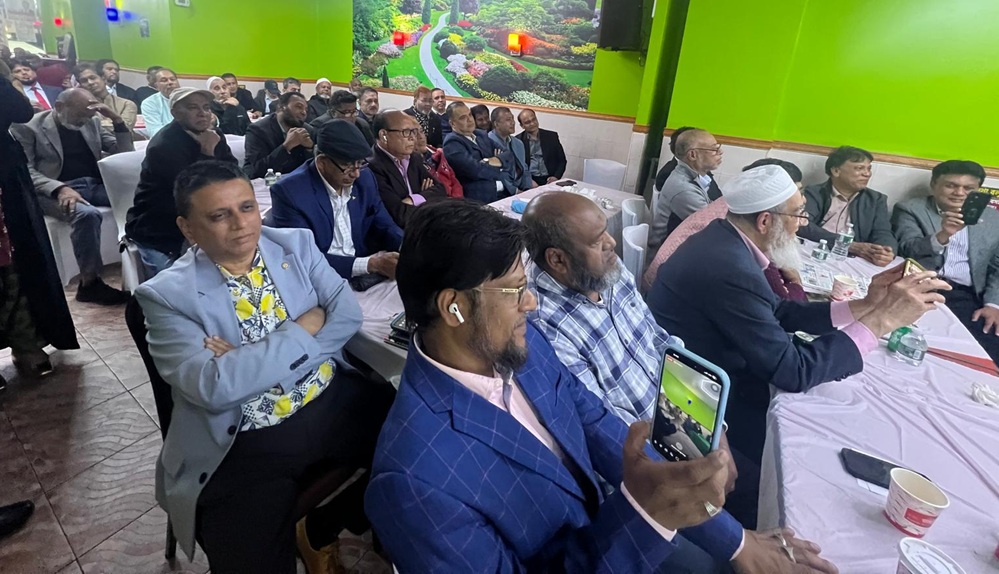
NEW YORK — Fatikchhari MP Sarwar Alamgir was accorded a reception at Radhuni Restaurant in the Church-McDonald area of New York on Thursday night, September 25. The event was organized at the initiative of Mohammad Hanif, chief adviser and former president of the Chattogram Association of New York. The reception was chaired by Mohammad Hanif and moderated by Md. Ariful Islam, general secretary of the Chattogram Association of New York. Among those attending were New York City Councilwoman Shahana Hanif, former Chattogram Association president Kazi Shakhawat Hossain Azam, current president Abu Taher, and poet and writer Shamsuddin Mahmud of Washington, D.C., along with prominent members of the Bangladeshi-American community.

In his speech as the chief guest, Sarwar Alamgir recalled his longstanding family relationship with Mohammad Hanif and his family. “Hanif bhai has not merely acted like an elder brother; he has always stood by me as my elder brother. I am therefore very happy to be able to visit New York and attend this gathering as his guest first,” Alamgir said. Alamgir also highlighted various initiatives undertaken for the development of Fatikchhari and expressed his determination to take necessary measures to eliminate terrorism and improve law and order in the constituency.

He also thanked Prime Minister Tarique Rahman for nominating him from Fatikchhari.  New York City Councilwoman Shahana Hanif said that although she was born and raised in New York City, her roots are in Fatikchhari.

Members of the Bangladeshi-American community attend a reception honoring Fatikchhari MP Sarwar Alamgir in New York on September 25. Photo: KHABOR

“I am a New York City Councilwoman. I was born and raised here, but my roots are in Fatikchhari,” she said. Shahana Hanif expressed her happiness that the people of Fatikchhari have a leader like Sarwar Alamgir. She also expressed hope that Alamgir would provide necessary advice and cooperation to Prime Minister Tarique Rahman not only for the development of Fatikchhari but also for the broader development of Bangladesh.

During the event, poet and writer Shamsuddin Mahmud presented two of his books to Sarwar Alamgir as gifts. The program concluded with guests being served traditional Chattogram-style mezbani cuisine. Recent reporting also identifies Sarwar Alamgir as the MP for Chattogram-2 (Fatikchhari) and confirms that he is currently serving as a lawmaker.


Iran Proposes Seven-Day Plan to Reopen Strait of Hormuz

Shibbir Ahmed, New York — Iran has proposed a plan that could reopen the strategically important Strait of Hormuz within seven days and pause fighting across the region, Iranian officials said during the United Nations General Assembly in New York.

Iranian Foreign Minister Abbas Araqchi said the proposal was transmitted to the United States through Qatari mediators. Under the proposal, a seven-day countdown would begin once Washington agrees to the terms, potentially leading to the reopening of the strategic waterway and a halt to hostilities. The Strait of Hormuz is one of the world’s most important energy-shipping routes, making its continued disruption a major concern for global oil markets and international trade.

Iran’s proposal reportedly calls for the United States to lift its blockade on Iranian ports, release frozen Iranian funds and waive oil sanctions. Tehran has also indicated that broader negotiations could follow once fighting is halted.

Iranian officials have said they are not prepared to make concessions on their nuclear program as part of the proposal. Tehran maintains that it retains rights related to uranium enrichment and has rejected demands that it surrender highly enriched uranium.

The initiative comes amid continuing military tensions across the Middle East. The disruption of oil shipments through the Strait of Hormuz has added pressure to global energy markets and raised concerns about alternative shipping routes.

Iran has also discussed safe shipping arrangements in the strait with Saudi Arabia, according to Iranian officials. The United States has not formally accepted Iran’s proposal, leaving the status of the initiative uncertain.


Bangladesh Sramik League Holds Protest Outside UN Headquarters in New York

NEW YORK: A protest rally was held outside the United Nations headquarters in New York on Wednesday, with the Bangladesh Sramik League USA chapter calling for the withdrawal of the ban imposed on the Bangladesh Awami League and the Sramik League. The protest was organized at 2 p.m. during the ongoing United Nations General Assembly session. Organizers said the demonstration was aimed at drawing international attention to their demands, including the withdrawal of restrictions on the Sramik League in accordance with the principles of International Labour Organization (ILO) conventions.

Nazmul Alam Romen, an executive member of the central committee of the Bangladesh Sramik League, addressed the rally as the chief guest. The event was chaired by Kazi Azizul Haque Khokon, president of the Sramik League USA, and moderated by Jewel Ahmed, general secretary of the organization. Speakers alleged that following August 5, 2024, the activities of the Bangladesh Awami League and its affiliated and associated organizations were banned through an executive order. They further claimed that the activities of the Bangladesh Sramik League, which they described as affiliated with the International Labour Organization (ILO) and the International Trade Union Confederation (ITUC), were also prohibited in violation of labour laws.

The speakers said the right to form and join trade unions is recognized by the ILO as a fundamental labour right. They said protecting trade union rights is important for ensuring democratic conditions in the workplace and allowing workers to pursue their legitimate demands.

Referring to ILO conventions, the speakers said Convention No. 87 protects freedom of association and the right to organize, while Convention No. 98 provides protection against anti-union discrimination. They alleged that the ban on the Sramik League’s activities through an executive order violates these principles.

The speakers also alleged that the headquarters of the Bangladesh Awami League and the Sramik League at 23 Bangabandhu Avenue in Dhaka had been burned and destroyed, while offices of various trade unions affiliated with the Sramik League had been closed.

They further claimed that thousands of Sramik League activists had lost their jobs and that workers had been killed or injured in attacks, while others were being harassed through what they described as false cases.

The rally called for the withdrawal of the restrictions on the Bangladesh Awami League and the immediate lifting of the ban on the Sramik League’s activities, which the speakers said should be done in accordance with ILO conventions. The speakers also called on the ILO, ITUC, international human rights organizations and the broader international community to take notice of their concerns.

Among those attending the rally were Sramik League USA leaders M.A. Alam Biplob, Laskar Moyzur Rahman Jewel, Abdur Razzak Anwar, Md. Motaleb Hossain and Saidul Islam, among others.


Landau Calls for Shift From Aid to Investment in U.S. Economic Diplomacy

Shibbir Ahmed, New York — U.S. Deputy Secretary of State Christopher Landau has called for a stronger focus on trade and private investment as a long-term alternative to traditional foreign aid, saying economic diplomacy should play a central role in strengthening relationships between countries. Speaking at a Trade Over Aid Deals Showcase on September 25, Landau said economic and commercial issues had for decades taken a back seat in diplomacy, which he argued had too often focused primarily on political, military and security matters.

‘Economic and commercial issues should be treated as a core element of diplomacy’, Landau said, arguing that governments have a responsibility to create prosperity, economic opportunities and jobs for their people. Landau said economic projects can create lasting relationships that survive changes in government. While acknowledging that aid programs can help countries remain afloat, he argued that long-term economic projects can provide more sustainable value by generating investment, infrastructure, employment and economic growth.

He also emphasized that foreign investment does not necessarily mean a loss of national sovereignty. According to Landau, governments should establish clear terms and conditions for investments so that both investors and host countries understand their respective obligations and potential returns.

‘Investment is an engine of growth’, Landau said, urging governments and businesses to view foreign capital as an opportunity to expand economic activity rather than as a threat to sovereignty. He described investment relationships as potentially “win-win” arrangements, saying capital inflows can support infrastructure, jobs and economic growth while also strengthening political and commercial ties between countries.

U.S. private sector at the center

Landau said one of his priorities as deputy secretary is to improve communication between the U.S. government and American companies seeking investment opportunities overseas. He noted that during trips around the world, he frequently hears foreign governments asking why American companies are absent from projects where businesses from other countries have submitted bids.

Landau said he had previously focused largely on American companies directly operating overseas, including construction, infrastructure, oil and mining firms. He said he now sees a greater role for U.S. financial capital, particularly from New York City, which he described as the world’s financial capital.

‘There are trillions of dollars here that can be deployed around the world,’ Landau said, arguing that attracting capital providers could help connect foreign investment opportunities with American operating companies. He said he recently met with major capital providers to discuss why they were not investing in certain countries and what obstacles were preventing greater U.S. participation.

Calls for a more coordinated U.S. approach

Landau also acknowledged concerns from private investors about the fragmented nature of the U.S. government’s economic engagement overseas. He said investors sometimes want the U.S. government to have a financial stake or other involvement in projects to reduce risks associated with political changes in foreign countries.

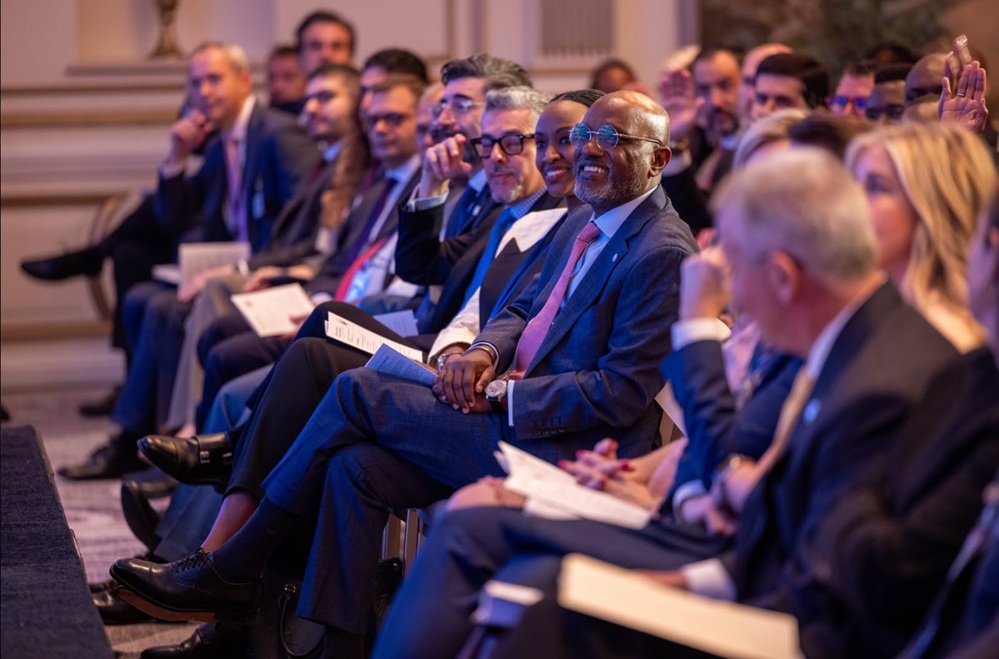
Government officials, private-sector representatives and international participants attend the “Trade Over Aid Deals Showcase” as U.S. officials discuss expanding trade and investment opportunities.

Landau said he wants the State Department, Commerce Department, Export-Import Bank, Development Finance Corporation and Millennium Challenge Corporation to work more closely together and make the U.S. government a more accessible “one-stop shop” for businesses seeking to invest overseas.

He cited the Pacific Islands as one region where he believes greater investment opportunities exist. Landau said he had organized a business summit and investment roundtable in Honolulu in February with Pacific Island leaders and U.S. private-sector representatives to identify sectors where investment could be expanded.

Landau said the U.S. government’s role is to improve communication between governments, businesses and investors and help identify opportunities for private capital. Concluding his remarks, Landau reaffirmed his commitment to expanding the global role of American businesses and called for what he described as an “unprecedented golden era for the American private sector around the world.”