Mamdani Skips NYC Columbus Day Parade Amid Backlash

Shibbir Ahmed, New York — New York City Mayor Zohran Mamdani skipped Manhattan’s annual Columbus Day Parade on Monday, drawing criticism from some Italian-American leaders and paradegoers who viewed his absence as a sign of disrespect toward their community and its cultural heritage.

The 82nd annual parade proceeded along Fifth Avenue, celebrating Italian-American history, culture and contributions to the United States. Mamdani was not expected to attend, breaking with a tradition long observed by many previous New York City mayors. The mayor’s absence has reignited debate over the relationship between Christopher Columbus’s historical legacy and the celebration of Italian-American identity in New York City.

Mamdani did not attend Monday’s Manhattan parade, despite releasing a video over the weekend marking Italian-American Heritage Month. In the video, the mayor highlighted the contributions of Italian-American figures, including former New York City Mayor Fiorello La Guardia and Congressman Vito Marcantonio. He described Italian-American history as an important part of New York City’s broader story.

However, the video did not mention Christopher Columbus, whose role as the central historical figure associated with the holiday remains controversial. Mamdani has previously criticized Columbus, arguing that his legacy includes the mistreatment and displacement of Indigenous peoples. During his time as a state assemblyman in 2020, he posted a photograph of himself making an obscene gesture toward a Columbus statue and called for its removal.

Some Italian-American community leaders criticized the mayor’s decision, arguing that the parade represents more than the historical figure of Columbus. They say the annual event is an opportunity to celebrate Italian-American culture, recognize the achievements of generations of immigrants and honor their contributions to the city.

Angelo Vivolo, chairman of the Columbus Heritage Coalition, was among the community figures who objected to Mamdani’s absence, according to reporting by the New York Post. Other critics argued that the mayor, as the city’s chief elected official, should make an effort to participate in major cultural celebrations even when he disagrees with aspects of their historical symbolism.

Former mayoral candidate Curtis Sliwa also criticized the decision, while other political figures and paradegoers expressed disappointment. The criticism reflects a broader debate over whether a mayor’s attendance at a cultural event should be understood as recognition of a community’s heritage, endorsement of the event’s historical namesake, or both.

New York City’s Columbus Day Parade is one of the country’s major celebrations of Italian-American heritage. The annual event brings together cultural organizations, marching bands, community groups and public officials along Fifth Avenue. Organizers said this year’s parade would include more than 100 participating groups and several bands. Investor and philanthropist Ray Dalio was named grand marshal, with his son, Matt Dalio, representing him at the event.

For many Italian-American families, the parade is a longstanding tradition associated with family history, community pride and the experience of earlier generations of immigrants. At the same time, Columbus’s historical treatment of Indigenous peoples has led many Americans to question whether he should remain the central symbol of the holiday. Some communities instead emphasize Indigenous Peoples’ Day, which recognizes Indigenous history, culture and survival. The competing perspectives have made Columbus Day celebrations a recurring source of political and cultural disagreement.

Monday’s absence follows Mamdani’s decision not to participate in New York City’s Israel Day Parade earlier this year. At that time, the mayor said he had made his position clear during his campaign and argued that his personal attendance should not determine whether participants could gather safely. His administration provided security measures for the event, and NYPD Commissioner Jessica Tisch attended.

Mamdani’s approach to public parades has therefore become part of a wider discussion about how mayors balance personal political views, cultural representation and their responsibility to serve residents with different backgrounds and beliefs.

The Columbus Day Parade controversy presents a challenge for an administration that has emphasized inclusion and the contributions of immigrant communities. Supporters of Mamdani’s position may view his absence as consistent with his longstanding criticism of Columbus and his refusal to endorse celebrations centered on a figure associated with colonial violence.

Critics, however, argue that the mayor could have attended to recognize Italian-American residents without endorsing every aspect of Columbus’s historical legacy. His decision has also drawn attention to a broader question facing New York City’s leadership: how to acknowledge the historical concerns of different communities while ensuring that residents feel represented by City Hall.

The dispute does not, by itself, establish how Italian-American voters as a whole view the mayor. The criticism reported so far comes from particular leaders, political figures and paradegoers.

Mamdani’s absence is likely to remain a subject of debate as the city continues to navigate disagreements over historical commemorations, immigration and cultural identity. The mayor has publicly recognized Italian-American Heritage Month and highlighted Italian-American public figures, but critics say those gestures do not replace participation in the community’s longstanding parade. Whether the controversy leads to further dialogue between City Hall and Italian-American organizations remains to be seen.

For now, Mamdani’s decision to skip the Columbus Day Parade has exposed a continuing divide over how New York City should celebrate Italian-American heritage while confronting the contested history of Christopher Columbus.
Mamdani Orders NYPD Use-of-Force Review

Shibbir Ahmed, New York — New York City Mayor Zohran Mamdani on Monday ordered a comprehensive review of the New York Police Department’s (NYPD) use-of-force policies and practices, marking the first such review in a decade as his administration introduces new measures aimed at strengthening police accountability. The announcement follows renewed scrutiny of the NYPD after an officer facing disciplinary charges related to the 2024 fatal shooting of 19-year-old Win Rozario retired before a disciplinary trial could take place.

The administration said the review would take place over the coming months and include public engagement with communities across New York City. The new measures also include additional funding for independent police oversight, changes to disciplinary procedures and greater transparency for families affected by serious police incidents.

“When the government uses force against a New Yorker, the standard for accountability must be at its highest,” Mamdani said in a statement released by City Hall. The mayor said the review would examine whether police policies provide officers with appropriate guidance and training while ensuring that force is used lawfully and only when necessary.

The reforms follow the death of Win Rozario, a 19-year-old Queens resident who was fatally shot by NYPD officers during a mental health crisis in March 2024. According to reporting by CBS New York, Rozario called 911 while experiencing a mental health crisis. Responding officers encountered him inside his family’s home, where body-camera footage showed him approaching officers with a pair of scissors as police deployed Tasers before firing their weapons.

The shooting prompted protests and renewed debate over police responses to people experiencing mental health emergencies. One of the officers involved later faced disciplinary charges brought by the Civilian Complaint Review Board, the city agency responsible for investigating allegations of misconduct by NYPD officers.

However, the officer retired with a disability pension before the disciplinary trial could proceed, preventing the case from reaching a final disciplinary determination. City Hall said the retirement exposed weaknesses in the procedures used to manage disciplinary cases involving officers who leave the department before their cases are resolved. The administration’s new measures are intended to reduce the likelihood of similar cases ending without a completed disciplinary process.

A central component of Mamdani’s announcement is an additional $2.6 million for the Office of the Inspector General for the NYPD. The independent oversight office examines police policies, practices and procedures and makes recommendations intended to improve the department’s performance and accountability. According to the mayor’s office, the additional funding will restore staffing to a historic peak and triple the office’s current headcount.

The administration said the expanded resources would strengthen the office’s ability to investigate policies and practices that could undermine accountability in cases involving police misconduct. The funding increase comes amid broader debate over how New York City should balance police oversight, officer accountability and public safety.

The administration also announced changes intended to help ensure that disciplinary proceedings are completed before officers retire. The NYPD has implemented a new notification system designed to prioritize the resolution of disciplinary cases before an officer leaves the department. The city will also formalize the department’s practice of notifying the New York State Division of Criminal Justice Services when an officer retires with pending disciplinary charges.

The department will submit relevant personnel information for decertification when applicable, a process intended to help prevent officers facing serious unresolved disciplinary matters from avoiding scrutiny by moving to another law enforcement agency in New York State.

The reforms do not mean that every officer facing allegations will automatically be barred from future employment. Their effect will depend on the circumstances of individual cases and the applicable state rules. The administration also said the NYPD would maintain full and timely compliance with the state’s STAT Act, which requires reporting data related to deaths involving police.

Another element of the reforms concerns communication with the public and families following incidents in which people are killed or seriously injured during encounters with police.

The NYPD will standardize and formalize its procedures for sharing information after critical incidents, according to City Hall. The changes include providing final reports from the department’s Force Investigation Division to families or their representatives who request them.

The administration said the measures are intended to make it easier for affected families to understand how the city investigates serious incidents and reaches conclusions about police conduct. Greater access to information could also help address concerns that families have raised about delays or a lack of clarity following police-involved deaths.

The announcement comes as Mamdani faces pressure from some progressive supporters to pursue more substantial changes to the NYPD. During his mayoral campaign, Mamdani advocated shifting some responsibilities away from police officers and toward mental health professionals, particularly in situations involving people experiencing mental health crises.

The implementation of those proposals has drawn scrutiny from supporters who want faster action. Mamdani has also faced criticism over his decision to retain Police Commissioner Jessica Tisch, who served in the previous administration.

Recent criticism intensified after a separate shooting involving federal immigration officers in New York City. Some progressive allies have called for stronger changes to the city’s public safety leadership. The mayor’s latest announcement addresses several accountability concerns, although it does not itself represent a wholesale restructuring of the NYPD.

Police union representatives criticized the announcement, arguing that the city should also address concerns about the fairness and effectiveness of the civilian complaint process. Patrick Hendry, president of the Police Benevolent Association, said the proposed changes would not improve public safety and characterized them as an attempt to satisfy the mayor’s progressive supporters.

Other police union representatives also questioned the administration’s approach, arguing that officers need support and that oversight bodies must be held accountable for their own procedures. The criticism highlights a continuing divide over how the city should address allegations of police misconduct while maintaining effective law enforcement.

The administration, meanwhile, says the reforms are intended to ensure that serious allegations receive appropriate scrutiny and that disciplinary cases are not left unresolved because an officer retires.

The comprehensive review of NYPD use-of-force policies is expected to take place over the coming months, with community engagement forming part of the process. The review will examine existing policies and practices, while the administration’s new oversight measures are intended to improve the handling of disciplinary proceedings and communication following serious incidents.

The announcement does not establish the outcome of the review or specify which use-of-force policies will ultimately change. Its impact will depend on the recommendations that emerge, how the NYPD implements them and whether the changes address concerns raised by families, community organizations, oversight officials and police representatives.

For New Yorkers, the central questions are whether the review leads to clearer rules governing police use of force, more consistent disciplinary procedures and greater transparency when serious incidents occur.

Mamdani’s announcement marks a new phase in the city’s debate over police accountability, with the coming months likely to determine whether the review produces substantive changes to NYPD policies and practices.


New York Labor League President Khokon Dies at 58; Body Sent to Bangladesh

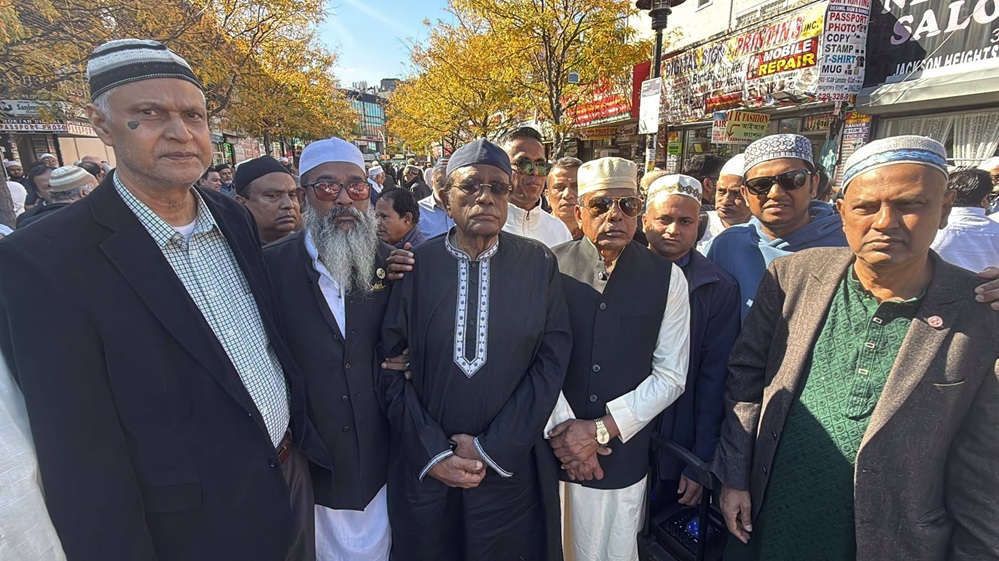
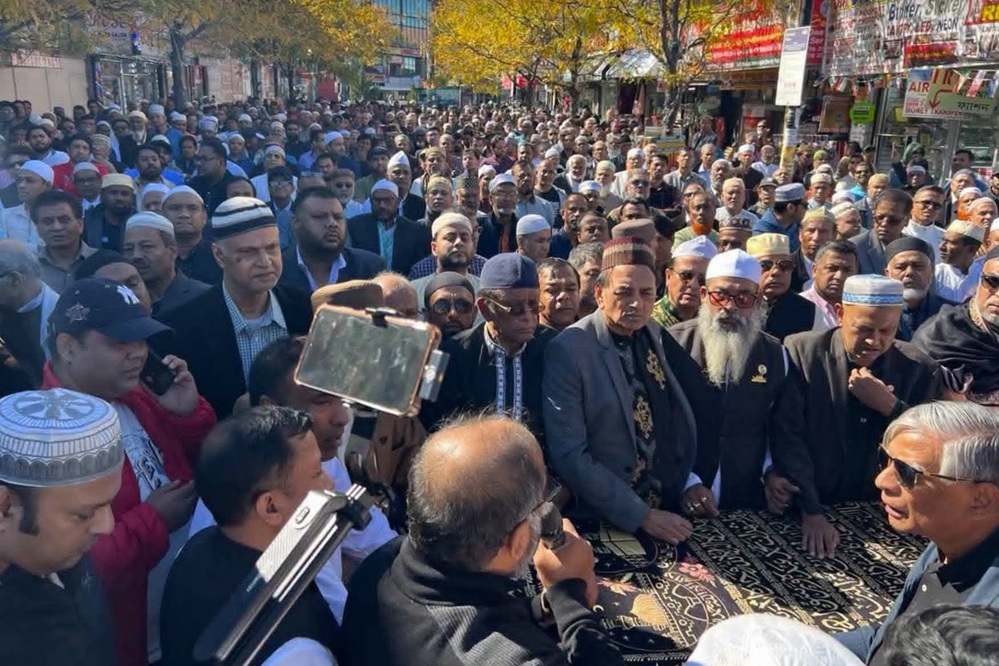
Shibbir Ahmed, New York — Kazi Azizul Haque Khokon, 58, president of the United States Labor League, was remembered with tears, prayers and heartfelt tributes as hundreds of Bangladeshi expatriates from across the political spectrum gathered to pay their final respects to the community leader in New York City.

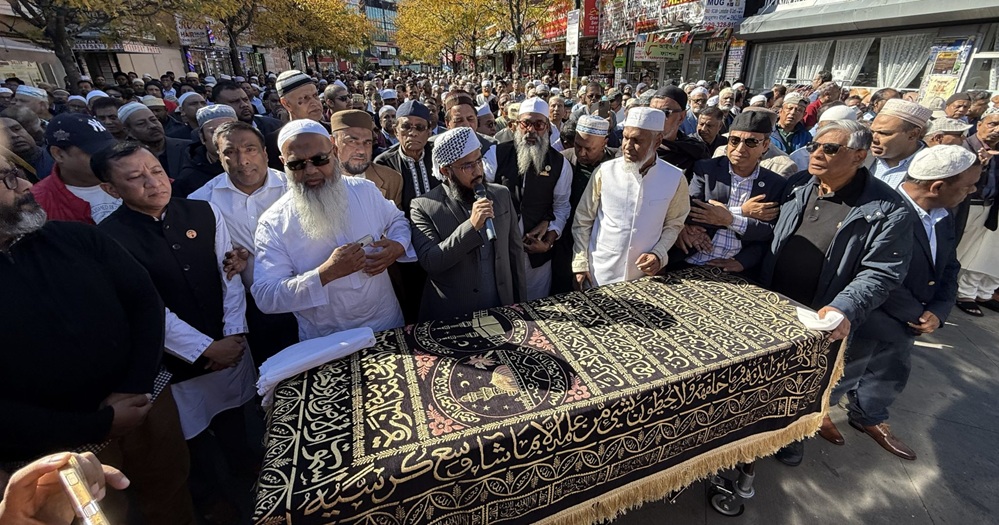
Thousands of worshippers and mourners attended his funeral prayers after Jumu’ah on October 9 at Diversity Plaza in Jackson Heights, Queens. Community members, political leaders and longtime acquaintances gathered to bid farewell to Khokon, whose death had left many in the Bangladeshi diaspora in mourning.

Khokon reportedly suffered a cardiac emergency while traveling by bus to work on October 3. When he could not be located, a report was filed with police. Friends and political associates searched for him before his body was found at Bellevue’s morgue on the evening of October 7.

Originally from Magura, Bangladesh, Khokon came to the United States in 1992. According to people familiar with his circumstances, he had not obtained permanent immigration status and spent his years in the country living as a bachelor.

Before the funeral prayers, Jewel Ahmed, secretary of the U.S. Labor League, appealed to anyone who had outstanding financial matters with Khokon to contact him. Hossain Rana, an Awami League leader and one of the owners of Obosor Book Corner, where Khokon worked in Jackson Heights, also asked anyone who believed Khokon had wronged them to forgive him.

Ataur Rahman Selim, president of the Bangladesh Society, prayed for the forgiveness of Khokon’s soul and said the organization was taking responsibility for the funeral arrangements and the costs associated with sending his body to Bangladesh.

The funeral drew a broad cross-section of the Bangladeshi-American political and community leadership. Those attending included Moin Chowdhury, a Democratic Party district leader-at-large and attorney; Siddiqur Rahman, president of the U.S. Awami League; General Secretary Abdus Samad Azad; spokesperson Dr. Masudul Hasan; Awami League leader Engineer Mohammad Ali Siddiqui; Haji Enam; Misbah Ahmed; Rafiqul Rahman and Imdad Chowdhury, president and general secretary of the New York City Awami League, respectively.

Also present were Mujibur Rahman Mia, president of the State Awami League and a freedom fighter; General Secretary Shaheen Azmal; Abdur Rahim Badsha, chief adviser to the U.S. Labor League; H.M. Iqbal and Syed Kibria Zaman, president and general secretary of the Swechchhasebak League; former president Nuruzzaman Sardar; Momtaz Shahnaz, president of the Women’s Awami League; Shahahana Rahman, an executive committee member of the U.S. Awami League; former member of parliament Nazrul Islam Babu; Mahmud Hasan and Hridoy Mia, president and general secretary of the U.S. Chhatra League; Harun Bhuiyan and Fahad Solaiman, president and general secretary of the JBBBA; and Mahiyuddin Dewan and Mohammad Ali, senior vice president and general secretary of the Bangladesh Society, among others.

Following the funeral prayers, a vehicle carrying Khokon’s coffin departed for John F. Kennedy International Airport. His body was scheduled to leave for Dhaka on an Emirates flight that night, according to the information provided by community representatives.

Meanwhile, members of the Awami League and affiliated organizations gathered at Nabanna Party Hall on the evening of October 8 in response to a call from the Labor League. They reportedly raised approximately $10,000 to assist with arrangements related to Khokon’s death and support his family.

Jewel Ahmed and Dr. Masudul Hasan said the collected funds, along with cash reportedly found in Khokon’s pocket, would be sent to his brothers and sisters in Magura. Khokon’s funeral brought together political colleagues, community leaders and expatriates from different backgrounds, reflecting the connections he had built during his decades in the United States. As his body was prepared for its final journey to Bangladesh, members of the community offered prayers and expressed condolences to his family.


Kazi Azizul Haque Khokon Missing in New York for Three Days

NEW YORK — Concern is growing in New York’s Bangladeshi community over the disappearance of Kazi Azizul Haque Khokon, who has reportedly been missing for the past three days. Khokon lived alone at his home in Kew Gardens, Queens, and was well known within the Bangladeshi community in Jackson Heights. Friends and acquaintances regularly saw him in Jackson Heights, where he worked at Obokash Store, located near Khamarbari Grocery and Nabanna Restaurant.

People close to Khokon became increasingly concerned after he failed to report to work for three consecutive days. Khokon has also been involved in politics and is known as a leader of the Awami League and president of the US Sramik League. Md. Hamid, publicity secretary of the US Awami League, confirmed Khokon’s disappearance.

According to people familiar with the situation, local police went to Khokon’s residence in Kew Gardens and entered after breaking open the door, but they reportedly found no trace of him.

Awami League adviser Dr. Masuduzzaman has also reportedly contacted several hospitals in an effort to locate Khokon. However, there has been no confirmed information about his whereabouts so far.

The disappearance has caused concern among members and supporters of the US Awami League. Dr. Siddiqur Rahman, president of the US Awami League, said he had learned about the incident shortly before speaking and was heading to Jackson Heights to gather more information.

Khokon reportedly came to the United States about 30 years ago. His family home is in Magura District, Bangladesh. People involved in the search have also been attempting to contact Rana, the owner of Obokash Store.

There has also been speculation among some people that Khokon may have been detained or arrested by U.S. Immigration and Customs Enforcement (ICE). However, there is currently no official confirmation from ICE, police, or other law enforcement authorities that he has been detained or arrested.

Khokon’s family, coworkers, friends and community members are appealing for assistance in locating him. Anyone with reliable information about his whereabouts is urged to contact the appropriate law enforcement authorities or people close to the family.


UN Faces Funding and Reform Crisis as New Leader Takes Charge

Shibbir Ahmed, New York — The United Nations is approaching a critical leadership transition as it confronts mounting financial pressure, deep divisions among major powers and growing demands for reform. The organization’s next secretary-general will inherit a UN struggling to maintain its influence over some of the world’s most serious conflicts while facing questions about its ability to meet expanding humanitarian and development needs.

The transition comes as the United Nations prepares for a new secretary-general to take office on January 1, 2027. The incoming leader will succeed António Guterres, who has spent nearly a decade at the helm of the organization and has repeatedly warned that the international system is under severe strain.

In a recent assessment, The Associated Press described the UN as facing a combination of financial difficulties, geopolitical divisions and questions over its relevance. The organization continues to play a major role in humanitarian assistance and international cooperation, but its ability to resolve major conflicts has often been constrained by disagreements among powerful member states.

One of the most immediate challenges is the United Nations’ financial position. The United States, historically the organization’s largest financial contributor, has accumulated substantial unpaid assessments. According to Congressional Research Service data, U.S. unpaid assessments stood at approximately $2.04 billion for the UN regular budget and $2.25 billion for peacekeeping as of April 30, 2026.

Washington has indicated that it intends to make payments toward its outstanding obligations. Reuters reported in August that the Trump administration had notified Congress of plans for a payment of $725 million toward U.S. debt to the United Nations. The issue nevertheless remains part of a broader dispute over the cost, structure and effectiveness of the international organization.

The financial pressure has consequences beyond the UN’s headquarters in New York. United Nations agencies and programs provide assistance to millions of people affected by conflict, displacement, hunger and natural disasters. Reduced or delayed funding can force agencies to scale back operations at a time when humanitarian needs are increasing in several regions.

The organization is also under pressure to reform its internal structure. Guterres has promoted the UN80 Initiative, an effort intended to make the United Nations more efficient, reduce duplication and strengthen accountability. The initiative has included organizational restructuring and reductions in posts as the UN seeks to operate with fewer resources.

But the most difficult reforms are political rather than administrative. For years, countries across Africa, Asia and Latin America have demanded changes to the UN Security Council, arguing that its current structure does not adequately reflect the modern international system.

The Security Council’s five permanent members—the United States, China, Russia, France and the United Kingdom—retain veto power over substantive decisions. African countries in particular have called for permanent representation on the council, while other governments have pressed for broader changes to the composition of the body.

Reforming the Security Council, however, remains extremely difficult. Any major change would require agreement among member states, including the existing permanent members whose own political interests can conflict with calls for a broader distribution of power.

The UN’s difficulties have become particularly visible during major international conflicts. The organization has remained heavily involved in humanitarian operations related to wars in Gaza, Ukraine and other regions, but disagreements among major powers have frequently limited the Security Council’s ability to take decisive action.

That gap between the UN’s humanitarian responsibilities and its political limitations has become one of the central challenges facing the organization. UN agencies continue to deliver food, medical assistance and other essential services, even as political divisions make it difficult for the wider organization to establish unified responses to conflicts.

The financial challenge is being compounded by a wider decline in international assistance. The UN’s own reform reporting has warned that international assistance fell sharply between 2024 and 2025, increasing pressure on humanitarian programs and development efforts.

Despite those difficulties, the United Nations remains a central institution for international cooperation. Its agencies continue to coordinate humanitarian relief, support refugees, assist developing countries and address global issues ranging from climate change to poverty and public health.

The organization has also continued efforts to provide emergency assistance to underfunded crises. UN officials have warned that financial resources alone are not sufficient, however, and that humanitarian operations also depend on security, political access and cooperation from governments and armed groups.

For the next secretary-general, the challenge will be to balance competing demands while restoring confidence in an institution facing unprecedented political fragmentation. The new leader will have to work simultaneously with Washington, Beijing, Moscow and other major powers while maintaining relationships with the broader UN membership.

The transition therefore represents more than a change in leadership. It is a test of whether the United Nations can adapt to a rapidly changing international system while retaining the principles on which it was founded.

Guterres has argued that the world does not need a weaker United Nations. The next secretary-general will face the task of demonstrating how the organization can become more effective at a time when its members are increasingly divided over money, power and the future of international cooperation.

For an organization created after World War II to prevent conflict and promote cooperation among nations, the coming years could prove decisive. Whether the UN emerges from its current difficulties stronger or weaker will ultimately depend not only on its next leader, but on whether its member states are prepared to provide the political support and financial resources necessary for reform.


Off-Duty NYPD Stabbed During Attempted Robbery in Bronx

Md. Mashiur Rahman Majumder, New York — An off-duty NYPD detective was stabbed several times during what authorities described as an apparent attempted robbery in the Norwood section of the Bronx on Friday afternoon. The incident happened shortly before 2 p.m. near Rochambeau Avenue and East 206th Street, according to police and local reports. The detective was taken to Jacobi Medical Center for treatment and was reported to be in stable condition.

New York City Mayor Zohran Mamdani said preliminary information indicated that the detective was attacked during an attempted robbery. Mamdani and NYPD Commissioner Jessica Tisch visited the detective and his family at Jacobi Hospital following the incident. Authorities said the investigation remained active Friday evening. Reports indicated that two suspects fled the scene on e-bikes or scooters after the attack. Police circulated images of the suspects as investigators worked to identify and locate them.

Sources familiar with the investigation told local media that the detective is assigned to the NYPD’s 44th Precinct. Additional reports said the suspects approached the officer as he was near his vehicle and attempted to rob him before the confrontation turned violent.

The detective sustained multiple injuries and was transported by emergency medical personnel to Jacobi Medical Center. Officials did not initially release his identity publicly through the NYPD, while the investigation into the circumstances of the attack continued.

The incident also led the NYPD to cancel a previously scheduled briefing at One Police Plaza where Commissioner Tisch and Mayor Mamdani were expected to discuss the city’s quarterly crime statistics.

Police continued searching for the suspects as investigators gathered evidence from the scene. No final determination had been announced regarding the identities or motives of those responsible beyond the preliminary robbery information. The investigation remains ongoing.


America-Bangladesh Press Club Marks 18th Anniversary in New York

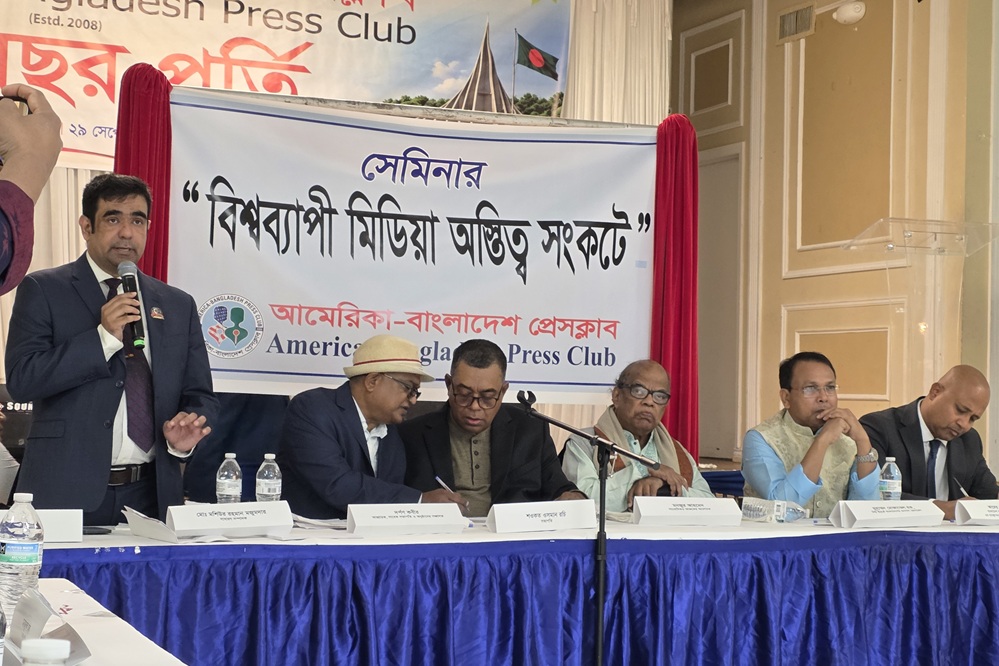
Md. Mashiur Rahman Majumder, New York — The America-Bangladesh Press Club marked its 18th anniversary with a seminar, publication of a commemorative magazine, awards and a cultural program in New York. The event was held Tuesday, September 29, at the Gulshan Terrace auditorium in Woodside. The seminar focused on the theme “The Global Media Crisis: Challenges to Media Survival,” bringing together journalists, editors, academics and diplomats to discuss the changing media landscape in Bangladesh, the United States and around the world.

Speakers examined the challenges facing Bangladesh’s media, the professional experiences of Bangladeshi journalists living in the United States, and the impact of social media, artificial intelligence and changing audience habits on traditional journalism. Several speakers emphasized the importance of responsible, objective and investigative journalism. They also discussed concerns over political favoritism, misinformation and declining public trust in news organizations.

The seminar was chaired by America-Bangladesh Press Club President Shawkat Osman Rachi and moderated by former club president Darpan Kabir. Guests included Gholam Mortuza, Press Minister at the Bangladesh Embassy in Washington, D.C.; Mohammad Mozammel Haque, Consul General of Bangladesh in New York; and veteran journalist Manzur Ahmed. Panelists included veteran journalist Saeed Tarek; journalist Moinuddin Naser; Bangladesh Patrika editor Dr. Wazed A. Khan; Janmabhumi editor Ratan Talukdar; Prothom Alo North America editor Ibrahim Chowdhury; Probash editor and former Press Club president Mohammad Sayeed; and Shoeb Ahmed Bhuiyan, a lecturer at Columbia University.

Press Club General Secretary Mashiur Rahman Majumder delivered the welcome address. Treasurer Mallika Khan Muna, Vice President Mohammad Manzurul Haque and Joint General Secretary Abu Bakar Siddiq also delivered congratulatory remarks. During the seminar, moderator Darpan Kabir read an article titled “How Is Bangladesh’s Media Doing?” by Matiur Rahman Chowdhury, editor-in-chief of Manab Zamin. Panelists subsequently discussed various aspects of the article and the broader challenges facing journalism.

Veteran journalist Manzur Ahmed said that when media outlets engage in misinformation, propaganda or attempts to conceal the truth, audiences will turn to social media and other alternative sources for information. Such practices, he said, can undermine the credibility of mainstream media. He also stressed the importance of journalists developing strong news-writing skills and maintaining a habit of reading and learning, noting concerns over the decline of traditional reporting skills.

Bangladesh Embassy Press Minister Gholam Mortuza discussed the role of media owners and editors in the challenges facing Bangladesh’s media. He said political favoritism has contributed to a loss of public confidence in some media organizations. Consul General Mohammad Mozammel Haque said audiences want accurate information and objective journalism. He noted that social media has become an important source of information in today’s media environment.

Veteran journalist Saeed Tarek said journalism in Bangladesh has changed significantly from the 1960s and 1970s. He pointed to the challenges created by social media and also noted that financial difficulties, including problems with journalists receiving regular salaries, can affect responsible journalism.

Dr. Wazed A. Khan said the media industry is facing challenges worldwide as audience behavior continues to change. He highlighted the growing influence of social media and artificial intelligence on print and electronic media and emphasized the responsibility of professional news organizations to verify information and counter misinformation.

Journalist Moinuddin Naser stressed the importance of integrity in journalism, saying honesty must remain a fundamental principle of the profession. Shoeb Ahmed Bhuiyan said responsible journalism becomes difficult when journalists become overly aligned with those in power. He also noted that a country’s economic conditions can have an impact on its media industry and broader society.

Probash editor Mohammad Sayeed said Bangla-language media outlets in the diaspora play an important role in building community connections and maintaining ties between Bangladesh and expatriate Bangladeshis. He also pointed to declining readership and challenges facing community newspapers abroad.

Ibrahim Chowdhury, editor of Prothom Alo North America, said the media crisis is not new and has appeared in different forms over time. He cautioned against attributing the current challenges solely to artificial intelligence or technology, saying changes in technology, audience behavior, news consumption and media business models have all contributed to the transformation of journalism.

Janmabhumi editor Ratan Talukdar said media challenges existed in the past and will continue in the future. He emphasized the importance of remaining vigilant to prevent false information from being presented as news. Following the seminar, organizers cut a cake to mark the Press Club’s 18th anniversary. The commemorative publication “Alokbartika”, released to mark the club’s milestone, was also unveiled during the event. Publication editor Tofazzal Liton delivered remarks on the occasion.

The America-Bangladesh Press Club also honored singer M.A. Soaib and actress Moushumi with special commemorative awards. Renowned singer Rathindranath Roy presented the award to M.A. Soaib, while Press Minister Gholam Mortuza and Consul General Mohammad Mozammel Haque presented the award to actress Moushumi.

Guests were welcomed with roses by representatives of the Press Club. The evening concluded with a cultural program featuring musical performances by M.A. Soaib and Tina Russell. Community leaders, journalists, businesspeople, cultural figures and Press Club members attended the anniversary celebration with their families.


New NYC Laws and Rules Taking Effect in October 2026

Mashiur Rahman, New York — New York City is implementing several new laws and rules in October 2026, affecting consumers, rent-stabilized tenants, businesses and commercial waste operations across the city. Among the changes taking effect this month are a new “Click-to-Cancel” rule for subscriptions, new restrictions on certain menstrual and intimate-care products, updated protections for small-business owners during city inspections, and changes to commercial waste requirements.

One of the most significant changes for consumers took effect October 1, when New York City’s new Click-to-Cancel rule became effective. The rule requires businesses offering automatic-renewal or continuous-service subscriptions to clearly explain subscription terms and provide customers with a straightforward way to cancel. In general, the cancellation process must be available through the same method used to sign up.

Businesses that violate the rule may face civil penalties beginning at $525 per violation, as well as potential restitution to affected consumers. The city’s Department of Consumer and Worker Protection (DCWP) is responsible for enforcement. The city also launched a complaint process allowing New Yorkers to report businesses that make subscription cancellation unnecessarily difficult.

For rent-stabilized apartments, leases beginning between October 1, 2026, and September 30, 2027 will have a 0% guideline adjustment for both one-year and two-year leases under the NYC Rent Guidelines Board’s adopted Order No. 58. The same 0% guideline applies to the covered rent-stabilized loft units during the period. The Rent Guidelines Board establishes annual rent adjustments for rent-stabilized apartments and other covered housing units in New York City.

Another local law takes effect October 10, 2026, restricting the sale, offering for sale and distribution of certain menstrual and intimate-care products containing specified intentionally added ingredients considered harmful to human health. The law also provides for the development of health-based threshold levels after relevant New York State Department of Health regulations are established.

Changes to New York City’s Commercial Waste Zone program are also scheduled to take effect October 16. The Department of Sanitation says the implementation will cover commercial waste zones in Brooklyn East, Manhattan Northeast, Queens, West and Manhattan West. Businesses producing commercial waste in participating zones are required to work with an authorized commercial waste carter during the applicable implementation period. Businesses in Brooklyn North and Upper Manhattan also began their Commercial Waste Zone contract sign-up period on October 1.

Beginning October 1, inspectors from several city agencies must provide storefront businesses with a physical copy of the updated Business Owner Bill of Rights at the beginning of onsite inspections, along with information about accessing the city’s customer-service survey and translated versions of the document.

The requirement applies to inspectors from agencies including the Department of Buildings, Department of Consumer and Worker Protection, Department of Environmental Protection, FDNY, Department of Health and Mental Hygiene, Department of Parks and Recreation, Department of Sanitation and Department of Transportation.

The updated requirements are part of Mayor Zohran Mamdani’s Executive Order No. 18, which also directs city agencies to prominently post the updated Business Owner Bill of Rights at public offices and service locations serving businesses.

With several of these measures now taking effect, October marks a significant month of regulatory changes for New York City residents and businesses. The changes cover consumer subscriptions, rent-stabilized housing, personal-care products, commercial waste and interactions between city inspectors and small businesses.


Iranian Delegation Leaves New York Early Amid US-Iran Tensions

Shibbir Ahmed, New York — U.S. Secretary of State Marco Rubio ordered Iranian Foreign Minister Abbas Araghchi and his delegation to leave New York earlier than scheduled, according to two U.S. officials familiar with the matter, adding a new dimension to ongoing diplomatic tensions between Washington and Tehran. Iranian President Masoud Pezeshkian left New York last week after delivering his address to the United Nations General Assembly. Araghchi, however, remained in the city as efforts continued toward indirect discussions with the United States on reopening the Strait of Hormuz, ending the ongoing conflict and restarting negotiations over Iran’s nuclear program.

According to U.S. officials, weekend meetings involving Iranian and Qatari mediators produced little progress. Rubio subsequently instructed the Iranian delegation on Monday to leave New York immediately. One U.S. official said the delegation had remained in the country after the high-level UN meetings had ended and was no longer expected to stay. Araghchi and members of his delegation left New York early Tuesday and were expected to travel back to Iran via Doha, Qatar.

Iran, however, rejected the U.S. account. Iran’s permanent mission to the United Nations said the delegation had not been ordered to leave or expelled from the United States. The mission said its departure schedule had been arranged in advance and had been communicated to the U.S. State Department on September 17.

The Iranian mission also accused Washington of spreading what it described as “baseless” reports following the lack of progress in the negotiations. The conflicting accounts have highlighted the differences between Washington and Tehran over the circumstances surrounding the delegation’s departure.

Indirect discussions between the United States and Iran have continued with Qatar playing a mediating role. Key issues remain unresolved, including the reopening of the Strait of Hormuz, sanctions, frozen Iranian assets, the ongoing conflict and Iran’s nuclear program.

The departure of the Iranian delegation comes as diplomatic contacts between Washington and Tehran continue, but the two sides have yet to reach an agreement aimed at resolving the broader conflict and their longstanding disputes.


Sheikh Hasina’s 80th Birthday Celebrated in New York

NEW YORK: The U.S. chapter of the Bangabandhu Foundation marked the 80th birthday of former Bangladesh Prime Minister Sheikh Hasina at an event in New York on Monday. Members, supporters and leaders of the organization cut a birthday cake during the celebration and raised slogans including “Bangladesh is blessed because of Sheikh Hasina,” “Sheikh Hasina, don’t be afraid—we are with you,” and “Joy Bangla, Joy Bangabandhu.”

Participants at the event also expressed their intention to welcome Sheikh Hasina back to Dhaka by December, according to organizers. Among those attending were Dr. A.K. Abdul Momen, central president of the Bangabandhu Foundation and former foreign minister of Bangladesh; Abdul Kader Mia, president of the foundation’s U.S. chapter; Senior Vice President Engineer Md. Fazlul Haque; Vice Presidents Md. Zafarullah, Afsar Mohammad and Abu Taher M. Rahman; General Secretary Kamal Hossain Mithu; and Joint General Secretaries Alim Khan Akash and Ariful Islam Arif.

The event was also attended by the foundation’s Communications Director and freedom fighter Lablu Ansar, along with leaders and community members including Nazrul Islam Babul, Mobasher Hossain, Abdul Jalil, M.A. Kadir, community leader Abul Hashem, Sirajul Maola, Abul Hasan Mahiuuddin, Mosharraf Hossain Abdul Hamid, Abul Kashem, Idris Alam, Yasin Arafat Bappi and Ahsan Ullah Saki, among others.