New York — Abdulrahman El Bahnasawy, 28, a resident of Ontario, Canada, has been sentenced to an additional 50 years in federal prison for attacking two correctional officers at a Pennsylvania prison in 2020 while serving a separate sentence for plotting a mass-casualty terrorist attack in New York City on behalf of ISIS. According to a U.S. Department of Justice announcement dated Monday, October 19, 2026, the new sentence will run consecutively to the 40-year prison term Bahnasawy is already serving for his role in the 2016 New York City terror plot.
According to court records, Bahnasawy attacked two correctional officers at U.S. Penitentiary Allenwood on December 7, 2020, using a weapon made from part of a steel desk in his cell. He stabbed one officer in the head and face. When a second officer intervened to help, he stabbed her in the hand. The first officer eventually lost his right eye as a result of the attack.
After Bahnasawy was restrained, authorities discovered a note inside his sock stating, “This is a terrorist attack for the Islamic State.” Investigators also found a pledge of allegiance to the Islamic State of Iraq and al-Sham, commonly known as ISIS, taped inside a locker door in his prison cell.
In November 2025, Bahnasawy pleaded guilty to multiple offenses, including assault, assault with intent to commit murder, possessing contraband inside a prison, and providing material support to ISIS, a designated foreign terrorist organization.
Assistant Attorney General for National Security John A. Eisenberg said the additional sentence would help ensure that Bahnasawy remains in prison for a long time after carrying out another violent attack in the name of ISIS.
U.S. Attorney Brian D. Miller for the Middle District of Pennsylvania said the sentence reflects the government’s commitment to prosecuting people who commit violence in the name of ISIS, including those who carry out attacks behind prison walls.
Bahnasawy was arrested in May 2016 after traveling from Canada to the New York City area in preparation for a planned terrorist attack. At the time, he was 20 years old and had conspired with Talha Haroon and Russell Salic to plan bombings and shootings in heavily populated areas of New York City during the Islamic holy month of Ramadan. The alleged plot was intended to cause mass casualties on behalf of ISIS.
An undercover FBI agent infiltrated the group by posing as an ISIS supporter willing to participate in the planned attacks. Bahnasawy has remained in custody since his arrest. The FBI’s Philadelphia Field Office investigated the prison attack case. Assistant U.S. Attorney Geoffrey MacArthur and Deputy Chief Larry Schneider of the Justice Department’s National Security Division Counterterrorism Section prosecuted the case.
Taseen Ferdous Dies at 35 in New York
New York — Taseen Ferdous, a 35-year-old dancer, educator, and cultural artist, has died in New York, leaving the Bangladeshi American community and the local cultural world in mourning. Ferdous passed away early Sunday, October 18, while receiving treatment at Jamaica Hospital Medical Center in Queens, New York. Reports indicate that she developed a severe viral infection, and her condition deteriorated rapidly despite medical treatment.
Ferdous was the only daughter of Annie Ferdous, artistic director of the Bangladesh Institute of Performing Arts (BIPA), and engineer Zafar Ahmed. Her unexpected death has brought profound grief to her family, friends, colleagues, students, and members of the Bangladeshi American community.
In addition to her work as a teacher with the New York City Department of Education, Ferdous was actively involved in dance and cultural activities. She was known for her dedication to preserving and promoting Bengali cultural traditions through performance and education. She began her dance journey at an early age under the influence of her mother and through her association with BIPA. Over the years, she developed her skills in traditional, folk, and contemporary dance.
At the age of 13, Ferdous began studying Bharatanatyam, a classical Indian dance form, under renowned dance teacher Tejaswini Raj at the Shiva Jyoti Dance Academy in New York. After years of training, she completed her arangetram, a traditional solo debut performance marking a significant milestone in a Bharatanatyam dancer’s journey, in 2013.
Through her involvement with BIPA and the Shiva Jyoti Dance Academy, Ferdous participated in multicultural events and performances that helped showcase South Asian and Bengali cultural traditions to wider audiences.
Beyond her professional and artistic pursuits, Ferdous was also involved in community initiatives. Published reports describe her participation in social service and efforts supporting immigrant communities, including activities in the Kensington neighborhood of Brooklyn. Her work reflected a commitment to education, cultural expression, and community engagement. Her sudden passing at the age of 35 has left a deep void among those who knew her and appreciated her contributions.
Ferdous is survived by her husband, young son Lucas, parents, and other family members. Her death has been a devastating loss for her loved ones and the wider community. Members of the Bangladeshi American community have expressed condolences and sympathy for the bereaved family. Her contributions as an educator and dancer are being remembered by those whose lives she touched through her work and cultural activities. Further details regarding funeral arrangements and memorial services should be confirmed with the family or official community announcements.
Times Square Durga Utsav 2026 Concludes in New York
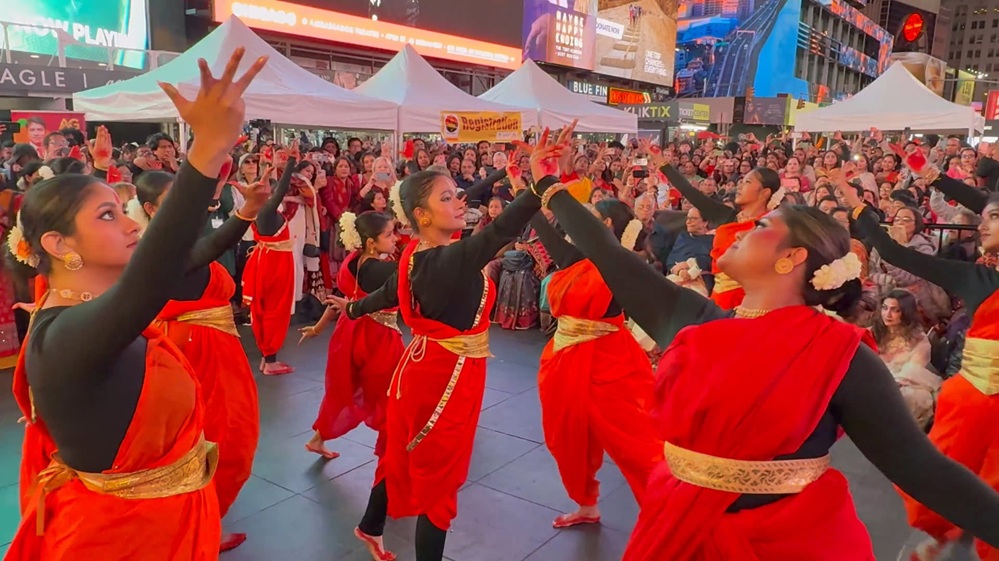
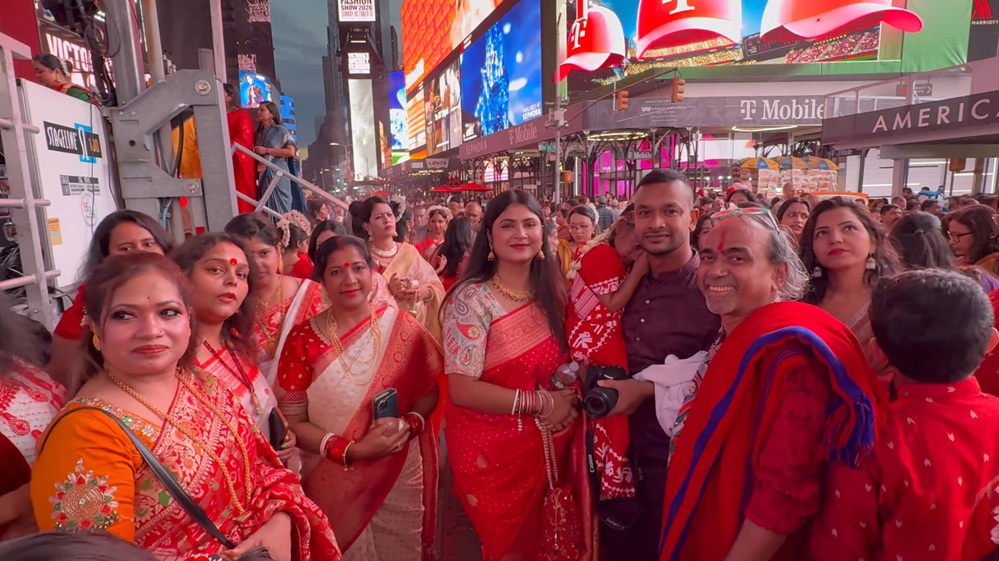
New York Correspondent — The two-day Times Square Durga Utsav 2026 concluded successfully in the heart of New York City, bringing together members of the Bengali diaspora for a vibrant celebration of religious tradition, culture, music, and dance. The festival, held on October 10 and 11, drew enthusiastic participation from the Bengali community despite challenging weather conditions on the second day.
Following the conclusion of the event, the Times Square Durga Utsav Association expressed its heartfelt gratitude to everyone who attended, volunteered, contributed, and supported the celebration.
On Saturday, October 10, thousands of Bengalis gathered at Times Square under bright, sunny skies to celebrate the spirit of Durga Puja. The event transformed the iconic Manhattan destination into a lively gathering place for Bengali culture, devotion, and community spirit. Participants from New York and surrounding areas came together to pay their respects to Goddess Durga and celebrate their cultural heritage far from their ancestral homeland.
The festival provided an opportunity for members of the Bengali diaspora to reconnect with their traditions while sharing their rich cultural identity with the wider public. Weather conditions changed on Sunday, October 11, as rain swept through the area. Despite the unfavorable weather, hundreds of people continued to visit the festival venue to offer their prayers and pay homage to Goddess Durga.
Their presence reflected the deep devotion, enthusiasm, and cultural bonds that unite Bengalis across geographical boundaries. The turnout demonstrated that adverse weather could not dampen the community’s spirit or its connection to one of its most cherished festivals.
The two-day celebration featured religious rituals, prayers, floral offerings, the distribution of prasad, music, dance, and other cultural activities. Through these programs, the organizers sought to showcase Bengali heritage and the traditions of Durga Puja on an international platform. The celebration also served as an opportunity for younger generations of Bengali Americans to connect with their cultural roots.
For many members of the diaspora, the gathering represented more than a religious celebration. It was a moment to strengthen community ties, preserve traditions, and share Bengali culture with people from different backgrounds.
One of the notable highlights of this year’s festival was the recognition of six organizations for their contributions to preserving Bengali culture and the tradition of Durga Puja in the United States. The organizations honored were Bay Area Probashi Incorporated, Bengali Association of Greater Chicago, Bengali Cultural Society, East Coast Durga Puja Association, Kallol, and Pragati.
Their work in maintaining Bengali cultural traditions, promoting community engagement, and passing heritage on to younger generations was recognized as an important contribution to the Bengali diaspora.
In a message following the conclusion of the festival, the Times Square Durga Utsav Association thanked everyone who contributed their time, effort, and support to make the event possible.
The organizers highlighted the enthusiastic participation on the first day and the determination of devotees who attended despite the rain on the second day. They said the community’s love, devotion, and cooperation would remain a source of inspiration for future events.
The association also emphasized that although this year’s celebration had come to an end, the spirit of unity, friendship, and cultural harmony would continue. Organizers expressed their hope of welcoming Goddess Durga again next year with renewed enthusiasm and fresh aspirations.
The Times Square Durga Utsav has become an important occasion for the Bengali community to celebrate its religious traditions and showcase its cultural identity in one of the world’s most recognizable public spaces.
Beyond the religious ceremonies, the event highlighted the importance of preserving Bengali language, heritage, and traditions among communities living abroad. As the 2026 celebration concludes, organizers and participants look forward to returning next year for another gathering centered on devotion, cultural pride, and community solidarity. The Times Square Durga Utsav Association concluded its message by wishing peace, prosperity, and well-being for all and thanking everyone who helped make the festival memorable.
Channel i Celebrates 28th Anniversary in New York
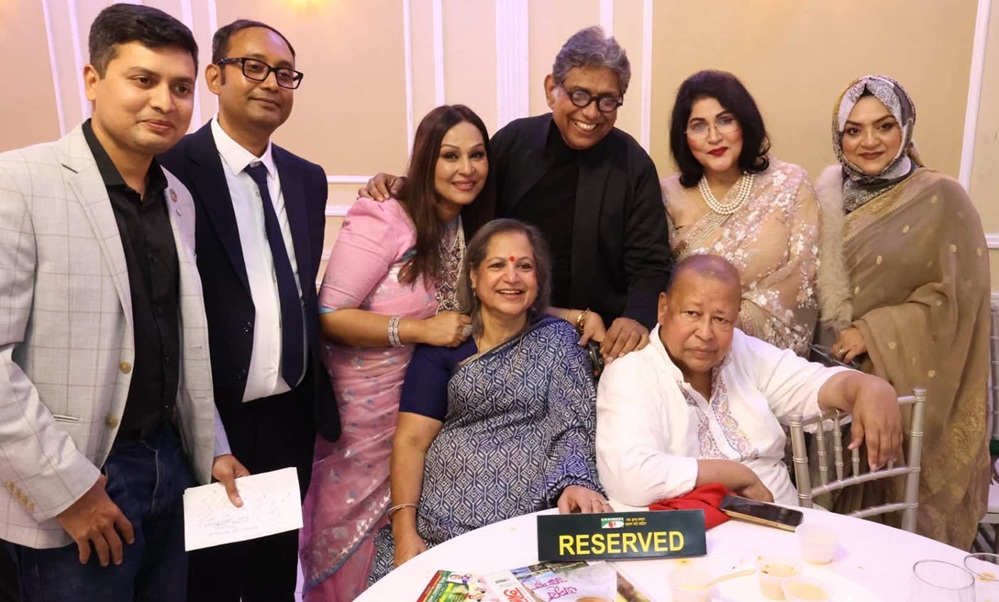
Shibbir Ahmed, New York – Channel i and Impress Telefilm, two prominent names in Bangladesh’s television industry, celebrated their 28th anniversary with a colorful event in New York. The celebration brought together prominent members of the Bangladeshi diaspora for an evening of awards, musical performances and greetings. The event was jointly hosted by Ekushey Padak-winning writer, filmmaker and singer Afzal Hossain and journalist and television presenter Mainul Islam.
One of the highlights of the program was the presentation of awards recognizing contributions to journalism, environmental journalism, and the promotion and expansion of Channel i across North America.
Mainul Islam, special correspondent and presenter at Channel i, was honored for his contributions to journalism. Special correspondent Md. Soumik Ahmed received recognition for his work in environmental journalism, while General Manager Md. Mohiuddin Khan Moin was honored for his role in promoting and expanding Channel i’s presence in North America.
The award ceremony was attended by Faridur Reza Sagar, managing director of Impress Telefilm Limited and Channel i, along with Afzal Hossain, entrepreneur Kona Reza and other distinguished guests.
Speakers emphasized the importance of the media in promoting the Bengali language and culture and showcasing Bangladesh’s heritage abroad. They noted that Bangla-language media serving expatriate communities can help strengthen the connection between younger generations and Bangladesh’s language, culture and traditions. The cultural segment was another major attraction of the evening. Popular actress Moushumi and singer Dinat Jahan Munni delighted the audience with a duet performance.
Other notable attendees included journalist Khalid Mohiuddin, Bangladesh’s Press Minister in Washington, Golam Mortuza, and Anisuzzaman, Bangladesh’s Deputy Consul General in New York. Leaders of the Bangladesh-American Police Association (BAPA), along with artists, businesspeople and guests from various professional backgrounds, also attended the celebration.
The 28th anniversary celebration of Channel i and Impress Telefilm served as a gathering of the Bangladeshi diaspora, highlighting the enduring role of Bengali-language media in preserving cultural identity and strengthening community ties abroad.
NYCFC vs LAFC: 1-1 Draw at Citi Field
NEW YORK: New York City FC and Los Angeles FC played out a 1-1 draw in their Major League Soccer (MLS) clash at Citi Field on Saturday night, leaving both teams with one point as the race for the playoffs intensifies.
LAFC took the lead through Finnish midfielder Leo Walta, who scored from a free kick from around 30 yards in first-half stoppage time. The goal was his first in MLS since joining the Los Angeles club on loan in late August.
NYCFC responded strongly after the break and found the equalizer in the 59th minute. Andrés Perea powered home a header from a corner delivered by Nicolás Fernández Mercau to bring the home side level.
Both teams pushed for a winner in the closing stages, creating a dramatic finish. LAFC forward Son Heung-min came particularly close to scoring in stoppage time, but his shot struck the inside of the post and bounced away.
The draw extended LAFC’s unbeaten run under interim head coach Xavi Tamarit to three matches. The club remained sixth in the Western Conference with 46 points, moving closer to securing a place in the 2026 MLS Cup Playoffs.
For NYCFC, however, the result was another setback in a difficult season. The team continued to struggle for consistency and remained under pressure to collect points in its remaining regular-season fixtures to keep its postseason hopes alive. LAFC will next host its city rival, the LA Galaxy, on October 25, while NYCFC is scheduled to visit Orlando City on October 24.
Enamul and Two Other Bangladeshis Detained in New York
New York: Several Bangladeshis have been detained by U.S. Immigration and Customs Enforcement (ICE) in New York State, raising concern within the expatriate community. Among those detained is Inamul Haque Inam, a familiar face in the Bangladeshi community and a cultural worker. Inam was detained last Wednesday. Since then, acquaintances have said they have been unable to contact him.
Inam came to the United States about 42 years ago. He lived for a long time in Jamaica, New York. Alongside his cultural activities, he was involved in organizing entertainment events. Inam used to bring actors, actresses and singers from Bangladesh to the United States to take part in various events. In the 1990s, artists such as Ferdous Wahid and Kumar Bishwajit visited New York at his invitation.
A few years ago, Inam moved to Virginia. Later, he began living in Buffalo, a city about 400 miles from New York City. Some acquaintances have claimed that despite living in the United States for many years, he was unable to obtain the necessary documents for lawful residence. However, no statement from the relevant authorities has been obtained regarding this claim.
ICE also detained another Bangladeshi businessman in Buffalo about a week ago. The man, known as Babu, owns a Bangladeshi restaurant on Kenmore Avenue. He was originally from the T&T Colony area of Moghbazar in Dhaka. He has not yet been released following his detention, according to people who know him. His restaurant has also closed.
Earlier, Bangladeshi national Zakir Hossain was detained in Buffalo. Although he had a green card, he did not have it with him at the time of his detention. He was subsequently released. These incidents have increased concern among the Bangladeshi community in Buffalo.
A report published on September 1 by Western New York media outlets Buffalo Toronto Public Media (BTPM) and WXXI News said the number of people detained by ICE in Upstate New York had exceeded 600 in July 2026.
An analysis of government data cited in the report also showed that the number of people detained by ICE across New York State had reached approximately 1,500 by the same period. The analysis found that nearly four out of every five people detained in Upstate New York had no criminal history. However, the U.S. Department of Homeland Security disputed the accuracy of the data and analysis.
UN Secretary-General Race Intensifies as Grynspan Leads
Shibbir Ahmed, New York — The race to select the next Secretary-General of the United Nations has entered a decisive phase, with Costa Rica’s Rebeca Grynspan emerging as the narrow frontrunner in the latest informal Security Council poll. However, opposition from permanent members of the Council has left the contest without a clear winner. According to a Reuters report published on October 16, Grynspan secured nine votes marked “encourage,” five marked “discourage” and one “no opinion” in the sixth informal ballot. Crucially, two of the negative votes came from permanent members of the Security Council, whose positions carry decisive weight in the selection process.
The latest poll underscores the diplomatic challenge facing candidates seeking to succeed current Secretary-General António Guterres, whose second term ends on December 31, 2026. No candidate has yet secured the support needed to overcome opposition from the Council’s five permanent members: China, France, Russia, the United Kingdom and the United States.
Alongside Grynspan, Argentina’s Rafael Grossi and Guyana’s Carolyn Rodrigues Birkett remain prominent contenders. Both received eight “encourage” votes and six “discourage” votes in the latest poll, according to reporting by The National. Each also faced opposition from two permanent members.
Grynspan, a former Vice-President of Costa Rica and head of the UN Conference on Trade and Development (UNCTAD), has called for significant reforms to make the world body more effective. In remarks reported by Reuters on October 15, she argued that the UN had become too risk-averse and called for stronger diplomatic engagement, more effective conflict prevention and a review of overlapping responsibilities across UN agencies. If elected, Grynspan would become the first woman to serve as UN Secretary-General since the organisation was founded in 1945.
The Secretary-General is appointed by the General Assembly on the recommendation of the Security Council. Under the established selection procedure, a candidate must obtain at least nine affirmative votes in the 15-member Council and avoid a veto from any of its five permanent members.
The latest ballot therefore does not amount to a final election. Instead, it offers an indication of the candidates’ standing and the diplomatic obstacles that must be overcome before the Council can recommend a nominee to the General Assembly.
The selection process remains open to further diplomatic negotiations and potentially additional candidates. With the end of Guterres’s term approaching, Council members face mounting pressure to reach an agreement in time for an orderly leadership transition.
The leadership contest comes at a time when the UN faces mounting pressure to respond to armed conflicts, humanitarian emergencies, geopolitical divisions and questions about the effectiveness of multilateral institutions. The next Secretary-General will be expected to strengthen the organisation’s ability to mediate conflicts, coordinate humanitarian assistance, advance sustainable development and uphold international law.
For now, Grynspan’s lead in the latest poll has not translated into a clear path to appointment. The decisive question remains whether any candidate can secure sufficient support among Council members while avoiding opposition from the five permanent powers.
NYCFC Face Crucial Playoff Test Against LAFC at Citi Field
Shibbir Ahmed, New York – New York City FC will face Los Angeles Football Club in a crucial Major League Soccer (MLS) regular-season matchup on Saturday, October 17, at Citi Field in Queens, New York, as the home side looks to regain momentum in the race for a playoff place. Kickoff is scheduled for 7:30 p.m. Eastern Time, with the match available to watch on Apple TV. The fixture was originally scheduled for November 4 before being moved to October 17, according to NYCFC’s official schedule announcement.
The match comes at a difficult time for NYCFC, which slipped below the Eastern Conference playoff qualification line following a 2–0 defeat to Inter Miami on Wednesday. With the regular season approaching its conclusion, the club faces mounting pressure to collect points and strengthen its position in the standings. A positive result against LAFC would offer an important opportunity to restore confidence and keep its postseason hopes alive.
LAFC, meanwhile, arrives in New York after earning a 3–1 victory over Austin FC. Denis Bouanga scored twice in that match, reinforcing his importance to the Los Angeles attack. His pace, movement and finishing ability could pose a significant challenge for NYCFC’s defense. The home side will need to limit the space available to Bouanga while maintaining control in midfield if it hopes to contain the visitors’ attacking threat.
The match will take place at Citi Field, located at 41 Seaver Way, Flushing, Queens, New York, NY 11368. Supporters traveling by public transportation can take the No. 7 subway train to Mets–Willets Point station. The Long Island Rail Road’s Port Washington Branch also serves the station. According to the club’s match-day information, shuttle buses will operate from designated parking locations on Long Island, in New Jersey, and in the Bronx and Westchester area. Advance shuttle fares start at $8 per person, while a four-person family package costs $22. These prices cover shuttle transportation only and do not include admission to the match.
NYCFC will also host an Asian American and Pacific Islander (AAPI) Night during the game. The club has announced that the first 10,000 fans entering the stadium will receive a charm bracelet, with early arrival recommended for supporters hoping to receive the giveaway.
Ticket prices may vary depending on seat location, availability, seller and additional fees. Some online resale listings have indicated starting prices of approximately $40 to $51, although those figures should not be treated as guaranteed prices. Fans should check the latest availability and total cost before purchasing through the official Ticketmaster event page or NYCFC’s official match information. Prices and available seating may change as the game approaches.
With playoff implications hanging over the contest, NYCFC will be eager to capitalize on home-field support and avoid losing further ground in the Eastern Conference race. LAFC, on the other hand, will seek to build on its recent victory and maintain its momentum. The outcome could prove significant for both teams as they pursue their respective goals in the closing stages of the MLS regular season.
Flushing Town Hall to Host 12th Annual Diwali Festival Celebrating Indian Wedding Traditions
QUEENS, NY — Flushing Town Hall will celebrate its 12th annual Diwali Festival on Sunday, November 1, with an Indian wedding-themed cultural event featuring traditional Kathak dance, Indian cuisine, live drumming, and interactive arts workshops for families. The festival, titled Diwali Festival: The Indian Wedding, will take place from noon to 4 p.m. at Flushing Town Hall, 137-35 Northern Boulevard in Flushing, Queens. The event will bring Indian wedding traditions to life through live performances and hands-on activities designed to introduce audiences of all ages to South Asian culture. Admission is free for children.
The centerpiece of the festival will be a wedding dance drama presented by Abha B. Roy and the Srijan Dance Company at 2:15 p.m. The performance will showcase traditional Indian wedding customs, including henna application, the haldi ceremony, regional dances, marriage rituals, and the bride’s farewell. A tassa drumming procession will welcome the bridal party, inviting audiences to experience the atmosphere of a traditional Indian wedding.
Throughout the afternoon, visitors can participate in Indian classical and folk dance workshops, explore block printing with Dr. Alka Mukerji, and create colorful rangoli designs with Josh Roychowdhury. Additional activities will include henna art by Bella Beauty and Hindi calligraphy with Jasbir Bhatia.
Food will also be a central part of the celebration. Queens Curry Kitchen will offer Indian food and beverages, while Chef Nupur Arora will demonstrate how to prepare traditional vegetarian Indian dishes.
“Our theme for this year’s Diwali Festival is the Indian Wedding, offering audiences a festive window into one of India’s most cherished cultural traditions,” said Ellen Kodadek, executive and artistic director of Flushing Town Hall.
Kodadek said the festival reflects the organization’s commitment to presenting international arts and creating meaningful cultural experiences for the diverse communities of Queens and the greater New York City area. She also acknowledged the Guru Krupa Foundation for its longstanding support of the annual event.
Diwali, also known as Deepavali, is widely celebrated as the Festival of Lights. Its name comes from a Sanskrit expression meaning “row of lights,” and the holiday symbolizes the triumph of light over darkness, hope over despair, and knowledge over ignorance.
Celebrated by millions of people around the world, Diwali is marked by the lighting of traditional oil lamps, festive gatherings, family activities, and cultural performances. While the festival has deep roots in Hindu traditions, it is also observed by people from different religious and cultural backgrounds.
Gabrielle M. Hamilton, director of education and public programs at Flushing Town Hall, said the Indian wedding theme would allow visitors to experience the vibrant colors, music, dance, and traditions associated with the celebrations.
The festival’s teaching artists will encourage participants to engage directly with Indian art and performance traditions, making the event an opportunity for both cultural discovery and family entertainment.
Roy, artistic director of Srijan Dance Center, has led Flushing Town Hall’s annual Diwali Festival since its inception. A specialist in Kathak, a classical dance form from northern India, she trained under renowned gurus Kundan Lal Gangani and Pandit Durgalal and completed her specialization at Kathak Kendra in New Delhi. She has performed and taught internationally, including appearances at Lincoln Center, Flushing Town Hall, and the Queens Museum.
Arora, founder of Queens Curry Kitchen and author of The Vegan Indian Home, combines her culinary background with a passion for Indian home-style cooking. Mukerji, a professor in the Studio Art Department and director of the Berger & Brownson Art Gallery at Manhattanville University, explores themes of cultural identity, coexistence, social justice, and peace through her artistic practice.
Adult admission is $20, while adult members can purchase tickets for $15. Children will be admitted free. Tickets and additional information are available at https://www.flushingtownhall.org/show-details/diwali-festival-the-indian-wedding.
Flushing Town Hall will continue its international music programming on Saturday, November 14, with GLOBAL MASHUP: Bollywood Meets Hollywood. The concert will bring together musicians from both traditions, blending Bollywood rhythms with Hollywood musical classics and pop anthems. The evening will begin with a dance lesson at 7 p.m., followed by individual performances and a collaborative musical finale.
Flushing Town Hall is a nonprofit cultural institution operated by the Flushing Council on Culture and the Arts. Located in a historic 1862 landmark, the organization presents international and local artists through performances, arts education, and community programs. As a Smithsonian Affiliate and a member of New York City’s Cultural Institutions Group, it promotes cultural exchange and artistic engagement across Queens and beyond. For more information, visit www.flushingtownhall.org or call (718) 463-7700, extension 222.
JFK Airport Protest Against Dr. Yunus Over Bangladesh Politics
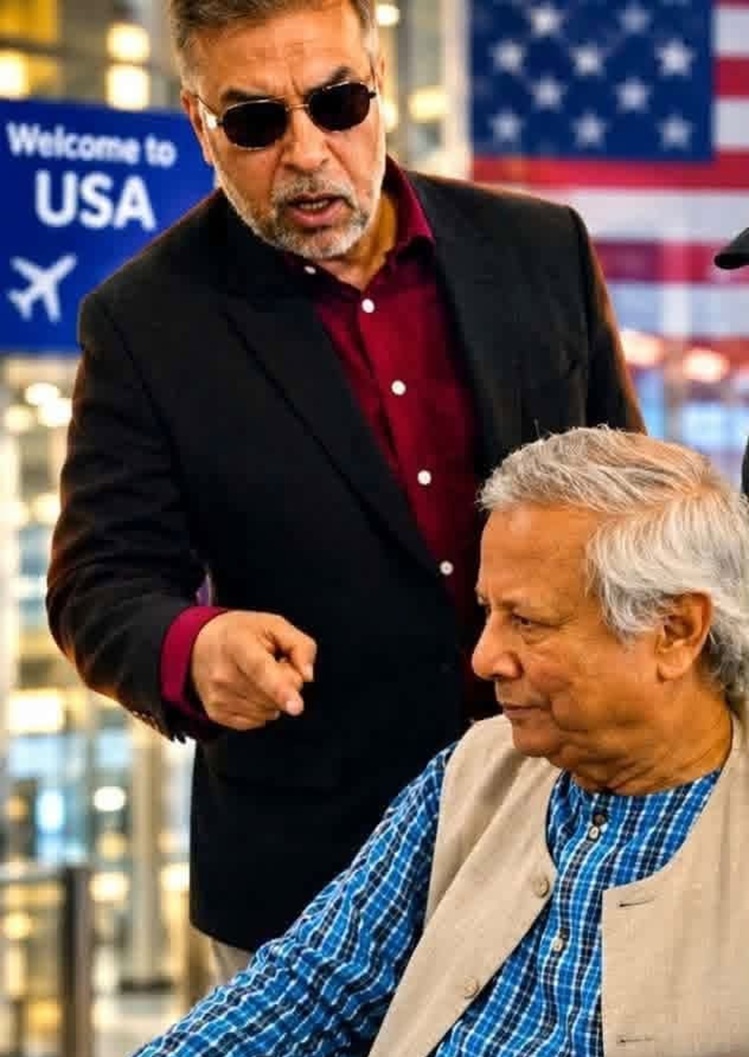
NEW YORK: Activists affiliated with the Awami League have claimed that they staged a protest against Dr. Muhammad Yunus at John F. Kennedy International Airport in New York on October 12, expressing anger over Bangladesh’s political situation and the restrictions imposed on their party’s political activities. In a social media post accompanying a video, the activists claimed that a group led by Imdad Chowdhury, general secretary of the New York Metropolitan Awami League, confronted Yunus at the airport.
According to the post, other participants included Mizan Chowdhury, general secretary of the US Jubo League; Sakhawat Hossain Chanchal, vice president of the New York Metropolitan Awami League; Tanvir Kaisar, general secretary of the Jackson Heights Awami League; and Jubo League leader Sagor.
The post raised several allegations concerning Bangladesh’s political environment, including claims of political repression, mob violence, police killings, attacks on opposition activists, arrests, assaults, killings, torture, and vandalism and looting of homes and businesses. These allegations reflect the protesters’ claims and have not been independently verified in connection with the airport incident.
The activists also expressed anger over the ban on the Awami League’s political activities and questioned the purpose of Yunus’s visit to the United States. According to the social media account, they sought answers from him about Bangladesh’s political situation. The post further claimed that Yunus left the area quickly with his associates without responding to their questions. The circumstances of the encounter could not be independently established from the account provided.
Dr. Muhammad Yunus assumed leadership of Bangladesh’s interim government after Sheikh Hasina’s government fell in August 2024 following a student-led mass uprising. The political transition prompted discussions about democratic reform, accountability, judicial independence, and investigations into alleged human rights violations committed under the previous administration.
At the same time, the interim government faced criticism over political violence, retaliatory attacks, arrests, and law enforcement practices. Following the change of government, cases were filed against numerous Awami League leaders and activists, and several were arrested. Concerns were also raised about alleged politically motivated harassment, arbitrary detention, and the need to uphold due process.
These developments have placed political accountability and human rights protection at the center of Bangladesh’s ongoing political debate. Ensuring justice for past abuses while protecting the legal rights and security of citizens regardless of political affiliation remains a significant challenge.
Imdad Chowdhury confronts Dr. Muhammad Yunus at New York’s JFK International Airport, raising questions about Bangladesh’s political situation and the ban on Awami League activities, according to a social media post accompanying the video.
On May 11, 2025, Yunus’s interim government announced a decision to prohibit all activities of the Awami League under the Anti-Terrorism Act. The government said the measure was taken in the interest of national security while legal proceedings concerning serious allegations against the party were underway. Allegations of involvement in deaths during the 2024 uprising were among the issues cited in the context of the decision.
The Awami League rejected the ban, calling it unacceptable. The decision triggered debate over the party’s ability to conduct public political activities, maintain its organizational structure, and participate in the country’s political process.
The restrictions also raised broader questions about political pluralism, freedom of association, and the distinction between prosecuting individuals accused of crimes and restricting the activities of an entire political organization.
Human Rights Watch’s World Report 2026 raised concerns about arrests under the interim government, including the detention of thousands of people described as political opponents. The report discussed the detention of Awami League leaders, members, and supporters, difficulties in obtaining bail, and the importance of ensuring due process. The broader human rights debate has focused on whether arrests are based on credible evidence and whether detainees receive fair treatment under the law. Human rights advocates have emphasized that allegations of criminal conduct should be investigated individually and adjudicated through independent legal proceedings.
Concerns have also persisted over mob attacks, harassment of political opponents, and obstruction of political meetings and demonstrations. Public humiliation, physical assaults, and organized pressure intended to silence political activity pose challenges to the rule of law and the protection of civil liberties.
In a July 2025 assessment, Human Rights Watch said retaliatory violence and human rights violations had continued following the fall of Sheikh Hasina’s government. The organization cited attacks on Hindu homes in Rangpur and clashes in Gopalganj in which five people were killed. It also expressed concern over the detention of people considered supporters of the Awami League following the Gopalganj violence.
These incidents underscored the risks of political retaliation during periods of transition. Human rights advocates have stressed that allegations against individuals or groups should be addressed through impartial investigations, credible evidence, and fair judicial proceedings rather than collective punishment.
Bangladesh’s political landscape has continued to evolve following the February 2026 national election. As a result, scrutiny of the interim government’s decisions has increasingly intersected with questions about political rights, arrests, and freedom of expression under the current administration.
In an October 5, 2026, report, Human Rights Watch said police took approximately 290 people into custody from a meeting of a left-wing political party in Dhaka. According to the report, authorities alleged that those detained had attended a clandestine meeting of the banned Awami League. The organization also reported that 27 of the detainees were subsequently sent to court custody.
The reported incident renewed concerns about the use of mass detention in cases involving alleged political affiliation or participation in gatherings associated with a banned party. Human rights advocates argue that accountability for abuses committed under previous administrations must go hand in hand with protections against arbitrary detention and politically motivated restrictions under the current government. Political affiliation alone should not determine a person’s right to freedom, a fair hearing, or peaceful political participation.
Bangladesh’s political divisions have also become increasingly visible among expatriate communities in the United States. Political rallies, competing slogans, and allegations of confrontations involving supporters of rival parties have highlighted tensions within the Bangladeshi diaspora, particularly in New York.
The claimed October 12 protest against Yunus at JFK Airport is another example of how developments in Bangladesh continue to shape political activism among expatriate Awami League supporters.
The airport incident also highlights the competing narratives surrounding Bangladesh’s political transition. Supporters of the former ruling party have raised concerns about political exclusion and alleged repression, while the authorities have cited accountability for serious alleged crimes as a justification for restrictions and legal proceedings.
The claims surrounding the airport encounter, however, should be distinguished from independently established facts about the incident and the broader political allegations.
Bangladesh’s political future will depend in part on whether the country can pursue accountability for past human rights violations while safeguarding political freedoms, public safety, and the rule of law. Allegations of crimes should be investigated impartially, with individuals held accountable on the basis of evidence and through fair legal proceedings. At the same time, political identity should not be grounds for collective punishment, arbitrary detention, or violence.
As Bangladesh continues to navigate the consequences of the 2024 political upheaval and the subsequent transition of power, ensuring equal protection under the law and meaningful political participation remains essential to restoring public confidence in democratic institutions.