Trump to Mark 25th Anniversary of 9/11 at Pentagon as White House Hosts ‘Steel Across America’ Tribute

Shibbir Ahmed, WASHINGTON, D.C. — President Donald J. Trump will mark the 25th anniversary of the September 11, 2001, terrorist attacks at the Pentagon on September 11, while Vice President JD Vance is expected to represent the Trump administration at the annual memorial ceremony in New York City. The developments come as the White House prepares for a separate September 8 commemoration featuring a massive piece of World Trade Center steel at the White House.

On September 8, Trump is expected to host 9/11 first responders and other officials as the “Steel Across America” tour arrives in Washington. A 21-foot-long, 16,900-pound steel beam recovered from the South Tower of the World Trade Center will be displayed on the White House Ellipse. Trump and Tunnel to Towers Foundation CEO Frank Siller are expected to speak at the event.

The Tunnel to Towers Foundation launched the nationwide Steel Across America campaign to carry the historic World Trade Center beam through communities across the country ahead of the 25th anniversary of the attacks. The tour is intended to connect Americans with the history of September 11 and honor the victims, first responders and military veterans whose lives were changed by the attacks and their aftermath.

Trump to observe 9/11 at Pentagon

On September 11, Trump will attend the official 9/11 observance at the Pentagon rather than the annual ceremony at the National September 11 Memorial & Museum in Lower Manhattan. Trump confirmed that he would commemorate the anniversary at the Pentagon, one of the three locations directly targeted on September 11, 2001. The president also marked the anniversary at the Pentagon last year.

Vice President JD Vance is expected to attend the memorial ceremony at the World Trade Center site in New York City. The New York ceremony traditionally focuses on the victims and their families and does not feature political speeches. Family members read the names of those killed in the attacks, while moments of silence mark the timeline of the attacks and their aftermath.

The 2026 observance will carry particular significance as the United States marks 25 years since the September 11 attacks, which killed nearly 3,000 people and reshaped U.S. national security and foreign policy for decades.

Trump’s decision to attend the Pentagon rather than the New York ceremony has drawn attention because he is a native New Yorker and had previously been expected to participate in the Ground Zero commemoration. Trump has rejected reports that his decision was related to restrictions on political speeches at the New York memorial.

The three major sites of the September 11 attacks — New York, the Pentagon and Shanksville, Pennsylvania — will all be represented in the nation’s 25th-anniversary commemorations, with administration officials expected to participate in ceremonies across the three locations.

For the Trump administration, the September 8 White House event and the September 11 Pentagon ceremony will provide two separate opportunities to honor the victims, first responders and military personnel connected to the attacks and the wars that followed.



Nepal Floods Highlight Urgent Need for Global Climate Action: GCF Chief

Shibbir Ahmed, United Nations, New York: The devastating floods in Nepal and recent wildfires in Europe should serve as a wake-up call for the world to take more urgent action against the growing risks of climate change, said Mafalda Duarte, Executive Director of the Green Climate Fund (GCF).

In an interview with Agence France-Presse (AFP) in Palau, Duarte said climate change was receiving less urgency in global politics than other major crises. While the international community has demonstrated the ability to mobilise large amounts of funding quickly in response to wars, conflicts and other emergencies, climate-related challenges have not received a similar response, she said.

Duarte warned that the world is moving closer to several climate “tipping points”, beyond which reversing environmental damage could become increasingly difficult or even impossible.

“We can mobilise money quickly when we choose to respond to an emergency,” Duarte said, stressing that climate change should be treated with the same sense of urgency.

She cited Nepal’s recent floods, along with heatwaves and wildfires in Europe, as examples of the increasingly widespread impacts of climate change. According to Duarte, climate-related disasters are no longer confined to developing countries. Both developed and developing nations are increasingly facing the consequences of a changing climate.

Growing Concern Over Nepal Disaster

The recent floods and landslides in Nepal’s Himalayan region have caused extensive destruction and raised fresh concerns about the vulnerability of mountain communities to extreme weather events. The disaster occurred in the Himalayan region near the Nepal-China border, with sudden flows of water and large amounts of debris affecting several areas.

Nepal’s Prime Minister Balendra Shah has also described the disaster as a serious warning about the growing risks associated with climate change and called for stronger international action to support countries vulnerable to climate-related disasters.

Experts say rising global temperatures are contributing to changes in Himalayan glaciers, snow cover and other environmental conditions, potentially increasing the risks of floods, landslides and glacier-related disasters. However, determining the precise contribution of climate change to any individual disaster requires further scientific analysis.

Concerns Over Climate Finance

The Green Climate Fund provides financial support to developing countries for climate adaptation, resilience and efforts to reduce greenhouse-gas emissions. According to the BSS/AFP report, the fund has invested about $19 billion across 134 developing countries.

However, concerns remain over the future of international climate finance. The report said the United States withdrew from the fund in January, while Britain halved its contribution in May. Duarte stressed that climate-vulnerable countries need faster and more accessible financing to prepare for and respond to the growing impacts of climate change.

Pacific Region Sees Increased Investment

Duarte is currently in Palau, where leaders of Pacific island nations are attending their annual summit. For many of these small island states, climate change represents a major threat to their security, economies and long-term survival. The Green Climate Fund has increased its investment in the Pacific region significantly. Over the past three years, its investment there has doubled to around $1 billion.

Duarte acknowledged that accessing climate finance remains difficult for many small island nations. She said efforts were under way to streamline the process, with the average approval period now taking about nine months.

Tina Stege, the climate envoy of the Marshall Islands, has also called for faster and more tangible progress on climate finance. She expressed frustration over the limited funding available through the separate United Nations-backed “loss and damage” mechanism, which is intended to help vulnerable developing countries address the impacts of climate-related disasters.

Duarte said there was still time to act on climate change, but the window for effective action was narrowing. She urged governments and the international community to move faster, increase climate financing and work together to address the growing risks posed by a warming planet.


Moyeen Seeks Stronger World Bank Support for Bangladesh Development

DHAKA – LGRD and Cooperatives Minister Dr Abdul Moyeen Khan has expressed hope that the World Bank will further strengthen its support for the country’s sustainable development and improvement of people’s quality of life. He said various government initiatives are underway in important areas such as water supply, sanitation, rural development and addressing the impacts of climate change.

Continued support from development partners is necessary to make these activities more effective and sustainable, he said when World Bank Division Director for Bangladesh and Bhutan Jean Pesme paid a courtesy call on him at his office at the Secretariat today.

Various issues including the World Bank’s support for various ongoing development projects in Bangladesh, water supply and sanitation systems, rural development, climate change and local government sector were discussed.

The minister said the government and development partners need to work in coordination to accelerate and sustain the country’s development activities. He said WB support could play an important role in strengthening the capacity of the local government sector and ensuring quality civic services reach people at their doorsteps.

The minister expressed gratitude for the World Bank’s longstanding support for Bangladesh’s development journey and hoped that the bank would continue its support for the country’s key development initiatives in the future.

During the exchange of views, emphasis was placed on further strengthening the existing cooperation between Bangladesh and the World Bank. LGD Md Shahidul Hassan, senior officials from the ministry and the WB were present at the meeting.


President Urges US to Simplify Visa Processing for Bangladeshis

DHAKA – President Mirza Fakhrul Islam Alamgir today urged the United States to simplify its visa processing procedures for Bangladeshi tourists and business people to facilitate people-to-people and business ties between the two countries. The President made the call when US ambassador to Bangladesh Brent T Christenen paid a courtesy call on him at Bangabhaban this morning.

During the meeting, the US envoy congratulated the President on his assumption of office as the President of Bangladesh. Recalling the past US investment and cooperation in the country’s agricultural development, the President called for further US investment and cooperation in the country’s development sector.

He also referred to Chevron’s investment and important role in the development of the country’s energy sector and urged increased US investment in Bangladesh’s energy, information technology, infrastructure, and health and high-tech industries sectors. The President also sought US cooperation in ensuring the safe, dignified and sustainable repatriation of the Rohingyas to their homeland.

Thanking the US ambassador, the President said, “The United States is one of the Bangladesh’s important development partners. The existing trade relations with the US are playing an important role in Bangladesh’s economic development.”

On international relations, the President said, “Bangladesh attaches the highest importance to the principles of independence, sovereignty, national interest, mutual respect and equality in its international relations.”

He expressed the hope that bilateral relations and trade agreements with the United States would be further expanded in the days to come through mutual respect while protecting common interests. Referring to the recent bilateral trade agreements with US, the President said, “This is an important development in expanding the trade relations between the two countries.”

“There is a scope to make the agreement more balanced and mutually beneficial, taking into consideration the economic realities and interests of both the countries,” he added.

The ambassador assured that the US would continue its cooperation with Bangladesh and stressed the importance of strengthening cooperation with ASEAN countries. He also reiterated his US’s interest in further deepening and diversifying relations with Bangladesh. Military secretary to the President and Press Secretary and senior officials were present during the meeting.


Nearly 600,000 Jobs at Risk in Bangladesh: World Bank

Shibbir Ahmed, Washington DC: Nearly 600,000 jobs in Bangladesh could be at risk if the economic fallout from the ongoing Middle East conflict persists, according to a World Bank assessment. The warning comes as Bangladesh faces rising fuel prices, severe gas shortages, disruptions to fertilizer production and growing pressure on industries and household incomes.

The World Bank’s mid-June assessment, prepared as part of a proposed Contingent Emergency Response Project, said the conflict could significantly weaken Bangladesh’s economic recovery and slow the pace of poverty reduction.

The assessment estimates that the number of people expected to move out of poverty in 2026 could fall from around 1.7 million to about 500,000 because of the conflict. Bangladesh had already been facing rising poverty. The World Bank estimated that the number of poor people increased by about 1.4 million in 2025, as weak job creation, slow growth in labor incomes and persistent inflation reduced the poverty-reducing impact of economic growth.

Energy crisis adds to pressure

The energy sector is among the areas most severely affected. Natural gas accounts for more than half of Bangladesh’s primary energy supply, while domestic gas production has fallen significantly from its 2016 peak. The country also relies heavily on the Middle East for imported energy, sourcing about 60–65% of its crude oil and 55–60% of its LNG from the region.

The conflict has disrupted LNG supplies, with five of Petrobangla’s six LNG supply contracts reportedly placed under force majeure. Spot LNG prices have risen to around $24–$28 per million British thermal units (MMBtu), more than double their previous level.

Higher energy costs are also expected to put additional pressure on inflation. The World Bank assessment said that passing higher energy prices on to consumers could increase inflation by more than 0.5 percentage points, with further effects on food and non-food prices.

Fertilizer production disrupted

Bangladesh’s agriculture sector is also vulnerable to the crisis. Gas shortages have forced five of the country’s six domestic urea fertilizer plants to suspend production, while international urea prices have increased by around 30%. The World Bank warned that fertilizer prices could potentially rise much further if the disruption continues, increasing production costs for farmers and putting additional pressure on food prices.

Smallholder farmers, who represent a significant share of Bangladesh’s population, could be particularly exposed to higher input costs and supply disruptions.

Industries and workers under pressure

The energy crisis is also affecting industrial activity. Factory operating hours, production and new industrial gas connections have reportedly been affected, while some businesses have faced rising operating costs.

The World Bank’s projection of nearly 600,000 jobs at risk reflects the broader economic consequences of higher energy costs, supply disruptions, weaker production and inflation. Economists have also pointed to signs of the crisis already appearing in the labor market, including factory closures, reduced working hours and job losses.

Government finances face additional strain

The crisis could also increase pressure on Bangladesh’s public finances. Higher energy subsidies could substantially increase government expenditure, potentially reducing the fiscal space available for social protection and emergency programs, according to the World Bank assessment.

The World Bank has already approved $1.1 billion in emergency financing for Bangladesh to help protect food security, support vulnerable households and businesses, and address volatility in global fertilizer and fuel markets.

Risk, not a confirmed job-loss figure

The World Bank’s figure of nearly 600,000 should be understood as a projection of potential job losses if the crisis continues, rather than a confirmed number of workers who will definitely lose their jobs.

The final impact will depend on how long the Middle East conflict lasts, global energy and fertilizer prices, supply conditions and Bangladesh’s ability to manage the economic shock. For Bangladesh, however, the warning highlights the vulnerability of an economy already struggling with inflation, weak job creation and limited fiscal space.

Source: World Bank assessment on Bangladesh’s proposed Contingent Emergency Response Project.


US House Passes Funding Bill 370–48 to Avert Government Shutdown

Shibbir Ahmed, Washington, D.C.: The United States House of Representatives has taken a major step to avert a potential government shutdown, overwhelmingly passing a short-term federal funding bill on Tuesday.

The measure passed by a vote of 370–48 and would keep the federal government funded through December 11, 2026. The bill has now been sent to President Donald Trump for his signature. The Senate had already approved the measure on August 8.

The vote came as Congress has yet to complete the full set of spending legislation needed to fund the federal government for fiscal year 2027. The new fiscal year begins on October 1. With lawmakers unable to complete the 12 regular appropriations bills, Congress turned to a temporary funding measure to prevent federal agencies from running out of money at the start of the new fiscal year.

The House vote received strong bipartisan support. According to the official House Clerk’s voting record, 193 Republicans, 176 Democrats and one Independent voted in favor of the measure. Nineteen Republicans and 29 Democrats voted against it, while 14 members did not vote.

The legislation, H.R. 6500, is a continuing appropriations measure designed to maintain federal government funding on a temporary basis. By extending current funding through December 11, it removes the immediate threat of a shutdown that otherwise could have begun when existing funding expires on October 1.

The Senate passed the measure on August 8. Following Tuesday’s House approval, the legislation was sent to President Trump. Once signed, it will become law and provide temporary funding for federal operations through December 11.

However, Tuesday’s vote does not resolve the broader budget dispute facing Washington. Instead, it postpones the most difficult funding decisions until later in the year. Congress will still need to negotiate and approve the full set of appropriations measures for fiscal year 2027 before the December 11 deadline.

The timing of the agreement also carries significant political implications. The United States is scheduled to hold its midterm elections on November 3, and lawmakers from both parties have a strong incentive to avoid a government shutdown during the final weeks of the campaign. A shutdown could disrupt federal services, affect government workers and create additional political pressure ahead of the elections.

The temporary funding agreement therefore allows Congress to move the broader budget confrontation beyond the November elections. Lawmakers will have additional time to negotiate the government’s full-year spending plans after the election.

The bill also contains funding provisions for specific areas. Among them is $1.2 billion in additional funding related to the continued construction of Virginia-class and Columbia-class submarines, according to information released by congressional lawmakers.

Despite the overwhelming bipartisan vote, disagreements between Republicans and Democrats over federal spending and policy priorities remain unresolved. Some Republicans opposed the measure over policy concerns, while Democrats have also criticized aspects of the administration’s spending and policy agenda.

Nevertheless, Tuesday’s vote represents a significant bipartisan effort to keep the federal government operating and prevent an immediate shutdown.

For now, Washington has avoided another shutdown crisis. But the underlying budget battle has not gone away. As the December 11 deadline approaches, Congress will once again face the question of whether it can reach agreement on the full fiscal year 2027 spending bills—or whether the United States will once again face the threat of a government shutdown.


‘1945 World Order No Longer Reflects Reality’: Guterres Calls for UN Reform

Shibbir Ahmed | United Nations, New York — United Nations Secretary-General António Guterres has called for sweeping reforms to global institutions, arguing that the international system must adapt to a rapidly changing, increasingly multipolar world.

Addressing the Shanghai Cooperation Organization (SCO) summit in Bishkek on Tuesday, Guterres said global power relations were changing while many multilateral institutions continued to reflect the geopolitical realities of 1945.

“We must reform our multilateral institutions, including the United Nations and the Bretton Woods system, to reflect today’s realities,” Guterres said, calling for greater representation and influence for developing countries in order to build a fairer global order.

Guterres said the world was becoming increasingly multipolar and argued that the trend should be strengthened.

“Multipolarity is a condition for justice in global governance and international relations,” he said, describing it as a foundation for effective multilateralism and a United Nations that serves all countries without double standards.

The UN chief has repeatedly called for reforms to the Security Council and other international institutions to make them more representative of the current distribution of global power.

His remarks in Bishkek also highlighted four areas for stronger international cooperation: global security, development financing, climate action and governance of artificial intelligence.

Guterres’ call comes amid growing geopolitical tensions, conflicts and disputes over the effectiveness of existing international institutions. His message was clear: as global power shifts, the institutions governing international affairs must change with it.


U.S. Plans Weekly Sanctions on Iran as Military Tensions Escalate

Shibbir Ahmed, WASHINGTON DC — The United States is preparing to intensify economic pressure on Iran with a new campaign of weekly secondary sanctions, Treasury Secretary Scott Bessent said Monday, as military tensions between Washington and Tehran sharply escalated.

Bessent told Reuters that the U.S. Treasury Department is expected to announce new secondary sanctions every week, beginning with measures targeting banks and financial institutions that help Iran maintain access to international markets.

The planned measures are designed to further restrict Iran’s access to the global financial system and increase pressure on institutions and countries that continue doing business with Tehran. The announcement comes as the United States and Iran have entered their most serious period of renewed hostilities in weeks.

U.S. forces struck two Iranian launchers on Larak Island on Sunday after American forces identified what U.S. officials said were preparations by Iran’s Islamic Revolutionary Guard Corps to launch rockets carrying sea mines into the Strait of Hormuz.

Iran responded by launching missiles toward U.S. military bases in Jordan, according to U.S. and Iranian officials. The attacks marked the first direct exchange of fire between the two sides in about a month. President Donald Trump on Monday warned that the United States would respond forcefully to Iran’s attacks. The latest escalation has raised concerns about a wider regional conflict, particularly because of the strategic importance of the Strait of Hormuz, a critical route for global oil shipments.

Financial Pressure on Iran

The planned sanctions would expand the use of so-called secondary sanctions, which can penalize foreign companies, banks and other institutions that conduct certain business with Iran even when those entities are not based in the United States.

Bessent said the campaign would initially focus on banks and could increasingly target institutions that help Iran move money through the international financial system. The Treasury secretary’s announcement represents a further expansion of the administration’s economic campaign against Tehran.

The United States has already broadened the range of Iranian economic activities that could expose foreign businesses to secondary sanctions, including sectors such as digital assets, gold, technology, aviation and shipping.

Last week, the Treasury Department launched what it described as an unprecedented campaign against Iranian financial networks, targeting channels used by Tehran to generate revenue, evade sanctions and finance activities opposed by Washington.

Military Tensions Add to Economic Pressure

The new sanctions strategy comes as diplomatic and military tensions continue to worsen. The U.S. military said its strike on Larak Island was aimed at preventing Iran from deploying sea mines in the Strait of Hormuz. Iran has rejected the U.S. justification and warned that it would respond to further attacks.

Following the Iranian missile launches toward U.S. forces in Jordan, Trump said the United States would respond strongly. Reuters reported that the exchange of attacks represents a renewed escalation after a period in which the two sides had avoided direct military confrontation.

The conflict has also affected global energy markets. Brent crude oil futures settled more than 2.5% higher on Monday after the latest U.S.-Iran military exchanges, reflecting renewed concerns over the security of oil shipments through the Strait of Hormuz.

Pressure on Iran’s Financial Lifelines

The Trump administration has increasingly focused on Iran’s financial networks as part of its broader strategy to weaken Tehran’s ability to fund its government, military and regional activities.

The planned weekly sanctions would represent a significant escalation because foreign financial institutions could face increasing pressure to choose between maintaining business relationships with Iran and retaining access to the U.S.-dominated international financial system.

For Iran, the measures could further complicate access to foreign currency, international banking services and overseas trade. For the United States and its allies, however, the strategy carries its own risks, particularly if increased economic pressure contributes to further military escalation or disruption of global energy supplies.

With the United States preparing additional sanctions and military tensions rising, the coming days could determine whether the latest confrontation remains limited or develops into a broader regional crisis.


Trump Announces Drug-Price Deals With 9 More Pharmaceutical Companies

Shibbir Ahmed, WASHINGTON DC — President Donald Trump on Monday announced new agreements with nine pharmaceutical manufacturers aimed at lowering prescription drug prices for Americans, expanding his administration’s effort to tie U.S. drug prices to the lower prices paid in other developed countries.

The White House said the agreements bring the total number of pharmaceutical manufacturers participating in the administration’s Most-Favored-Nation (MFN) drug-pricing program to 26, covering about 89% of the branded-drug market.

The nine companies joining the latest agreements are Alcon, Astellas Pharma, BeOne Medicines, BridgeBio, CSL, Kyowa Kirin, Sun Pharma, Teva Pharmaceuticals and UCB.

Under the agreements, the companies will provide MFN pricing to state Medicaid programs across the United States on eligible medicines. The White House said the deals cover drugs used to treat a range of serious and chronic conditions, including hemophilia, Parkinson’s disease, macular degeneration, glaucoma, liver disease, skin conditions and cancer.

The administration’s MFN strategy seeks to align prices paid in the United States with the lowest prices paid by comparable developed nations.

$19.6 Billion U.S. Manufacturing Investment

The new agreements also include commitments to strengthen pharmaceutical manufacturing in the United States. According to the White House, the nine companies have collectively committed to invest at least $19.6 billion in U.S. manufacturing in the near term.

Several companies have additionally agreed to provide active pharmaceutical ingredients to the federal government’s Strategic Active Pharmaceutical Ingredients Reserve, which is intended to strengthen domestic pharmaceutical supply chains and reduce dependence on foreign sources.

UCB, for example, will contribute 163 tons of levetiracetam, a drug used to control and prevent seizures. Sun Pharma will contribute supplies of the antibiotics clindamycin and doxycycline, while Teva will provide metronidazole and amlodipine. Astellas will contribute tacrolimus, an immunosuppressant used to help prevent organ rejection following transplants.

Administration Projects Major Savings

The White House says patients have already saved more than $700 million through TrumpRx, the administration’s prescription-drug discount platform, since its launch in February.

The administration also says more than 500,000 seniors have saved a combined $216 million since July through a program offering certain GLP-1 obesity medicines for $50 a month to seniors without coverage for those drugs.

The White House’s Council of Economic Advisers estimates that the administration’s broader MFN agreements could generate approximately $600 billion in savings over the next decade. That figure is an administration estimate rather than an independently verified projection.

Part of Trump’s Broader Drug-Pricing Push

Trump ordered his administration in May 2025 to pursue Most-Favored-Nation pricing for prescription medicines, seeking to bring U.S. prices closer to those paid in other developed countries.

The administration subsequently reached agreements with major pharmaceutical manufacturers, including Pfizer, AstraZeneca, Eli Lilly, Novo Nordisk, Amgen, Bristol Myers Squibb, Merck, Novartis, Sanofi and others.

Trump launched TrumpRx.gov in February 2026 as part of the administration’s effort to make lower-priced medicines available directly to American consumers through participating manufacturers and pharmacies.

Reuters reported Monday that the latest agreements include a mix of international pharmaceutical companies and smaller biotechnology firms, expanding the program beyond the large drugmakers that participated in earlier rounds.

The new agreements come as prescription-drug affordability remains a major issue for American consumers and as the Trump administration prepares for the November midterm elections.

The White House is also calling on Congress to advance what it describes as the “Great Healthcare Plan,” which the administration says would seek to lower drug prices and insurance premiums while increasing price transparency.

For Americans, the practical impact of Monday’s agreements will depend on which medicines receive the new pricing arrangements, when the lower prices take effect and how the discounts are implemented through Medicaid and participating drug programs. The White House announcement marks the latest and one of the largest expansions of Trump’s MFN drug-pricing initiative since it began in 2025.


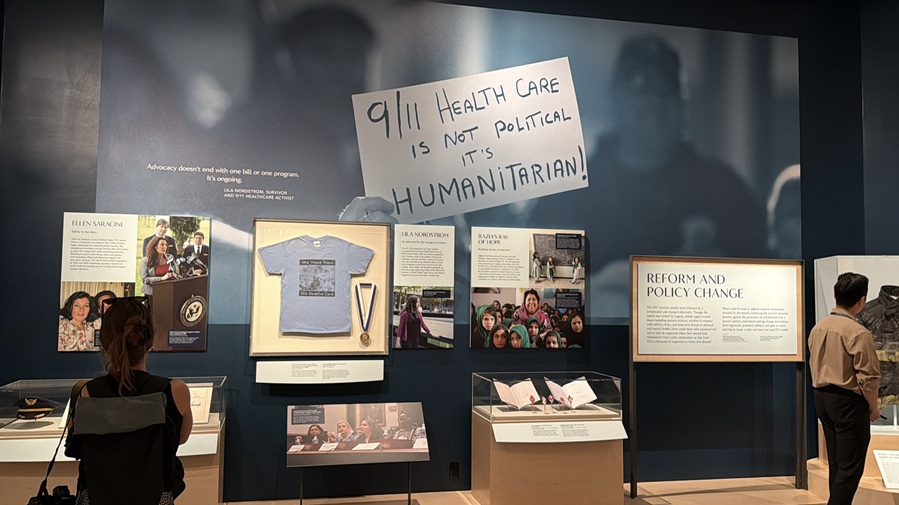
9/11 at 25: New ‘In Their Honor’ Exhibition Unveiled in New York

Shibbir Ahmed, NEW YORK — The 9/11 Memorial & Museum on 31St August Monday unveiled a new exhibition highlighting the enduring legacy of service inspired by the September 11 attacks, as New York prepares to mark the 25th anniversary of the tragedy. Titled “In Their Honor: 25 Years of 9/11-Inspired Service,” the exhibition offers a look at how individuals and communities transformed the aftermath of the attacks into acts of service and public commitment.

The exhibition was previewed for members of the media during a briefing at the 9/11 Memorial & Museum in Lower Manhattan. It will open to the public on September 12, 2026, one day after the 25th anniversary of the attacks.

The afternoon program began with remarks from Beth Hillman, President and CEO of the 9/11 Memorial & Museum, followed by comments from 9/11 family member Logan Miller and Noah Rauch, Senior Vice President of Education and Public Programming.

The museum’s new exhibition comes as New York and the nation prepare for a major commemoration of the nearly 3,000 people killed in the September 11, 2001 terrorist attacks. The exhibition focuses on the continuing impact of September 11 beyond the immediate loss of life, emphasizing the service and civic engagement that emerged in the years following the attacks.

Museum officials said the exhibition explores the ways people responded to the attacks through service, volunteering and efforts to help others, demonstrating how the legacy of September 11 continues to shape communities a quarter-century later.

Monday’s media program also included a guided preview of the exhibition, giving journalists an early look before its public opening. The museum is also preparing for the 25th-anniversary commemoration on September 11, which will bring families of victims, survivors, first responders and government and community leaders together at the World Trade Center site.

As the anniversary approaches, the museum’s programming is placing particular emphasis not only on remembering those who were killed, but also on the long-term consequences of the attacks and the continuing acts of service inspired by their memory.

The 25th anniversary will mark a quarter-century since the attacks on the World Trade Center, the Pentagon and United Airlines Flight 93. For many families and survivors, the anniversary remains both a day of remembrance and an opportunity to reflect on how the events of September 11 have shaped the lives of subsequent generations. The “In Their Honor” exhibition will open to visitors at the 9/11 Memorial & Museum on September 12.