Why the UN General Assembly Still Matters

Shibbir Ahmed, New York — The United Nations General Assembly remains a central forum for international diplomacy, providing all 193 UN member states with a platform to debate global issues ranging from war and peace to development, climate change and human rights. In an interview with UN News, Richard Gowan, Director of UN and Multilateral Diplomacy at the International Crisis Group, discussed the Assembly’s changing role and its importance in global affairs ahead of the UN General Assembly’s high-level week.

Gowan said the UN’s founders initially expected the Security Council to be the main center of decision-making. However, divisions among the major powers quickly shifted many political discussions toward the General Assembly. During the early years of the UN, the Assembly played a significant role in debates over Palestine and Korea while the Security Council was frequently affected by Cold War divisions.

One major test came in 1956, when the Suez crisis and the Soviet intervention in Hungary unfolded simultaneously. According to Gowan, the General Assembly authorized the first UN peacekeeping operation in response to the Suez crisis, marking an important moment in the Assembly’s role in international crisis management.

A platform for newly independent states

The expansion of UN membership during the 1960s transformed the General Assembly. Newly independent countries used the forum to raise issues including apartheid in South Africa and remaining colonial conflicts.

Gowan said the Assembly became an important platform for countries emerging from colonial rule to make their voices heard internationally. During the 1960s, the Assembly adopted a series of resolutions condemning apartheid, while its debates increasingly reflected the growing influence of countries from what is now commonly called the Global South.

Developing countries also used the Assembly to challenge what they regarded as an unfair international economic system. In 1974, the General Assembly adopted a resolution calling for a new international economic order intended to provide a fairer system for developing countries.

Gowan said the Assembly gave countries emerging from colonialism a major platform to assert themselves on the world stage. He also argued that the international campaign against apartheid contributed to the eventual end of apartheid in South Africa, while acknowledging that efforts to establish a new international economic order did not achieve their intended outcome.

Post-Cold War cooperation

Following the end of the Cold War, diplomats were able to cooperate more closely on strengthening the UN system. Gowan pointed to the creation of the Peacebuilding Commission in 2005 as an example of initiatives developed through cooperation between member states and the UN Secretariat and subsequently approved by the General Assembly.

The global financial crisis of 2008–2009 presented another challenge. Gowan said many UN members expected the organization to respond, while the United States and other major economies instead worked through the G20. At the same time, discussions on environmental protection and efforts to address global environmental challenges gained greater prominence within the UN system.

A voice for smaller countries

Gowan said the General Assembly remains particularly important for small countries and middle powers, which often have fewer opportunities to influence international affairs through smaller diplomatic groupings. He noted that despite frequent discussion about the UN’s future, large numbers of world leaders continue to travel to New York every September to address the General Assembly.

He also emphasized the significance of keeping the Assembly at UN Headquarters in New York, describing the location as an important center for global diplomacy and international media attention.


Security Council Meets on United Nations Peacekeeping Operations

Shibbir Ahmed, New York — The United Nations Security Council met on September 18 to discuss the future of United Nations peacekeeping operations amid increasingly complex conflicts and growing challenges facing peace missions around the world. The meeting, the Council’s 10,226th, focused on the changing nature of UN peace operations and the need to ensure that missions remain effective, adaptable and capable of responding to evolving security threats. The meeting was formally listed as “United Nations peacekeeping operations.”

UN Secretary-General António Guterres told the Council that many UN peacekeeping missions are now operating in environments where peace remains elusive. He called for greater emphasis on peacemaking and for peace operations to adapt to the realities of modern conflicts.

The discussion comes as the United Nations undertakes a broader review of the future of all forms of peace operations. The review, led jointly by the Department of Peace Operations and the Department of Political and Peacebuilding Affairs, was submitted to the General Assembly and Security Council in August 2026.

According to the UN, today’s conflicts are increasingly protracted and internationalized, while peace agreements are becoming harder to achieve. Peace missions also face emerging challenges including the increased use of drones, advanced weapons technologies, threats to civilians and civilian infrastructure, and the involvement of a wider range of state and non-state actors.

The United Kingdom said peace operations must remain adaptable, effective and suited to the challenges they face. In a statement to the Council, UK Deputy Permanent Representative Kate Foster said Britain was prepared to work with the United Nations to strengthen the effectiveness of peace operations.

Pakistan’s Permanent Representative to the United Nations, Asim Iftikhar Ahmad, also addressed the Council, highlighting Pakistan’s longstanding contribution to UN peacekeeping. Pakistan has been among the major contributors of troops and personnel to UN peacekeeping missions for decades.

The Council’s discussion comes at a critical time for several UN missions. In Lebanon, for example, the UN Interim Force in Lebanon (UNIFIL) is preparing for a scheduled withdrawal by the end of 2026, with UN officials stressing the importance of a smooth transition and continued coordination with Lebanese authorities and other UN agencies.

The Security Council’s September 18 meeting formed part of its September programme of work, during which members also addressed issues including Sudan, Afghanistan, the Middle East, terrorism and non-proliferation.

The broader debate is expected to continue as UN member states consider how peace operations can become more focused, flexible and responsive while maintaining their mandates to support peace and security.


Tarique to Highlight Democracy, Rohingya Crisis at UNGA

DHAKA — Prime Minister Tarique Rahman is set to highlight Bangladesh’s renewed democratic journey and its positions on major global challenges when he addresses the 81st session of the United Nations General Assembly on September 24, Foreign Secretary Asad Alam Siam said Sunday. The prime minister will leave Dhaka for New York on Monday for the high-level UNGA proceedings. According to the Foreign Secretary, his maiden address to the General Assembly as prime minister will outline the government’s vision for Bangladesh and its approach to key regional and international issues.

At a press conference at the Ministry of Foreign Affairs, Siam said Tarique’s speech would cover Bangladesh’s democratic transition, the rule of law and accountability, global peace and security, climate change, sustainable development and economic cooperation.

The prime minister is also expected to address youth and women’s empowerment, education and health, the Rohingya crisis, equitable access to modern technology and reform of the multilateral system. The speech will be Tarique Rahman’s first appearance at the General Assembly as Bangladesh’s prime minister. It will also mark the first UNGA participation of the incumbent government, according to the Foreign Secretary.

Rohingya crisis to feature prominently

The protracted Rohingya crisis is expected to be a major focus of Bangladesh’s diplomatic engagement in New York. Tarique is scheduled to attend a Bangladesh-hosted side event on the Rohingya issue on September 23, where he is expected to seek stronger international cooperation toward the repatriation of Rohingyas who fled to Bangladesh from Myanmar.

Siam said Bangladesh would again use the gathering of world leaders to draw attention to the scale of the crisis, the challenges it poses and the international assistance required to address it. Bangladesh has consistently called for the safe, voluntary, dignified and sustainable return of Rohingyas to Myanmar as a lasting solution to the crisis.

Climate change and sea-level rise

Climate change will also be a prominent issue during the prime minister’s UN engagements. On September 23, Tarique is scheduled to participate in a high-level meeting on “Climate Action and the Just Transition,” convened at the initiative of the UN secretary-general. The following day, he will deliver opening remarks at a high-level meeting addressing the existential threats posed by sea-level rise.

At the climate-related meetings, Bangladesh is expected to emphasize the priorities of climate-vulnerable countries, including climate finance, adaptation, technology transfer, loss and damage, and climate justice.

Global inequality and maternal health

Tarique will also participate in a high-level meeting focused on tackling the global inequality crisis, jointly organized by Brazil, South Africa, Norway and Spain. A Bangladesh-hosted side event on maternal and newborn health and midwifery is also scheduled for September 24. The prime minister is expected to discuss government initiatives on maternal and child health and the importance of skilled and professionally trained midwives.

Bilateral meetings

Alongside the UNGA program, Tarique is scheduled to hold bilateral meetings with the Crown Prince of Kuwait and the prime ministers of Croatia, Bhutan, Thailand, Pakistan and Haiti. According to the Foreign Secretary, the discussions are expected to cover political and economic relations, trade and investment, development cooperation, the Rohingya crisis and other issues of mutual interest.

The prime minister is also scheduled to meet UN Secretary-General António Guterres, the president of the European Council, the president of the World Bank Group, the UN secretary-general’s special envoy on Myanmar, and the UN high commissioners for refugees and human rights. He is also expected to meet the president of the International Peace Institute.

Economic diplomacy

Tarique’s New York visit will also include an economic diplomacy component, with meetings planned with senior representatives of Meta, Wall Street and other business organizations. The discussions are expected to focus on Bangladesh’s investment climate, manufacturing, infrastructure and technology, human-resource and skills development, and employment opportunities for young people.

The prime minister is scheduled to leave New York for Dhaka on September 25 after completing his official engagements. The Foreign Secretary said the visit would provide an opportunity for Bangladesh to present its priorities to the international community and strengthen bilateral and multilateral cooperation.

Bangladesh will be presiding over the 81st UN General Assembly this year, with Foreign Minister Khalilur Rahman serving as president of the 193-member General Assembly for its one-year term.


US-China Talks in New York Target AI, Trade and Critical Minerals

Shibbir Ahmed, New York — The United States and China opened high-level economic talks in New York on Sunday, with artificial intelligence, trade, tariffs and critical minerals on the agenda as Washington and Beijing prepare for a summit between President Donald Trump and Chinese President Xi Jinping later this week.

U.S. Treasury Secretary Scott Bessent and Chinese Vice Premier He Lifeng are meeting at JPMorgan Chase’s headquarters in Manhattan, alongside U.S. Trade Representative Jamieson Greer. The talks were scheduled to begin at about 10:30 a.m. ET and were expected to continue throughout the day. The discussions are intended to prepare potential agreements and reduce outstanding differences ahead of the Trump-Xi summit scheduled for Sept. 24 in Washington.

Trade truce and tariffs

A central issue is the status of the current U.S.-China trade truce, which is scheduled to expire on Nov. 10. Officials are expected to discuss tariffs on non-strategic goods, market access and China’s commitments to increase purchases of U.S. agricultural products. Issues left unresolved from Trump’s May meeting with Xi in Beijing are also expected to remain part of the negotiations. The talks come as both countries seek to manage a trade relationship that has significant implications for global markets and supply chains.

Critical minerals and rare-earth supplies

Critical minerals and Chinese rare-earth magnets are another major issue in the New York discussions. The United States has raised concerns about the flow of rare-earth magnets and other critical materials needed for advanced manufacturing and technology industries. Rare earths are particularly important to the production of components used in electronics and advanced semiconductor technologies. Washington is seeking greater reliability in these supply chains as the two countries negotiate broader economic arrangements.

AI takes center stage

Artificial intelligence is emerging as a new area of U.S.-China economic and strategic competition. Bessent said the discussions are expected to cover both open-weight and closed-weight AI models. Open-weight systems make key elements of an AI model available to users, allowing them to download and modify the technology for specific applications.

U.S. officials are also interested in potential safeguards, or “guard rails,” to address shared risks associated with increasingly powerful AI systems. Reuters reported that the talks come amid concerns about security breaches involving AI models.

The United States and China are among the world’s leading developers and users of advanced artificial intelligence, making cooperation and competition over the technology an increasingly important part of their broader relationship.

Ahead of Trump-Xi summit

The New York meetings are taking place just days before Trump and Xi are scheduled to meet in Washington. Several issues from previous negotiations remain unresolved, including tariffs, agricultural purchases, rare-earth supplies and technology-related concerns. Reuters reported that analysts expect the two sides to focus on limited steps that could help prevent further escalation rather than seeking an immediate comprehensive agreement.

The outcome of the New York discussions could therefore help shape the agenda for the leaders’ upcoming meeting, while providing an indication of whether Washington and Beijing can maintain their current trade truce and expand cooperation in selected areas. The talks are also taking place as New York prepares to host world leaders for the United Nations General Assembly’s high-level week, bringing increased diplomatic activity to the city.


UN General Assembly 2026: World Leaders Gather in New York

Shibbir Ahmed, New York: World leaders are converging on New York as the United Nations prepares for the high-level week of its 81st General Assembly, with wars, global security, artificial intelligence, climate change and the future of multilateral cooperation expected to dominate discussions. The high-level segment of the 81st session will take place at United Nations Headquarters in New York beginning September 22, with the General Debate continuing through September 26 and September 28. Nearly 130 heads of state and government are expected to participate in the annual gathering, according to current reporting.

The theme of this year’s General Assembly is “Restoring Trust, Managing Transformation: A United Nations That Delivers for All.” The 81st session officially opened on September 8. The gathering comes at a time of heightened international tensions, with the wars in the Middle East and Ukraine, global energy and food-security concerns, and the rapid development of artificial intelligence among the major issues facing governments.

The Middle East is expected to feature prominently in diplomatic discussions. The Ukraine war will also remain a major international issue, while leaders are expected to discuss humanitarian concerns and the broader challenges facing the international system. Reuters reported that the UN is also facing financial pressures and questions about its role in responding to major global crises.

AI emerges as a major global issue

Artificial intelligence is expected to receive significant attention during this year’s UN meetings. UN officials and governments are examining how the international community can establish appropriate rules and cooperation mechanisms as AI technology develops rapidly.

OpenAI CEO Sam Altman is also scheduled to brief the UN Security Council during the General Assembly week at an open session focused on artificial intelligence and international security. The meeting is expected to address both the opportunities and security risks associated with rapidly advancing AI technologies.

Climate, sea-level rise and pandemic preparedness

The General Assembly’s formal program includes several high-level meetings dealing with major global challenges. A high-level meeting on the 40th anniversary of the Declaration on the Right to Development is scheduled for September 23. On September 24, world leaders will address the existential threats posed by sea-level rise, while September 25 will focus on pandemic prevention, preparedness and response. A meeting commemorating the 25th anniversary of the Durban Declaration and Programme of Action is scheduled for September 28.

Climate change and sustainable development are also expected to feature prominently throughout the week as governments discuss efforts to accelerate progress toward the Sustainable Development Goals.

Diplomatic meetings beyond the General Debate

The UN General Assembly week traditionally provides an opportunity for leaders to hold numerous bilateral and multilateral meetings on the sidelines of the formal sessions. The European Union, for example, is planning several meetings and initiatives during the week, including a Partners for Multilateralism, International Law, Peace and Prosperity Summit on September 21, co-hosted by the European Council, Canada and Kenya.

The annual gathering is therefore expected to turn New York into the center of international diplomacy, with leaders using the week not only to address the General Assembly but also to negotiate and discuss issues affecting global peace, security, development and international cooperation.

With conflicts continuing in several regions and governments facing new challenges from technology, climate change and economic pressures, the 81st General Assembly is set to become one of the year’s most closely watched international diplomatic gatherings.


Sam Altman to Brief UN Security Council on AI

Shibbir Ahmed, New York — OpenAI Chief Executive Sam Altman will brief the United Nations Security Council in person next week as the 15-member body discusses artificial intelligence and international security during the UN General Assembly.

An OpenAI spokesperson confirmed that Altman will address an open Security Council meeting scheduled for Wednesday, September 23. His remarks are expected to focus on international coordination, shared safety standards and measures OpenAI is taking to ensure that artificial intelligence is safe and benefits people globally.

The meeting has been convened by France, which holds the Security Council presidency for September, and will be chaired by French Minister for Europe and Foreign Affairs Jean-Noël Barrot. A French concept note circulated among council members highlights concerns about the misuse of AI and calls for urgent action to promote its safe and responsible development.

The council is expected to examine risks associated with the loss of control over increasingly advanced AI models, including their potential use in activities that could affect international peace and security. Diplomats have also indicated that senior representatives from Anthropic could attend, although their participation had not been confirmed.

The Security Council first held a dedicated discussion on the risks of artificial intelligence in 2023. Since then, concerns over AI’s potential impact on security, warfare and global stability have become a growing issue at the United Nations.

Altman has previously warned about the potential risks of advanced AI. In a 2015 essay, he described the development of superhuman machine intelligence as a major threat to humanity’s continued existence.


Trump to Personally Welcome Xi in Washington

Shibbir Ahmed, Washington DC — U.S. President Donald Trump is set to personally welcome Chinese President Xi Jinping at Joint Base Andrews when Xi arrives in the Washington area next week for a high-profile state visit, in a rare protocol gesture by a U.S. president.

Xi is expected to arrive on Wednesday, September 23, ahead of talks with Trump at the White House on September 24. Trump’s decision to greet Xi at the airport marks a departure from the usual practice of receiving visiting foreign leaders at the White House.

The visit will include a formal arrival ceremony at the White House, a military review in the Rose Garden and a state dinner hosted by Trump and First Lady Melania Trump. Senior U.S. officials said a number of leading technology executives are expected to attend the dinner.

Trade, rare-earth supplies and artificial intelligence are expected to be among the major issues discussed by the two leaders. The summit comes as Washington and Beijing continue efforts to manage tensions over trade and technology while seeking greater stability in their bilateral relationship.

The upcoming meeting will be the second face-to-face encounter between Trump and Xi this year, following Trump’s visit to Beijing in May. Chinese Vice Premier He Lifeng is also scheduled to hold preparatory economic and trade talks with U.S. officials ahead of the summit.


Riyadh on Alert Amid Houthi Escalation

RIYADH — Saudi Arabia issued emergency alerts in Riyadh and the nearby city of Al-Kharj early Saturday, warning residents of a potential aerial threat amid escalating attacks by Yemen’s Iran-aligned Houthi movement. Saudi Civil Defence later issued an all-clear, saying the immediate danger had passed. A Reuters journalist in Riyadh reported hearing loud booms after the alerts were issued.

The alerts were the first reported in the Saudi capital since the latest escalation in fighting involving the Houthis. The warnings came hours after Houthi military spokesperson Yahya Saree accused Saudi Arabia of carrying out what he described as “criminal attempts” in Yemen’s capital, Sanaa, and vowed retaliation. A large plume of black smoke and flames was later seen near Riyadh’s main airport. Reuters said the cause of the smoke was not immediately clear, and Saudi government officials had not immediately commented.

The latest developments come amid a sharp escalation in Houthi attacks targeting Saudi territory and infrastructure. The Houthis have intensified their military activity in the region since declaring a naval blockade against Saudi Arabia in July, according to Reuters.

Saudi Arabia has also issued security alerts in several other parts of the kingdom in recent days, including Jeddah, Taif, Khamis Mushait and AlUla. Earlier this week, Saudi authorities said they intercepted a Houthi drone south of Mecca before it entered the city’s restricted airspace. The Houthis denied targeting Mecca or other Islamic holy sites. The escalation has raised concerns over regional security, energy infrastructure and international shipping, particularly as the Houthis control territory along parts of Yemen’s Red Sea coast near the strategic Bab el-Mandeb Strait.


UN Chief Deeply Regrets US Visa Denial to Mahmoud Abbas

Shibbir Ahmed, New York: United Nations Secretary-General António Guterres has expressed “deep regret” over the United States’ decision to deny a visa to Palestinian Authority President Mahmoud Abbas for the second consecutive year, preventing him from attending the upcoming UN General Assembly in person. UN spokesperson Stéphane Dujarric said Friday that Guterres was concerned about the impact of the decision on the ability of the State of Palestine to participate fully in the work of the United Nations.

“The full participation of all delegations in the work of the Organization is essential to its proper functioning,” Dujarric said in a statement. The U.S. State Department announced that visas would not be issued to Abbas and other Palestinian officials seeking to attend the high-level UN General Assembly session, which begins in New York on Tuesday. Members of the Palestinian mission to the United Nations will continue to participate.

Guterres has urged the United States, as the host country, to ensure that visas are issued to members of all delegations in accordance with its obligations. Dujarric said the secretary-general would continue engaging with U.S. authorities on the issue.

Abbas to Address UNGA Virtually

The U.S. decision marks the second consecutive year that Abbas has been unable to attend the General Assembly in person. Last year, he addressed the gathering by video after the Trump administration denied visas to members of the Palestinian delegation. On Thursday, the UN General Assembly voted 152-3 to allow Abbas to address this year’s high-level debate virtually. The United States, Israel and Paraguay voted against the measure, while four countries abstained.

US Cites Palestinian Policies

Washington has defended the visa restrictions by citing what it describes as the Palestinian Authority’s failure to meet commitments related to peace efforts and reforms. The U.S. State Department has also cited Palestinian efforts to pursue the Israeli-Palestinian conflict through international institutions, including the International Criminal Court (ICC) and the International Court of Justice (ICJ). Washington has argued that such moves seek to bypass negotiations through international legal and diplomatic mechanisms.

The United States and Israel have also criticized the Palestinian Authority’s former policy of providing payments to families of imprisoned or killed Palestinians, including individuals accused of carrying out attacks against Israelis. The Palestinian Authority has since reformed the system, saying assistance would be based on families’ financial needs rather than political affiliation or prisoner status.

Continuing Tensions Over Palestinian Representation

The visa dispute comes amid continuing tensions over Palestinian representation at the United Nations and the broader Israeli-Palestinian conflict. The United States has opposed efforts to internationalize the conflict through international courts and has also disagreed with the position of the majority of UN member states that recognized Palestine at the United Nations last year. According to AFP, 142 UN member states recognized a Palestinian state in 2025.

Despite the visa restrictions, Palestinian diplomats accredited to the United Nations will continue to represent the State of Palestine at UN meetings, while Abbas is expected to address the General Assembly remotely. Guterres has maintained that the participation of all delegations is important to the functioning of the United Nations and said he would continue discussions with Washington over the issue.


Global Financial Architecture Must Support Sustainable Development: Titumir

Shibbir Ahmed, New York — Dr. Rashed Al Mahmud Titumir, Adviser to the Prime Minister on the Ministries of Finance and Planning, has called for comprehensive reform of the global financial architecture to ensure affordable, predictable and vulnerability-sensitive financing for developing countries.

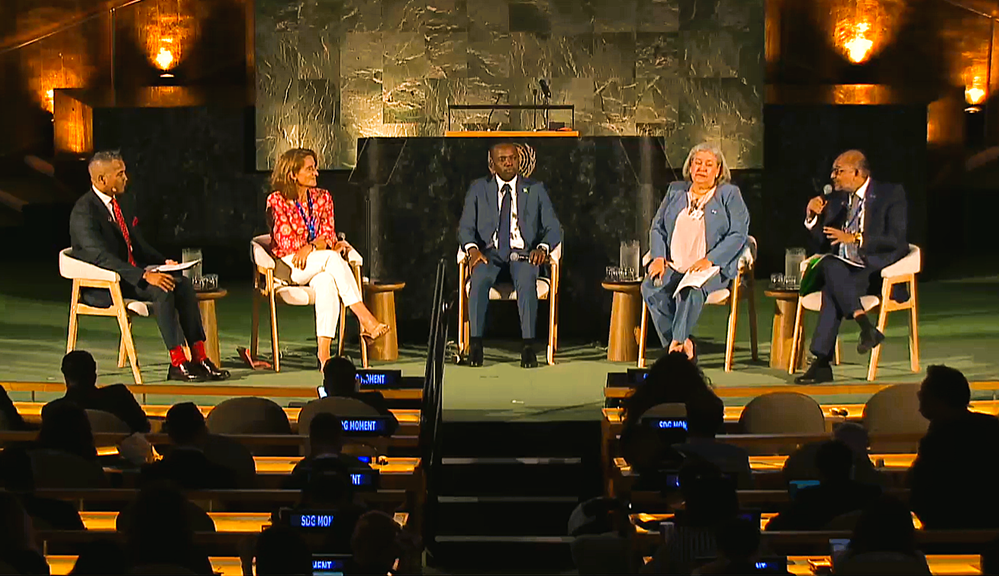
Speaking at the Leaders’ Dialogue on “Leading SDG Action” during the 2026 SDG Moment at the United Nations General Assembly Hall in New York, Dr. Titumir said the global financial system must move beyond simply financing development and instead create the conditions necessary to sustain it.

“Our broader vision should be collective and forward-looking: a global financial architecture that does not merely finance development, but creates the conditions in which development can be sustained,” he said. Dr. Titumir outlined five priorities for reforming the international financial architecture, particularly the role of multilateral development banks.

He called for a shift from responding to crises after they emerge toward anticipating vulnerabilities; greater representation and voice for vulnerable countries in international financial institutions; longer-term, lower-cost and predictable financing; closer alignment of international financing with national development strategies through coordinated, multi-year financing; and flexible transition support and preferential arrangements for countries graduating from the least developed country (LDC) category, including Bangladesh.

Bangladesh Adviser to the Prime Minister Dr. Rashed Al Mahmud Titumir speaks at the Leaders’ Dialogue on “Leading SDG Action” during the 2026 SDG Moment at the United Nations Headquarters in New York on September 18, 2026. Photo: Khabor

The Bangladeshi adviser also highlighted the country’s SDG Village initiative, describing it as an integrated, community-led approach to translating the Sustainable Development Goals into tangible improvements at the local level.

The 2026 SDG Moment, held on September 18 at UN Headquarters, brought together representatives of UN member states, international organizations and civil society to discuss accelerating action toward the Sustainable Development Goals ahead of the 2030 deadline.

The Leaders’ Dialogue also featured Teresa Ribera of the European Commission, Aristide Médénou, Minister of Economy and Finance of Benin, and Beatriz Carles de Arango, Minister for Social Development of Panama. The discussion was moderated by Sherwin Bryce-Pease of the South African Broadcasting Corporation.