Russia Backs India’s Bid for Permanent UN Security Council Seat

Shibbir Ahmed, New York — Russia has backed India’s bid for a permanent seat on the United Nations Security Council, with Foreign Minister Sergey Lavrov calling for greater representation of Asia, Africa and Latin America in the powerful UN body. Speaking during the general debate of the 81st United Nations General Assembly in New York on Saturday, Lavrov said Moscow supports the candidacies of both India and Brazil for permanent membership of the Security Council.

“We are in favour of broadening the representation of Asia, Africa, and Latin America. We support Brazil’s and India’s candidatures for a permanent seat,” Lavrov said, according to reports of his UNGA address. Lavrov also said Russia opposed allocating additional permanent seats to Western countries, specifically mentioning Germany and Japan. He argued that any reform of the Security Council should preserve the prerogatives of its existing permanent members while increasing representation from the Global South.

The Security Council currently has 15 members, including five permanent members — China, France, Russia, the United Kingdom and the United States — which hold veto power. The remaining 10 members are elected for two-year terms. India has for years sought a permanent seat on the Security Council as part of broader efforts to reform the UN’s principal body responsible for international peace and security. India has argued that the Council’s composition should better reflect contemporary geopolitical and economic realities.

Russia’s latest statement adds to recent international support for India’s bid. During the current UNGA session, Mauritius and Portugal also expressed support for India’s candidature, while other countries have called for broader reform of the Security Council. The issue of Security Council reform has gained renewed attention at the 81st UN General Assembly, where countries from the Global South have continued to call for greater representation in the UN’s decision-making institutions.

Russia’s position, however, distinguishes between the countries seeking permanent membership. While Moscow supports India and Brazil, Lavrov opposed additional permanent seats for Germany and Japan, according to reports of his speech. The debate over expansion of the Security Council remains subject to negotiations among UN member states, and Russia’s support for particular candidates does not itself change the Council’s membership.


Trump Reportedly Rejects Iran’s Proposal to Reopen Strait of Hormuz

Washington DC — U.S. President Donald Trump has reportedly rejected an Iranian proposal aimed at reopening the Strait of Hormuz within seven days and ending fighting across the region, according to a report by The Wall Street Journal cited by Reuters.

Iran has been seeking an agreement that would reopen the strategically important waterway and establish a pause in the wider regional conflict. Tehran said the proposal was transmitted to the United States through Qatari mediators.

Iranian Foreign Minister Abbas Araqchi said the plan would trigger a seven-day countdown to reopening the strait if Washington agreed to the terms. Tehran has also called for the lifting of U.S. restrictions affecting Iranian ports, the release of frozen Iranian funds and the removal of oil sanctions.

However, The Wall Street Journal reported that Trump had rejected the proposal. Reuters said it could not immediately independently confirm the report, and Iran was still awaiting an official U.S. response.

The uncertainty comes as the Strait of Hormuz remains central to the international economic consequences of the conflict. The waterway is a critical route for global energy shipments, and prolonged disruption has contributed to concerns about oil supplies and shipping costs.

Iran has said it is prepared to discuss broader issues after hostilities are paused, but Tehran has ruled out concessions on several aspects of its nuclear program. The latest developments leave the diplomatic initiative in an uncertain position as Washington considers its response and regional tensions continue.


US, China Agree to $30 Billion Tariff Cut and AI Dialogue

Washington DC — The United States and China have agreed to a reciprocal tariff-reduction arrangement covering about $30 billion in trade, while also establishing a new dialogue on artificial intelligence, according to China’s Foreign Ministry and reporting by Reuters.

The agreement was reached during Chinese President Xi Jinping’s visit to the United States and his meeting with U.S. President Donald Trump. The two sides described the discussions as part of broader efforts to manage trade disputes and maintain communication between the world’s two largest economies.

Under the arrangement, the United States and China will reduce tariffs affecting certain goods, with the agreement reportedly covering about $30 billion in reciprocal trade. U.S. Trade Representative Jamieson Greer separately said Washington and Beijing had reached understandings concerning several categories of goods, including agricultural products, medical devices and consumer goods. Further details are expected to be released by U.S. officials.

The two countries also agreed to establish a new channel for discussions on artificial intelligence. The mechanism is intended to improve communication between Washington and Beijing over AI-related issues, including incidents that could have broader security implications. The AI component comes as both countries compete for technological leadership while attempting to manage concerns over the security implications of rapidly advancing artificial intelligence.

The latest trade understanding follows years of escalating economic tensions between Washington and Beijing. Previous tariff measures had pushed duties on some goods to exceptionally high levels before the two sides moved toward a temporary reduction and broader negotiations. The new agreement does not resolve all U.S.-China trade disputes, but it creates additional areas for negotiation and communication between the two governments.


U.S. Says Decisions on Awami League and Sheikh Hasina Are Bangladesh’s to Make

Shibbir Ahmed, New York – The United States has said it has taken no position on lifting restrictions on Bangladesh’s Awami League or on allowing former Prime Minister Sheikh Hasina to return to Bangladesh and participate in the country’s political process. Washington has also not taken an official position on the judicial proceedings against Sheikh Hasina, a senior U.S. State Department official said during an on-background briefing on South Asia at the New York Foreign Press Center on Thursday.

Asked whether the United States supports lifting restrictions on the Awami League and allowing Sheikh Hasina to return to Bangladesh and participate in politics, the official said Washington does not want to take sides in Bangladesh’s domestic political affairs.

The official said the United States is working with Bangladesh’s elected government and wants to strengthen bilateral relations with the aim of helping build a stronger, safer and more prosperous Bangladesh. Asked whether the decision to lift restrictions on the Awami League was ultimately a matter for the United States, the official replied that it was “a decision for the government of Bangladesh.”

No official U.S. position on Sheikh Hasina’s trial

The issue of Sheikh Hasina’s trial and possible return to Bangladesh was also raised by journalist Lovlu Ansar. He asked about the U.S. position on the verdict against Hasina by a Bangladeshi court, her reported desire to return to the country and her request for an opportunity to challenge proceedings conducted in her absence.

In response, the U.S. official said Washington has not taken an official position on the matter. The official described the issue as an important point of disagreement in India-Bangladesh relations and said the United States hopes India and Bangladesh will resolve the matter through discussions between the two countries.

The official also said Washington has not taken a specific position on what should be done regarding Sheikh Hasina. The United States, the official added, wants to see improved relations between India and Bangladesh and encourages both countries to strengthen their bilateral ties.

U.S. responds to questions about AQIS in Bangladesh

The briefing also touched on concerns regarding the activities of Al-Qaeda in the Indian Subcontinent (AQIS). Journalist Lovlu Ansar referred to a report by the UN Security Council sanctions monitoring team that raised concerns about AQIS attempting to establish small clandestine terrorist cells in several countries, including Bangladesh. Asked about Bangladesh’s response and the U.S. position on the issue, the official said he was not familiar with the details of the specific report.

However, he described Al-Qaeda as a terrorist organization and said the United States would work with countries on counterterrorism efforts. The official declined to comment specifically on the report because he had not reviewed its details.

U.S. does not want Bangladesh to choose sides

The official was also asked about Bangladesh’s efforts to maintain relations with the United States, India and China. He said Washington does not want Bangladesh to be forced to choose one side over another. At the same time, he said Bangladesh should make careful decisions regarding sensitive sectors, including critical infrastructure and telecommunications. The United States, he said, wants to help Bangladesh protect its sovereignty and systems while providing alternatives in strategically sensitive areas.

“We’re not saying you have to choose between this or that. We want to provide alternatives for these countries, particularly in their sensitive sectors,” the official said.

U.S. monitoring Imran Khan’s situation

The briefing also included a question about former Pakistani Prime Minister Imran Khan. The U.S. official said Washington is closely monitoring developments surrounding Khan’s legal cases and health situation. However, the official said U.S. involvement in the matter remains primarily limited to monitoring developments.


Govt pursuing 3-R strategy to repair Bangladesh: PM

Shibbir Ahmed, New York — Prime Minister Tarique Rahman today said his government is pursuing a 3-R strategy — Recovery, Restoration and Reconstruction — to repair Bangladesh, which he described as having been ravaged by more than one and a half decades of “fascist rule and exploitation.”

“To repair Bangladesh, which was ravaged by fascist rule and exploitation, the Government is pursuing a 3-R strategy — Recovery, Restoration and Reconstruction,” he said while addressing the 81st session of the United Nations General Assembly at the UN Headquarters in New York.

The Prime Minister said Bangladesh had freed itself from what he described as enforced disappearances, killings, abductions, corruption, looting and money laundering and was once again embarking on the path of democracy.

He said an immense horizon of possibilities had opened before Bangladesh and that his government had begun implementing extensive programmes to transform the country’s working-age population into skilled human resources by harnessing its demographic dividend.

“Detailed measures have been taken to create extensive employment opportunities and develop Bangladesh as a ‘manufacturing hub’,” he said, seeking support from the country’s development partners in this endeavour.

The government has allocated US$50 million in the current fiscal year to create opportunities for young entrepreneurs, researchers and innovators to implement start-up initiatives, he said.

Focus on women’s empowerment

Highlighting the government’s focus on women’s empowerment, Tarique Rahman said women were at the forefront of its plans for the country’s socio-economic transformation, noting that women account for more than half of Bangladesh’s population.

He said the government was prioritising women’s education, employment and entrepreneurship, including expanded access to cash financing, particularly in the small and medium-sized industries sector. Free education opportunities for women up to the undergraduate level had also been made available, he said.

The Prime Minister said the government wanted to ensure not only electoral democracy but also the democratisation of the economy so that the benefits of economic growth and prosperity reached every family and citizen.

To this end, the government had introduced social protection initiatives such as the Family Card, Farmers’ Card, Sports Card and e-Health Card to support economically disadvantaged people.

He described the Family Card, issued in the name of the female head of each household, as a symbol of women’s economic empowerment and said the government planned to introduce a Universal Card by integrating various support cards.

31-point programme and development

Tarique Rahman said the government was implementing its 31-point programme presented to the people ahead of the February 12 national election. He said 73 percent of the programme’s activities were directly aligned with the UN Sustainable Development Goals’ “Leave No One Behind” theme, while another 27 percent were indirectly aligned.

The government hoped implementation of the programmes would reduce development disparities between urban and rural areas and strengthen accountability and inclusive sustainable development under the 2030 Agenda, he said.

Education, health and sports

The Prime Minister said his government had given special importance to education, health and sports and had made the highest-ever budget allocation for the education sector.

“There are plans to gradually increase education spending to 5 per cent of GDP within the next five years,” he said. He said a curriculum had been developed with an emphasis on technical and practical education to establish an ethically sound and employment-oriented education system.

School bags, uniforms and free midday meals were being provided to primary students from the first grade, he said, expressing hope that the initiatives would increase school enrolment and improve the quality of education.

Sports had also been included as a subject in the education curriculum for the first time, with the aim of establishing sports as a profession, he said. More than two million students participated in a month-long nationwide football tournament last June as part of the initiative, he added.

Call for dialogue to resolve conflicts

Turning to the international situation, Tarique Rahman said human-made conflicts had created unrest in many countries, causing displacement and humanitarian crises while placing pressure on the global economy, energy security and supply systems and contributing to rising inflation.

He said conflicts should be resolved through dialogue, diplomatic processes and mutual cooperation, with equality, fairness, protection of mutual interests, respect and dignity forming the basis of bilateral and multilateral relations.

Bangladesh sees the United Nations as the centre of efforts to establish an understanding-based global community that respects the independence and sovereignty of states, he said.

Tarique Rahman reaffirmed Bangladesh’s commitment to general and complete disarmament, prevention of nuclear weapons proliferation and arms control, while supporting UN initiatives aimed at promoting global peace.

He also reaffirmed Bangladesh’s support for the legitimate demands of the Palestinian people, including their right to self-determination and to establish an independent State of Palestine.

Rohingya crisis

On the Rohingya crisis, the Prime Minister said Bangladesh had been providing shelter to more than 1.2 million forcibly displaced Rohingyas from Myanmar for more than nine years, putting immense pressure on the country’s resources, environment, security and local communities.

“The only solution to this problem is the safe return of the displaced Rohingya population to their homeland, Myanmar,” he said. He called for firm and effective support from the United Nations and the international community for a lasting solution and urged continued life-saving assistance for the Rohingyas until their repatriation.

“If the international community fails to ensure justice for the displaced Rohingya population, this may turn into a humanitarian crisis in the near future,” he added.

Climate change and development

On climate change, Tarique Rahman said Bangladesh was among the countries most vulnerable to its adverse impacts despite making little contribution to global carbon emissions. He said Bangladesh expected stronger global action at COP31 on climate justice, climate finance and adaptation support. The government has launched a programme to plant 250 million trees across the country over the next five years, while placing emphasis on clean and solar energy, he said.

He also said a programme had been launched to excavate 20,000 kilometres of canals across the country to help address flooding and drought. The government had begun implementing the Teesta Master Plan and the Padma Barrage project to increase freshwater flow into the Sundarbans and conserve water through large reservoirs, he said.

Technology and AI

On science and technology, the Prime Minister said Bangladesh’s large young population and growing digital capabilities had created new possibilities, but access to advanced technology, knowledge and research must be made available to all.

“We do not want today’s digital divide to become tomorrow’s artificial intelligence divide,” he said, stressing technology transfer, skills development and affordable access to modern technologies for developing countries. He called for an effective UN policy framework to ensure that the benefits of artificial intelligence and social media could be used positively around the world.

LDC graduation and global cooperation

The Prime Minister also called for continued international support as Bangladesh prepares to graduate from the Least Developed Country category, particularly through assured financing, greater market access, technology transfer and capacity building.

He said regional trade facilitation, connectivity and meaningful cooperation could help countries achieve shared prosperity in an increasingly interdependent world. Tarique Rahman also stressed the need to ensure sustainable production of vaccines, medical supplies and diagnostic equipment in developing countries so that they remain readily accessible to all.

‘Bangladesh First: Bangladesh for All’

Tarique Rahman said Bangladesh wanted to establish a prosperous, self-reliant and welfare-oriented democratic state where everyone, irrespective of political affiliation, religion or race, could live safely with equal rights, respect and dignity.

“Bangladesh’s progress in the areas of democracy, human rights, good governance, accountability, political stability and the investment environment is continuing,” he said, adding that the government was working to establish a safe and stable Bangladesh with a business- and investment-friendly environment.

“We want to build a Bangladesh where young people can pursue their dreams without fear or hindrance, women can lead their lives with confidence, and every child can grow up with the opportunity to realise their full potential,” he said.

“Above all, the people will have the assurance of a safe and peaceful life. That is why we say, ‘Bangladesh First: Bangladesh for All’.”

Earlier remarks

Earlier in his address, Tarique Rahman congratulated the President of the 81st session of the UN General Assembly on his election and assured Bangladesh’s full support during his tenure. He paid tribute to the martyred freedom fighters of Bangladesh and recalled the contributions of those who sacrificed their lives in the struggle to establish democracy, justice and people’s rights since independence.

He also paid respect to those killed and injured during the July-August 2024 mass uprising. The Prime Minister said the people had entrusted the Bangladesh Nationalist Party (BNP) with the responsibility of governing the state through the “fair, free and impartial” national election held on February 12 this year.

He said he felt nostalgic standing before the UN General Assembly as his father, Shaheed President Ziaur Rahman, and his mother, former Prime Minister the late Khaleda Zia, had also addressed the world from the same platform on behalf of Bangladesh and its people.

Tarique Rahman said Bangladesh remained committed to multilateralism in maintaining international peace and security and, as Vice-Chair of the UN Peacebuilding Commission, continued to advocate sustainable peace, conflict prevention and inclusive peacebuilding.

He also highlighted the contributions of Bangladeshi peacekeepers and women peacekeepers to UN missions around the world. On migration, he said the government was committed to ensuring regular, safe and orderly migration and called for stronger global cooperation to protect the rights, dignity and welfare of migrants. Concluding his address, the Prime Minister reaffirmed Bangladesh’s unwavering support for the principles and values of the United Nations in the cause of establishing world peace.


PM pledges to establish prosperous, democratic Bangladesh

Shibbir Ahmed, New York — Prime Minister Tarique Rahman today pledged to build a prosperous, self-reliant and welfare-oriented democratic Bangladesh by ensuring political and economic empowerment of the people and creating equal opportunities for all.

“We want to establish a prosperous, self-reliant, welfare-oriented democratic state where everyone, irrespective of political affiliation, religion or race, can live without anxiety and in safety, with equal rights, respect and dignity,” he said. The Prime Minister made the remarks while addressing the General Debate of the 81st session of the United Nations General Assembly at the UN headquarters in New York.

He said his government was working to establish a safe and stable Bangladesh with a business- and investment-friendly environment while strengthening democracy, human rights, good governance, accountability and political stability. Tarique Rahman said the government was pursuing a three-pronged strategy — Recovery, Restoration and Reconstruction — to rebuild Bangladesh.

“Bangladesh is now once again embarking on the path of democracy,” he said, adding that the government was taking steps to transform the country’s working-age population into skilled human resources by harnessing its demographic dividend. He said detailed measures had been taken to create extensive employment opportunities and develop Bangladesh as a “manufacturing hub.”

The government has allocated US$50 million in the current fiscal year to provide opportunities for young entrepreneurs, researchers and innovators to implement start-up initiatives, he said. The Prime Minister said women were at the forefront of the government’s plans for the country’s socio-economic transformation, noting that women account for more than half of Bangladesh’s population.

“The government is giving priority to women’s education, women’s employment and the creation of women entrepreneurs,” he said. He said access to cash financing had been expanded for women, particularly in the small and medium-sized industries sector, to support the development of women-led businesses. The government had also introduced free education opportunities for women up to the undergraduate level, he said.

Tarique Rahman said the government sought to ensure not only electoral democracy but also the democratisation of the economy so that the benefits of economic growth and prosperity reached every family and citizen. To this end, the government had introduced social protection initiatives, including the Family Card, Farmers’ Card, Sports Card and e-Health Card, to support economically disadvantaged people.

“The government considers the ‘Family Card’, issued in the name of the female head of each household, to be a symbol of women’s economic empowerment,” the Prime Minister said. He said the government also planned to introduce a “Universal Card” by integrating the various cards designed to provide support in different sectors. The Prime Minister said the government had placed special emphasis on education, health and sports and had made the highest-ever allocation for the education sector in the country’s history.

“There are plans to gradually increase education spending to 5 per cent of GDP within the next five years,” he said. He said a new curriculum had been developed with greater emphasis on technical and practical education to build an ethically sound and employment-oriented education system.

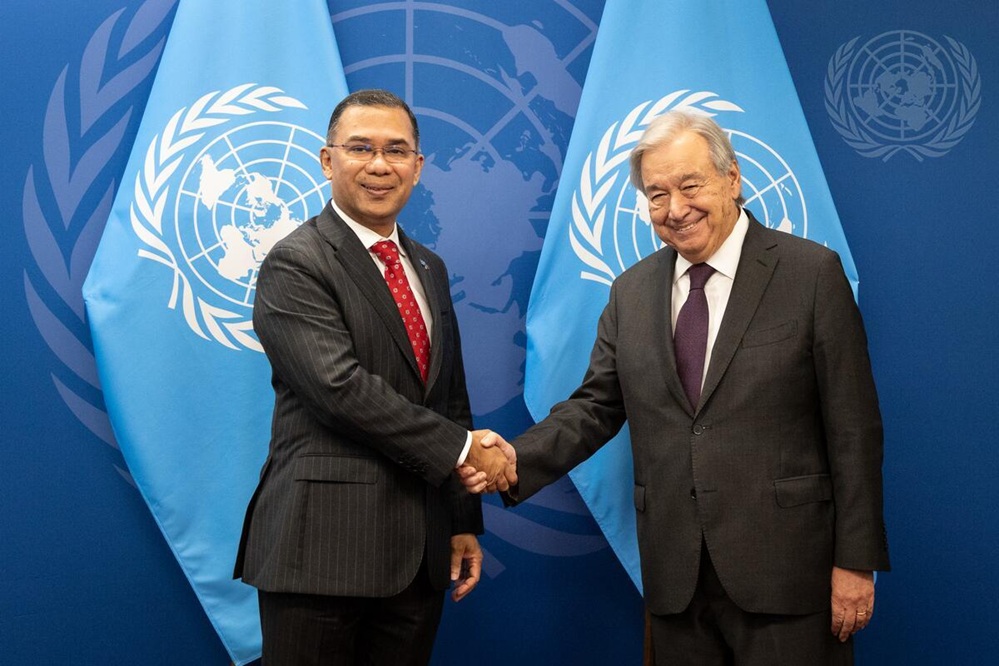
Secretary-General António Guterres (right) meets with Tarique Rahman, Prime Minister of the People’s Republic of Bangladesh.UN Photo/Ariana Lindquist

School bags, uniforms and free midday meals were being provided to primary school students from the first grade, he said, expressing hope that the initiatives would boost school enrolment and improve the quality of education. Tarique Rahman said sports had also been introduced as a subject in the education curriculum for the first time, with the aim of establishing sports as a profession.

As part of the initiative, more than two million students participated in a month-long football tournament held across the country in June, he said. The Prime Minister said science and technology would shape the future as the world entered a new era driven by artificial intelligence, biotechnology and scientific innovation. He said Bangladesh’s large young population and expanding digital capabilities had created new opportunities, but access to advanced technology, knowledge and research needed to be made available to all.

“We do not want today’s digital divide to become tomorrow’s artificial intelligence divide,” he said. Tarique Rahman said Bangladesh respected innovation and intellectual property while stressing the importance of technology transfer, skills development and affordable access to modern technologies.

“It is now time for the United Nations to adopt an effective policy framework so that the benefits of the development and rapid expansion of artificial intelligence and social media can be used positively in countries around the world,” he said. Turning to the Rohingya crisis, Tarique Rahman said Bangladesh had been sheltering more than 1.2 million forcibly displaced Rohingyas from Myanmar for more than nine years.

He said the only solution to the crisis was the safe and dignified return of the displaced Rohingya population to their homeland in Myanmar and called for continued life-saving assistance until their repatriation. The Prime Minister said Bangladesh was continuing its progress in democracy, human rights, good governance, accountability, political stability and improving the investment environment.

“In the present democratic Bangladesh, we welcome partnership, innovation and both domestic and foreign investment,” he said. Tarique Rahman said the government wanted to build a Bangladesh where young people could pursue their dreams without fear or hindrance, women could lead their lives with confidence and every child could grow up with opportunities to realise their full potential.

“Above all, the people will have the assurance of a safe and peaceful life. That is why we say, ‘Bangladesh First: Bangladesh for All’,” he added.


Bangladesh, Pakistan premiers discuss bilateral ties, regional, global issues

Shibbir Ahmed, New York – Prime Minister Tarique Rahman and his Pakistani counterpart Muhammad Shehbaz Sharif on Thursday discussed various aspects of Bangladesh-Pakistan bilateral relations, along with regional and international issues of mutual interest.

The two leaders held a bilateral meeting at the Secretariat Building of the United Nations Headquarters in New York on the sidelines of the 81st session of the United Nations General Assembly (UNGA).

The meeting focused on matters of mutual interest, the regional and international situation, and potential areas of cooperation for the benefit of the peoples of Bangladesh and Pakistan, said Prime Minister’s Assistant Press Secretary KM Nazmul Haque. Tarique Rahman and Shehbaz Sharif underscored the importance of further strengthening relations between the two countries on the basis of mutual respect, understanding and cooperation.

The two premiers also stressed the need for regular communication and continued dialogue on issues of common interest. The meeting took place amid the two countries’ ongoing efforts to enhance bilateral engagement and explore areas of cooperation at regional and international forums.


PM calls for four urgent actions to tackle sea-level rise

Shibbir Ahmed, New York – Prime Minister Tarique Rahman on Thursday called for four urgent global actions to address the growing threat of sea-level rise, including faster and deeper cuts in global emissions, predictable adaptation finance, wider access to climate-smart technologies and stronger international cooperation to address climate-induced displacement and loss and damage.

He made the call while addressing a high-level meeting on the existential threat posed by sea-level rise at the United Nations Headquarters in New York, held on the sidelines of the 81st session of the United Nations General Assembly.

The Prime Minister said a 25-centimetre rise in sea level could submerge around four percent of Bangladesh’s land by 2050, threatening the homes, livelihoods and human dignity of around 10 million people, citing a World Bank estimate.

“The sea is rising fast. Our ambition must rise faster,” Tarique Rahman said, urging the international community to translate the commitments of the Declaration on Sea-Level Rise into concrete action and ensure that no country is left behind to face the consequences of rising seas. He thanked the UN President for convening the high-level meeting and the co-facilitators for their efforts in preparing the Declaration.

Four urgent actions

Elaborating on his four-point call, Tarique Rahman first urged countries to accelerate and deepen global emissions reductions while ensuring that climate action remains fair.

“First, we must cut global emissions faster, deeper, and more fairly. We must keep 1.5 degree Celsius within reach,” he said. Second, he called for predictable, accessible and adequate financing for climate adaptation in vulnerable countries.

“Vulnerable countries like Bangladesh cannot face the grave consequences of sea-level rise alone,” he said, stressing the need for greater international support to help climate-vulnerable nations strengthen their resilience. Third, the Prime Minister called for wider access to climate-smart technologies, reliable climate data and early-warning systems for vulnerable coastal countries. He said Bangladesh had already invested in early-warning systems, strengthened cyclone preparedness and developed coastal protection measures despite having limited resources.

As his fourth call, Tarique Rahman urged stronger international cooperation to address climate-induced displacement, loss and damage, and to establish dignified pathways for communities forced to relocate because of rising sea levels. The Prime Minister said these measures were particularly important for Bangladesh, a densely populated delta where hundreds of rivers flow into the sea and millions of people live close to the coast.

“Our prosperity and future are tied to the coast,” he said.

Bangladesh’s climate initiatives

Tarique Rahman said adaptation alone would not be sufficient to address the consequences of rising sea levels because “the ocean reacts to every tonne of carbon the world releases.”

“Therefore, we need to rethink the way we consume, so that we reduce carbon emissions into the environment,” he said. He said Bangladesh was taking a number of steps to strengthen its climate resilience.

“Over the next five years, Bangladesh aims to dig around 20,000 kilometres of rivers and canals, advance the Padma Barrage initiative to retain and reserve water, modernize the Teesta Barrage with a master plan and plant 250 million trees,” he said.

At the same time, Bangladesh is pursuing a green-growth strategy, with a target of generating at least 20 percent of its electricity from renewable sources by 2030, with a particular emphasis on solar power.

The country is also promoting green industries and environmentally friendly transportation, while developing a national carbon market and strengthening the protection of forests, wetlands and vulnerable coastal ecosystems, he said.

The high-level meeting brought together heads of state and government and representatives of international organisations to discuss the growing threat posed by sea-level rise and ways to translate international commitments into concrete action. Concluding his remarks, Tarique Rahman reiterated the need to turn the Declaration on Sea-Level Rise into tangible measures.

“I believe we will all come together, turn the promises of the Declaration into action, and ensure that no nation is left behind to face the rising tide,” he said. “Let our resolve rise with the sea, and let our action rise even faster,” the Prime Minister added.


Biman to Sign Deal for 11 More Boeing Aircraft

Shibbir Ahmed, New York: Biman Bangladesh Airlines is set to sign an agreement in New York to purchase 11 additional commercial aircraft from U.S. aircraft manufacturer Boeing. The agreement is scheduled to be signed Wednesday on the sidelines of Prime Minister Tarique Rahman’s visit to New York for the 81st session of the United Nations General Assembly.

U.S. Ambassador to Bangladesh Brent T. Christensen welcomed the deal. In a social media post, he congratulated Boeing and Biman Bangladesh Airlines, describing the purchase of 11 additional commercial aircraft as another mutually beneficial achievement for U.S.-Bangladesh relations.

Christensen also said he was looking forward to witnessing the signing ceremony in New York. The new agreement for 11 aircraft is in addition to a $3.7 billion deal signed with Boeing on April 30. Under that agreement, Biman Bangladesh Airlines agreed to purchase 14 aircraft, including eight Boeing 787-10 Dreamliners, two Boeing 787-9s and four Boeing 737-8s.

With the additional 11 aircraft, Biman’s planned purchases from Boeing will rise to 25 aircraft. However, the specific models, total purchase price, financing arrangements and delivery schedule for the additional 11 aircraft have not yet been disclosed.

The purchase is part of Biman Bangladesh Airlines’ plans to expand and modernize its fleet. At the same time, Biman is considering a separate proposal to purchase 10 Airbus aircraft. The additional aircraft are expected to support the airline’s fleet expansion and meet growing demand in the aviation sector. The new aircraft are also intended to help Biman expand its international network and enhance passenger services.


US Announces New Visa Restrictions Targeting Birth Tourism

Shibbir Ahmed, Washington DC — U.S. Secretary of State Marco Rubio has announced a new visa restriction policy targeting individuals who knowingly engage in or facilitate commercial “birth tourism” to the United States. Under the policy, announced September 23, the State Department said it will use Section 212(a)(3)(C) of the Immigration and Nationality Act to restrict visa issuance to people involved in commercial birth-tourism operations. The policy specifically targets owners, operators and managers of birth-tourism networks, visa “fixers” who coach applicants to commit fraud, foreign medical providers who knowingly facilitate such travel, and others who knowingly support or enable the practice.

Rubio said foreign commercial birth-tourism networks have exploited the U.S. immigration system by charging large sums of money to arrange births in the United States for the purpose of obtaining U.S. citizenship for children. The statement also accused some networks of coaching foreign nationals to provide false information on visa applications and of facilitating fraudulent use of Medicaid.

“The Trump Administration is using every tool at our disposal to defend the integrity of U.S. citizenship, protect American public benefits and U.S. taxpayers from exploitation, and safeguard our national security,” Rubio said in the statement.

The State Department has already prohibited birth tourism as a permissible purpose for a U.S. visitor visa. Its current visitor-visa guidance defines birth tourism as travel to the United States primarily to give birth so that the child obtains U.S. citizenship, and states that such travel is not permissible on a visitor visa.

The department previously introduced specific rules addressing birth tourism in 2020. Under those rules, consular officers were directed to deny B-visa applications when they had reason to believe an applicant’s primary purpose for traveling to the United States was to give birth in order to obtain U.S. citizenship for the child.

The newly announced policy goes beyond the individual seeking to travel for birth tourism by specifically targeting people and organizations that facilitate or profit from the practice. According to Rubio’s statement, certain family members of individuals covered by the restrictions may also be subject to the new visa restrictions.

The announcement comes as the State Department has continued to expand visa screening and vetting measures. On September 18, the department announced that, effective October 1, online-presence review would be expanded to additional nonimmigrant visa categories, saying the screening process is intended to identify applicants who may be inadmissible or who fail to establish eligibility for the visa requested.

The new birth-tourism policy is being implemented under existing provisions of U.S. immigration law rather than through a change to the statutory citizenship rules themselves. The announcement specifically concerns visa restrictions on people involved in or facilitating commercial birth tourism.