PM Tarique Rahman to Visit US Sept 21

Mujib Rahman, Dhaka: Prime Minister Tarique Rahman will leave for the United States on September 21 to attend the 80th session of the United Nations General Assembly in New York, Foreign Affairs State Minister Humayun Kabir said on Sunday. Speaking to reporters at the Foreign Ministry on September 13, Kabir said the prime minister would remain in New York until September 26.

“Prime Minister Tarique Rahman will leave for the United States on September 21 to attend the UN General Assembly,” Kabir said. “During the visit, he will present Bangladesh’s new vision and priorities on the global stage.”

The state minister said the prime minister is expected to hold several bilateral meetings with world leaders during his stay in New York, alongside a number of important sideline meetings.

“Along with presenting Bangladesh’s vision to the international community, discussions will also focus on a range of issues concerning the country’s national interests,” Kabir said.

Asked whether Prime Minister Tarique Rahman would meet US President Donald Trump during his New York visit, Kabir said the prime minister’s primary purpose was to attend the UN General Assembly and deliver his address.

“There will be some meetings on the sidelines. Such meetings are often decided at the very last moment,” he said.

“Donald Trump has said that he wants to meet the prime minister. When he goes there, we will inform you about whom he meets or holds discussions with. There will be nothing secret about it, and you will be informed,” Kabir added. The state minister also said a special sideline meeting on resolving the Rohingya crisis is expected to be organized during the prime minister’s visit to the United States.

“The Rohingya issue will receive significant attention in the prime minister’s meetings with world leaders,” Kabir said.


America Marks 25 Years Since 9/11

Shibbir Ahmed, Ground Zero, New York — The United States on Friday marked the 25th anniversary of the September 11, 2001, terrorist attacks with memorial ceremonies in New York, Virginia and Pennsylvania, while the release of newly declassified CIA intelligence records renewed attention on what U.S. officials knew about al-Qaida and Osama bin Laden before the attacks. Nearly 3,000 people were killed when 19 al-Qaida hijackers seized four commercial passenger aircraft and carried out coordinated attacks on the World Trade Center in New York and the Pentagon in Virginia. United Airlines Flight 93 crashed near Shanksville, Pennsylvania, after passengers attempted to regain control of the aircraft.

At Ground Zero in Lower Manhattan, relatives of victims gathered for the annual memorial ceremony and read the names of those killed. The observance began with a moment of silence at 8:46 a.m., the time American Airlines Flight 11 struck the World Trade Center’s North Tower. Vice President JD Vance attended the New York ceremony alongside former Presidents Bill Clinton, George W. Bush, Barack Obama and Joe Biden. The gathering brought together current and former national leaders as families commemorated those who died a quarter-century ago.

The ceremony included additional moments of silence marking the attacks on the South Tower, the Pentagon and Flight 93. This year, organizers also included a seventh moment of silence for people who subsequently died from illnesses associated with exposure to toxic materials at the World Trade Center site.

The 9/11 Memorial & Museum said the commemoration remains centered on the victims and their families, with the names of those killed read during the ceremony. The annual Tribute in Light is also scheduled to illuminate the New York skyline Friday evening.

Trump Attends Pentagon Ceremony

President Donald Trump marked the anniversary at the Pentagon in Arlington, Virginia, where American Airlines Flight 77 crashed after being hijacked. The attack killed 184 people at the Pentagon and aboard the aircraft. Trump attended the ceremony with First Lady Melania Trump and Defense Secretary Pete Hegseth. Senior military and government officials also participated in the remembrance.

The Pentagon ceremony focused on the victims and the military personnel, civilian employees and others who lost their lives in the attack. Trump and Hegseth also linked the events of September 11 to current U.S. national-security policy and the country’s military role overseas. Arlington County and other communities in Virginia also held local commemorations honoring residents, first responders and others connected to the Pentagon attack.

Flight 93 Remembered in Pennsylvania

In Shanksville, Pennsylvania, families and visitors gathered at the Flight 93 National Memorial to commemorate the 40 passengers and crew members who died when the hijacked aircraft crashed into a field. The passengers had learned through telephone calls that other hijacked aircraft had struck the World Trade Center and the Pentagon and attempted to take control of Flight 93. The plane crashed before reaching its intended target. The Pennsylvania observance included the reading of the passengers’ and crew members’ names and a wreath-laying ceremony.

CIA releases 71 intelligence reports

The 25th anniversary also brought a significant new development in Washington. The Central Intelligence Agency released 71 intelligence reports related to the period before and immediately after the September 11 attacks. The collection includes 70 reports prepared before the attacks and one report dated September 12, 2001. The documents were prepared for the President’s Daily Brief and were provided to Presidents Bill Clinton and George W. Bush and senior administration officials.

The documents show that U.S. intelligence agencies had been tracking bin Laden and al-Qaida for years before the attacks. A February 1998 report warned about bin Laden’s interest in obtaining chemical, biological and nuclear materials. Other reports discussed his growing network, his activities in Afghanistan and the Taliban’s reluctance to surrender him.

A September 1998 intelligence report described a possible al-Qaida plan involving an explosive-laden aircraft and identified Washington as a preferred target. Later reports discussed possible hijackings and surveillance of locations in the United States.

An August 2001 President’s Daily Brief, already publicly known as “Bin Ladin Determined To Strike in US,” warned of suspicious activity in the United States consistent with preparations for hijackings or other attacks. The newly released collection provides additional surrounding intelligence records from that period.

The documents remain partly redacted, and officials said the release does not fundamentally overturn the established historical account of the attacks. Instead, the records provide additional detail about the intelligence available to U.S. officials before September 11.

The 9/11 Commission previously concluded that failures involving intelligence sharing, management, policy and the ability to interpret the available information contributed to the government’s inability to prevent the attacks.

New records revive questions about Ground Zero exposure

In New York, the anniversary has also brought renewed attention to the long-term health consequences of the attacks. Thousands of firefighters, police officers, emergency workers, construction workers, residents and others who were exposed to the dust and debris around the World Trade Center site have developed illnesses associated with the disaster.

The FDNY has continued adding the names of members who died from illnesses linked to their work at Ground Zero. More than 600 firefighters have died from 9/11-related illnesses, according to department figures cited in anniversary coverage.

The city has also begun releasing large collections of records concerning its response to the World Trade Center disaster, including documents related to air quality and the handling of information about environmental hazards after the attacks. The records have renewed questions about what officials knew about the risks in Lower Manhattan and when that information was communicated to residents and workers.

A continuing national security legacy

The attacks prompted major changes in U.S. national security policy. Congress created the Department of Homeland Security, federal agencies expanded counterterrorism operations and intelligence-sharing systems were reorganized. Airport security procedures were substantially expanded, while Congress approved new surveillance authorities.

The attacks also led to the U.S. military campaign in Afghanistan against al-Qaida and the Taliban. The United States later invaded Iraq in 2003, beginning two wars that became central to American foreign policy for the following two decades.

The wars resulted in the deaths of thousands of U.S. military personnel and large numbers of civilians in Afghanistan and Iraq. The post-9/11 period also produced prolonged debates over detention, interrogation, surveillance, civil liberties and the balance between national security and individual rights.

Impact on Muslim and South Asian Americans

The attacks also had significant consequences for Muslim, Arab and South Asian communities across the United States. In the years following September 11, members of those communities faced hate crimes, discrimination, profiling and increased scrutiny. At the same time, Muslim and South Asian Americans have become an increasingly visible part of American civic, political and professional life. The 25th anniversary has therefore prompted communities across the country to remember both the victims of the attacks and the broader social consequences that followed.

Texas and communities across the country

The anniversary was not limited to New York, Virginia and Pennsylvania. Communities across the United States held ceremonies, vigils, memorial services and events honoring victims and first responders. In Houston, an interfaith remembrance brought together volunteers who read the names of those killed on September 11 alongside names associated with the wars in Afghanistan and Iraq. The event reflected a broader effort in some communities to discuss both the attacks and the consequences of the U.S. response. Other communities organized stair climbs, flag displays and local memorial ceremonies, often focusing on residents who died in the attacks or first responders who later became ill.

A 25-year transition

The anniversary comes as the United States enters a period in which a growing portion of the population has no personal memory of September 11. People born after the attacks now make up a significant share of the American population. For victims’ relatives, survivors and first responders, however, the events remain personal rather than historical. At Ground Zero, in Arlington and at Shanksville, the ceremonies continued to place individual victims at the center of the commemoration.

The newly released intelligence documents added another dimension to this year’s anniversary by providing additional evidence of the warnings available to U.S. officials before the attacks.

The records do not offer a simple explanation for why the attacks were not prevented. They instead add to an extensive historical record showing that U.S. agencies had identified bin Laden and al-Qaida as serious threats but failed to translate available intelligence into effective action against the specific plot.

Twenty-five years after September 11, the United States is therefore commemorating the victims while continuing to examine the decisions, intelligence failures, policies and human consequences associated with the attacks and their aftermath.


25 Years After 9/11: Victims’ Names Read at Ground Zero

Shibbir Ahmed, New York: The United States is marking the 25th anniversary of the September 11, 2001, terrorist attacks on Friday, with memorial ceremonies taking place across the country. In New York, victims’ relatives are gathering at the World Trade Center site to remember those who were killed in the attacks, while moments of silence mark key points in the timeline of that morning.

At the 9/11 Memorial in Lower Manhattan, family members are reading the names of their loved ones who died in the attacks. This year’s commemoration also includes a new moment of silence honoring people who were exposed to toxic dust and debris after the collapse of the World Trade Center and later died from related illnesses.

On September 11, 2001, al-Qaida terrorists hijacked four commercial airplanes. Two planes crashed into the World Trade Center towers in New York, one struck the Pentagon near Washington and the fourth crashed in a field near Shanksville, Pennsylvania, after passengers and crew members fought the hijackers. A total of 2,977 people were killed in the attacks.

The consequences of the attacks have continued long after that day. Thousands of firefighters, police officers, emergency workers, volunteers and others who worked at or around Ground Zero were exposed to toxic substances. More than 600 New York City firefighters have since died from illnesses related to their 9/11 exposure, according to figures cited by Reuters.

Memorial ceremonies are also being held at the Pentagon and at the Flight 93 National Memorial near Shanksville. President Donald Trump is attending the Pentagon observance, while Vice President JD Vance and all four living former presidents are attending the New York commemoration, according to Reuters and the Associated Press.

New York also held commemorative events ahead of Friday’s anniversary. On Wednesday night, a special drone installation titled “2,977 Lights Over New York Harbor” illuminated the sky above New York Harbor. The display featured 2,977 lights, representing each person killed in the 2001 attacks, before forming the outline of the Twin Towers at full architectural scale. Organizers said the project was developed in collaboration with 9/11 family members, survivors and first responders.

The city’s commemoration will continue Friday evening with the annual “Tribute in Light.” Two powerful beams of light will rise from Lower Manhattan, creating a symbolic representation of the Twin Towers and honoring those who died in the attacks. The 9/11 Memorial has scheduled the installation from Friday evening through early Saturday morning.

Twenty-five years later, the anniversary remains more than a remembrance of those who died on September 11, 2001. It also reflects the continuing grief of victims’ families, the sacrifices of first responders and the lasting health consequences faced by thousands of people who worked at Ground Zero.

For New York and the nation, the 25th anniversary is a moment to remember the lives lost, honor those who responded and preserve the history of a day that profoundly changed the United States.


9/11 at 25: America Remembers the Fallen, Honors Their Legacy

Shibbir Ahmed, New York — The National September 11 Memorial & Museum will mark the 25th anniversary of the September 11, 2001 terrorist attacks with its annual commemoration ceremony in Lower Manhattan, bringing together victims’ families to remember the nearly 3,000 people killed in the 2001 attacks and the 1993 World Trade Center bombing.

Family members will read aloud the names of the 2,983 men, women and children who lost their lives in the two attacks during the ceremony at the 9/11 Memorial. This year’s ceremony will include a new moment of silence honoring people who have died from illnesses or injuries linked to the September 11 attacks and their aftermath.

Seven moments of silence will be observed during the commemoration. They will mark the moments when the World Trade Center towers were struck and collapsed, as well as the attacks on the Pentagon and the crash of Flight 93. The additional moment of silence will follow the reading of the names and will become a permanent part of the annual ceremony.

The memorial said hundreds of thousands of people participated in rescue, recovery and relief operations following the attacks in New York City, Arlington, Virginia, and Somerset County, Pennsylvania. Many responders and civilians were exposed to hazardous materials and toxins at Ground Zero, contributing to chronic illnesses and deaths in the years since the attacks.

The 25th anniversary comes as more than 100 million Americans are too young to have a personal memory of September 11, according to the 9/11 Memorial & Museum. The institution said its education programs have reached more than 20 million students as it works to preserve the history and lessons of the attacks for younger generations.

The annual Anniversary Digital Learning Experience will allow students and teachers around the world to commemorate the anniversary through a 30-minute film featuring first-person accounts of the attacks and their aftermath, followed by a live chat with museum staff.

The museum is also continuing its Never Forget Fund campaign, which supports 9/11 education and efforts to preserve the memory of those who were killed. Chairman Michael R. Bloomberg is matching donations to the fund dollar-for-dollar, up to $25 million.

The annual Tribute in Light installation will return at dusk on September 11, illuminating the New York City skyline with two beams of light representing the footprints of the World Trade Center towers. The lights will remain visible overnight before fading at dawn on September 12.

For the first time, the Tribute in Light will also be featured in a live national broadcast. At 8 p.m. Eastern Time, the 9/11 Memorial & Museum, in partnership with Disney Entertainment Television, will present a one-hour special, “9/11 Tribute in Light: Live from Lower Manhattan.”

The program will be hosted by David Muir, Robin Roberts and Diane Sawyer and will feature performances by Lainey Wilson, Cyndi Lauper and John Ondrasik of Five For Fighting.

The museum will also open a new exhibition, “In Their Honor: 25 Years of 9/11-Inspired Service,” on September 12. The exhibition will explore the continuing legacy of service inspired by the attacks through firsthand accounts, artifacts and multimedia presentations.

Musical performances during the anniversary commemoration will include Grammy-winning cellist Yo-Yo Ma, Jennifer Nettles and the Brooklyn Youth Chorus, along with musicians from the Orchestra of St. Luke’s, Musica Reginae and The Harlem Chamber Players.

The 9/11 Memorial & Museum said it is also inviting journalists who covered the attacks and their aftermath to record and share their personal experiences as part of an effort to preserve the memories of those who witnessed one of the defining events of the 21st century.

The 25th anniversary commemoration is intended not only to remember those killed on September 11, 2001, and February 26, 1993, but also to preserve the stories of courage, service, resilience and compassion that emerged in the aftermath of the attacks.


I Will Return to Bangladesh in December: Sheikh Hasina

Shibbir Ahmed, New York: Former Bangladesh Prime Minister Sheikh Hasina has said she intends to return to Bangladesh in December despite knowing that she could be arrested, tortured or even killed upon arrival. In an interview with Anandabazar Patrika, published on Thursday, Hasina said she had made the decision after considering all possible consequences. The interview was conducted by journalist Agni Roy in New Delhi and was first published in the newspaper’s print edition.

Asked how she planned to return and whether she expected to be arrested immediately, Hasina said she was aware of the risks regardless of whether she travelled by air or road. She said she could be arrested as soon as she entered Bangladesh and that there was also a possibility of being taken to an undisclosed location and subjected to prolonged mistreatment. Despite those risks, she said the difficult circumstances faced by people in Bangladesh had influenced her decision to return.

Hasina also said that the Awami League has a longstanding organisational structure that allows the party to function even when its president is absent. Referring to the party’s history, she said its leadership arrangements had continued during earlier periods when political activities were restricted.

During the interview, Hasina also discussed Bangladesh’s current political environment, including the relationship between the Bangladesh Nationalist Party and Jamaat-e-Islami. She alleged that Jamaat-e-Islami had collaborated with Pakistani forces during the 1971 Liberation War and accused the current authorities of reviving the International Crimes Tribunal and using it against her. She also rejected the legal proceedings against her, describing them as unjust. Hasina further argued that BNP and Jamaat-e-Islami were politically closely aligned and said she saw little substantive difference between the two.

Hasina was also asked about the decision of Bangladesh Prime Minister Tarique Rahman not to visit India despite an invitation. She dismissed the suggestion that a statement she made at an August 5 press conference had prevented the Bangladeshi prime minister from travelling to India. She referred to Tarique Rahman’s years in London and questioned why his political activities there had not prevented relations between Britain and Bangladesh from continuing.

She also alleged that instructions connected to the 2024 political movement had been issued from abroad. These are claims made by Hasina and were presented in the context of the interview.

Hasina’s announcement is not the first time she has spoken about returning to Bangladesh in December. In July, she told Reuters that she planned to return despite the possibility of arrest or death.

She also reiterated her intention to return during a virtual media interaction on August 5, saying she was prepared for detention or imprisonment. The latest Anandabazar interview, however, provides a more detailed account of her stated reasoning and the risks she says she is prepared to face.

Source: Anandabazar Patrika, interview by Agni Roy, published September 10, 2026.


Bangladesh Condemns Israeli Settlement Plan in West Bank

DHAKA: Bangladesh has strongly condemned Israel’s plan to advance settlement construction in the E1 area of the occupied West Bank, saying the move violates international law and threatens prospects for a viable two-state solution.

In a statement issued today, Bangladesh’s Ministry of Foreign Affairs said the planned settlement expansion was contrary to international law and relevant United Nations Security Council resolutions.

The ministry said the proposed construction would further undermine the territorial integrity of the occupied Palestinian territory and diminish prospects for the establishment of a viable and sovereign Palestinian state. Bangladesh called on Israel to immediately halt all settlement activities in the occupied Palestinian territory.

Dhaka also reaffirmed its unwavering support for the legitimate and inalienable rights of the Palestinian people, including their right to establish an independent and sovereign State of Palestine based on the pre-1967 borders, with East Jerusalem as its capital.

Bangladesh urged the international community to intensify diplomatic efforts to prevent actions that could undermine Palestinian statehood and to advance a just, comprehensive and lasting peace in the Middle East based on international law and the two-state solution.

“Bangladesh stands in solidarity with the people of Palestine and remains committed to supporting their legitimate aspirations for freedom, dignity, justice and statehood,” the statement said.


Bangladesh Missions Operate Mobile Consular Camps in 63 Countries: Khalilur Rahman

Shibbir Ahmed, UN, New York: Bangladesh’s diplomatic missions in 63 countries are operating mobile consular camps to make essential government services more accessible to Bangladeshi expatriates, Foreign Minister and President of the 81st United Nations General Assembly Dr. Khalilur Rahman has said.

According to Rahman, the initiative is aimed at bringing consular services closer to expatriate Bangladeshis, particularly those living far from the country’s embassies and consulates.

Through mobile consular camps, expatriates can access a range of services without having to travel long distances to diplomatic missions. Depending on the mission and the specific camp, services may include passport-related assistance, document attestation, birth registration, citizenship-related services and other consular facilities.

Bangladesh’s diplomatic missions have been organizing mobile consular camps in different countries for several years. The Bangladesh Embassy in Washington, for example, regularly conducts such outreach programs in different U.S. cities. The embassy has also announced a mobile consular camp in Oklahoma City on September 12 and 13, 2026.

The mobile camps are particularly important for Bangladeshis living outside major metropolitan areas, allowing them to receive government services closer to their communities.

Rahman’s remarks highlight the government’s efforts to expand access to consular services for the country’s large overseas community. By taking services directly to expatriate communities, Bangladesh’s missions are seeking to make consular assistance more accessible and convenient.

The figure of 63 countries is attributed to Rahman’s statement. Bangladesh’s missions are independently documented as conducting mobile consular outreach in several countries, although a publicly available official source confirming the full 63-country figure was not located at the time of publication.


Iran Fires 20 Missiles Toward U.S.-Used Base in Jordan

AMMAN/WASHINGTON DC — Iran fired a barrage of ballistic missiles toward a military base in Jordan used by U.S. forces on Wednesday, escalating an already widening confrontation with Washington following the destruction of five Iranian oil tankers by the United States.

Jordanian authorities said their air defenses intercepted 18 of the 20 Iranian missiles launched toward the kingdom. The remaining two missiles fell in unpopulated areas, according to Jordanian officials. A U.S. official said American military personnel in Jordan were accounted for following the attack. There were no immediate reports of U.S. casualties.

Iran said the missile attack was carried out in retaliation for recent U.S. military strikes against Iranian oil tankers. The Islamic Revolutionary Guard Corps has warned that Tehran will intensify its response to further American attacks.

The target was the Muwaffaq Salti Air Base near Al-Azraq in eastern Jordan, a strategically important facility that hosts U.S. military personnel and aircraft. The base has played a significant role in American military operations in the region.

The missile attack was part of a broader escalation on Wednesday. Iran also said it had attacked 10 vessels near the Strait of Hormuz, including oil tankers, after the United States destroyed five Iranian tankers. Washington has disputed Iranian claims that U.S. naval vessels were hit.

The latest exchange marks one of the most significant escalations in the six-month-old U.S.-Iran conflict. The confrontation has increasingly spread beyond Iran and the United States, drawing neighboring countries and international shipping into the crisis.

The Strait of Hormuz remains at the center of the escalation. The strategic waterway is one of the world’s most important routes for oil shipments, and renewed attacks on commercial vessels have raised fears of major disruptions to global energy supplies.

The developments have already shaken international energy markets. Brent crude rose sharply on Wednesday, with prices moving above the $100-a-barrel level amid fears that the fighting could disrupt oil production and shipping in the Gulf.

The United States has said its military operations against Iranian vessels were carried out in response to attacks by Iran’s Revolutionary Guard on an American warship. Iran, meanwhile, has threatened further retaliation and warned that the area of restricted maritime activity around the Strait of Hormuz could be expanded.

The latest missile attack on Jordan raises concerns that the conflict could increasingly involve U.S. military facilities and American allies across the Middle East, increasing the risk of a broader regional war.

With Iran threatening further retaliation and the United States continuing military operations against Iranian targets, governments across the region are closely monitoring the situation for signs of another major escalation.


Iran Captures U.S. Underwater Drone in Strait of Hormuz

SHibbir Ahmed, WASHINGTON DC — Iran’s Islamic Revolutionary Guard Corps (IRGC) says it has captured a U.S. unmanned underwater vehicle near the entrance to the Strait of Hormuz, in the latest development in the escalating confrontation between Tehran and Washington.

Iranian state media identified the vessel as a Dive-LD, a large autonomous underwater vehicle manufactured by California-based defense company Anduril. The approximately 19-foot (5.8-meter) unmanned submersible is designed for missions including seabed mapping, mine detection, intelligence gathering and inspection of underwater infrastructure. The IRGC described the operation as a complex intelligence and military mission and claimed that Iranian forces had “trapped” one of the most advanced unmanned submarines operated by the United States.

However, the U.S. military gave a significantly different account of the incident. A Pentagon spokesperson acknowledged that a U.S. underwater drone had been lost, but said the vehicle had malfunctioned more than a day earlier while surveying regional waters in support of ongoing operations. According to the Pentagon, the drone was an older model and did not carry classified sonar or radar equipment or collect sensitive data.

Anduril also confirmed the loss of one of its underwater vehicles and emphasized that the Dive-LD was designed to operate in dangerous environments where losing the vehicle was considered a possibility.

Reuters said it could not independently verify Iran’s claim that it had captured the vehicle through a deliberate intelligence operation. The Dive-LD can reportedly operate for up to 10 days and is designed to reach depths of approximately 6,000 meters (19,700 feet). The system is part of the U.S. military’s growing use of autonomous underwater and surface vessels for surveillance, mine detection and other missions without putting American personnel directly at risk.

The incident comes as tensions around the Strait of Hormuz continue to rise. Commercial shipping through the strategic waterway has fallen sharply amid the ongoing U.S.-Iran confrontation, while oil prices have climbed above $100 a barrel amid fears of further disruption to global energy supplies.


‘This Is Not 1945’: Bangladesh’s Khalilur Rahman Opens UNGA 81

Shibbir Ahmed, UN, New York: The United Nations General Assembly opened its 81st session on Tuesday at United Nations Headquarters in New York, with Bangladesh’s veteran diplomat Khalilur Rahman taking over as president and calling for renewed global trust in the international organization amid wars, humanitarian crises, climate change and deepening geopolitical divisions.

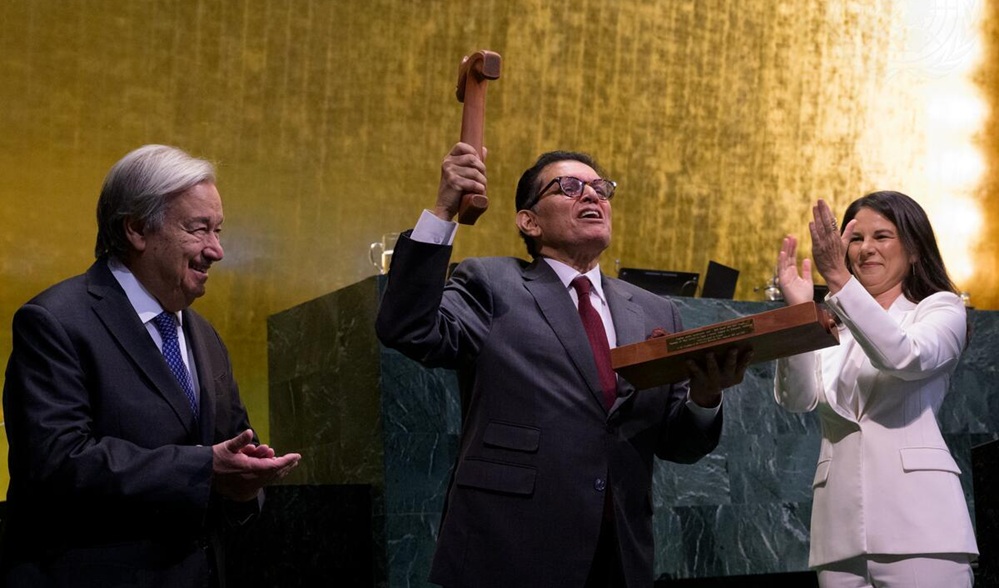
Rahman formally assumed the presidency after receiving the traditional Icelandic wooden gavel from outgoing General Assembly President Annalena Baerbock. In his opening remarks, he said the United Nations must adapt to the realities of a rapidly changing world and become more responsive to the needs and expectations of people across the globe.

“We must make the United Nations fit for the future,” Rahman said, stressing the importance of listening to civil society and giving greater space to voices outside governments and traditional diplomatic institutions.

“We have a situation where trust is in deficit. This is not 1945. This is the 81st session. The world has moved on. The Organization must move on, and I’ll help that process,” he said.

Rahman has placed restoring trust and managing global transformation at the center of his presidency. His agenda includes strengthening international peace and security, accelerating progress toward the 2030 Sustainable Development Goals, addressing climate change, protecting human rights, supporting refugees and migrants, promoting responsible technological development and advancing reform of the United Nations and the broader multilateral system.

The new session begins at a time of heightened international tensions, with conflicts in several regions, growing humanitarian emergencies, geopolitical rivalries, persistent poverty and inequality, and increasing concerns over climate-related disasters. The risk of nuclear escalation has also added to concerns about international peace and security.

United Nations Secretary-General António Guterres, speaking at the opening of the session, said rebuilding confidence in the multilateral system had become one of the defining challenges of the current era.

“Rebuilding trust in the multilateral system is the defining challenge of our time,” Guterres said, arguing that international cooperation remains essential at a moment when the world is confronting crises that cannot be effectively addressed by individual countries acting alone.

Guterres said institutions across the multilateral system, including the Security Council and international financial institutions, are under growing pressure to respond to the realities of the present day. He warned that international law and human rights are too often violated with impunity, while geopolitical mistrust and suspicion continue to prevent the international community from reaching effective solutions.

Despite those difficulties, Guterres said he remained hopeful about the ability of the General Assembly to contribute to a better future. Through diplomacy, dialogue and cooperation, he said, countries can work to rebuild trust and goodwill and help ensure that future generations inherit a more peaceful and sustainable world.

The opening of the 81st session also marked the conclusion of Baerbock’s term as president of the General Assembly. Addressing member states at the final meeting of the 80th session, she defended the continuing importance of the United Nations despite criticism of its shortcomings.

Baerbock said she was more convinced than ever of the importance and necessity of the organization. She pointed to the work of United Nations agencies and peacekeeping missions around the world as evidence of the practical impact of the international body.

She cited the role of the United Nations Children’s Fund in helping millions of children and the contribution of peacekeepers to protecting civilians in conflict-affected areas. Baerbock also warned that the positive work of the United Nations often receives less public attention than negative developments, particularly in an environment where divisive and hateful content can spread rapidly.

Climate change and sustainable development are expected to remain major issues during the new session. Rahman has called for stronger international efforts to build climate resilience and protect the environment, while also accelerating progress toward the 2030 Sustainable Development Goals.

The new president has emphasized the need to ensure that development reaches vulnerable populations and that no country is excluded from international efforts to address poverty, inequality, education, health, food security and other development challenges.

Human rights and humanitarian action are also central to the new presidency. Continuing conflicts and instability have displaced millions of people, increasing pressure on the international community to protect refugees and migrants and provide assistance to populations affected by war and persecution.

The rapid development of artificial intelligence and other emerging technologies is another issue expected to receive greater attention. Rahman has called for technological innovation that is inclusive and responsibly governed, with appropriate safeguards to protect people and future generations.

United Nations reform is also expected to feature prominently during the 81st session. The international political and economic landscape has changed substantially since the organization was established in 1945, prompting continued debate over whether its institutions adequately reflect the realities of the contemporary world.

Questions surrounding representation, inclusiveness and the effectiveness of international decision-making have become increasingly important, particularly for developing countries seeking a greater voice in global affairs.

Another major diplomatic issue during the coming year will be the selection of the next United Nations secretary-general. Guterres is scheduled to complete his term, with his successor expected to take office in January 2027.

Rahman brings extensive diplomatic experience to the presidency of the General Assembly. He previously served as foreign minister of Bangladesh and held senior positions including national security adviser and high representative for the Rohingya issue in Bangladesh’s interim government. He has also held senior positions within the United Nations system and was a founding member of East West University in Dhaka.

His assumption of the presidency gives Bangladesh a prominent role in one of the international community’s most representative forums at a particularly challenging moment for multilateral diplomacy.

As the 81st session begins, the central challenge for the General Assembly will be whether countries can overcome deep political divisions and rebuild confidence in international cooperation. For Rahman, the task is rooted in a simple premise: the world has changed significantly since 1945, and the United Nations must evolve with it.