President Mirza Fakhrul Vows to Uphold Non-Partisan Role in State Duties

DHAKA: President Mirza Fakhrul Islam Alamgir today pledged to discharge his constitutional responsibilities in a completely non-partisan manner for the welfare of the state. “I resigned from the party, parliament and the Cabinet before assuming the responsibility of the President. I am now completely a non-partisan person, and after assuming the responsibility of the President of my state, I will work in a completely non-partisan manner for the welfare of the state and the nation,” he said.

He made the remarks at the first Durbar of the President with the officers and employees of Bangabhaban at the Durbar Hall of Bangabhaban at 11:30 am. The President said that after assuming the responsibility as President, he would have no anger or affection towards anyone, and the interests of the country, state and people would be his prime objective.

At the event, he urged the officers and employees of Bangabhaban to discharge their respective responsibilities with dedication, sincerity and honesty. He stressed ensuring public trust, honesty, dedication, sincerity and responsibility under any circumstances. “We must have love, respect and loyalty towards the country and its people.”

The President also emphasized on maintaining confidentiality of the important activities related to national securities that took place in the Bangabhaban. He called for economy and responsibility in state expending and urged prevention of waste.

The President said government resources and other facilities are managed with the money of the country’s people. “Therefore, their proper, responsible, transparent and accountable use must be ensured,” he said. He urged the officers and employees to maintain discipline in their personal lives as well as regularly strive to build moral strength and good character while maintaining balance between family life and workspaces.

“We are a family here and we all work from the same place. We will have opportunities, and at that time we will talk to each other and try to resolve the problems,” he said. The President said he had spent a long period of his political life and during that time had participated in struggles alongside the people.

He paid deep respect to those who sacrificed their lives in the country’s Great War of Liberation in 1971 and the contribution on Shaheed President Ziaur Rahman during the Liberation War and nation building afterwards.

Later, he recalled BNP Chairperson Begum Khaleda Zia for her courageous leadership, sacrifices and contribution throughout her long political career. Highlighting the history and tradition of Bangabhaban, he expressed the hope that everyone would continue to work together in the future.


Govt Vows No Politically Motivated Detention: Shama

DHAKA: State Minister for Foreign Affairs Shama Obaed Islam has said the government is committed to protecting human rights and ensuring that no citizen is detained or imprisoned unjustly because of political affiliation or vendetta.

“The government will definitely ensure that no one is unjustly imprisoned or detained due to political vendetta,” she told journalists at the foreign ministry on Wednesday.

Shama said the government’s commitment to due process and fundamental rights extends to supporters of all political parties, including opposition parties and the Awami League, whose activities are currently banned.

“No party, be it the opposition party, Awami League, or any party, the current government will definitely ensure that no one is unjustly imprisoned or detained due to political vendetta,” she said.

The State Minister alleged that Bangladesh had experienced widespread human rights violations over the past 17 years, saying BNP leaders and activists were among the major victims.

“The kind of human rights that have been violated in Bangladesh in the last 17 years has never been violated in the history of Bangladesh,” she said.

“The biggest victim is the Bangladesh Nationalist Party, its leaders and activists,” she added.

Shama said the government would not allow a return to what she described as the country’s previous “fascist era” and would work to protect the fundamental rights of every citizen.

“We will never want the past fascist era to return now or in the future. We want all human rights to be ensured to every citizen,” she said.

She said the government has a responsibility to protect citizens’ rights and ensure that the justice system is not used for political revenge.

“Our government’s stand is that we are trying to protect human rights. We are responsible to the people,” she said.

Bangladesh policy guides foreign relations

Turning to foreign policy, Shama said Bangladesh’s approach is focused on protecting national interests while maintaining balanced and respectful relations with all countries.

“Our foreign policy is first and foremost a ‘Bangladesh policy’… with equal rights with everyone and maintaining our own interests with respect,” she said.

She said the elected government’s political mandate had strengthened Bangladesh’s position in negotiations with international partners.

“When Bangladesh is talking, the Prime Minister of Bangladesh is talking, then all the other stakeholders including China are listening to our words with more attention, more seriously,” she said.

“Now that Bangladesh is an elected government, we have a stronger position in our negotiation space,” she added.

Rohingya crisis requires political solution

On the Rohingya crisis, Shama said Bangladesh would use its strengthened diplomatic position to encourage greater international engagement and push for a lasting political solution.

“The matter is absolutely a political problem, it is a very sensitive matter and we need to solve this problem politically,” she said.

She said Bangladesh remains engaged in both official and unofficial communication with various stakeholders in Myanmar as part of efforts to resolve the crisis.

“We are trying to involve the international community more,” she said, referring to a high-level UN session on the Rohingya crisis scheduled for September, which Prime Minister Tarique Rahman is expected to attend.

Bangladesh will also explore whether greater involvement from the Muslim world could help increase pressure on Myanmar and create momentum towards a solution, she said.

According to Shama, the crisis has become increasingly complex since the massive influx of Rohingyas into Bangladesh began in 2017, particularly because of Myanmar’s changing political and security landscape.

She pointed to the emergence of the Arakan Army and other actors in Rakhine State, as well as growing security concerns along the Bangladesh-Myanmar border, including human smuggling and drug trafficking.

Shama said it was difficult to determine the exact number of Rohingyas currently living in Bangladesh because of continued arrivals and births in the camps.

“We don’t know the exact number right now, but it will definitely be over 1.3 million,” she said, adding that an estimated 30,000 children are born in the camps each year.

She said Chinese President Xi Jinping had expressed Beijing’s willingness to cooperate with Bangladesh in finding a solution to the Rohingya crisis during Prime Minister Tarique Rahman’s recent visit to China.

Shama also questioned the effectiveness of existing arrangements for resolving the crisis without stronger involvement from the United Nations and other major international stakeholders.

She said Bangladesh could gain additional diplomatic leverage from Foreign Minister Dr Khalilur Rahman’s upcoming role as President of the UN General Assembly.

“From that place, we have a power to speak for Bangladesh in the international community. We think that at least in the next year, we will be able to use this capacity a little better,” she said.

Shama reiterated that Bangladesh would continue to pursue a “Bangladesh policy” in its international relations, protecting national interests while maintaining ties with other countries on the basis of equality and mutual respect.


Bangladesh Plans $2.14 Billion Purchase of 20 Chinese J-10CE Fighter Jets

DHAKA, Bangladesh: Bangladesh has prepared a draft agreement to negotiate the purchase of 20 Chinese J-10CE multirole fighter jets at an estimated cost of $2.14 billion, as the government moves ahead with a major plan to modernize the Bangladesh Air Force. Government sources said the proposed acquisition would be financed over eight fiscal years, with the procurement process expected to run from the current 2026–27 fiscal year through 2034–35.

Ten of the aircraft are planned to meet existing operational requirements, while the remaining 10 would be used to establish a new fighter squadron within the Bangladesh Air Force. The development was disclosed after Prime Minister’s Information Adviser Zahed Ur Rahman said Tuesday that the government was advancing the process of purchasing J-10 fighter aircraft from China.

$2.14 billion procurement plan

According to documents cited by government sources, each J-10CE is estimated to cost about $62.7 million. At an exchange rate of Tk123 to the U.S. dollar, that would put the price of each aircraft at roughly Tk7.71 billion. The 20 aircraft would cost approximately $1.256 billion, while additional expenditure would cover pilot and technical training, transportation and operational equipment.

The broader procurement package is estimated at approximately $2.14 billion, according to the documents. Bangladesh initially expected the procurement to be completed during the 2025–26 and 2026–27 fiscal years. More recent government documents, however, indicate that payments and implementation would continue through 2034–35. Defense sources said Bangladesh is seeking to receive six J-10 aircraft by 2027, with the remaining 14 aircraft delivered in phases.

Government-to-government purchase

The proposed purchase would be conducted either through a government-to-government arrangement with China or through direct negotiations with China National Aero-Technology Import & Export Corporation (CATIC), according to the documents. A committee formed to negotiate the purchase of J-10 aircraft and attack helicopters has already prepared a draft agreement and forwarded it to the Armed Forces Division.

The Bangladesh Air Force is currently evaluating the technical and financial proposals associated with the procurement. The modernization program also includes plans to acquire anti-drone systems, long-range radar, electronic warfare systems and passive defense systems.

New fighter squadron and air force infrastructure

Under the proposed acquisition plan, Bangladesh would establish a new multirole combat aircraft unit. The government is also working on restructuring elements of the country’s air warfare and field infrastructure, while some activities related to establishing an aerospace research and development complex are underway.

Documents also indicate that Bangladesh is pursuing land acquisition for the establishment of a full-fledged air base in Bogura, aimed at expanding Bangladesh Air Force flight and operational capabilities in the country’s northern and northwestern regions.

Why Bangladesh is considering the J-10CE

Bangladesh has been seeking to modernize its fighter fleet for several years. The country’s existing combat aircraft are aging, raising concerns over their ability to meet modern air-defense requirements. The J-10CE has attracted additional attention in Bangladesh following the May 2025 India-Pakistan conflict, when Pakistan deployed Chinese-made J-10C-series aircraft.

Pakistan claimed that its J-10s were used to shoot down several Indian aircraft, including Rafale fighters. India acknowledged losing aircraft during the conflict but did not publicly confirm the number or the specific aircraft involved.

International reporting has also examined India’s reported loss of Rafale aircraft during the fighting. The precise number and circumstances surrounding those losses remain subject to differing accounts. The conflict nevertheless drew international attention to the capabilities of China’s J-10C/J-10CE family of fighter aircraft.

J-10CE versus Rafale

The J-10CE is the export version of China’s J-10C and is designed as a multirole combat aircraft, capable of performing both air-to-air and air-to-ground missions. Bangladesh currently operates fighter aircraft primarily focused on air-defense missions, while the proposed J-10CE acquisition would provide a broader multirole capability.

The J-10CE is capable of supersonic flight and is designed for high maneuverability and modern aerial combat. Its advanced radar, electronic systems and weapons integration are among the features that have attracted interest from potential foreign buyers. The aircraft is generally considered a 4.5-generation fighter, while France’s Rafale is also widely classified in the 4.5-generation category.

Bangladesh has considered Western fighters

Bangladesh’s interest in modern fighter aircraft predates the current J-10CE proposal. Since 2016, Dhaka has considered a number of options for modernizing its combat fleet, including France’s Rafale, the European Eurofighter Typhoon and U.S.-made F-16 aircraft. French President Emmanuel Macron also promoted the Rafale during his September 2023 visit to Dhaka. The decision to pursue the J-10CE therefore represents a significant shift toward a Chinese platform for Bangladesh’s next-generation multirole fighter capability.

Broader military modernization

The fighter procurement is part of a wider effort to strengthen Bangladesh’s defense capabilities. According to the government, procurement initiatives are also underway for attack helicopters, VIP helicopters and unmanned aerial vehicle systems.

The proposed J-10CE deal would be one of Bangladesh’s largest military acquisitions and would further deepen the country’s longstanding defense relationship with China. For now, the procurement remains subject to negotiations, technical and financial evaluation and the necessary government approvals.


Muhammad Abdul Muhith appointed as Bangladesh envoy to Britain

DHAKA: The government has appointed Foreign Service Academy Rector Muhammad Abdul Muhith as Bangladesh’s next High Commissioner to the United Kingdom for a two-year term. The Ministry of Public Administration issued a gazette notification confirming his contractual appointment.

A career diplomat with more than three decades of experience, Muhith has served Bangladesh in various capacities at home and abroad, with assignments spanning New York, Vienna, Washington, DC, and several key Middle Eastern and European capitals.

His diplomatic career has particularly focused on multilateral diplomacy, United Nations governance, sustainable development, peacebuilding and institutional reform. Muhith previously served as Bangladesh’s Ambassador and Permanent Representative to the United Nations in New York. Prior to his latest appointment, he has been serving as Rector of the Foreign Service Academy.


UNDP Offers Full Support for Bangladesh’s Overall Reform Process

Shibbir Ahmed, New York: The United Nations Development Programme (UNDP) has expressed its willingness to provide full support to Bangladesh in its overall reform process, including legal and judicial reforms and proposed constitutional amendments.

UNDP Resident Representative Stephen Rodriques expressed the organization’s interest during a courtesy meeting with Bangladesh Home Minister Salahuddin Ahmed at the minister’s office at the Bangladesh Secretariat on Tuesday morning, according to a press release issued by the ministry.

The meeting was held in a cordial atmosphere, with the two sides discussing a wide range of issues of mutual interest, including constitutional reform, assistance for Rohingya refugees, capacity building for the Bangladesh Police, institutional and technological support to combat rumors and misinformation, the proposed National Human Rights Commission Act, and the draft Prevention and Remedy of Enforced Disappearance Act. Rodriques said UNDP is keen to support the priorities and reform agenda of the current government.

“We want to support the goals, priorities and action plans of the present government,” he said, congratulating Salahuddin Ahmed on his appointment as chairman of the special committee on constitutional amendments.

“If you wish, we are interested in providing the necessary support for this reform process,” he added.

The home minister highly appreciated UNDP’s longstanding contributions to Bangladesh’s socioeconomic development and called for further expansion of the partnership in the coming days.

Referring to UNDP’s work with forcibly displaced Myanmar nationals, commonly known as Rohingyas, the resident representative said the organization has been working to improve living conditions in the refugee camps through environmental protection initiatives, including landslide prevention, as well as various social development programmes.

The home minister said Bangladesh wants appropriate improvement and modernization of existing infrastructure in the Rohingya camps but does not want any new infrastructure to be constructed there in the greater national interest.

Rodriques also said UNDP has been providing training to Bangladesh Police on protecting citizens’ rights, conflict resolution and other professional skills to strengthen the institutional capacity of the force. The home minister stressed the importance of continued UNDP support in improving the professionalism and operational capacity of the police.

Discussing the misuse of information technology, Rodriques said misinformation, disinformation and hate speech are spreading rapidly through digital platforms. He said UNDP is already working with the Ministry of Information and Broadcasting and the Ministry of Posts, Telecommunications and Information Technology and is prepared to provide technological and institutional support to ensure prompt remedies for violations.

The minister said Bangladesh has already enacted the Cyber Security Act and suggested that UNDP could provide logistical support for its effective implementation. Responding to a question about the proposed National Human Rights Commission Act, Salahuddin Ahmed said the draft National Human Rights Commission Act, 2026 has received final approval from the Cabinet and is expected to be passed during the next session of Parliament.

He said opinions from UNDP, international organizations, foreign missions, development partners, newspaper editors and legal experts had been incorporated into the drafting process, along with consideration of Bangladesh’s social values and religious sentiments. The minister also said that no incidents of enforced disappearance or extrajudicial killing have occurred since the current government assumed office.

Sharing his personal experience of enforced disappearance, he said the draft Prevention and Remedy of Enforced Disappearance Act, 2026 has also received policy approval from the Cabinet.  Highlighting Bangladesh’s image abroad, the UNDP resident representative said international media do not always portray the country’s actual situation. He described Bangladesh as a liberal and religiously tolerant country and said UNDP is interested in supporting efforts to promote Bangladesh’s positive image internationally.


Chiefs of three services call on President

DHAKA: Chiefs of three services today paid a courtesy call on President Mirza Fakhrul Islam Alamgir at Bangabhaban, said a Bangabhaban press release here. Chief of Army Staff General Waker-Uz-Zaman, Chief of Naval Staff Admiral Khondkar Misbah Ul Azim and Chief of Air Staff Air Chief Marshal Hasan Mahmood Khan met the President this noon. During the meeting, they congratulated the President on his assuming office as the President and conveyed their best wishes for his tenure.

They also briefed the President on various activities of their respective forces and sought his guidance and cooperation as the Supreme Commander of the Armed Forces in discharging their responsibilities. The President expressed satisfaction with the activities of the Armed Forces and said the incumbent government is working to develop the Armed Forces into a modern four-dimensional force.

The President assured the chiefs of the three armed forces that all-out cooperation would be extended for the overall development of the Armed Forces alongside enhancing their professional skills.


Emotional Fakhrul Seeks MPs’ Votes Ahead of Presidential Election

DHAKA: BNP presidential candidate and outgoing Secretary General Mirza Fakhrul Islam Alamgir made an emotional appeal to the party’s lawmakers on Wednesday, urging them to vote for him in Thursday’s presidential election. Fakhrul made the appeal at a meeting of the BNP Parliamentary Party held at the government party meeting room of the Jatiya Sangsad Bhaban in Dhaka. The meeting was chaired by BNP Chairman and Prime Minister Tarique Rahman.

The meeting began at 2 p.m. and continued for about one and a half hours. According to lawmakers who attended the meeting, Fakhrul became emotional at the beginning of his speech and broke down in tears several times. His emotional remarks created a somber atmosphere in the meeting, with Prime Minister Tarique Rahman also becoming emotional.

Recalling his long political journey with the BNP, Fakhrul said he had served the party as Senior Joint Secretary General, Acting Secretary General and Secretary General. “If I have made any mistake while carrying out my responsibilities, or if I have unintentionally hurt anyone, I ask for forgiveness,” Fakhrul told his colleagues.

He expressed gratitude to the party for giving him what he described as immense respect and responsibility throughout his political career. He also recalled the contributions of the late BNP Chairperson Begum Khaleda Zia and the party’s founder, former President Ziaur Rahman. Fakhrul thanked Tarique Rahman for continuing to place his trust in him and assigning him important responsibilities over the years.

He pledged that he would preserve throughout his life the honor and trust that the party had placed in him. He also said he would never compromise on the issues of Bangladesh’s independence and sovereignty.

Referring to the possibility of moving to Bangabhaban if elected president, Fakhrul said he would miss his longtime colleagues and asked them to pray for him. He then directly appealed to the BNP lawmakers to vote for him in Thursday’s presidential election. Earlier, Chief Whip Md. Nurul Islam Moni welcomed the participants and briefed the lawmakers about the voting procedure for the presidential election. He also sought their votes for Fakhrul.

Moni informed the meeting that the presidential election would be held on Thursday, August 20, and that Fakhrul himself would also cast his vote. He further explained that if Fakhrul is elected president and assumes office, his parliamentary seat in Thakurgaon-1 would become vacant. After Fakhrul, Prime Minister Tarique Rahman addressed the meeting and also urged BNP lawmakers to vote for Fakhrul in the presidential election.

The meeting was attended by BNP Standing Committee members Khandaker Mosharraf Hossain, Gayeshwar Chandra Roy, Abdul Moyeen Khan, Amir Khasru Mahmud Chowdhury, Salahuddin Ahmed, Iqbal Hasan Mahmud, Selima Rahman and A.Z.M. Zahid Hossain, among others.The pre sidential election is scheduled to take place on Thursday, August 20. If elected, Mirza Fakhrul Islam Alamgir will assume the office of President. As a result, Wednesday’s parliamentary party meeting could be Fakhrul’s final such meeting as a sitting member of parliament, giving the gathering an added emotional significance.


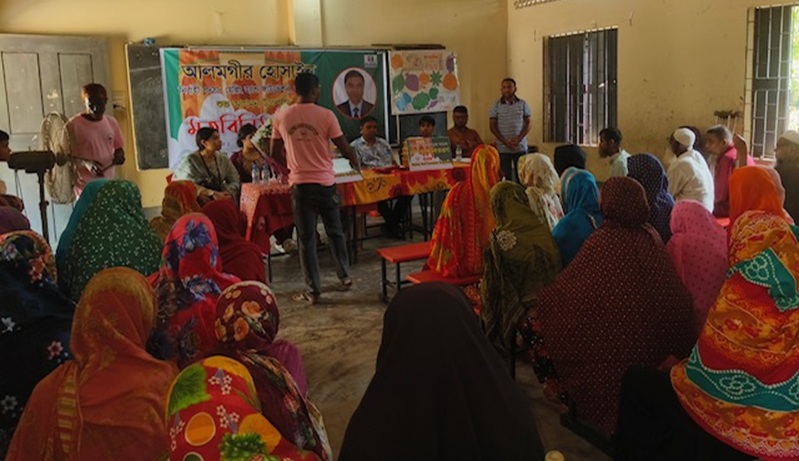
Helping Hand Foundation Executive Member Alamgir Hossain Supports Humanitarian Efforts in Bogura

BOGURA CORRESPONDENT: Alamgir Hossain, an executive member of the Helping Hand Foundation and a Bangladeshi expatriate living in the United States, recently visited Bogura to observe the foundation’s humanitarian activities and meet people who have benefited from its various support programs.

Arriving in Bogura from Dhaka, Hossain, accompanied by his family members, toured several of the foundation’s ongoing initiatives and spoke directly with beneficiaries. He also followed up with people who had previously received assistance from the organization, including financial support, sewing machines, and help with house construction.

During the visit, Hossain personally distributed clothing and cash assistance among beneficiaries. He also listened to their experiences and learned about their current living conditions and the impact of the support they had received from the foundation.

Hossain was accompanied by his wife, one son, and two daughters. Together, they visited several of the foundation’s humanitarian initiatives aimed at supporting underprivileged and disadvantaged people in Bogura.

Foundation officials said the Helping Hand Foundation has been carrying out a range of programs not only to provide immediate humanitarian assistance but also to improve the livelihoods and living standards of disadvantaged people.

They described Hossain’s visit and his direct involvement in the assistance programs as a positive and encouraging development, particularly because he continues to remain connected with the foundation’s activities while living abroad.

At the conclusion of the visit, foundation representatives expressed their gratitude to Alamgir Hossain and his family for their support and participation. They said they hope such humanitarian initiatives will continue in the future for the welfare of vulnerable and underprivileged communities.


All upazila health complexes to become nine-storey facilities: Sakhawat

JHENAIDAH – Health and Family Welfare Minister Sardar Md Sakhawat Hussain has said that, under the Prime Minister’s directives, all upazila health complexes across the country will be transformed into modern nine-storey health complexes within the next three years.

“A long-term plan has been taken to upgrade all 50-bed upazila health complexes in the country into 151-bed hospitals within the next three years,” he said while responding to queries from reporters after making surprise visits to the Maheshpur and Kotchandpur upazila health complexes in the district today.

He said the country’s healthcare sector had been seriously neglected during the 17-year rule of the “fascist Awami League government”. “Looting took place in all sectors, and extensive looting also occurred in the healthcare sector. There was a lack of accountability, which disrupted health services,” he said.

Corruption had also taken place in the purchase of medicines for hospitals during the fascist government, Sakhawat said, adding the government wants to bring the country’s health sector and medical system under a new discipline.

“We have undertaken long-term plans to address the shortage of doctors and medicines and to make services easier for patients. We will not compromise in implementing the plans to restore public confidence in government healthcare services,” he continued.

He said that after the 151-bed upazila health complexes are launched, the hospitals will have a special 25-bed ward for pregnant women and a separate 20-bed ward for children. “We have also taken plans to introduce services such as kidney dialysis at these hospitals. Once these are implemented, the country’s health sector and the system of medical services will be transformed,” he said.

Earlier in the morning, the Health Minister visited different wards of the Maheshpur and Kotchandpur upazila health complexes. During the visits, he enquired about the overall condition of patients receiving treatment at the hospitals. He also spoke with patients and their attendants about the quality of healthcare services and food at the hospitals. Later, he visited the Kaliganj Upazila Health Complex.


Presidential Election: EC validates nominations of Mirza Fakhrul, Oli Ahmed

DHAKA- The Election Commission (EC) has declared valid the nomination papers of Mirza Fakhrul Islam Alamgir, the nominee of the Bangladesh Nationalist Party (BNP), and Dr Oli Ahmed, Bir Bikram, candidate from the Jamaat-e-Islami-led 11-party alliance, in the presidential polls. At Nirbachan Bhaban in the capital today, Chief Election Commissioner (CEC) AMM Nasir Uddin declared their nomination papers valid after verification.

He informed a BNP delegation, led by its standing committee member Dr Abdul Moyeen Khan, that the nomination papers of Mirza Fakhrul Islam Alamgir have been accepted as valid. Earlier, the CEC accepted the nomination papers of 11-party alliance Oli Ahmed Bir Bikram as valid. The presidential election will be held on August 20. The scrutiny of nomination papers began at 11:00 am today (Sunday).

The two candidates submitted their nomination papers on the last day of the presidential election on August 13. On Thursday last, BNP submitted the nomination papers of Mirza Fakhrul Islam Alamgir to the CEC at Nirbachan Bhaban. On the other hand, the 11-party alliance submitted its nomination papers in favour of Liberal Democratic Party (LDP) Chairman Colonel (retd) Oli Ahmed.

EC Secretariat Senior Secretary Akhtar Ahmed said the last date for withdrawal of candidacy is 4:00 pm on August 18 (Tuesday). Voting will be held in the session hall of Jatiya Sangsad from 2:00 pm to 5:00 pm on August 20 (Thursday), he said.