Moyeen Seeks Stronger World Bank Support for Bangladesh Development

DHAKA – LGRD and Cooperatives Minister Dr Abdul Moyeen Khan has expressed hope that the World Bank will further strengthen its support for the country’s sustainable development and improvement of people’s quality of life. He said various government initiatives are underway in important areas such as water supply, sanitation, rural development and addressing the impacts of climate change.

Continued support from development partners is necessary to make these activities more effective and sustainable, he said when World Bank Division Director for Bangladesh and Bhutan Jean Pesme paid a courtesy call on him at his office at the Secretariat today.

Various issues including the World Bank’s support for various ongoing development projects in Bangladesh, water supply and sanitation systems, rural development, climate change and local government sector were discussed.

The minister said the government and development partners need to work in coordination to accelerate and sustain the country’s development activities. He said WB support could play an important role in strengthening the capacity of the local government sector and ensuring quality civic services reach people at their doorsteps.

The minister expressed gratitude for the World Bank’s longstanding support for Bangladesh’s development journey and hoped that the bank would continue its support for the country’s key development initiatives in the future.

During the exchange of views, emphasis was placed on further strengthening the existing cooperation between Bangladesh and the World Bank. LGD Md Shahidul Hassan, senior officials from the ministry and the WB were present at the meeting.


President Urges US to Simplify Visa Processing for Bangladeshis

DHAKA – President Mirza Fakhrul Islam Alamgir today urged the United States to simplify its visa processing procedures for Bangladeshi tourists and business people to facilitate people-to-people and business ties between the two countries. The President made the call when US ambassador to Bangladesh Brent T Christenen paid a courtesy call on him at Bangabhaban this morning.

During the meeting, the US envoy congratulated the President on his assumption of office as the President of Bangladesh. Recalling the past US investment and cooperation in the country’s agricultural development, the President called for further US investment and cooperation in the country’s development sector.

He also referred to Chevron’s investment and important role in the development of the country’s energy sector and urged increased US investment in Bangladesh’s energy, information technology, infrastructure, and health and high-tech industries sectors. The President also sought US cooperation in ensuring the safe, dignified and sustainable repatriation of the Rohingyas to their homeland.

Thanking the US ambassador, the President said, “The United States is one of the Bangladesh’s important development partners. The existing trade relations with the US are playing an important role in Bangladesh’s economic development.”

On international relations, the President said, “Bangladesh attaches the highest importance to the principles of independence, sovereignty, national interest, mutual respect and equality in its international relations.”

He expressed the hope that bilateral relations and trade agreements with the United States would be further expanded in the days to come through mutual respect while protecting common interests. Referring to the recent bilateral trade agreements with US, the President said, “This is an important development in expanding the trade relations between the two countries.”

“There is a scope to make the agreement more balanced and mutually beneficial, taking into consideration the economic realities and interests of both the countries,” he added.

The ambassador assured that the US would continue its cooperation with Bangladesh and stressed the importance of strengthening cooperation with ASEAN countries. He also reiterated his US’s interest in further deepening and diversifying relations with Bangladesh. Military secretary to the President and Press Secretary and senior officials were present during the meeting.


Nearly 600,000 Jobs at Risk in Bangladesh: World Bank

Shibbir Ahmed, Washington DC: Nearly 600,000 jobs in Bangladesh could be at risk if the economic fallout from the ongoing Middle East conflict persists, according to a World Bank assessment. The warning comes as Bangladesh faces rising fuel prices, severe gas shortages, disruptions to fertilizer production and growing pressure on industries and household incomes.

The World Bank’s mid-June assessment, prepared as part of a proposed Contingent Emergency Response Project, said the conflict could significantly weaken Bangladesh’s economic recovery and slow the pace of poverty reduction.

The assessment estimates that the number of people expected to move out of poverty in 2026 could fall from around 1.7 million to about 500,000 because of the conflict. Bangladesh had already been facing rising poverty. The World Bank estimated that the number of poor people increased by about 1.4 million in 2025, as weak job creation, slow growth in labor incomes and persistent inflation reduced the poverty-reducing impact of economic growth.

Energy crisis adds to pressure

The energy sector is among the areas most severely affected. Natural gas accounts for more than half of Bangladesh’s primary energy supply, while domestic gas production has fallen significantly from its 2016 peak. The country also relies heavily on the Middle East for imported energy, sourcing about 60–65% of its crude oil and 55–60% of its LNG from the region.

The conflict has disrupted LNG supplies, with five of Petrobangla’s six LNG supply contracts reportedly placed under force majeure. Spot LNG prices have risen to around $24–$28 per million British thermal units (MMBtu), more than double their previous level.

Higher energy costs are also expected to put additional pressure on inflation. The World Bank assessment said that passing higher energy prices on to consumers could increase inflation by more than 0.5 percentage points, with further effects on food and non-food prices.

Fertilizer production disrupted

Bangladesh’s agriculture sector is also vulnerable to the crisis. Gas shortages have forced five of the country’s six domestic urea fertilizer plants to suspend production, while international urea prices have increased by around 30%. The World Bank warned that fertilizer prices could potentially rise much further if the disruption continues, increasing production costs for farmers and putting additional pressure on food prices.

Smallholder farmers, who represent a significant share of Bangladesh’s population, could be particularly exposed to higher input costs and supply disruptions.

Industries and workers under pressure

The energy crisis is also affecting industrial activity. Factory operating hours, production and new industrial gas connections have reportedly been affected, while some businesses have faced rising operating costs.

The World Bank’s projection of nearly 600,000 jobs at risk reflects the broader economic consequences of higher energy costs, supply disruptions, weaker production and inflation. Economists have also pointed to signs of the crisis already appearing in the labor market, including factory closures, reduced working hours and job losses.

Government finances face additional strain

The crisis could also increase pressure on Bangladesh’s public finances. Higher energy subsidies could substantially increase government expenditure, potentially reducing the fiscal space available for social protection and emergency programs, according to the World Bank assessment.

The World Bank has already approved $1.1 billion in emergency financing for Bangladesh to help protect food security, support vulnerable households and businesses, and address volatility in global fertilizer and fuel markets.

Risk, not a confirmed job-loss figure

The World Bank’s figure of nearly 600,000 should be understood as a projection of potential job losses if the crisis continues, rather than a confirmed number of workers who will definitely lose their jobs.

The final impact will depend on how long the Middle East conflict lasts, global energy and fertilizer prices, supply conditions and Bangladesh’s ability to manage the economic shock. For Bangladesh, however, the warning highlights the vulnerability of an economy already struggling with inflation, weak job creation and limited fiscal space.

Source: World Bank assessment on Bangladesh’s proposed Contingent Emergency Response Project.


15,717 Missing-Child GDs Filed in Bangladesh in Seven Months

DHAKA — A total of 15,717 General Diaries (GDs) were filed over missing-child incidents across Bangladesh during the first seven months of this year, according to figures presented by the government. However, the figure should not be interpreted as meaning that 15,717 children are currently missing, the government’s Information and Broadcasting Adviser Dr. Zahed Ur Rahman said on Tuesday. He disclosed the figures during a press briefing at the Secretariat on the government’s recent activities and developments.

According to the adviser, 15,717 GDs related to missing children were filed from January through July 2026. During the previous seven-month period, from June through December 2025, the number was 13,876.

Dr. Zahed said many children reported missing eventually return home or are found, but families do not always inform police after the child returns. As a result, the number of GDs cannot be used to determine how many children remain missing.

“There is no complete information on exactly how many children have not returned,” he said, emphasizing the difference between missing-child reports and the number of children who remain missing.

Missing-child figures raise questions over case outcomes

The latest figures have renewed questions about how missing-child cases are recorded and followed up after a GD is filed. Recent reports citing Police Headquarters data put the number of missing-child GDs at 15,917 between January and July 2026—more than 75 reports a day, or roughly one report every 20 to 21 minutes.

However, that figure also represents GDs rather than the number of children currently missing. There is no regularly published, consolidated national record showing how many children were rescued, returned home, found elsewhere, remained missing, or became involved in cases of abduction or trafficking.

The difference between the 15,717 figure presented by the government adviser and the 15,917 figure cited in recent Police Headquarters reporting also highlights the need for better coordination and verification of national missing-child data.

‘MUN Alert’ launched to speed up rescue

In January this year, Bangladesh launched the Missing Urgent Notification (MUN Alert) system to help locate and rescue missing and abducted children more quickly. The initiative was launched by the Criminal Investigation Department (CID) of Bangladesh Police in cooperation with Amber Alert for Bangladesh.

A 24-hour toll-free hotline, 13219, was also introduced for reporting missing children. The system is designed to allow authorities to quickly verify information and disseminate details such as a missing child’s photograph and last known location.

CID officials have emphasized the importance of the first few hours after a child goes missing, saying that rapid dissemination of verified information can increase the chances of a successful recovery.

Missing does not automatically mean trafficking

The large number of missing-child GDs has also prompted concern over possible child trafficking. Police, however, have said there is currently no evidence establishing a direct link between all of the missing-child GDs and child trafficking. At the same time, authorities acknowledge that trafficking remains a potential risk in individual cases.

Experts have therefore cautioned against treating every missing-child case as an abduction or trafficking case while stressing that potential trafficking risks should be properly investigated.

Need for a coordinated national database

Child-rights advocates and experts have called for a more coordinated national system linking police stations, the CID, the Police Bureau of Investigation, hospitals, morgues and other relevant agencies.

Such a system could track each case from the initial missing-person report through its final outcome—including whether the child was rescued, returned home, found elsewhere, became the subject of an abduction or trafficking investigation, or remained missing.

Without such follow-up information, the number of GDs provides only a partial picture of the country’s missing-child situation. The government’s latest figure therefore highlights a significant concern, but it does not establish how many children are currently missing in Bangladesh. The key challenge now is to determine what happened after each of those thousands of reports—and to ensure that every missing child is accounted for.


Bangladesh Gripped by Fear of Missing Children, Its Future Generation Slipping Away!

Shibbir Ahmed: The greatest asset of an independent nation is its children. Today’s children are not merely the sons and daughters of individual families—they are tomorrow’s citizens, workforce, leaders, and the future of the state. The dreams that take shape in a child’s eyes are, in many ways, the first sketches of a nation’s future.

But when those very children begin disappearing one after another, the question is no longer limited to an individual family. It becomes a question of national security, social responsibility, and our collective conscience.

In Bangladesh, the growing number of general diaries, or G.D.s, filed over missing children has recently created renewed concern. According to data from Police Headquarters cited in recent reports, 15,917 G.D.s concerning missing children were filed across the country during the first seven months of 2026. That works out to an average of more than 75 reports a day, or roughly one missing-child report every 20 to 21 minutes.

The figure is undoubtedly alarming. But one important distinction must be made: **15,917 is the number of missing-child-related G.D.s, not the number of children who are necessarily still missing.** It would be wrong to interpret the figure as proof that 15,917 children remain missing.

Government and police officials have acknowledged that a G.D. does not necessarily tell us the final outcome of a case. Many children return home after going missing, but their families may not go back to the police station to report the child’s return or formally update the original G.D. As a result, a missing-child case may remain in police records even after the child has returned home. Recent reporting has also highlighted the absence of a regularly published, consolidated national record showing how many children were rescued, returned home, remained missing, or became victims of other crimes. And this is where the deepest part of the crisis lies.

The more important question is not simply how many children have gone missing—but how many have returned, and how many have not?

If the state does not have an accurate, coordinated and regularly updated answer to that question, then the true picture of the missing-child crisis remains unclear. And when a crisis cannot be accurately measured, it becomes extremely difficult to design an effective national strategy to confront it.

A child who disappears leaves behind a family whose suffering cannot be measured by statistics. A mother stands outside a police station holding a photograph of her child. A father searches street after street. Every unfamiliar phone call becomes a moment of hope—and sometimes a source of unbearable fear. The slightest sound at the door can make a parent think: perhaps my child has finally come home. Days pass. Nights pass. The waiting remains. There is no statistic capable of measuring such waiting.

Does Missing Always Mean Abduction?

Every missing-child case is not the same. A child may become separated from family members in a crowded fair, shopping center, railway station or bus terminal. A teenager may leave home voluntarily because of family conflict, hurt feelings, misunderstanding or excessive discipline. In other cases, however, serious crimes such as abduction or trafficking may be involved.

Therefore, it would be wrong to place every missing-child case in the same category. But it would be equally dangerous to dismiss a case as ordinary at the outset.

When a child moves beyond the immediate control of the family, the first few hours can be critical. Information about where the child went, whom the child contacted, which route the child took, or who may have come into contact with the child needs to be collected and analyzed as quickly as possible.

Technology can be one of the state’s most powerful tools in this effort. CCTV footage, mobile communication data, digital investigation, transportation surveillance, and the coordinated use of government databases can significantly improve the chances of locating a missing child. But technology can only be effective when information is connected.

Bangladesh has already taken a step in this direction. Police launched **MUN Alert—Missing Urgent Notification—on January 13, 2026**, to help identify and recover missing or abducted children more quickly. The system allows cases to be reported around the clock and facilitates the rapid dissemination of information, including a child’s photograph and last known location. Police have said the system is intended to verify reports, assess risk and issue emergency alerts when necessary. However, it has not yet been fully integrated with the missing-child information maintained at individual police stations. That gap must be closed.

The Dark World of Trafficking

One of the most frightening possibilities surrounding missing children is human trafficking. Bangladesh has long faced serious trafficking risks, and women and children remain particularly vulnerable. The U.S. Department of State’s Trafficking in Persons reporting has documented trafficking investigations and continuing challenges in Bangladesh, while UNICEF has highlighted the country’s position as a source, transit and destination country for trafficking in women and children.

Poverty, family instability, social vulnerability, child marriage, unsafe migration and displacement can all increase a child’s exposure to exploitation. A trafficker does not always need an elaborate scheme to lure a child. A mobile phone, a small amount of money, a promise of employment, food, or even the trust of a familiar person can become the beginning of a trap.

And once a child falls under the control of a criminal network, finding that child can become far more difficult. But there is another important point that must not be ignored: missing does not automatically mean trafficking.

Police have said there is currently no evidence establishing a direct link between all of the 15,917 missing-child-related G.D.s and child trafficking. At the same time, the possibility of trafficking cannot simply be dismissed in individual cases.

This distinction matters. If we label every missing child a trafficking victim without evidence, we distort the facts. But if we fail to investigate trafficking as a possible explanation in appropriate cases, we may allow serious crimes to disappear behind incomplete records.

Child trafficking is not merely a story about crossing international borders. Children can also face different forms of exploitation within the country itself. Therefore, missing-child cases should not be viewed merely as isolated law-and-order incidents. They must also be examined in the broader context of human trafficking, child labor, sexual exploitation, organized begging and other forms of criminal exploitation.

The Greatest Weakness—Fragmented Information

One of the most urgent steps Bangladesh needs is a genuinely integrated national information system for missing children. The moment a child is reported missing, essential information—including the child’s name, age, photograph, physical description, last known location, clothing, family contact information and circumstances surrounding the disappearance—should be securely recorded in a centralized system.

When the child is found or returns home, that information should be updated immediately in the same system. Police, the Criminal Investigation Department, the Police Bureau of Investigation, Border Guard Bangladesh, hospitals, morgues, social services and other relevant child-protection institutions should have an effective mechanism for sharing appropriate information.

This is not merely a technological issue. It is an issue of governance. A missing-child case should have a beginning, a middle and an end. It should not simply become a G.D. number sitting in a police register.

The final outcome should be recorded—whether the child was rescued, returned home independently, found elsewhere, abducted, identified as a trafficking victim, or remains missing. Experts have specifically called for such an outcome-based system, including better coordination among police records, hospitals, morgues and other relevant institutions.

At the same time, children’s privacy and personal information must be protected. Technology should be used to find a missing child—not to expose that child to another danger. A system designed to protect children must therefore include strong safeguards for their identity and personal data.

Faster Alerts, Faster Rescue

Bangladesh needs an even stronger mechanism for rapidly alerting the public when a child goes missing. Several countries use emergency child-alert systems that can quickly distribute a missing child’s photograph and identifying information to large numbers of people when authorities determine that an emergency alert is warranted.

Bangladesh has already begun moving in that direction through MUN Alert. The next step should be to make the system broader, faster and better integrated with existing police, child-protection and emergency-response mechanisms.

A missing child’s photograph circulating on social media should not depend solely on the desperate efforts of family members. Wherever appropriate, verified information should become part of a coordinated official response.

The media also has an important role to play. But that role must be exercised responsibly. Publishing a child’s photograph, identity or family information must never expose the child to further danger. News organizations need clear guidelines to ensure that efforts to locate a child do not compromise the child’s safety, dignity or future.

Families Cannot Escape Responsibility Either

The state carries the greatest responsibility—but families and society also have important roles to play. In crowded fairs, markets, railway stations, bus terminals or large public gatherings, young children should never be allowed to disappear from their guardians’ sight, even for a moment. Children should have access to emergency contact information and should receive age-appropriate safety education.

For adolescents, however, safety means more than supervision. It also means communication. Why does a teenager want to leave home? Why does he or she feel afraid to speak with parents? Why can a young person not share personal problems with family members? These questions must be addressed.

Only discipline cannot keep a child safe. Trust, friendship, communication and emotional support are also essential parts of child safety.

The State Must Know Who Came Home—and Who Did Not

One of the most important reforms Bangladesh can undertake is the establishment of a complete missing-to-recovery information cycle. A GD is the beginning. It cannot be the end. After a child goes missing, the system should record the progress of the search, the actions taken by investigators, whether the child has been found, how the child was found and, where necessary, what protection, counseling or rehabilitation was provided afterward.

Such a system would not only improve statistical transparency. It would also make it possible to identify where children are most frequently reported missing, which age groups are most vulnerable, which regions face greater risks and what circumstances repeatedly appear in these cases.

There is another issue that cannot be ignored: unidentified bodies. If a missing child’s body is later recovered but the identity cannot be established, and there is no effective system linking missing-child records with unidentified-body records from hospitals and morgues, a family’s search may remain unresolved for years. Experts have therefore called for compatible databases and a national-level matching mechanism. Then the state would not merely count numbers. It would see the human beings behind those numbers.

The Ultimate Measure of Development Is the Safety of Children

A nation’s development cannot be measured simply by the number of bridges, roads, flyovers, skyscrapers or the size of its GDP. One important measure of how developed a state truly is lies in how safely it can raise its children. For a mother who cannot send her child to school without fear, for a father who remains anxious every moment his child is away from home, or for a family that spends day after day waiting for reliable information after a child disappears—the meaning of development is different.

For them, development means their child will return home before evening. Development means hearing a familiar little hand knock on the door after school. Development means never having to stand outside a police station holding a photograph of their child. The figure of 15,917 missing-child-related G.D.s is alarming enough to demand our attention. But more than alarming us, it should force us to ask harder questions.

Because behind every G.D. is the possibility of a child in distress, a family in anguish, a story that remains unfinished and a future placed at risk. We must not limit the discussion to numbers.

We must ask How many children have returned? How many have not? Where did they disappear? Why did they disappear? And, most importantly— How prepared is the state to bring them home? Protecting Bangladesh’s future generation is not an act of charity. It is a fundamental responsibility of the state. A child who goes missing is not merely someone’s son or daughter. That child belongs to Bangladesh.

Protecting that child’s safe childhood means protecting the future of Bangladesh. Our children must never become mere statistics of disappearance. They must return to their homes, reclaim their childhoods, and allow Bangladesh to reclaim its future.

—The author is a journalist based in Jackson Heights, New York.


Bangladesh, China Ready to Launch Diplomacy and Defense Dialogue

DHAKA – Bangladesh and China today discussed launching a State Minister-level Diplomacy and Defense Dialogue alongside an early Foreign Minister-level Strategic Dialogue as the two countries seek to further deepen their strategic partnership. The issue was discussed when Chinese Ambassador to Bangladesh Yao Wen paid a courtesy call on State Minister for Foreign Affairs Humaiun Kobir at the foreign ministry here, according to a ministry press release.

During the meeting, Kobir described China as a “trusted friend and valued strategic partner” of Bangladesh and reaffirmed Dhaka’s commitment to the One-China Principle. He expressed satisfaction over the renewed momentum in bilateral relations and the elevation of the ties to a “China-Bangladesh Community with a Shared Future” following Prime Minister Tarique Rahman’s recent visit to China.

The two sides discussed a wide range of issues of mutual interest, including cooperation on the Teesta River Comprehensive Management and Restoration and the early launching of the Foreign Minister-level Strategic Dialogue.

They also discussed beginning the State Minister-level Diplomacy and Defense Dialogue, initiating the process for exporting Bangladeshi jackfruit and guava to China, the China-Bangladesh-Myanmar Economic Corridor and cooperation on the Rohingya issue.

Ambassador Yao congratulated Kobir on assuming office and sought his support to further advance the longstanding and close relationship between the two countries.

He also conveyed felicitations from China’s Executive Deputy Foreign Minister to the state minister. The Chinese envoy briefed Kobir on progress regarding outcomes of the prime minister’s recent China visit, including the groundbreaking of the China Economic and Industrial Zone (CEIZ) and signing of a commercial contract for modernisation of Mongla Port.

Possible cooperation on establishing a Mongla Export Processing Zone (EPZ) also featured in the discussion. Yao said the CEIZ is expected to attract around 30 Chinese companies with approximately US$500 million in investment, potentially creating an estimated 100,000 jobs for Bangladeshis.

The ambassador also briefed the state minister on upcoming high-level exchanges and visits, including planned visits to Bangladesh by the Vice President of the China International Development Cooperation Agency (CIDCA), the Minister of the International Department of the Central Committee of the Communist Party of China (IDCPC), and the Executive Vice Governor of Yunnan Province. Yao also invited Kobir to visit China in October this year.


Criminals involved in enforced disappearances should be brought to justice: President

DHAKA – President Mirza Fakhrul Islam Alamgir has said all criminals involved in enforced disappearances should be brought to justice, no matter how powerful they are. “There would be no more ‘Aynaghar’ in independent Bangladesh and every criminal involved in enforced disappearance must receive the maximum punishment under the law,” he said.

The President said this while addressing an event today marking the International Day of the Victims of Enforced Disappearances-2026 as the chief guest. Organized by the Ministry of Liberation War Affairs, the discussion was held at the Bangladesh-China Friendship Conference Centre here this morning.

The president said during the past one and a half decades under the fascist government, the unbearable grip of enforced disappearance and secret detention centre ‘Aynaghar’ had weighed heavily on Bangladesh.

“Those who protested against injustice, expressed dissent, or remained vocal on the streets to demand democratic rights were picked up to silence them and were subjected to enforced disappearance and killings. Yet, the state institutions subservient to the fascists continued to deny those heinous crimes,” he added.

Mirza Fakhrul said in the backdrop of mass uprising of unarmed students and people the fascist ruler was forced to flee the country. Now, reparation measures must be taken instead of revenge, and the real criminals must be brought under law.

The President noted that all scopes of returning fascism to this country would be permanently closed. He said enforced disappearance is not merely taking away a person. It takes away the smiles, peace, dreams, and economic and social well-being of their beloved ones.

“It is a heinous violation of human rights. The constitution of country has guaranteed rights of every citizen to live, enjoy liberty anf getting protection of law. Through enforced disappearances and killings, all these rights are violated at once,” he noted.

“I believe the state’s responsibility will not end merely by punishing the criminals,” he said, urging the government to stand beside the victims and families of enforced disappearance by ensuring their dignity, social security, healthcare, education, livelihood, and rehabilitation. The President said establishment of culture of enforced disappearance and killing is a deeply painful and humiliating chapter in our national history.

He mentioned the incidents of enforced disappearance during the fascist regime including Ilias Ali, Chowdhury Alam, Sajedul Islam, incumbent home minister Salahuddin Ahmed, Barrister Arman and retired Lieutenant General Azmi saying countless dissents, officials, writers, journalists, social workers, and even housewives and ordinary citizens were subjected to disappearance.

The President said former Prime Minister Begum Khaleda Zia had always been vocal against enforced disappearances and killings by the fascist government. Many leaders of BNP, Jamaat-e-Islami, social entities, media, civil society members, and people from all walks of life fell victim of enforced disappearance and killings during the fascist regime, he said. The president also remembered Sanjida Islam Tulee, convener of Mayer Dak, who had been vocal against enforced disappearances during the fascist era.

“We want a Bangladesh where there will be political differences, but no political vengeance. There will have freedom of expression, but no culture of fear. There will have law and order, but no injustice in the name of law. The state will have power, but that power will remain under the control of the Constitution and the law,” he said.

“Alongside economic growth, the true picture of a state’s development and success is reflected on how it practices democratic, how much it’s based on justice and humanity and how much safe its citizens lives,” he said.

Liberation War Affairs Minister Ahmed Aazam Khan presided over the event while Home Minister Salahuddin Ahmed, Law Minister Md. Asaduzzaman and State Minister for the Ministry of Liberation War Affairs Ishraque Hossain were present as special guests. Victims of enforced disappearances also lawmakers Humam Quader Chowdhury, Anisur Rahaman, Tahsina Rushdir, Sanjida Islam, Mir Ahmad Binquasem spoke on the occasion and demanded a fair trial of the incidents of enforced disappearances.


Irene Khan Takes Office as Bangladesh’s UN Representative

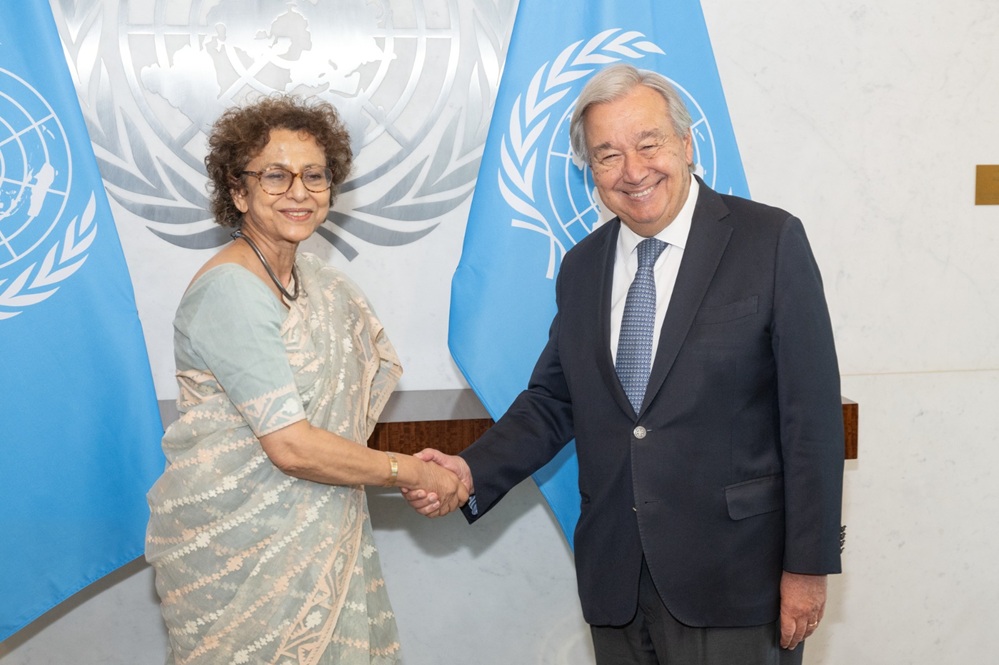
Shibbir Ahmed, UN, New York: Irene Zubaida Khan, a veteran international human rights advocate, has taken office as Bangladesh’s Permanent Representative to the United Nations in New York. Khan presented her credentials to United Nations Secretary-General António Guterres at UN Headquarters in New York on Friday, formally assuming her role as Bangladesh’s envoy to the world body.

She brings decades of experience in human rights, international law, refugee protection, the rule of law and sustainable development, including senior roles at the United Nations and other international organizations.

Before taking up her new role, Khan had served since 2020 as the UN Special Rapporteur on the promotion and protection of the right to freedom of opinion and expression. From 2001 to 2009, she served as Secretary-General of Amnesty International, becoming the first woman to lead the organization.

From 2012 to 2019, Khan served as Director-General of the International Development Law Organization (IDLO). Earlier in her career, she spent 21 years with the Office of the United Nations High Commissioner for Refugees (UNHCR), holding a number of senior positions including Chief of Mission in India and Deputy Director of the Division of International Protection.

Khan received the Sydney Peace Prize in 2006 and is the author of The Unheard Truth: Poverty and Human Rights. She studied law at the University of Manchester and Harvard Law School.


China-Bangladesh sign MoU to strengthen vocational education, training

DHAKA: A Memorandum of Understanding (MoU) has been signed to establish the ‘China-Bangladesh Vocational Education, Training and Research Center’. The MoU was signed today at the ‘China-Bangladesh Education Exchange Conference’ organized by the Jiangxi Provincial Government and Jiangxi Science and Technology Normal University of China.

Secretary of the Technical and Madrasa Education Division Md. Daud Mia signed the MoU on behalf of Bangladesh, while Professor Zheng Pengwu of Jiangxi Science and Technology Normal University signed it on behalf of China.

Education Minister Dr. A N M Ehsanul Hoque Milonand Prime Minister’s Adviser on Education Dr. Mahdi Amin were present at the event. Three major cooperation platforms were formally inaugurated at the conference. Education Minister and Deputy Director of the Jiangxi Provincial Department of Education Fan Honghui jointly inaugurated the ‘China-Bangladesh Vocational Teacher Training Center’.

Prime Minister’s Adviser on Education Mahdi Amin and Professor Pei Hongwei of the university inaugurated the ‘Bangladesh Vocational Education Research Center’, while Secretary Md. Daud Mia and Professor Zheng Pengwu inaugurated the ‘Bangladesh Chinese Language Skill Development’ Center.

Addressing the conference, Education Minister said, “The young population of Bangladesh is the country’s greatest strength. Through quality technical education and modern technological training, they can be transformed into a world-class skilled workforce.”

He added that with China’s modern experience and technical assistance, Bangladesh’s education sector will reach new heights. “Technical and vocational education must remain closely aligned with the real needs of industry and employment,” he said.

He called for stronger Bangladesh-China cooperation in curriculum development, teacher training, institutional partnerships, modern technology, practical education and employment-oriented education.

Mahdi Amin said, “Today’s signing of the MoU marks the beginning of a new chapter in Bangladesh-China cooperation in technical education. Our main objective is to transform education into skills, skills into employment, and employment into economic opportunities.”

Representatives of 19 universities, technical institutions and industries from Jiangxi Province attended the conference, where both sides pledged to build a sustainable partnership through industry-education linkages, teacher training, joint research and student exchanges.


Putin congratulates President Mirza Fakhrul

DHAKA: Russian President Vladimir Putin has congratulated newly elected Bangladesh President Mirza Fakhrul Islam Alamgir, wishing him success in serving the people of Bangladesh. In a congratulatory message, the Russian President extended his best wishes to his Bangladeshi counterpart on his election as President of the People’s Republic of Bangladesh, said the Russian embassy here.

Putin wished President Mirza Fakhrul well-being, sound health and success in his future endeavours for the benefit of the friendly people of Bangladesh. The message reflects the longstanding friendly relations between Bangladesh and Russia.