Special Investigative Report: How NY Is Spending $2B to Save Manhattan From Rising Seas

Shibbir Ahmed, New York — When nature retaliates, even the most powerful cities on Earth can find themselves utterly defenseless. New York remains a grim witness to this reality. During those ill-fated 48 hours of Hurricane Sandy in 2012, 44 New Yorkers lost their lives, two million people were plunged into sudden darkness, and $19 billion in wealth evaporated in the blink of an eye. Standing on those very ruins, New York has refused to surrender.

Instead, the city has launched an unprecedented “climate war.” To suppress the ravenous waves of the Atlantic and the relentlessly rising sea levels, a massive $2 billion (approx. 24,000 crore BDT) megaproject is being carved directly through the Manhattan waterfront.

A recent on-site report by the United Nations has revealed the thrilling realities of this ultra-modern engineering feat—a saga blending science, architecture, and the raw survival of millions.

An Impregnable Fortress Disguised as a Park

The most magical transformation of this master plan is unfolding across Manhattan’s historic East River Park. Just north of the Williamsburg Bridge, the roar of giant cranes and heavy machinery echoes day and night. Millions of tons of specialized soil brought from the riverbed are being deposited to raise the entire park up to 10 feet (3 meters) above sea level.

Yet, what meets the eye is only one-third of the actual reality. Below the surface lies an invisible, titanic shield. Extending 100 feet (30 meters) deep into the reclaimed earth along the riverbank are massive concrete and steel piles. These piles were driven with immense force, crushing ancient shipwreck remains and forgotten piers to anchor themselves directly into bedrock. Right above them runs a colossal, hidden floodwall. While it appears to be an ordinary recreation park on top, it conceals a state-of-the-art fortress beneath.

Preparing for the Surge: When the City Locks Down Automatically

The impacts of climate change are no longer a distant future; they are a merciless present-day reality. Data from the World Meteorological Organization (WMO) indicates that the rate of global sea-level rise has doubled since satellite measurements began in 1993. For a city boasting 520 miles of coastline, the ultimate threat is no longer just a singular superstorm, but the creeping menace of the everyday high tide.

Kathryn Prybylski, New York City’s Assistant Commissioner of the Bureau of Coastal Resilience, issued a stark warning: “Without these walls, many New Yorkers would face regular tidal flooding in the decades ahead—once, twice, or even 10 times a month. It would disrupt daily commutes and change how people send their children to school.”

To counter this, the entire system has been engineered with incredible foresight. If a severe storm approaches, no human deployment will be required inside the park itself. Elsewhere along the waterfront, 18 massive sliding floodgates will be swung shut, while farther south, nearly 100 mechanical ‘flip-up’ barriers will rise from the ground to block incoming surges. The blueprint successfully factors in an extra 30 inches (76 centimeters) of sea-level rise. With 90 percent of the project now operational, the city stands structurally prepared for volatile weather events.

Global Disparity: The Luxury of Rich Cities vs. the Anguish of South Asia

While New York’s $2 billion megaproject wins global applause, it simultaneously exposes a cruel, naked economic disparity in global climate politics. The United Nations has explicitly pointed out that wealthy megacities like New York, Miami, or Guangzhou possess the capital to build multi-billion-dollar defenses to save themselves. But for low-lying, developing cities in South Asia, the roar of rising seas is an immediate death knell.

According to UN reports, permanent inundation puts more than 14 million people across South Asia—particularly in low-lying hubs like Dhaka, Kolkata, and Mumbai—at catastrophic risk of losing their homes forever. Pacific island communities in Fiji, Vanuatu, and the Solomon Islands have already begun fleeing their ancestral lands.
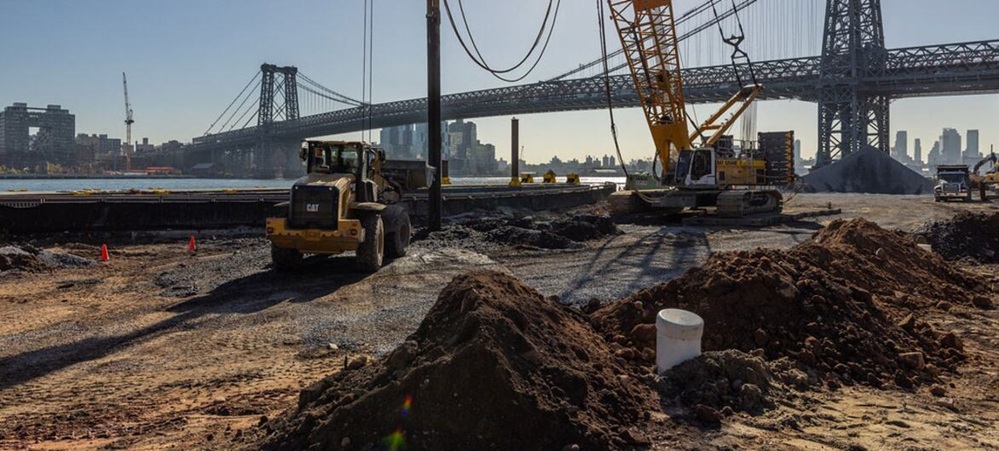
Heavy equipment is used in the construction of flood defences along the East River in New York City. Photo: NYCDDC

Navid Hanif, a representative from the UN’s Department of Economic and Social Affairs (DESA), noted: “What New York is doing is a commendable step forward and a message to all big cities. But it is also a reminder that funding must be accessible so that less developed nations are not left to drown.”

Life Beyond the Wall: Where Dreams Flourish

The most beautiful aspect of this project is that it is not a concrete jungle built at the expense of the environment. The newly elevated East River Park is carpeted with lush green lawns. It features modern running tracks, children’s playgrounds, sports fields, and community barbecue spots. In the evenings, as the sun sets over the Brooklyn skyline, local residents gather to walk their dogs and breathe freely.

Liz, a neighborhood resident walking her dog, shared her thoughts: “We’re in this park twice a day, every day. We love it! We don’t always think about what is built underneath, but the beautiful life we enjoy on top is a perfect example of how climate resilience can help people enjoy their lives.”

As New York races toward its final 2027 completion date, this project offers a definitive message to the world: fighting climate change does not mean simply cowering in fear of the ocean. It means adapting intelligently, embracing nature, and elevating the very quality of human life.


UN Biodiversity Summit COP17: Nations Agree to Nature Goals

Shibbir Ahmed, New York – Nearly 200 nations struck hard-fought agreements Friday at a UN biodiversity summit, but the outcome was accompanied by disappointment over missed opportunities to address humanity’s destructive toll on nature. Delegates cheered as crucial texts were approved in overtime but the celebrations were tempered by acrimonious debates and regret over limited progress on some of the most contentious issues.

The COP17 summit in Armenia sought to revive a landmark commitment to halt and reverse the destruction of nature by 2030 after global efforts to meet that goal fell short. Over two bruising weeks in Yerevan, nations were urged to correct course to keep the pact alive and protect the plants, animals and ecosystems that sustain life on Earth. The United Nations had warned that progress was insufficient to meet the goals of the 2030 target including protecting 30 percent of Earth’s land and oceans, tackling pollution and invasive species, and boosting money for conservation.

“And that’s it. Perfect,” said COP17 president Hambardzum Matevosyan in Armenia as he brought down the gavel on two major texts, the final versions of which were still not available early Saturday. But the outcome was “not commensurate” with the crisis engulfing the natural world, said French Ecological Transition Minister Monique Barbut early Saturday as the summit drew to a close.

“The progress we failed to achieve here is a series of missed opportunities to speed up our response to the loss of biodiversity,” Barbut said in a lengthy statement sent to AFP, stressing that “nature will not wait for the pace of our negotiations.”

The final plenary stretched through Friday night and well into the next morning, with negotiations turning sour as the hours dragged on. Even as some delegates left to catch flights, others stayed behind to argue technical points. Veteran COP observer Juliette Landry from the IDDRI think tank told AFP “there was a lot of push and pull in every direction” throughout the summit and “in that context, it’s hard to get things accepted”.

In a draft agreement of one closely watched text, nations were urged to “accelerate” their efforts and warned that “increased action” was needed to tackle the forces driving biodiversity loss. This “represents a positive outcome… and though there are weaknesses, particularly on harmful subsidies, it does represent a step forward,” Guido Broekhoven from WWF International told AFP. Tackling subsidies and other incentives that encourage activities harmful to nature — such as fossil fuels, intensive agriculture and overfishing — was one of the most politically fraught agenda items at the summit.

“Even though the agreed decision text expresses it in weak terms, COP17 saw important political momentum to address harmful financial incentives, including subsidies,” An Lambrechts from Greenpeace International told AFP. A rare fight over science cast a pall over the summit, with a number of countries accused of undermining efforts to approve key reports in scenes that shocked even seasoned negotiators.

“We regret the increasing instances in which scientific evidence and its uptake has been challenged or constrained” by politics, said Swiss negotiator Gabriela Blatter in a statement on behalf of dozens of countries.

“Our delegations fully respect every state’s right to safeguard national interest but science is not negotiable”.

A separate row revolved around finding new cash sources to fund conservation efforts — another hot-button issue with public budgets under strain amid an energy crisis and conflicts in Ukraine and the Middle East. The European Union led a charge for wealthy emerging economies such as China to contribute to global conservation efforts, a contentious issue at COP17.

In a sign of possible compromise, another draft text that circulated Friday invited countries outside the developed-country donors to voluntarily join the group. Outstanding questions over the design of the Cali Fund — a UN mechanism that hoped to attract billions of dollars in corporate contributions but is close to empty — were left unresolved.

“By punting essential decisions to two years from now, parties have all but ensured the fund remains empty until then,” said Pakhi Das from the nonprofit organisation Plant-for-the-Planet. The COP17 summit decided early Saturday that Ecuador would host the next biodiversity talks in 2028 after the South American nation defeated rival candidate Panama in a secret vote.


UN Grants Bangladesh Three More Years Before LDC Graduation

Shibbir Ahmed, New York – The United Nations General Assembly (UNGA) has granted Bangladesh a three-year deferment of its graduation from the Least Developed Country (LDC) category, extending the country’s preparatory period until November 24, 2029. Nepal has also received a similar extension. The decision followed extensive discussions during the 81st session of the UN General Assembly in New York, after both countries requested additional time to prepare for the economic and trade-related challenges associated with graduation.

The Bangladesh Nationalist Party-led government submitted its request to the UN Committee for Development Policy (UNCDP) two days after assuming office on February 19, 2026, seeking more time to implement essential reforms and strengthen key economic sectors. In its resolution, the United Nations acknowledged the serious challenges confronting Bangladesh, particularly the heightened uncertainties arising from recent conflicts and disruptions to international energy supplies and global supply chains.

The UN cited uncertainties in global trade, the lingering effects of recent economic shocks and longstanding domestic vulnerabilities as reasons for granting the additional preparatory period.

The resolution also acknowledged that Bangladesh’s recent political transition had created a complex set of circumstances requiring consideration, although domestic political transitions are not normally recognised under the existing LDC graduation framework as grounds for extending preparatory periods.

The UN further observed that domestic challenges can intensify the effects of external shocks and limit a government’s ability to respond effectively. As part of the extended period, Bangladesh has been encouraged to accelerate domestic reforms and implement a national Smooth Transition Strategy. The UN system, together with bilateral, regional and multilateral development and trading partners, was called upon to support the process.

Bangladesh will also be required to provide regular updates on the implementation of its transition strategy in its annual reports to the UNCDP. Following Bangladesh’s request, the UNCDP established a panel to examine the matter during its 28th plenary session in February at UN Headquarters in New York. The UN Economic and Social Council (ECOSOC) subsequently recommended further consideration of the issue by the General Assembly.

Commerce Minister Khandakar Abdul Muktadir recently said Bangladesh’s request received broad support during the 81st UNGA session, including backing from G-77 countries and the European Union.

The three-year deferment is expected to provide significant breathing room for Bangladesh’s export-oriented industries. Bangladesh had been preparing to graduate from the LDC category, a move that could have resulted in higher tariffs and the gradual loss of preferential market access in several major export destinations.

According to the information presented in the report, Bangladeshi exporters currently enjoy duty-free market access in 38 countries and trade blocs under LDC-specific arrangements. Approximately 73 percent of the country’s total exports benefit from these preferences. The deferment is expected to help businesses prepare for increased international competition, adjust to changing trade conditions and strengthen their competitiveness before the transition.

Bangladesh was originally scheduled to graduate from the LDC category in 2026 after meeting all three UN graduation criteria: gross national income (GNI) per capita, the Human Assets Index (HAI) and the Economic Vulnerability Index (EVI).

According to the UN Department of Economic and Social Affairs, Bangladesh’s GNI per capita stood at $2,684 in the 2024 triennial review. The country scored 77.5 on the HAI and 21.9 on the EVI, meeting the required thresholds in all three areas. Bangladesh first met the graduation criteria in March 2018 and received the final recommendation for graduation following the UNCDP’s second triennial review on February 22–26, 2021. The country had previously received a two-year extension because of the COVID-19 pandemic.

Under UN rules, an LDC must meet at least two of the three graduation criteria and maintain the required performance through two consecutive triennial reviews conducted by the UNCDP. Bangladesh’s latest deferment highlights the challenges of managing the transition while protecting the economic and social progress achieved over several decades.

As the world’s largest LDC economy and a major beneficiary of international development and trade preferences, Bangladesh faces the complex task of strengthening its domestic economy while preparing for a new phase of global trade competition.

The extended preparatory period is expected to give the government, exporters and development partners additional time to address structural weaknesses and ensure a smoother transition out of the LDC category.


Irene Khan Calls for Women’s Greater Role in Peacebuilding

New York – Bangladesh’s Permanent Representative to the United Nations Ambassador Irene Zubaida Khan has called for meaningful women’s participation in peace processes and decision-making emphasising that grassroots initiatives are vital to preventing violence and building lasting peace. Speaking at the UN Security Council’s open debate on Women, Peace and Security (WPS) on Wednesday, Ambassador Khan recalled Bangladesh’s role as a key co-sponsor of Security Council Resolution 1325 and reaffirmed the country’s commitment to the WPS agenda.

She highlighted Bangladesh’s National Action Plan on WPS, introduced six years ago. Following the completion of its first phase, Bangladesh is now implementing the second phase, with consultations involving stakeholders, particularly civil society and women’s groups, remaining a key feature of the process. Ambassador Khan underscored the importance of training and sensitising girls and young women on violence prevention and supporting their active participation in community-level mediation. She stressed that grassroots efforts can prevent disputes from escalating into wider conflicts, noting that Bangladesh is prioritising these initiatives through government and NGO programmes.

She also called for greater investment in women’s organisations and human rights defenders, protection for women in conflict-affected settings, and predictable, sustained financing for peace operations and vulnerable communities. Emphasising a gender-centred approach to security, Ambassador Khan stressed that women must have a meaningful voice in peace negotiations, political leadership and decision-making. She urged the international community to translate WPS commitments into concrete action to advance inclusive and sustainable peace.


UN Votes to End US Embargo on Cuba, but Support Falls Sharply

Shibbir Ahmed, New York — The United Nations General Assembly on Wednesday adopted a resolution calling for an end to the United States’ decades-old economic, commercial and financial embargo against Cuba, but international support for the measure declined significantly compared with last year. The resolution received 130 votes in favor, 17 against and 25 abstentions. In 2025, the measure received 165 votes in favor, seven against and 12 abstentions, marking a substantial shift in the Assembly’s voting pattern.

The annual vote reflects the international community’s long-standing opposition to the embargo, which dates back to 1960. However, the resolution is not legally binding and does not require the United States to lift its restrictions.

The latest vote marked the lowest level of support for the resolution since the mid-1990s. Several countries that had traditionally supported the measure abstained this year, including Germany, Italy and Latvia. A number of countries also voted against the resolution, including some that had not previously opposed it in recent years. The changes came amid a renewed US diplomatic effort to persuade governments to reconsider their positions.

US Ambassador to the United Nations Mike Waltz welcomed the shift in voting, describing it as evidence that Washington’s arguments were gaining support. The United States maintains that Cuba’s economic difficulties stem primarily from its government’s policies and political system.

Cuban Foreign Minister Bruno Rodríguez Parrilla defended the resolution, arguing that US restrictions have contributed to shortages of fuel, medicines, food and other essential goods. Rodríguez said the effects of the embargo extend beyond government finances and directly affect Cuban families and patients who depend on access to essential supplies.

Cuba has repeatedly argued that the restrictions violate its sovereignty and undermine its ability to trade freely with other countries. Havana has also criticized Washington for increasing economic pressure on the island. The US government rejects Cuba’s characterization of the sanctions, arguing that its policy is intended to challenge the Cuban government rather than punish ordinary citizens.

The General Assembly has voted annually on a resolution calling for an end to the embargo since 1992, with the exception of 2020 during the COVID-19 pandemic. Support reached 191 votes in favor in 2015, 2016 and 2017, when relations between Washington and Havana briefly improved.

The dispute has intensified as Cuba faces severe economic difficulties, including fuel shortages, power outages and shortages of basic goods. The US administration has also increased pressure on Havana and raised the possibility of further action against the Cuban government. The issue prompted heated exchanges between US and Cuban representatives during the Assembly’s debate this week, highlighting the growing diplomatic tensions between the two countries.

Although the General Assembly resolution cannot compel Washington to change its policy, the annual vote remains an important indicator of international opinion on the embargo. Lifting the US embargo would require action through the US legal and political system, including Congress where applicable. The latest vote therefore renews international pressure on Washington but does not itself change the restrictions.

The decline in support, however, signals a notable diplomatic shift and gives the United States an opportunity to argue that opposition to its Cuba policy is no longer as broad as in previous years.


Mike Waltz Clashes With Cuban Foreign Minister at UN Over US Embargo

Shibbir Ahmed, New York – A heated confrontation erupted between U.S. Ambassador to the United Nations Mike Waltz and Cuban Foreign Minister Bruno Rodríguez Parrilla during a General Assembly debate on Tuesday over the longstanding U.S. economic embargo against Cuba. Waltz was criticizing the Cuban government when members of the Cuban delegation began shouting objections and banging on their table. The dispute escalated when Rodríguez Parrilla approached the podium and challenged the U.S. ambassador’s remarks.

“This individual needs to back away from this podium,” Waltz shouted, adding that he would not be intimidated in the United States. Waltz also insisted that, as the representative of the United States, he would not allow Cuban officials to silence him or his colleagues. Rodríguez Parrilla responded by accusing the American envoy of lying and called for him to be held accountable for his remarks.

General Assembly President Khalilur Rahman attempted to restore order and temporarily suspended the meeting. The Cuban delegation was subsequently given an opportunity to raise a procedural objection before Waltz resumed and completed his address.

The confrontation took place during the annual debate on a resolution calling for an end to the U.S. embargo against Cuba. Washington has defended its policy by citing concerns about political repression and human rights in Cuba, while Havana argues that the restrictions contribute to the island’s economic hardship. The exchange underscored the continuing diplomatic tensions between the two countries as the General Assembly considered the embargo resolution.


Michael Rubin Questions UN Role in Bangladesh’s 2024 Political Crisis

Shibbir Ahmed , New York – American analyst Michael Rubin has questioned the United Nations’ role in assessing the violence surrounding Bangladesh’s July–August 2024 uprising and the fall of former Prime Minister Sheikh Hasina. Rubin alleges that the UN’s death toll and its broader interpretation of the crisis warrant greater scrutiny and transparency. Rubin argues that international officials have not adequately examined the role of Islamist political groups in Bangladesh’s political transition. He also questions whether Western governments and the United Nations have approached allegations against Hasina’s government with sufficient impartiality.

Rubin’s article highlights a discrepancy between the UN’s estimate of approximately 1,400 deaths during the 2024 unrest and a figure of around 800 deaths that he attributes to the Awami League. He calls on international officials to publish a comprehensive list identifying those killed, along with evidence supporting the reported figures. According to Rubin, such disclosure would allow the public and independent investigators to examine the numbers and the circumstances surrounding the deaths.

Rubin compares Bangladesh’s political transition with the Iranian Revolution of 1979 and Egypt’s political upheaval in 2013. He argues that international policymakers should carefully assess the potential influence of Islamist political movements and their implications for secular governance, democracy and social tolerance. He also raises concerns about Jamaat-e-Islami, referring to the party’s historical role during Bangladesh’s 1971 Liberation War. Rubin contends that international responses to Bangladesh’s political crisis have insufficiently addressed the risks he associates with Islamist political influence.

Following Hasina’s removal from office in August 2024, Nobel Peace Prize laureate Muhammad Yunus led Bangladesh’s interim administration. Rubin questions the relationship between Yunus, international officials and the political narrative surrounding the uprising. He also criticizes UN Secretary-General António Guterres and Western officials, arguing that the organization should disclose the evidence and methodology underlying its casualty estimates.

The central issue, according to Rubin, is whether international assessments of the crisis have been sufficiently transparent and impartial.

Rubin calling for a political process that allows competing parties to participate freely in elections. He argues that Bangladesh’s future should protect democratic participation, secular governance, economic development and social tolerance. His remarks makes serious allegations about the United Nations and the political forces involved in Bangladesh’s transition.


Irene Khan Calls for Human Rights at the Center of Economic Policy

Shibbir Ahmed, New York – Bangladesh’s Permanent Representative to the United Nations Ambassador Irene Zubaida Khan called for placing human rights at the centre of economic policymaking and governance during a high-level dialogue titled “The Political Economy of Human Rights” held at UN Headquarters today. Ambassador Khan emphasized that economic progress must be measured not merely by growth but by its contribution to equality, human dignity and the realization of fundamental rights. She underscored the need for equitable taxation, affordable development financing, debt sustainability and reforms of the international financial architecture.

UN High Commissioner for Human Rights Volker Türk highlighted growing concentrations of economic and political power, rising military expenditure, mounting debt burdens and widening inequalities that are sending back human rights. Speakers stressed the need for fairer international tax system, equitable debt restructuring, accountable economic governance and meaningful civil society participation to address structural inequalities and protect vulnerable communities.

Discussions examined how conflicts, excessive debt-servicing costs and declining development assistance constrain investments in education, healthcare, social protection and sustainable peace.
The event brought together Ambassadors Omar Hilale (Morocco), Laura Dupuy Lasserre (Uruguay), Mxolisi Nkosi (South Africa) and Stavros Lambrinidis (European Union) alongside human rights expert Ignacio Saiz, Professor Sakiko Fukuda-Parr and UN Independent Expert Attiya Waris.

Jointly organized by the Permanent Missions of Bangladesh, Morocco, South Africa and Uruguay, the dialogue emphasized the need to embed human rights principles in international economic governance and future global development frameworks beyond 2030.


Sheikh Hasina Appeals to UN Experts to Lift Ban on Awami League

Shibbir Ahmed, New York — Former Bangladesh Prime Minister Sheikh Hasina has submitted a formal communication to United Nations human-rights experts challenging the continued ban on the activities of the Bangladesh Awami League and seeking urgent international intervention, according to an announcement published by British barristers’ chambers Matrix Chambers on Tuesday.

The communication was submitted on Hasina’s behalf by barrister Steven Powles KC. It challenges restrictions imposed on the Awami League and argues that excluding the country’s former ruling party from political activities undermines fundamental rights, democratic participation and the ability of citizens to participate in public affairs.

According to Matrix Chambers, the submission questions the legality and proportionality of the restrictions and argues that the continued exclusion of the Awami League from electoral politics raises serious concerns about Bangladesh’s democratic process.

The communication reportedly cites provisions of the International Covenant on Civil and Political Rights, including protections for freedom of expression, peaceful assembly, association and participation in public affairs. It argues that the restrictions violate these internationally recognised rights and calls for action to address the situation.

The submission has reportedly been directed to three United Nations human-rights mandate holders: the Special Rapporteur on the promotion and protection of human rights while countering terrorism, the Special Rapporteur on the rights to freedom of peaceful assembly and of association, and the Independent Expert on the promotion of a democratic and equitable international order.

The communication urges the experts to examine the allegations and calls for free, fair and inclusive elections in Bangladesh. It also raises concerns about the political consequences of excluding a major political party and the ability of its supporters to exercise their fundamental rights.

The Awami League’s activities were prohibited by Bangladesh’s interim administration on May 12, 2025, pending the completion of proceedings against its leaders and activists before the International Crimes Tribunal. The restrictions cover the party’s political activities and have remained a contentious issue in the country’s political landscape.

The dispute comes amid continuing debates over accountability for alleged crimes during the former government, the treatment of political opponents and the restoration of democratic institutions. The communication challenges the restrictions on human-rights grounds, but its allegations and legal arguments should not be treated as findings already established by the United Nations.

UN Special Rapporteurs and independent experts can raise alleged violations with governments, request information and issue public statements. However, they do not have the direct authority to overturn domestic legal measures or independently order Bangladesh to restore the Awami League’s activities.

The submission therefore represents an attempt to bring international scrutiny to the restrictions rather than a confirmed decision by the United Nations to lift the ban. As of October 27, Matrix Chambers’ announcement did not report any decision by the UN experts on the specific communication.

The development could bring renewed international attention to the political and human-rights situation in Bangladesh, particularly questions concerning political participation, due process and the conditions necessary for inclusive elections.


UN Inquiry Accuses Russia of War Crimes in Ukraine

Shibbir Ahmed, Washington DC — A United Nations-backed commission of inquiry has concluded that Russian authorities committed war crimes and crimes against humanity by deliberately attacking Ukraine’s energy infrastructure, leaving millions of civilians without electricity, heating and other essential services during freezing winter conditions.

In a report presented on October 26, the Independent International Commission of Inquiry on Ukraine said repeated Russian attacks on power plants, heating facilities, gas infrastructure and electricity networks had caused extensive damage and severe hardship for civilians. The findings cover attacks dating back to autumn 2022, with particular attention to their impact during the winter of 2025–2026.

According to the commission, temperatures fell to minus 21 degrees Celsius in parts of Ukraine during the previous winter, while millions of people endured prolonged interruptions to electricity, heating, water and gas supplies. The resulting conditions placed older people, individuals with disabilities and hospital patients at particular risk. Power outages left some elderly residents unable to use elevators or reach shelters during air raids, while patients dependent on electricity-powered medical equipment faced potentially life-threatening situations.

The commission said Russian military commanders knew that the heating facilities targeted in major population centers were essential to civilian life, especially during winter. It concluded that deliberately directing attacks against civilian infrastructure constituted war crimes and that the resulting severe suffering amounted to crimes against humanity. The investigation drew on testimony from 255 people who experienced the winter conditions in Kyiv and eight other Ukrainian regions, alongside information from government officials, medical professionals and civil society organizations. Commission chair Erik Mose warned that renewed attacks as another cold season approaches pose serious risks to civilian lives and health.

The report also found evidence that Russian authorities recruited men from 29 countries into the Russian armed forces through deception or coercion, in violation of international law. Investigators said some recruits were reportedly offered civilian employment or other opportunities before being taken to Russia and pressured into signing military contracts written in Russian. Many came from economically vulnerable backgrounds, according to the commission.

The inquiry said the recruitment practices involved agents and agencies operating in different countries. It called for people who had been victims of human trafficking to be released from the Russian armed forces.

Russia rejected the commission’s conclusions. According to The Associated Press, Russia’s U.N. mission said Moscow did not recognize the commission’s mandate and described its findings as based on falsified data. Russia has maintained that its military targets military or military-related facilities in Ukraine.

The commission also examined Ukrainian attacks on energy facilities in Russia and Russian-occupied parts of Ukraine. However, it said it could not fully investigate their consequences because Russia did not provide access to the relevant territories or respond to requests for information. The findings add to international scrutiny of the conduct of the war as Ukraine prepares for another winter amid continued threats to its energy supplies and civilian infrastructure.