Bangladesh redesigning primary healthcare system with a focus on prevention: Zubaida

Shibbir Ahmed, New York – Ziaur Rahman Foundation Vice-President and eminent physician Dr Zubaida Rahman on Thursday said Bangladesh is redesigning its primary healthcare system around prevention, early identification and continuity of care, with a stronger frontline workforce and professional midwives at the centre of the transformation.

“Our vision of a Healthy Bangladesh is to move from a treatment-centred system to one that emphasises prevention, early identification and continuity of care, with services closer to people’s homes,” she said.

Addressing a high-level side event titled “From Commitment to Action: Integrating Midwifery into Primary Health Care to End Preventable Maternal and Newborn Deaths” at United Nations Headquarters in New York, Zubaida outlined Bangladesh’s ongoing and planned initiatives to transform its Primary Health Care (PHC) system.

Bangladesh, she said, is working towards an integrated PHC network extending to rural unions and urban wards, supported by a stronger frontline workforce and digital health services.

“Women and children are at the centre of this transformation,” she said.

Zubaida said recruitment of 25,000 professional midwives has already begun, stressing that the initiative is aimed not merely at increasing their number but at integrating them into multidisciplinary PHC teams.

“Our objective is not simply to increase their numbers. We want to integrate them into multidisciplinary PHC teams and provide continuity of care from preconception and pregnancy through childbirth, postnatal and newborn care,” she said. The PHC model presented at the discussion places midwives at the centre of the maternal healthcare journey and seeks to move Bangladesh’s health system from fragmented services towards an integrated and accountable platform, she said.

The platform will connect households and communities with primary healthcare facilities and, when necessary, with secondary, tertiary and specialised care through a functioning referral system, Zubaida said. She said midwife-led PHC could advance three priorities for Bangladesh: better access, stronger financial protection and better value in healthcare.

“It can bring essential care closer to women, reduce unnecessary interventions and out-of-pocket expenditure, and ensure respectful care at the right place and at the right time,” she said. Zubaida said Bangladesh’s approach reflects its broader effort to put people at the centre of development and build a modern health system around prevention, dignity and access. The vision, she said, is to ensure that women receive continuous care throughout the maternal journey rather than accessing fragmented services at different stages.

“Every woman should have access to a skilled professional midwife as part of her PHC team, close to where she lives,” she said, outlining the ambition that guided the discussion. Zubaida said the approach is also intended to provide a model for countries to learn from one another while developing solutions suited to their respective health systems.

“Professional midwives save lives. Our task now is to build health systems that enable them to do so effectively, equitably and sustainably,” she said. Bangladesh looks forward to continuing its engagement with governments, UN agencies, development partners and the global health community to turn the dialogue into practical action, she said.

The discussion brought together health ministers and senior representatives from Sierra Leone, Nepal, Thailand, Indonesia, the Philippines and other countries, along with UN agencies, development partners, professional organisations, civil society representatives and members of the global health community. The event was organised in partnership with the Government of Sweden and the United Nations Population Fund (UNFPA).


Primary healthcare at heart of vision for ‘Healthy Bangladesh’: PM

Shibbir Ahmed, New York – Prime Minister Tarique Rahman on Thursday said his government wants to build a “Healthy Bangladesh” where healthcare begins at home and in the community, placing primary healthcare at the centre of the country’s health reform agenda with particular emphasis on women and children.

“My government is transforming our health system, guided by a simple principle: ‘Prevention is better than cure.’ We want to build a Healthy Bangladesh, where healthcare begins in the home and community,” he said.

The Prime Minister made the remarks while opening a high-level side event titled “From Commitment to Action: Integrating Midwifery into Primary Health Care to End Preventable Maternal and Newborn Deaths” at United Nations Headquarters in New York.

Bangladesh co-hosted the event with Sweden in partnership with the United Nations Population Fund (UNFPA) on the sidelines of the 81st session of the United Nations General Assembly. The event focused on integrating professional midwifery into primary healthcare to improve maternal and newborn care and reduce preventable deaths.

Tarique Rahman outlined plans to strengthen community-based primary healthcare and expand the role of professional midwives as members of multidisciplinary primary healthcare teams.

He said his government intends to recruit 100,000 additional health workers, 80 percent of whom will be women, to connect families with the health system, identify health risks at an early stage and facilitate timely care.

“One professional has a particularly important role in this continuum: the midwife,” he said.

“A professional midwife can become a woman’s trusted health professional from preconception through the postnatal period,” he added.

The Prime Minister said the government has decided to recruit 25,000 professional midwives across Bangladesh and that the process has already begun. He said the midwives would provide essential reproductive healthcare, support antenatal care, promote safe and respectful childbirth, identify complications early and facilitate referrals. They would also support mothers and newborns through breastfeeding, immunisation and healthy childhood development, he said.

Tarique Rahman said Bangladesh had built an important foundation for professional midwifery, including through professional midwifery education, stronger regulation and deployment of midwives at district, sub-district and union-level facilities.

“We now have more than 11,000 licensed midwives, with the objective of reaching 25,000 by 2030,” he said. He also acknowledged the contribution of Sweden and UNFPA to the development of professional midwifery in Bangladesh.

With UNFPA’s cooperation, Bangladesh has expanded midwifery-led care across 22 districts, where skilled midwives have supported more than 154,000 births and managed critical maternal cases, he said.

“These are not merely statistics. They represent mothers returning home safely, and newborns beginning life with hope,” the Prime Minister said. He also outlined the government’s plan to develop an integrated digital health ecosystem under which every citizen would have a Health Card linked to a digital health record and electronic referral system.

“For a woman in rural Bangladesh, her care can be registered close to home, her visits tracked, and her risk factors recorded. If referred to a higher-level hospital, the necessary information should travel with her,” he said.

The Prime Minister said the government’s vision for women’s health extends beyond pregnancy and childbirth and covers women’s health throughout the life course. This includes adolescent health, reproductive health and family planning, as well as prevention and early detection of cervical and breast cancers, he said. “Midwifery must therefore be part of a broader platform for women’s health within Primary Health Care,” Tarique Rahman said. He stressed that the next phase of the initiative should be driven by national ownership and sustainable domestic investment.

“As we open today’s discussion, I leave you with one ambition: Every woman should have access to a skilled professional midwife as part of her Primary Health Care team, close to where she lives,” he said.

“For Bangladesh, this means deploying midwives nationwide, strengthening community health services and referral pathways, and connecting citizens through a modern digital health system,” he added.

“Together, these steps will help us build a healthy, thriving Bangladesh. And this is how we move from commitment to action,” the Prime Minister said.

The event brought together ministers, UN agencies, development partners and health experts to discuss ways of translating commitments on midwifery and primary healthcare into sustainable investments and stronger health systems. UNFPA described the integration of midwifery into primary healthcare as a key strategy for expanding equitable, high-quality and dignified maternal and newborn care.


PM to present Bangladesh’s vision, people’s aspirations at UNGA

Shibbir Ahmed, New York – Prime Minister Tarique Rahman will present Bangladesh’s vision for the future, national interests and aspirations of its people at the global forum of the United Nations General Assembly, with a focus on ensuring inclusive development, said PMO Spokesperson Mahdi Amin.

“Carrying the patriotism, emotions, sentiments and aspirations of the people, Prime Minister Tarique Rahman will present before the global community what Bangladesh’s vision for the future should be, how the country’s interests can be safeguarded and how inclusive development can be ensured,” he said.

Mahdi Amin made the remarks at a press conference in the lobby of the Hyatt Grand Central New York hotel at 9:00pm local time today after the premier arrived in New York to attend the UN General Assembly. He said the prime minister has arrived in New York on a historic visit as the head of a representative government elected by the people’s vote after a long time.

Referring to the historical context, he said, “Shaheed President Ziaur Rahman and Begum Khaleda Zia had presented Bangladesh’s position, vision and plans before the global community. As part of that historical continuity, their son, Prime Minister Tarique Rahman, will likewise uphold the spirit of patriotism and present Bangladesh’s interests and rights on the global stage.”

Mahdi Amin said the prime minister will deliver his address at the UN General Assembly on Thursday. Describing the prime minister’s visit as a very brief one, the spokesperson said he was moving away from the usual practice of lengthy foreign visits and would stay in New York for only a short period.

“Excluding the two days spent on travel, he will stay in New York for only four working days and will attend a number of bilateral and multilateral meetings,” he said. Regarding the size of the delegation, Mahdi Amin said the prime minister had completely broken away from the traditional practice and arrived with a small delegation for the brief visit.

“Officially, there are only 35 people here. Besides them, there are only essential media, security and personal staff. Prime Minister’s wife Dr Zubaida Rahman is also accompanying him,” he said. Informing that the prime minister’s official engagements will begin Tuesday, he said he would attend the opening session at the UN Headquarters at 9:00am, where heads of state and government of different countries will be present.

Earlier in the morning, he will attend a “Welcome Breakfast Reception” hosted at the invitation of the UN Secretary-General. PM’s Press Secretary AAM Saleh Shibly, Additional Press Secretary Atikur Rahman Ruman and Bangladesh’s Deputy Permanent Representative to the United Nations A K M Wahiduzzaman were also present at the press conference.


Biman Bangladesh Airlines Orders 11 More Boeing Aircraft in New York

Shibbir Ahmed, New York — Biman Bangladesh Airlines has ordered 11 additional Boeing aircraft as Bangladesh’s national flag carrier moves to expand and modernize its fleet. Boeing and Biman announced the agreement Wednesday in New York on the sidelines of the 81st session of the United Nations General Assembly. The order comprises five Boeing 787-10 Dreamliners and six Boeing 737-8 aircraft, according to Boeing.

The latest purchase follows Biman’s order for 14 Boeing aircraft announced in April, bringing the airline’s planned Boeing acquisitions to 25 aircraft this year. The April order included eight 787-10s, two 787-9s and four 737-8s. Reuters reported the April deal at approximately $3.7 billion based on list prices.

Signing ceremony in New York

The agreement was signed between Biman Bangladesh Airlines and Boeing during a ceremony in New York. Rumee A. Hossain, chairman of Biman Bangladesh Airlines, and Brad McMullen, Boeing senior vice president of Commercial Sales and Marketing, represented the two organizations at the signing ceremony. Boeing’s official photograph shows Hossain and McMullen in the front row of the ceremony.

The signing was attended by senior Bangladeshi and U.S. officials, reflecting the broader economic and trade context surrounding the aircraft purchase. Among those present were M. Rashiduzzaman Millat, Bangladesh Minister of Civil Aviation and Tourism; Humaiun Kobir, State Minister of Foreign Affairs; Chowdhury Ashik Mahmud Bin Harun, chairman of the Invest Bangladesh Authority; Madhi Amin, Advisor to the Prime Minister; U.S. Secretary of Commerce Howard Lutnick; and U.S. Deputy Secretary of State Christopher Landau.

Also pictured at the ceremony were William Kimmitt, Under Secretary of Commerce for International Trade; Brendan Nelson, Boeing Global senior vice president; Stephanie Pope, Boeing Commercial Airplanes president and CEO; S. Paul Kapur, Assistant Secretary of State for South and Central Asian Affairs; Kaanthi Bhuvanagiri, Boeing sales director for India and South Asia; and Paul Righi, Boeing vice president of Commercial Sales and Marketing for Eurasia, India and South Asia.

Fleet modernization and network expansion

Biman Chairman Rumee A. Hossain described the supplemental agreement as part of the airline’s ongoing fleet-renewal and network-expansion program. “Today’s supplemental agreement is an important step in Biman’s ongoing fleet renewal and network expansion,” Hossain said, adding that the order responds to specific requirements in the airline’s fleet plan. Hossain said Biman aims to develop its network and capabilities to meet the connectivity needs of passengers in Bangladesh, the country’s expatriate community, businesses and the tourism sector.

Boeing said the additional aircraft will strengthen Biman’s existing Boeing fleet. The 737-8 will provide additional range and capacity for the airline’s single-aisle network, while the 787-10 will add capacity alongside Biman’s existing 787-8 and 787-9 aircraft. Boeing also said the 787 Dreamliner and 737 MAX families provide approximately 20% to 25% greater fuel efficiency compared with the aircraft they replace, supporting Biman’s fleet-modernization strategy.

Boeing welcomes additional Biman order

Brad McMullen, Boeing’s senior vice president of Commercial Sales and Marketing, said the additional order reflects Biman’s approach to fleet renewal and capacity growth. “Biman’s follow-on order reflects its strategic approach to fleet renewal and capacity growth, and underscores the strength of our long-standing partnership,” McMullen said. He said the additional 787 Dreamliner and 737 MAX aircraft will provide the efficiency and versatility Biman needs as Bangladesh’s international aviation market grows.

Broader Bangladesh-U.S. trade context

The aircraft purchase comes as Bangladesh seeks to strengthen economic and trade ties with the United States. Reuters reported that the latest Boeing purchase expands Biman’s planned orders to 25 aircraft as Dhaka seeks to increase imports from the United States and address a trade imbalance of roughly $6 billion. Reuters also reported that the aircraft order is part of broader efforts to reduce pressure related to U.S. tariffs on Bangladeshi exports.

However, the aircraft agreement itself is a commercial purchase between Biman Bangladesh Airlines and Boeing, rather than a government-to-government contract between Bangladesh and the United States. Government officials attended and celebrated the signing, but Boeing and Biman are the parties to the aircraft purchase.

Biman’s Boeing fleet

Biman currently operates Boeing 787, 777 and 737 Next-Generation aircraft across its international network, serving destinations in the Middle East, South and Southeast Asia and Europe. With the latest order, Biman’s planned Boeing purchases announced in 2026 total 25 aircraft, comprising both wide-body Dreamliners and 737 MAX aircraft. The carrier says the fleet expansion is intended to support modernization, increase capacity and strengthen its international network.


U.S. State Department Launches Online Portal to Report Visa Fraud

Shibbir Ahmed, Washington DC – The U.S. Department of State has launched an online tip portal allowing members of the public to report suspected fraud and misuse involving U.S. visas. According to the State Department, information provided by members of the public has helped authorities identify suspected visa fraud. The new online system is intended to provide a convenient channel for submitting information for review and possible law-enforcement action.

The department said visa fraud can involve falsified documents or travel plans, sham marriages, shell companies, fabricated employment offers, and schemes involving birth tourism, among other activities. Authorities can take action that may include visa revocation and referral of suspected fraud for further investigation.

The State Department also warns that knowingly providing false or misleading information in an effort to obtain a U.S. visa can result in serious immigration consequences. Under U.S. immigration law, willful misrepresentation of a material fact or fraud can result in permanent visa ineligibility in certain circumstances.

Members of the public who have information about suspected U.S. visa or passport fraud can report it through the State Department’s official fraud-reporting resources. The department advises people to provide as much relevant information as possible so reports can be properly assessed.


Biman to Sign Deal for 11 More Boeing Aircraft

Shibbir Ahmed, New York: Biman Bangladesh Airlines is set to sign an agreement in New York to purchase 11 additional commercial aircraft from U.S. aircraft manufacturer Boeing. The agreement is scheduled to be signed Wednesday on the sidelines of Prime Minister Tarique Rahman’s visit to New York for the 81st session of the United Nations General Assembly.

U.S. Ambassador to Bangladesh Brent T. Christensen welcomed the deal. In a social media post, he congratulated Boeing and Biman Bangladesh Airlines, describing the purchase of 11 additional commercial aircraft as another mutually beneficial achievement for U.S.-Bangladesh relations.

Christensen also said he was looking forward to witnessing the signing ceremony in New York. The new agreement for 11 aircraft is in addition to a $3.7 billion deal signed with Boeing on April 30. Under that agreement, Biman Bangladesh Airlines agreed to purchase 14 aircraft, including eight Boeing 787-10 Dreamliners, two Boeing 787-9s and four Boeing 737-8s.

With the additional 11 aircraft, Biman’s planned purchases from Boeing will rise to 25 aircraft. However, the specific models, total purchase price, financing arrangements and delivery schedule for the additional 11 aircraft have not yet been disclosed.

The purchase is part of Biman Bangladesh Airlines’ plans to expand and modernize its fleet. At the same time, Biman is considering a separate proposal to purchase 10 Airbus aircraft. The additional aircraft are expected to support the airline’s fleet expansion and meet growing demand in the aviation sector. The new aircraft are also intended to help Biman expand its international network and enhance passenger services.


US Announces New Visa Restrictions Targeting Birth Tourism

Shibbir Ahmed, Washington DC — U.S. Secretary of State Marco Rubio has announced a new visa restriction policy targeting individuals who knowingly engage in or facilitate commercial “birth tourism” to the United States. Under the policy, announced September 23, the State Department said it will use Section 212(a)(3)(C) of the Immigration and Nationality Act to restrict visa issuance to people involved in commercial birth-tourism operations. The policy specifically targets owners, operators and managers of birth-tourism networks, visa “fixers” who coach applicants to commit fraud, foreign medical providers who knowingly facilitate such travel, and others who knowingly support or enable the practice.

Rubio said foreign commercial birth-tourism networks have exploited the U.S. immigration system by charging large sums of money to arrange births in the United States for the purpose of obtaining U.S. citizenship for children. The statement also accused some networks of coaching foreign nationals to provide false information on visa applications and of facilitating fraudulent use of Medicaid.

“The Trump Administration is using every tool at our disposal to defend the integrity of U.S. citizenship, protect American public benefits and U.S. taxpayers from exploitation, and safeguard our national security,” Rubio said in the statement.

The State Department has already prohibited birth tourism as a permissible purpose for a U.S. visitor visa. Its current visitor-visa guidance defines birth tourism as travel to the United States primarily to give birth so that the child obtains U.S. citizenship, and states that such travel is not permissible on a visitor visa.

The department previously introduced specific rules addressing birth tourism in 2020. Under those rules, consular officers were directed to deny B-visa applications when they had reason to believe an applicant’s primary purpose for traveling to the United States was to give birth in order to obtain U.S. citizenship for the child.

The newly announced policy goes beyond the individual seeking to travel for birth tourism by specifically targeting people and organizations that facilitate or profit from the practice. According to Rubio’s statement, certain family members of individuals covered by the restrictions may also be subject to the new visa restrictions.

The announcement comes as the State Department has continued to expand visa screening and vetting measures. On September 18, the department announced that, effective October 1, online-presence review would be expanded to additional nonimmigrant visa categories, saying the screening process is intended to identify applicants who may be inadmissible or who fail to establish eligibility for the visa requested.

The new birth-tourism policy is being implemented under existing provisions of U.S. immigration law rather than through a change to the statutory citizenship rules themselves. The announcement specifically concerns visa restrictions on people involved in or facilitating commercial birth tourism.


Trump Signs Greenland Security Agreement With Denmark and Greenland

Shibbir Ahmed, New York — President Donald Trump on Tuesday signed a new security agreement with Denmark and Greenland aimed at strengthening defense cooperation in the Arctic, during the 81st United Nations General Assembly in New York.

Danish Prime Minister Mette Frederiksen and Greenlandic Prime Minister Jens-Frederik Nielsen joined Trump for the signing ceremony. Secretary of State Marco Rubio was also present as the agreement was signed.

The agreement amends and supplements the existing 1951 U.S.-Denmark defense agreement concerning Greenland. It reaffirms the parties’ defense cooperation and provides for expanded U.S. military access and activities in Greenland.

Under the agreement, the United States will be allowed to modernize and expand activities at Pituffik Space Base and establish additional defense areas at Narsarsuaq and Mestersvig, subject to arrangements between the parties. The agreement also provides a framework for establishing additional defense areas in Greenland through consultations and mutual agreement.

The agreement gives U.S. forces specified rights of access and movement in Greenland, including access by land, air and sea between defense areas. It also establishes provisions concerning U.S. aircraft and public vessels operating in Greenland and its territorial waters.

The three parties also agreed to strengthen cooperation on Arctic security, including through greater NATO engagement, planning, military presence, exercises and intelligence gathering.

The agreement includes provisions restricting non-NATO states from establishing military installations or maintaining a persistent military presence in Greenland unless otherwise agreed by the parties. It also contains restrictions related to certain foreign investments and activities considered potential threats to national security or public order.

The document reaffirms the sovereignty and territorial integrity of the Kingdom of Denmark and recognizes the right of the people of Greenland to self-determination under international law. It also states that the agreement has no end date and can be amended only by mutual consent under the existing defense framework.

The White House described the agreement as a major step in strengthening U.S. security interests in the Arctic. The signing took place as world leaders gathered in New York for the 81st session of the United Nations General Assembly.

The agreement was signed in New York on September 22, 2026, in English, Danish and Greenlandic. It will enter into force after the required parliamentary procedures in Denmark and Greenland are completed and the United States receives the necessary diplomatic notification.


Melania Trump Expands Fostering the Future Together Coalition to 57 Nations

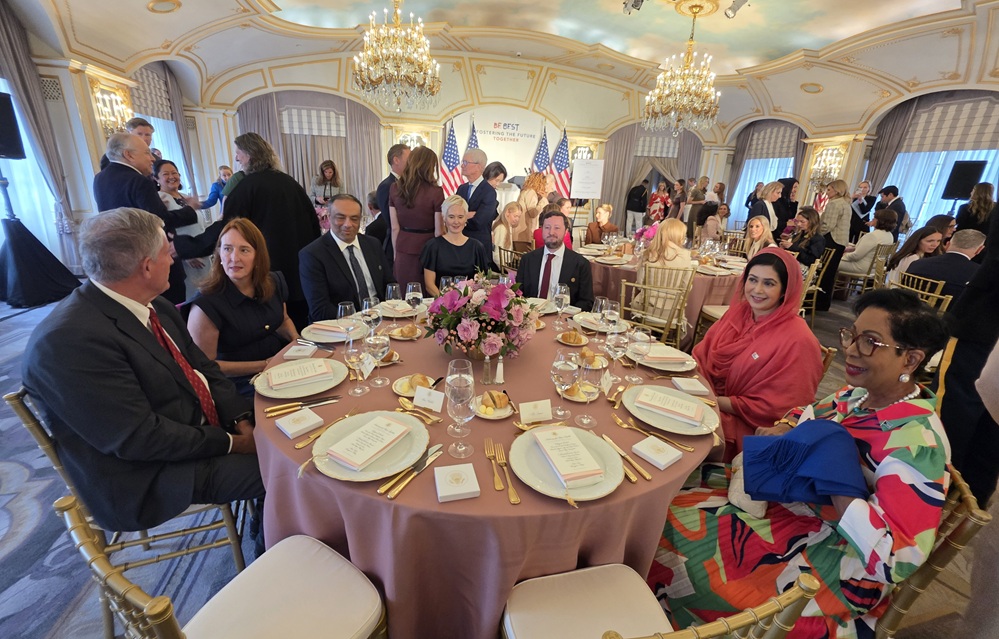
Shibbir Ahmed, New York — First Lady Melania Trump on Tuesday reconvened members of her Fostering the Future Together initiative in New York during the high-level week of the 81st United Nations General Assembly, announcing new technology partnerships, international events and an expansion of the coalition to 57 participating countries.

The gathering brought together representatives from countries including the United Kingdom, South Korea, the Philippines, Poland, Ukraine, Türkiye, the United Arab Emirates, Panama and Canada, according to the White House.

“Together, we are a beautiful range of cultures, languages, histories, and traditions,” Trump said. “And yet, we stand unified around one everlasting truth: the future of our world will be determined by what we do for our children today.”

Fostering the Future Together is described by the White House as a global coalition focused on empowering children through technology and education. Trump said the initiative is intended to provide young people with opportunities to learn, create and develop skills for the future.

New International Events Announced

Trump announced several Fostering the Future Together events planned for 2026.

They include a G20 event in Miami, which Trump plans to host, an ASEAN conference in Manila hosted by Philippine First Lady Liza Araneta Marcos, a European regional meeting hosted by Polish First Lady Marta Nawrocka, and a Caribbean regional meeting hosted by Saint Kitts and Nevis First Lady Diani Prince-Drew. “These leaders have stepped forward to activate their regions,” Trump said, adding that the initiative would provide support for their efforts.

Representatives and participants from countries around the world attend the Fostering the Future Together gathering in New York. Photo: KHABOR

Technology Partnerships

The First Lady also announced new private-sector partnerships involving Adobe, Amazon, Intel, Starlink, Google and Zoom. The companies are being brought into the initiative as part of its focus on expanding children’s access to technology and education. Tim Cook, executive chairman of Apple, and Enrique Lores, CEO of HP, also attended the gathering, according to the White House.

Trump emphasized that access to technology alone does not constitute empowerment and called for young people to be taught how to use technological tools responsibly and effectively.

“We must give our children the tools—and teach them how to use those tools wisely,” she said.

Focus on Technology and Education

In her remarks, Trump highlighted the rapid development of artificial intelligence and other technologies, describing the current period as a major technological transformation. She cited technologies including artificial intelligence, video communications, mobile computing, autonomous vehicles, virtual environments and biometric identification as examples of technologies that have moved from the realm of science fiction into everyday life.

She also called on participating countries and technology companies to help young people develop the knowledge and skills necessary to participate in an increasingly technology-driven economy.

“Our Fostering the Future Together coalition must strive to empower the youth of our nations to bend the boundaries of imagination, explore new frontiers of intellect, have the courage to take calculated risks, and build toward advancement of society,” Trump said.

Coalition Expands to 57 Countries

The White House said the initiative now includes 57 participating nations. Trump said the coalition’s long-term purpose is to create opportunities for children regardless of where they are born. Fostering the Future Together was announced during the 80th UN General Assembly in 2025. According to the White House, Trump subsequently convened the initiative’s inaugural Global Coalition Summit in Washington in spring 2026, bringing together first spouses and technology-sector leaders.

The latest gathering took place during the UN General Assembly’s high-level week in New York. The United Nations says the general debate of the 81st session is being held from September 22 to 26 and again on September 28.

Trump said the initiative’s success should ultimately be measured by its impact on future generations rather than by the meetings and speeches themselves. “Years from now, our children may not remember the meetings we held or the speeches we gave. But they will live with the consequences of what we do here,” she said.


PM Seeks Global Support for Dignified Rohingya Repatriation

Shibbir Ahmed, New York — Prime Minister Tarique Rahman has called on the international community to extend stronger support for the dignified repatriation of Rohingyas to their homeland in Myanmar and help find a sustainable solution to the prolonged crisis.

The prime minister made the appeal on Tuesday when Julie Bishop, Special Envoy of the UN Secretary-General on Myanmar, paid a courtesy call on him in New York, where he is attending the 81st session of the United Nations General Assembly.

During the meeting, Tarique Rahman stressed the importance of continued international cooperation to facilitate the safe and dignified return of Rohingyas and resolve the crisis, according to PM’s Additional Press Secretary Atikur Rahman Ruman.

The two sides also discussed the role of the international community in addressing the Rohingya crisis, including efforts to create conditions conducive to their eventual return to Myanmar.

The meeting comes ahead of a high-level Rohingya crisis side event scheduled for Wednesday at UN Headquarters, co-hosted by Bangladesh and The Gambia. The event will focus on finding a durable solution to the protracted displacement, along with justice and accountability.

Bangladesh has consistently called for the safe, voluntary, dignified and sustainable return of Rohingyas to Myanmar, where the crisis originated. The country is currently hosting about 1.2 million Rohingya refugees, placing significant humanitarian, economic and environmental pressure on Bangladesh. Prime Minister Tarique Rahman is scheduled to address the UN General Assembly on September 24.