US Imposes Visa Restrictions Over Corruption

Shibbir Ahmed, Washington DC — The United States has announced new visa restrictions on foreign nationals accused by the Trump administration of undermining democratically elected governments through corruption or narcotrafficking in the Western Hemisphere. The U.S. Department of State said the new policy applies under Section 212(a)(3)(C) of the Immigration and Nationality Act and can also affect the immediate family members of targeted individuals. The provision allows the United States to restrict entry when an individual’s presence or proposed activities could have potentially serious adverse consequences for U.S. foreign policy.

The State Department said the policy follows commitments made at the Doral Summit and reaffirmed in the Shield of the Americas leaders’ statement issued September 22. The administration said the United States would coordinate sanctions, designations and financial measures against individuals involved in activities that threaten security, the rule of law and democratic governance.

Initial visa-restriction actions were announced for nationals of Bolivia, Colombia, Ecuador and Peru.

In Bolivia, the State Department said it had taken steps to impose restrictions on 12 nationals and their families, including prosecutors, judges, a former justice minister, a police colonel, a former customs official and a private businessman. Existing U.S. visas for the named individuals were revoked, according to the department. Nine additional Bolivian nationals who do not currently hold U.S. visas were also made generally ineligible to receive visas, along with their families.

In Colombia, the United States said it revoked the visas of businessman Euclides Antonio Torres Romero and Senator Martha Isabel Peralta Epieyu and imposed corresponding restrictions on their families. The State Department identified Torres Romero as a businessman whose conglomerate operates mainly in the energy, traffic-signal and public-lighting sectors. Peralta Epieyu is affiliated with Colombia’s Historic Pact and the Alternative Indigenous and Social Movement, according to the department.

The State Department said two Ecuadorian nationals were also targeted under the new policy, with their visas revoked. The individuals were not identified in the announcement.

In Peru, the department said it revoked the existing U.S. visa of Juan Carlos Nunez Matos, a judge of the First Circuit Constitutional Court in Lima, and imposed restrictions on his family.

Separately, the State Department publicly designated Bolivia’s Attorney General Roger Mariaca under Section 7031(c) of the National Security, Department of State, and Related Programs Appropriations Act for fiscal year 2026.

The department alleged that Mariaca was involved in significant corruption and had abused his public positions by soliciting and accepting bribes to facilitate narcotrafficking and helping violent criminals evade justice. The State Department said the designation makes Mariaca and his immediate family members generally ineligible for entry into the United States.

The allegations against Mariaca are claims made by the U.S. government in announcing the designation.

Section 7031(c) allows the Secretary of State to publicly or privately designate foreign officials and their immediate family members when the Secretary has credible information indicating involvement in significant corruption or gross violations of human rights.

The State Department said the new visa restriction policy provides the United States with a mechanism to act as evidence develops and to coordinate measures with partner governments.

The administration said the measures are intended to support democratic governance, security and the rule of law across the Western Hemisphere while targeting corruption and narcotrafficking.


U.S. Announces New Visa Restrictions Over Child Abduction Cases

Shibbir Ahmed, Washington, DC — The Trump administration announced a new visa restriction policy Monday aimed at pressuring foreign officials to help resolve international parental child abduction cases involving children taken across international borders.

The policy targets foreign government officials, judges, judicial administrators, law enforcement officials and others who are determined to be responsible for, or complicit in, intentionally obstructing the prompt resolution of international parental child abduction cases.

Under the new policy, the United States may restrict visa issuance to individuals who intentionally fail to implement or comply with laws, policies or court orders intended to resolve such cases and facilitate the return of children to their country of habitual residence. The restrictions may also apply to the immediate family members of targeted individuals. The State Department said the policy provides the department with an additional accountability tool to encourage countries to meet their obligations and cooperate in resolving cases.

“The Department proactively works to prevent abductions and facilitate the quick and safe return of abducted children to their country of habitual residence,” the department said in its announcement.

The administration said the policy is intended to strengthen U.S. efforts to protect American children abducted across international borders and reunite them with their parents. The State Department also said the measures are intended to promote accountability when countries fail to meet their obligations under international law. The new visa restrictions are being implemented pursuant to Section 212(a)(3)(C) of the Immigration and Nationality Act.

The department emphasized that the United States remains committed to protecting the safety and well-being of American children involved in international parental child abduction cases.


UN General Assembly 2026: Leaders Discuss Global Crises, AI

Shibbir AHmed, New York — World leaders and senior officials are continuing high-level diplomatic discussions at the 81st United Nations General Assembly in New York, with conflicts, artificial intelligence, climate change, development and international cooperation remaining central issues.

The General Assembly’s high-level week, which runs through September 28, has brought together leaders and representatives from across the world to address major global challenges and debate the future of multilateral cooperation.

The General Debate is scheduled to continue on September 28, following several days of speeches and diplomatic meetings focused on international security, regional conflicts, economic development and emerging global challenges.

Artificial intelligence has emerged as an important issue during this year’s UN discussions. Secretary-General António Guterres has called for stronger international governance of AI and warned that technological developments are moving faster than existing global institutions can respond.

The UN has also placed conflicts and international diplomacy at the center of the General Assembly agenda as governments seek diplomatic approaches to ongoing crises, including tensions in the Middle East. The UN General Assembly’s 81st session is being chaired by Bangladesh’s Khalilur Rahman. The session’s theme is “Restoring trust, managing transformation: A United Nations that delivers for all.”

A major UN meeting taking place today, September 28, is commemorating the 25th anniversary of the adoption of the Durban Declaration and Programme of Action, which focuses on combating racism, racial discrimination, xenophobia and related intolerance.

The high-level week has also included meetings on climate action, sea-level rise and pandemic preparedness, reflecting the broad range of issues being addressed by the international community.

As the high-level portion of the General Assembly concludes, diplomatic attention remains focused on how governments can address conflicts, technological risks and other global challenges through international cooperation.


Cuba Condemns US Pressure, Warns of ‘Law of the Jungle’ at UN

Shibbir Ahmed, New York — Cuba’s Foreign Minister Bruno Eduardo Rodríguez Parrilla has warned that growing military and economic pressure in Latin America and the Caribbean is threatening international law, while accusing the United States of intensifying its longstanding campaign to isolate and weaken Cuba.

Addressing the General Debate of the 81st session of the United Nations General Assembly on Saturday, Rodríguez Parrilla said the international system was facing a rise in what he described as “expansionism, usurpation, plunder” and military and economic aggression.

He argued that fundamental principles of the UN Charter, including the sovereign equality of states, were under increasing pressure. The Cuban foreign minister called for the United Nations to be strengthened and made “more democratic and effective,” with a closer connection to the people it serves.

Cuba accuses US of economic pressure

A major part of Rodríguez Parrilla’s address focused on Cuba’s decades-long confrontation with Washington. He accused the United States of escalating economic pressure on Cuba since January, including what he called an “energy blockade” and efforts to discourage other countries from exporting fuel to the island. According to the Cuban minister, more than 7,000 containers were stranded in ports, including shipments containing food, medicines and medical equipment. He said some of the shipments had already been paid for by Cuban private companies.

Rodríguez Parrilla also accused Washington of putting pressure on foreign investors, restricting tourism and limiting Cuba’s access to financing, technology and international markets. He further criticized US efforts to discourage governments from maintaining arrangements under which Cuban medical professionals provide healthcare overseas.

“The economic warfare is aimed against the people,” Rodríguez Parrilla said, characterizing the alleged impact on Cuban families as deliberate “collective punishment.” He rejected claims that Cuba poses a threat to US national security.

“Cuba is not a threat; the blockade is!” he declared.

Havana says it remains open to dialogue

Despite his criticism of US policy, Rodríguez Parrilla said Cuba remained willing to engage in dialogue with Washington. He said any negotiations should be based on sovereign equality, respect for international law, non-interference in domestic affairs and the absence of preconditions. The Cuban government has maintained for decades that the US economic embargo has imposed significant costs on the country’s economy, while Washington has defended its policies on various political and security grounds.

Cuba outlines changes at home

The foreign minister also highlighted changes Cuba is pursuing in response to its economic and social difficulties. He pointed to a new program adopted by the National People’s Power Assembly that introduces new economic practices, actors and concepts while maintaining Cuba’s constitutional framework and socialist system.

According to Rodríguez Parrilla, the process is intended to address the needs of the Cuban population while pursuing what he described as greater social justice and protecting the country’s sovereignty and right to self-determination.

Warning over militarization in Latin America

Turning to the wider region, Rodríguez Parrilla criticized what he described as attempts at militarization, intervention and domination in Latin America and the Caribbean. He rejected the Monroe Doctrine and referred to the region’s 2014 declaration as a Zone of Peace.

The Cuban foreign minister also expressed solidarity with Small Island Developing States facing the effects of climate change, reiterated Cuba’s support for Nicaragua, backed Puerto Rico’s right to self-determination, and supported calls for reparations to African and Caribbean nations over colonialism and the transatlantic slave trade.

Concluding his address, Rodríguez Parrilla warned that allowing powerful states to impose their will through intimidation and coercion would create an unstable international order. “The law of the jungle cannot be the future of humanity,” he told the General Assembly, urging countries to strengthen the United Nations and preserve its role in international affairs.


Jaishankar Warns of ‘Weaponisation of Everything’ at UN

Shibbir Ahmed, New York — Indian External Affairs Minister S. Jaishankar has warned that the world is witnessing the “weaponisation of everything,” with finance, market access, supply chains and technology increasingly being used as tools of pressure. Addressing the General Debate of the 81st United Nations General Assembly in New York on Saturday, Jaishankar said growing conflicts and confrontations were undermining international security, economic progress and development, particularly affecting countries in the Global South.

“What we are actually seeing is a weaponisation of everything,” Jaishankar said, referring to the growing use of economic and technological tools as leverage. He said a mindset of extreme competition was undermining institutions and creating new chokepoints in global trade and cooperation.

According to Jaishankar, the trend extends from finance and market access to supply chains and technology. He said countries were increasingly focused on reducing risks and diversifying their economic relationships, but warned that the overall atmosphere was becoming less conducive to trust and goodwill.

Concerns Over Global Conflicts

Jaishankar also addressed ongoing conflicts in the Gulf, Ukraine and West Asia. He called for restraint, de-escalation and the protection of civilians, while stressing the importance of maintaining the uninterrupted flow of energy and commerce. He particularly condemned attacks on commercial shipping and seafarers in international waterways, saying the loss of Indian and other nationals in such attacks was “simply unacceptable.”

India has also launched a Group of Friends on Safety and Security of Shipping and Seafarers, with 23 other partners, aimed at strengthening international attention to maritime safety. On Ukraine, Jaishankar said India supports efforts to bring the conflict to an end, while reiterating the importance of protecting food and energy supplies. Regarding West Asia, he said India supports a two-state solution as the basis for a durable and lasting peace and called for humanitarian assistance for Palestinians.

Warning Over Global South’s ‘4F Crisis’

Jaishankar said developing countries were facing what he described as a “4F crisis” involving food, fuel, fertiliser and finance. He warned that fertiliser shortages, disruptions to grain movements and other global pressures were increasing the challenges faced by developing nations. He also argued that restrictions on market access and non-market practices were making it harder for countries in the Global South to industrialise. Jaishankar further raised concerns about artificial intelligence, saying technology that was expected to create opportunities could also become a source of anxiety if misused.

Call for a More Representative Global Order

The Indian minister also called for reforms to international institutions, arguing that the global order established after World War II is facing new realities. He said the world is moving toward a more multipolar system and that countries should engage through dialogue and cooperation. He also argued that large sections of humanity should not be excluded from global decision-making.

Jaishankar’s address placed India’s concerns about terrorism, maritime security, economic pressures, technology and global governance within a broader call for greater stability and international cooperation.


Russia Backs India’s Bid for Permanent UN Security Council Seat

Shibbir Ahmed, New York — Russia has backed India’s bid for a permanent seat on the United Nations Security Council, with Foreign Minister Sergey Lavrov calling for greater representation of Asia, Africa and Latin America in the powerful UN body. Speaking during the general debate of the 81st United Nations General Assembly in New York on Saturday, Lavrov said Moscow supports the candidacies of both India and Brazil for permanent membership of the Security Council.

“We are in favour of broadening the representation of Asia, Africa, and Latin America. We support Brazil’s and India’s candidatures for a permanent seat,” Lavrov said, according to reports of his UNGA address. Lavrov also said Russia opposed allocating additional permanent seats to Western countries, specifically mentioning Germany and Japan. He argued that any reform of the Security Council should preserve the prerogatives of its existing permanent members while increasing representation from the Global South.

The Security Council currently has 15 members, including five permanent members — China, France, Russia, the United Kingdom and the United States — which hold veto power. The remaining 10 members are elected for two-year terms. India has for years sought a permanent seat on the Security Council as part of broader efforts to reform the UN’s principal body responsible for international peace and security. India has argued that the Council’s composition should better reflect contemporary geopolitical and economic realities.

Russia’s latest statement adds to recent international support for India’s bid. During the current UNGA session, Mauritius and Portugal also expressed support for India’s candidature, while other countries have called for broader reform of the Security Council. The issue of Security Council reform has gained renewed attention at the 81st UN General Assembly, where countries from the Global South have continued to call for greater representation in the UN’s decision-making institutions.

Russia’s position, however, distinguishes between the countries seeking permanent membership. While Moscow supports India and Brazil, Lavrov opposed additional permanent seats for Germany and Japan, according to reports of his speech. The debate over expansion of the Security Council remains subject to negotiations among UN member states, and Russia’s support for particular candidates does not itself change the Council’s membership.


Iran Proposes Seven-Day Plan to Reopen Strait of Hormuz

Shibbir Ahmed, New York — Iran has proposed a plan that could reopen the strategically important Strait of Hormuz within seven days and pause fighting across the region, Iranian officials said during the United Nations General Assembly in New York.

Iranian Foreign Minister Abbas Araqchi said the proposal was transmitted to the United States through Qatari mediators. Under the proposal, a seven-day countdown would begin once Washington agrees to the terms, potentially leading to the reopening of the strategic waterway and a halt to hostilities. The Strait of Hormuz is one of the world’s most important energy-shipping routes, making its continued disruption a major concern for global oil markets and international trade.

Iran’s proposal reportedly calls for the United States to lift its blockade on Iranian ports, release frozen Iranian funds and waive oil sanctions. Tehran has also indicated that broader negotiations could follow once fighting is halted.

Iranian officials have said they are not prepared to make concessions on their nuclear program as part of the proposal. Tehran maintains that it retains rights related to uranium enrichment and has rejected demands that it surrender highly enriched uranium.

The initiative comes amid continuing military tensions across the Middle East. The disruption of oil shipments through the Strait of Hormuz has added pressure to global energy markets and raised concerns about alternative shipping routes.

Iran has also discussed safe shipping arrangements in the strait with Saudi Arabia, according to Iranian officials. The United States has not formally accepted Iran’s proposal, leaving the status of the initiative uncertain.


US, China Agree to $30 Billion Tariff Cut and AI Dialogue

Washington DC — The United States and China have agreed to a reciprocal tariff-reduction arrangement covering about $30 billion in trade, while also establishing a new dialogue on artificial intelligence, according to China’s Foreign Ministry and reporting by Reuters.

The agreement was reached during Chinese President Xi Jinping’s visit to the United States and his meeting with U.S. President Donald Trump. The two sides described the discussions as part of broader efforts to manage trade disputes and maintain communication between the world’s two largest economies.

Under the arrangement, the United States and China will reduce tariffs affecting certain goods, with the agreement reportedly covering about $30 billion in reciprocal trade. U.S. Trade Representative Jamieson Greer separately said Washington and Beijing had reached understandings concerning several categories of goods, including agricultural products, medical devices and consumer goods. Further details are expected to be released by U.S. officials.

The two countries also agreed to establish a new channel for discussions on artificial intelligence. The mechanism is intended to improve communication between Washington and Beijing over AI-related issues, including incidents that could have broader security implications. The AI component comes as both countries compete for technological leadership while attempting to manage concerns over the security implications of rapidly advancing artificial intelligence.

The latest trade understanding follows years of escalating economic tensions between Washington and Beijing. Previous tariff measures had pushed duties on some goods to exceptionally high levels before the two sides moved toward a temporary reduction and broader negotiations. The new agreement does not resolve all U.S.-China trade disputes, but it creates additional areas for negotiation and communication between the two governments.


PM leaves New York for home after attending UNGA session

New York – Prime Minister Tarique Rahman today left New York for home after winding up a five-day visit packed with high-level engagements, including his maiden address to the General Debate of the 81st United Nations General Assembly where he placed Bangladesh’s aspirations and priorities before the global community.

“An Emirates flight carrying the Prime Minister, his wife Dr Zubaida Rahman and members of his entourage departed John F Kennedy International Airport at 11:30pm (New York time) for Dhaka via Dubai,” Prime Minister’s Press Secretary Saleh Shibly told KHABOR.

The flight is scheduled to reach Dubai at 8:00pm on September 26 and depart for Dhaka at 2:00am on September 27. The Prime Minister is scheduled to arrive at Hazrat Shahjalal International Airport at 8:40am the same day.

During the visit, he presented Bangladesh’s positions on global peace and security, climate change, sustainable development, humanitarian issues, economic cooperation and the Rohingya crisis.

In his UNGA address on September 24, the Prime Minister reaffirmed Bangladesh’s support for UN initiatives aimed at establishing global humanity and world peace, calling for conflicts to be resolved through dialogue, diplomacy and mutual cooperation.

He also pledged to establish a prosperous, self-reliant and welfare-oriented democratic Bangladesh by ensuring political and economic empowerment of the people and equal opportunities for all, while outlining the government’s 3-R strategy of Recovery, Restoration and Reconstruction.

On the Rohingya crisis, he said safe and dignified repatriation to their homeland is the only solution to the prolonged crisis and sought stronger international support for creating conditions conducive to their voluntary return.

During the visit, the Prime Minister discussed the crisis separately with UN Secretary-General’s Special Envoy on Myanmar Julie Bishop and UN High Commissioner for Refugees Barham Salih.

The Prime Minister also met Turkish President Recep Tayyip Erdogan, with the two leaders discussing ways to expand Bangladesh-Türkiye trade and investment and diversify cooperation in economic sectors, while underscoring the importance of coordination on regional and international issues.

In separate meetings with Bhutanese Prime Minister Dasho Tshering Tobgay and Maldives Vice-President Uz Hussain Mohamed Latheef, Tarique Rahman discussed strengthening existing friendly relations and exploring new areas of bilateral, regional and international cooperation. At a meeting with World Bank Group President Ajay Banga, they discussed Bangladesh’s development priorities, economic progress, strengthening World Bank cooperation and exploring new areas of partnership.

The Prime Minister also held a meeting with Haitian Prime Minister Alix Didier Fils-Aimé, discussing bilateral relations, mutual interests and regional and international cooperation.

On September 22, Tarique Rahman and his wife joined a welcome breakfast hosted by UN Secretary-General Antonio Guterres for world leaders and their spouses before attending the opening of the 81st UNGA General Debate. In the evening, they attended a reception hosted by the US President for leaders joining the General Assembly.

On September 23, the Prime Minister held a breakfast meeting with representatives of the Gates Foundation, Visa Foundation, Rockefeller Foundation, International Rescue Committee and Rotary International, where Bangladesh’s perspectives on humanitarian challenges, international cooperation, climate change, sustainable development and economic partnership were highlighted.
He also met Gates Foundation CEO Mark Suzman and discussed public health, child healthcare, vaccination, affordable vaccines, preventive healthcare and health-system modernisation.

The Prime Minister also addressed the high-level meeting on “Climate Action and the Just Transition”, calling for collective global action to build a safer and more sustainable future for the next generation, including deeper emission cuts and predictable climate finance for climate-vulnerable countries.

A bilateral meeting with Croatian Prime Minister Andrej Plenkovic focused on expanding trade and investment, economic partnership, skilled manpower, education and technology, as well as greater coordination at multilateral forums.

The visit also featured economic diplomacy, including the signing of an agreement by Biman Bangladesh Airlines with Boeing to purchase 11 aircraft as Bangladesh seeks to expand its aviation sector and open new international routes.

On September 24, before his UNGA address, the Prime Minister delivered opening remarks at a high-level meeting on the existential threat posed by sea-level rise, calling for faster and deeper global emission cuts, predictable and accessible adaptation finance, wider access to climate-smart technologies and stronger international cooperation.

He also held a bilateral meeting with Pakistani Prime Minister Muhammad Shehbaz Sharif, with the two premiers discussing bilateral relations, regional and international situations and potential areas of cooperation.

At a Bangladesh-Sweden-UNFPA high-level event on midwifery, Tarique Rahman outlined his vision of a “Healthy Bangladesh”, placing primary healthcare at the centre of health reform.

He said the government plans to recruit 100,000 additional health workers, including 80,000 women, and 25,000 professional midwives, while developing an integrated digital health system.

The Prime Minister also held a bilateral meeting with UN Secretary-General Antonio Guterres, who expressed gratitude for Bangladesh’s role in sheltering the Rohingyas and contributing troops to UN peacekeeping operations, while praising Bangladesh’s role in climate resilience and multilateral affairs.

Tarique Rahman also met Thai Prime Minister Anutin Charnvirakul before delivering his UNGA address and later attended a dinner hosted in his honour by Bangladesh’s Permanent Representative to the UN.

On the final day of his New York visit, the Prime Minister attended a breakfast meeting with Wall Street representatives hosted by JPMorgan at its Manhattan Headquarters and held a bilateral meeting with Kuwait’s Crown Prince Sheikh Sabah Khaled Al-Hamad Al-Sabah.


Landau Calls for Shift From Aid to Investment in U.S. Economic Diplomacy

Shibbir Ahmed, New York — U.S. Deputy Secretary of State Christopher Landau has called for a stronger focus on trade and private investment as a long-term alternative to traditional foreign aid, saying economic diplomacy should play a central role in strengthening relationships between countries. Speaking at a Trade Over Aid Deals Showcase on September 25, Landau said economic and commercial issues had for decades taken a back seat in diplomacy, which he argued had too often focused primarily on political, military and security matters.

‘Economic and commercial issues should be treated as a core element of diplomacy’, Landau said, arguing that governments have a responsibility to create prosperity, economic opportunities and jobs for their people. Landau said economic projects can create lasting relationships that survive changes in government. While acknowledging that aid programs can help countries remain afloat, he argued that long-term economic projects can provide more sustainable value by generating investment, infrastructure, employment and economic growth.

He also emphasized that foreign investment does not necessarily mean a loss of national sovereignty. According to Landau, governments should establish clear terms and conditions for investments so that both investors and host countries understand their respective obligations and potential returns.

‘Investment is an engine of growth’, Landau said, urging governments and businesses to view foreign capital as an opportunity to expand economic activity rather than as a threat to sovereignty. He described investment relationships as potentially “win-win” arrangements, saying capital inflows can support infrastructure, jobs and economic growth while also strengthening political and commercial ties between countries.

U.S. private sector at the center

Landau said one of his priorities as deputy secretary is to improve communication between the U.S. government and American companies seeking investment opportunities overseas. He noted that during trips around the world, he frequently hears foreign governments asking why American companies are absent from projects where businesses from other countries have submitted bids.

Landau said he had previously focused largely on American companies directly operating overseas, including construction, infrastructure, oil and mining firms. He said he now sees a greater role for U.S. financial capital, particularly from New York City, which he described as the world’s financial capital.

‘There are trillions of dollars here that can be deployed around the world,’ Landau said, arguing that attracting capital providers could help connect foreign investment opportunities with American operating companies. He said he recently met with major capital providers to discuss why they were not investing in certain countries and what obstacles were preventing greater U.S. participation.

Calls for a more coordinated U.S. approach

Landau also acknowledged concerns from private investors about the fragmented nature of the U.S. government’s economic engagement overseas. He said investors sometimes want the U.S. government to have a financial stake or other involvement in projects to reduce risks associated with political changes in foreign countries.

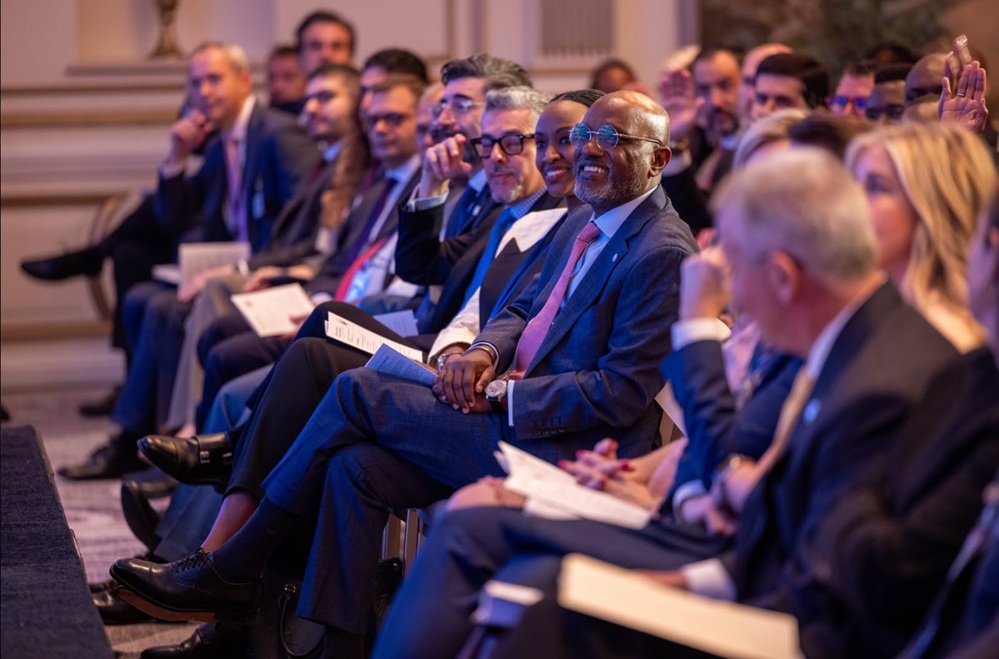
Government officials, private-sector representatives and international participants attend the “Trade Over Aid Deals Showcase” as U.S. officials discuss expanding trade and investment opportunities.

Landau said he wants the State Department, Commerce Department, Export-Import Bank, Development Finance Corporation and Millennium Challenge Corporation to work more closely together and make the U.S. government a more accessible “one-stop shop” for businesses seeking to invest overseas.

He cited the Pacific Islands as one region where he believes greater investment opportunities exist. Landau said he had organized a business summit and investment roundtable in Honolulu in February with Pacific Island leaders and U.S. private-sector representatives to identify sectors where investment could be expanded.

Landau said the U.S. government’s role is to improve communication between governments, businesses and investors and help identify opportunities for private capital. Concluding his remarks, Landau reaffirmed his commitment to expanding the global role of American businesses and called for what he described as an “unprecedented golden era for the American private sector around the world.”