White House Accord Sets New Safety Rules for Super Intelligence

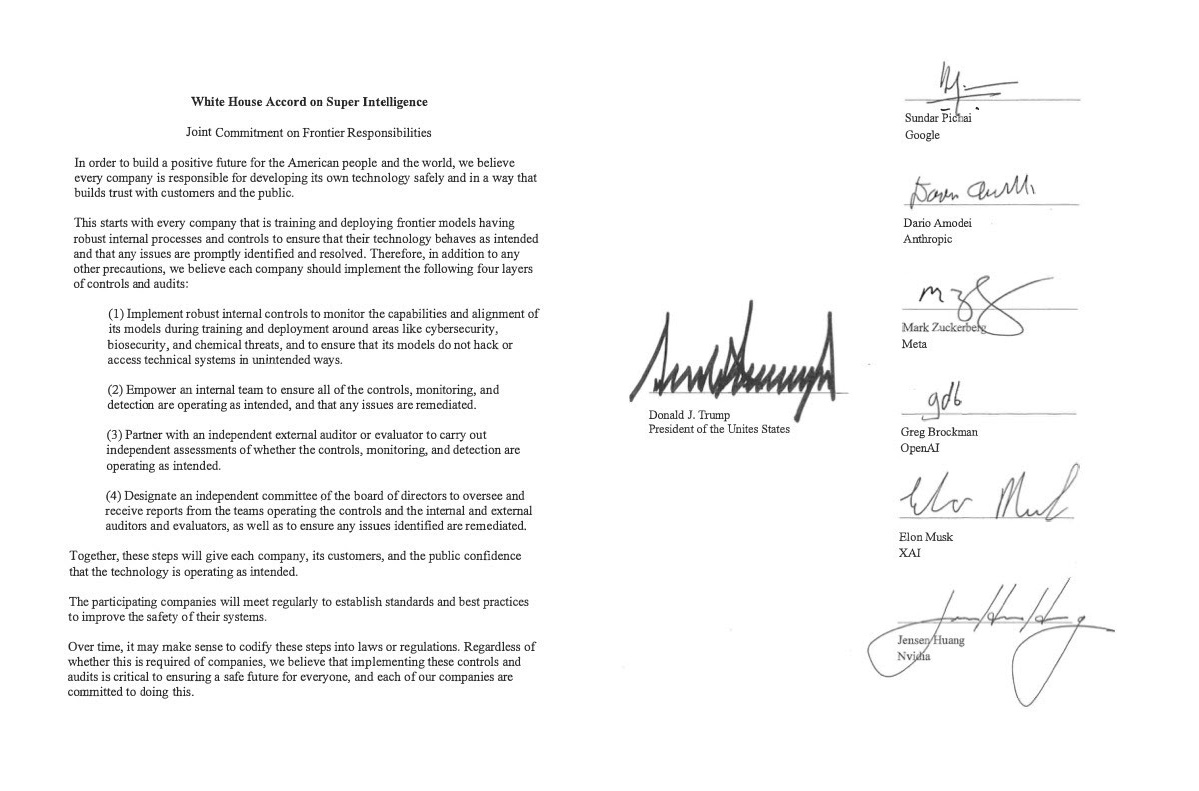
Shibbir Ahmed, Washington DC  — The White House has unveiled an accord with leading technology companies outlining a voluntary framework for strengthening safeguards around the development and deployment of advanced artificial intelligence systems. Titled the “White House Accord on Super Intelligence: Joint Commitment on Frontier Responsibilities,” the agreement calls on companies developing and deploying frontier AI models to establish robust internal controls, independent evaluations and board-level oversight.

The accord says companies have a responsibility to develop their technologies safely and in a manner that builds trust among customers and the public. It identifies four layers of controls and audits that participating companies should implement.

The first layer involves internal controls designed to monitor the capabilities and alignment of AI models during both training and deployment. The controls would cover risks involving cybersecurity, biosecurity and chemical threats, while also seeking to prevent AI systems from accessing or hacking technical systems in unintended ways.

The second layer calls for companies to establish dedicated internal teams responsible for ensuring that safety controls, monitoring and detection systems are functioning as intended. Those teams would also be responsible for ensuring that identified problems are addressed.

The third layer involves independent external auditors or evaluators. These outside reviewers would assess whether a company’s controls, monitoring and detection mechanisms are operating properly.
White House Accord on Super Intelligence — Joint Commitment on Frontier Responsibilities . Photo WH

The fourth layer would place responsibility at the board level, with companies designating an independent board committee to oversee the safety framework and receive reports from internal teams and external auditors. The committee would also monitor the remediation of problems identified through the oversight process.

According to the accord, the four-layer system is intended to provide companies, their customers and the public with greater confidence that advanced AI technologies are operating as intended. Participating companies are also expected to meet regularly to develop common standards and best practices aimed at improving the safety of their systems.

The document leaves open the possibility that the measures could eventually become part of formal government regulation. It states that, over time, it may be appropriate to codify the safeguards into laws or regulations, while emphasizing that the companies are committed to implementing the controls regardless of whether they are legally required.

The agreement was released following a White House meeting with leading technology executives on September 29. Reporting on the accord identifies Google CEO Sundar Pichai, Meta CEO Mark Zuckerberg, Anthropic CEO Dario Amodei, OpenAI President Greg Brockman, xAI CEO Elon Musk and Nvidia CEO Jensen Huang among the participating executives.

The accord focuses specifically on governance, monitoring and auditing of increasingly capable AI systems, rather than establishing detailed technical standards or specific implementation deadlines.


Pentagon to Cut 20% of General and Admiral Positions: Hegseth

Shibbir Ahmed, Washington DC — U.S. Defense Secretary Pete Hegseth is set to announce a major restructuring of the U.S. military’s senior leadership, with the Pentagon planning to reduce the number of positions reserved for generals and admirals by 20%. The announcement is part of Hegseth’s broader effort to restructure the military’s senior ranks and reduce what the administration views as unnecessary layers of leadership. The planned reduction doubles the 10% cut ordered last year.

Hegseth is expected to outline the changes during his “State of the Force” address at Marine Corps Base Quantico in Virginia on Wednesday. Pentagon officials say the reduction will apply across the military services and is expected to be completed by January 1, 2027.

According to reporting based on Pentagon officials, the plan concerns positions for one- to four-star generals and admirals. Some positions are expected to be eliminated, while others could be downgraded so they can be filled by officers at lower ranks.

The Pentagon’s latest move follows Hegseth’s May 2025 directive ordering reductions in senior military positions. That directive included a minimum 20% reduction in active-duty four-star positions, a minimum 20% reduction in National Guard general officers and an additional 10% reduction through changes to the military’s unified command structure.

The latest plan would bring the overall reduction in general and flag officer positions to 20%, according to Pentagon officials cited by AP. The military currently has roughly 800 such positions, meaning the changes could affect about 170 positions.

The restructuring comes as the Pentagon continues to review the organization and priorities of the U.S. armed forces. Hegseth has argued that reducing senior-level bureaucracy will allow the military to focus more resources and attention on operational readiness. The plan is expected to be implemented across the Army, Navy, Air Force and the broader joint military structure.


Mamdani Breaks Ground on 229 Affordable Senior Homes in Bronx

Shibbir Ahmed, New York — New York City Mayor Zohran Kwame Mamdani, the New York City Housing Authority (NYCHA) and development partners on Tuesday broke ground on Sol on Park, a 229-apartment, 100% affordable senior housing development at the Morris Houses campus in the Bronx. The project will provide new affordable homes for current NYCHA residents, formerly homeless New Yorkers and low-income seniors. City officials described it as the largest use of the Transfer of Assistance program to date, a financing approach that uses public land and investment to create new permanently affordable housing.

“New Yorkers are facing a housing crisis, and we have no time to waste,” Mayor Mamdani said at the groundbreaking. He said the project would provide current NYCHA residents and low-income seniors with access to new housing while strengthening the Morris Houses community.

80 homes reserved for NYCHA residents

Sol on Park will include 80 apartments reserved for current NYCHA residents living at Morris I and II Houses. Another 69 homes will be designated for formerly homeless seniors, while 79 apartments will be available through the Housing Connect lottery for low- and middle-income seniors.

The development will also include more than 8,000 square feet of community space, health-focused amenities, a pedestrian plaza and a new accessible space for the Morris Houses Resident Association.  Construction is now underway, with pre-leasing and early move-ins expected in early 2029.

Public land used for affordable housing

The project is being developed by The NRP Group, Selfhelp Realty Group and Foxy Management in partnership with NYCHA, the Department of Housing Preservation and Development and the Housing Development Corporation.

The city’s Transfer of Assistance model allows public land and investment to support new affordable housing while creating opportunities for existing NYCHA residents to move into newly constructed apartments. NYCHA said the project will provide current Morris Houses seniors with an opportunity to move into a new accessible building while also adding social services and community facilities.

The project is an 18-story development designed by Magnusson Architecture and Planning. It is planned to meet LEED Platinum and Passive House standards, with an emphasis on energy efficiency and resident health and comfort. On-site services will include partnerships with Union Community Health Center and Green Bronx Machine’s National Health & Wellness Center.

Part of Mamdani housing strategy

The Sol on Park development is part of the Mamdani administration’s broader effort to develop affordable housing on publicly owned land. The administration has said it plans to expand the Transfer of Assistance approach through its Block by Block housing plan. The city’s LIFT Tracker has identified more than 50,000 potential new homes across more than 100 active publicly owned sites.

NYCHA’s own development information confirms that Sol on Park is a 229-unit senior affordable housing project on Park Avenue, with 80 units set aside for Morris Houses seniors through the Transfer of Assistance program. The project had previously reached financial closing in July, when city housing agencies announced the $214 million development and its planned 229 affordable senior homes.


UNGA President Khalilur Rahman Calls Nuclear Disarmament a Top Priority

Shibbir Ahmed, New York — United Nations General Assembly President Dr. Khalilur Rahman called for urgent action to reduce nuclear risks and eliminate nuclear weapons, declaring that nuclear disarmament must remain the world’s highest disarmament priority. Speaking Tuesday at a high-level plenary meeting at UN Headquarters in New York to commemorate the International Day for the Total Elimination of Nuclear Weapons, Rahman warned that the global nuclear threat remains serious and is being compounded by growing geopolitical tensions and emerging technologies.

“The starting point must be a simple truth, reaffirmed in the Pact for the Future: a nuclear war cannot be won and must never be fought,” Rahman said.

He noted that the global nuclear inventory stood at more than 12,000 warheads as of January 2026, with an estimated 2,100 to 2,200 maintained on high operational alert. He also warned that, for the first time since the end of the Cold War, the global stockpile is expected to grow again as new warheads enter arsenals faster than older ones are dismantled.

Growing nuclear risks

Rahman said new technologies, including artificial intelligence, cyber capabilities and advanced delivery systems, are creating additional uncertainty around nuclear command, control and decision-making. He also pointed to the expiration of the New START treaty on February 5, 2026, saying that, for the first time since 1972, there are no binding limits on strategic nuclear arsenals.

The 2026 Review Conference of the Nuclear Non-Proliferation Treaty also ended without a consensus outcome, marking the third consecutive Review Conference to do so, according to Rahman.

“These are not abstract diplomatic setbacks,” Rahman said. “They increase the risks of arms racing, escalation, and catastrophic miscalculation.”

Four areas for action

Rahman called for action on four fronts: restoring dialogue and safeguards, strengthening the international nuclear non-proliferation system, reducing and ultimately eliminating nuclear arsenals, and mobilizing the public around nuclear disarmament. He urged nuclear powers to return to negotiations and establish frameworks that provide verifiable limits, transparency and predictability. He also called for stronger crisis communication and measures to reduce nuclear risks.

The General Assembly president reaffirmed the importance of the Nuclear Non-Proliferation Treaty and the role of the International Atomic Energy Agency in safeguards and verification. He also called on states that have not signed or ratified the Comprehensive Nuclear-Test-Ban Treaty to do so and urged all countries to maintain the moratorium on nuclear weapons testing.

‘Highest disarmament priority’

Rahman said nuclear-weapon states should take concrete, transparent, verifiable and irreversible steps toward disarmament, including reducing the role of nuclear weapons in security doctrines and lowering their operational readiness.

He also highlighted the role of survivors, civil society, young people, scientists and educators in keeping the human consequences of nuclear weapons at the center of international discussions. Despite the continuing risks, Rahman pointed to progress in nuclear disarmament, noting that the global inventory has fallen from roughly 70,000 warheads in 1986 to about 12,000 today.

“If the United Nations is to get back to basics – to prevent the scourge of war – then nuclear disarmament must remain our highest disarmament priority, just as it was at the birth of this Organization,” Rahman said. He urged governments to restore safeguards, reduce nuclear risks and work toward a world free of nuclear weapons.


UN Condemns Deadly Myanmar Airstrike, Urges Halt to Deportations

Shibbir Ahmed, New York — The United Nations has strongly condemned an airstrike in Myanmar’s Rakhine State that reportedly killed at least 50 people at a busy market and urged authorities to halt the deportation of Myanmar nationals from Malaysia. According to the UN, forces from Myanmar’s military junta reportedly struck Kyauktaw township around midday Monday, when more than 200 shops were operating. Women and children were among those killed, while at least 58 people were injured, many critically. The death toll is expected to rise.

UN High Commissioner for Human Rights Volker Türk said the attack raised serious concerns over respect for international humanitarian law. He also highlighted continuing abuses against the Rohingya by both Myanmar’s military and the Arakan Army.

UN urges Malaysia to halt deportations

The airstrike came as Malaysia began implementing a plan to deport some 5,000 Myanmar nationals. Malaysia has said the returns would be voluntary, following an agreement reportedly reached with Myanmar’s military rulers. The UN refugee agency, UNHCR, said it had not been involved in identifying those being returned and noted that some of the people were reportedly being held in detention centers.

Mr. Türk called on Malaysia to immediately halt the deportation process, warning that conditions in Myanmar remain “far from safe and sustainable.” UN Secretary-General António Guterres also called for a halt to the reported return of around 1,500 people. UNHCR stressed that no one should be returned to a place where they face a risk of persecution or torture.

UN releases emergency funds for drought-hit Africa

Meanwhile, UN relief chief Tom Fletcher has released millions of dollars from the Central Emergency Response Fund to prepare for the worsening effects of El Niño-driven drought in South Sudan, Zimbabwe and Chad. South Sudan will receive $6 million for early action, including food, health, nutrition, protection, water and sanitation services. More than 10 million people in the country already need humanitarian assistance.

Zimbabwe will receive $4 million for anticipatory measures, while $3.6 million will support 350,000 people in Chad ahead of worsening dry conditions. The funding will also support early warning systems, cash assistance, livestock feed, malnutrition services and disease surveillance.

Israeli fire reported near UN sites in Gaza

In Gaza, the UN humanitarian office, OCHA, said Israeli fire had been reported near UN facilities and humanitarian convoys on several occasions in recent days. No casualties were reported, but the UN stressed that civilians, aid workers and humanitarian operations must be protected. Humanitarian operations have continued, with protection partners providing mental-health support and other services to about 13,000 Palestinians during the third week of September.

Aid agencies also distributed food parcels, adult diapers, assistive devices and hygiene supplies to displaced families. UNRWA said 1,394 Palestinians had been killed since the faltering October 2025 ceasefire, citing local health authorities, while about 94 percent of the population requires shelter assistance.

Settler attacks continue in West Bank

OCHA also reported continuing settler attacks in the occupied West Bank. Several houses were damaged in Jalud, in the Nablus governorate, while a water network serving Palestinians in Tubas was vandalized and vehicles carrying water and produce were seized. OCHA said it has recorded more than 1,600 settler attacks so far this year—an average of 6.7 attacks a day, compared with five a day in 2025. More than 4,300 Palestinians have been displaced.


Trump Launches America.gov as Unified Digital Gateway to U.S. Government Services

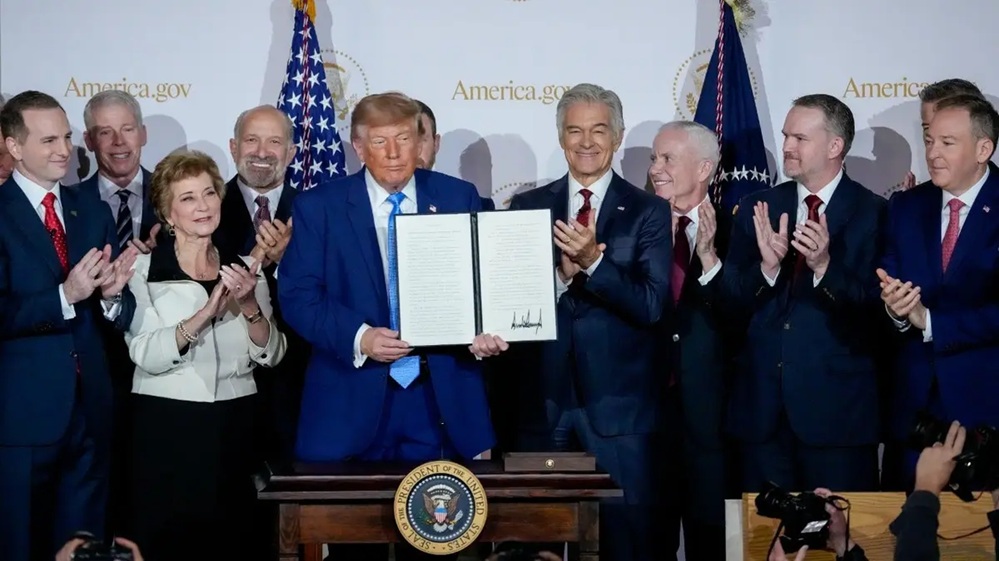
Shibbir Ahmed, Washington DC — President Donald Trump on Tuesday launched America.gov, a new digital platform designed to provide Americans with a single entry point to federal government information and services, as the administration seeks to simplify how people interact with the U.S. government. The platform was unveiled September 29 in Washington alongside an executive order directing the establishment of America.gov as a unified digital “front door” for Americans seeking federal information and covered online services.

The administration says America.gov uses artificial intelligence and information drawn from government websites to help users find answers and navigate federal services through a conversational interface. The U.S. General Services Administration said America.gov combines information from more than 29,000 government websites with AI-enhanced search technology, allowing users to find information and guidance without having to navigate a fragmented network of individual agency websites.

The executive order says Americans have traditionally been required to search across multiple federal agencies, interpret government terminology, provide the same information repeatedly and verify their identities through different systems. America.gov is intended to change that process by providing a single digital point of entry through which users can communicate in plain language, receive information and, where authorized and technically available, complete federal government transactions.

AI-powered access to federal services

The new platform is designed to allow users to describe what they need rather than determine which federal agency is responsible for providing the service. The GSA said the platform can help users find information about government benefits, passport services, Social Security and other federal needs. The administration’s executive order directs federal agencies to identify qualifying online services and integrate them with America.gov in a secure and privacy-preserving manner.

President Donald Trump holds up the executive order establishing America.gov during its launch event in Washington, D.C., on September 29, 2026. Administration officials joined the president at the event. Photo: WH

The order also calls for the integration of Login.gov as the authentication service for America.gov. Under the plan, agencies will continue to maintain control over their own records, systems, statutory responsibilities and decision-making authority. The order specifically states that the unified access system is not intended to create a centralized federal system of records about Americans. Privacy protections are also included in the order, including data minimization, secure authentication, auditable authorization and disclosure practices consistent with federal law.

Passport services among planned features

Secretary of State Marco Rubio said at the launch event that the State Department is partnering with America.gov to overhaul the passport application experience. Rubio announced that, beginning next year, Americans will be able to apply for their first U.S. passport entirely online. Applicants will be able to sign in through Login.gov, use information already held by the government where available, submit a photograph from a phone or other device, make a payment and track the status of the application. Rubio said the administration’s goal is for the vast majority of Americans to be able to apply for a passport or passport card through America.gov by the end of 2027.

Agencies given 90 days for implementation guidance

The executive order directs the Office of Management and Budget to issue implementation guidance to federal agencies within 90 days. Agencies will then be required to identify covered services, integrate those services with America.gov where appropriate and provide usage and performance information to the General Services Administration and OMB. The order defines covered services generally as public-facing federal services that serve more than 100,000 users during a 12-month period and can be accessed or applied for online. The order excludes Internal Revenue Service tax filing services, as well as services provided by the Department of War and elements of the Intelligence Community.

Existing government services will remain available

The administration says America.gov is intended to provide an additional, simplified way to access federal services rather than eliminate existing methods. The executive order specifically preserves existing lawful methods of obtaining government services, including in-person, telephone, mail and agency-specific digital services. That means Americans will not be required to use America.gov as the sole method of interacting with the federal government.

New passport design planned for 2028

Rubio also unveiled the planned design of a new U.S. passport expected in 2028. The redesigned passport features the American eagle and the Great Seal and includes artwork depicting major moments in U.S. history. Rubio said the new passport will visually represent 250 years of American history, with imagery ranging from the Revolutionary era and westward expansion to aviation, the raising of the American flag at Iwo Jima and the Artemis space program. The State Department also plans to change how the passport is packaged and delivered.

America.gov represents broader government technology push

The launch comes as the Trump administration expands its focus on artificial intelligence and digital technology as tools for government services. The new website is currently centered on AI-assisted information access, while additional transaction capabilities are expected to be introduced as federal agencies integrate their services with the platform.

The administration has described America.gov as a fundamental shift toward organizing government services around the needs of citizens rather than around the structure of federal agencies. For Americans, the intended result is a single digital starting point for finding federal information, understanding available services and eventually completing more government transactions online.


US Supreme Court Allows Third-Country Deportations to Continue

Shibbir Ahmed, New York — The U.S. Supreme Court on Tuesday allowed the Trump administration to continue rapidly deporting migrants to third countries while the justices consider the legality of the policy. The court’s 6-3 order temporarily suspended a lower-court requirement that migrants receive an opportunity to challenge their removal before being sent to countries other than their own. The case concerns the administration’s use of third-country deportations, under which migrants may be removed to countries with which they may have little or no connection. The Supreme Court is scheduled to hear full arguments over the policy in December.

The administration has argued that third-country removals are an important immigration-enforcement tool, particularly when migrants’ countries of origin refuse to accept them or when authorities consider them security or criminal threats. Immigration attorneys and other critics of the policy have challenged the practice in court, arguing that migrants can face serious risks if sent to unfamiliar countries without adequate opportunity to contest their removal.

According to Associated Press reporting, the administration has already deported roughly 25,000 people to more than two dozen countries under the policy, with Mexico among the principal destinations. The Supreme Court’s temporary order does not constitute a final ruling on whether the administration’s third-country deportation policy is lawful. The broader legal dispute remains pending before the justices.

The case is part of a wider legal battle over the Trump administration’s immigration policies, including the government’s authority to accelerate removals and limit procedural protections for migrants facing deportation. The December arguments are expected to provide the court with an opportunity to consider the legal requirements surrounding third-country removals and the protections available to people facing deportation.

For migrants currently subject to removal proceedings, Tuesday’s order means the administration can continue the challenged practice while the litigation proceeds. The Supreme Court’s eventual ruling could have broader implications for the government’s authority to deport migrants to countries other than their countries of origin and for the procedural protections available before such removals take place.


UNHCR Funding Crisis Could Leave 8.3 Million Refugees Without Aid

New York — Nearly 8.3 million refugees and forcibly displaced people could lose access to essential assistance this year as the United Nations refugee agency faces a severe funding shortfall, the UNHCR warned Tuesday. The United Nations High Commissioner for Refugees said it is facing a $5.789 billion funding gap for 2026, with humanitarian needs continuing to rise while donor contributions decline.

According to a new UNHCR report cited by Reuters, the agency had received only 32 percent of the $8.505 billion it estimated it would need for 2026 as of July. Funding available to UNHCR fell by 24 percent between 2024 and 2025, contributing to what the agency described as one of the most serious financial crises in its history. UNHCR expects the number of people under its mandate to reach 131.2 million by the end of 2026, up from 129.4 million at the end of last year.

The agency warned that further reductions could affect refugee registration, child-protection programs and services for survivors of gender-based violence. In Chad, where large numbers of refugees have fled violence in neighboring Sudan, approximately 319,000 people face delays in registration, while around 200,000 women and girls could lose access to safe spaces and prevention programs.

Sudan remains one of the world’s largest displacement emergencies. UNHCR said approximately 140,000 refugees and asylum-seekers in Sudan were still unregistered by the middle of the year after registration operations were suspended for several months. The funding crisis is also affecting assistance for people returning to Afghanistan.

UNHCR grants for returning Afghans have been reduced from $375 to $170 per person, while more than one million people have returned to the country this year following forced or voluntary returns from neighboring Iran and Pakistan. The agency has already taken significant cost-cutting measures. Its workforce was reduced by 33 percent in 2025, while offices were closed in 140 locations and operations were discontinued in 15 countries compared with 2024.

UNHCR also warned that an increasing proportion of donor funding is earmarked for specific purposes, limiting the agency’s ability to redirect resources toward emergencies as they arise. The proportion of tightly earmarked donor funding has risen to 51 percent in 2026, compared with 19 percent five years ago, according to the agency.

UNHCR said the consequences of continued underfunding could extend beyond reduced services, potentially weakening refugee protection systems and leaving more displaced people without documentation or access to essential support. The warning comes as global displacement remains near record levels, putting additional pressure on governments and humanitarian organizations already struggling with limited resources.


Developing Nations Demand Greater Voice in Global AI Rules at UN

Shibbir AHmed, New York — Developing countries are calling for a greater role in shaping the global rules governing artificial intelligence, warning that the rapid expansion of AI could deepen existing economic inequalities if decisions about the technology remain concentrated in wealthy nations. The issue emerged prominently during discussions surrounding the 2026 United Nations General Assembly in New York, where leaders and officials from Africa, Asia and Latin America argued that developing countries should not be left simply to adopt technologies and standards designed elsewhere.

Thérèse Kayikwamba Wagner, foreign minister of the Democratic Republic of Congo, said developing countries should have a meaningful role in establishing international standards and norms for artificial intelligence. She warned that technological changes could reproduce longstanding economic inequalities unless countries in the developing world have a voice in determining how AI is governed.

The debate comes as governments and technology companies accelerate the development of increasingly powerful AI systems, while policymakers grapple with questions involving safety, economic disruption, employment, security and access to technology. United Nations Secretary-General António Guterres has compared the challenges posed by artificial intelligence with other major global risks, emphasizing the need for international cooperation and attention to power imbalances.

A UN Security Council discussion on artificial intelligence also brought technology leaders into the conversation. OpenAI CEO Sam Altman and Anthropic CEO Dario Amodei were among those discussing the importance of international cooperation on AI safety. For developing countries, however, the debate extends beyond safety.

Officials from those countries are increasingly focused on access to computing infrastructure, investment, digital skills, data, economic opportunities and participation in the institutions that will establish AI standards. The World Bank and International Monetary Fund have highlighted the potential economic benefits of AI for developing economies, while also warning that unequal access could widen the technological divide.

The stakes are particularly significant in Africa, Asia and Latin America, where governments are seeking to use AI to improve public services, education, health care, agriculture and economic productivity while confronting limited technological infrastructure.

The discussions at the United Nations therefore reflect a broader question about who will shape the next generation of global technology rules. As AI development accelerates, developing countries are pressing for an international framework in which they participate not only as consumers of artificial intelligence but also as decision-makers in determining how the technology is developed, governed and deployed.


World Still Far From Fulfilling Pledge to End Racial Discrimination: Irene Khan

Shibbir Ahmed, New York: The world remains far from fulfilling the commitments made 25 years ago to end racial discrimination, Bangladesh’s Permanent Representative to the United Nations, Ambassador Irene Khan, said Monday. Khan made the remarks at a high-level event at the United Nations marking the 25th anniversary of the Durban Declaration and Programme of Action (DDPA).

The ambassador said the Durban Declaration and Programme of Action adopted 25 years ago made a clear commitment that no person should face discrimination on the basis of race, colour, descent, or national or ethnic origin. However, she said the world remains far from fully implementing that commitment.

Khan reaffirmed Bangladesh’s strong commitment to the full and effective implementation of the DDPA. She called for greater efforts in justice, education, development and international cooperation to address structural discrimination rooted in slavery, colonialism and other historical injustices. She also stressed the need to strengthen protection of the rights of migrants, refugees, forcibly displaced people, minorities, women, children and others in vulnerable situations.

Addressing the issue of artificial intelligence, Khan said emerging technologies should be used to advance sustainable development rather than spread hatred and incitement to violence. She also stressed the need to ensure that human rights, equality and non-discrimination are protected in the development of artificial intelligence.

“Bangladesh is committed to building a world where the diversity and dignity of all people are upheld, both online and offline,” Khan said.