U.S. Extends Visa Sanctions on Palestinian Officials

Shibbir Ahmed, WASHINGTON DC — The United States has extended visa sanctions against members of the Palestine Liberation Organization (PLO) and officials of the Palestinian Authority (PA), citing what the State Department described as continued failures to meet commitments made to Washington.

In a September 16 media note, the State Department said it had notified Congress that the PLO and PA had again failed to comply with commitments outlined under the PLO Commitments Compliance Act of 1989 and the Middle East Peace Commitments Act of 2002.

The department accused the two organizations of pursuing actions at international institutions that Washington says contradict previous commitments related to UN Security Council Resolutions 242 and 338. It also cited efforts to pursue the Israeli-Palestinian conflict through international legal institutions, including the International Criminal Court (ICC) and International Court of Justice (ICJ), as well as efforts to obtain unilateral international recognition.

The State Department also cited what it described as continued payments to individuals convicted of terrorism and the glorification of terrorism and terrorists in public statements and educational materials. These are U.S. government allegations and were presented as the basis for the policy.

As a consequence, Washington said it would extend visa restrictions denying entry visas to PLO members and PA officials under Section 604(a)(1) of the Middle East Peace Commitments Act. The State Department said it would continue a standing waiver for personnel notified to the PLO Observer Mission to the United Nations, as in previous determinations.

The announcement comes ahead of the 81st UN General Assembly, when Palestinian representatives are expected to participate in high-level diplomatic meetings in New York. Reuters reported that the restrictions continue measures imposed previously, including the denial of a U.S. visa to Palestinian President Mahmoud Abbas, preventing him from attending the General Assembly in person.

The Palestinian Authority holds observer status at the United Nations rather than full UN membership. The latest U.S. action adds another point of tension to Washington-Palestinian relations as international attention remains focused on the Gaza conflict and efforts toward a broader Israeli-Palestinian political settlement.


DFC Approves $8 Billion in Global Investments

Shibbir Ahmed, WASHINGTON, D.C. — The U.S. International Development Finance Corporation (DFC) Board of Directors has approved more than $8 billion in new investments aimed at expanding U.S. exports, strengthening critical infrastructure and energy security, and supporting American technology and businesses in international markets.

The DFC said the investments include projects in Ukraine, Jordan, Sub-Saharan Africa and emerging markets, with additional support for critical minerals in West Africa. The agency described the package as part of its effort to advance U.S. economic and national security interests.

One major component will support U.S. exports to emerging markets through a counter-guarantee for the International Finance Corporation’s Global Trade Finance Program. The arrangement is designed to help foreign banks expand trade-finance capacity and facilitate purchases of American goods.

In Ukraine, DFC will provide financing to Vodafone Ukraine to strengthen telecommunications infrastructure, including the development of secure and reliable 5G networks. The agency also approved financing for a 200-megawatt/400-megawatt-hour battery energy storage portfolio across six Ukrainian sites. The project, developed by DTEK with technology from U.S.-based Fluence, is designed to improve the stability and resilience of Ukraine’s electricity grid. DFC said the storage system could provide enough power for approximately 600,000 homes for two hours.

In Jordan, DFC approved a loan for the National Carrier Project Company to support construction, operation and maintenance of a seawater desalination plant and water-conveyance system. Political-risk insurance will also be provided for equity investors Meridiam and Suez.

In Sub-Saharan Africa, DFC will make an equity investment in WIOCC Group to expand digital infrastructure across the continent. WIOCC operates telecommunications, data-center and fiber-network infrastructure spanning 30 African countries, according to DFC.

DFC is also supporting a critical-minerals project in West Africa. The agency said some additional transactions remain confidential because of commercial sensitivities and may require further steps, including congressional notification, before they can be formally committed and closed.


UN Warns of Terrorists’ Growing Use of AI and Drones

Shibbir Ahmed, New York — The United Nations Security Council has warned that terrorist groups are adapting rapidly to new technologies, increasingly exploiting artificial intelligence, drones, social media, encrypted messaging and online platforms to recruit supporters, spread propaganda, raise funds and strengthen their operational capabilities. The warning came during a Security Council briefing marking the 25th anniversary of the September 11 terrorist attacks, as UN officials assessed how the global terrorist threat has evolved since 2001.

Assistant Secretary-General Natalia Gherman told the Council that terrorism has become more fragmented and diffuse, with terrorist groups decentralizing their operations and taking advantage of instability to expand their influence.

She also highlighted the growing role of technology in terrorist activities. According to the UN, extremist groups are exploiting social media platforms, gaming environments and other virtual spaces to identify vulnerabilities and recruit people, particularly young people.

AI and digital platforms create new challenges

UN officials said the rapid development of artificial intelligence and other digital technologies is changing the threat environment. The Security Council’s Counter-Terrorism Committee Executive Directorate said terrorist organizations are using AI-enabled tools and digital platforms to disseminate propaganda, recruit supporters and enhance their operational capabilities.

The UN also pointed to the use of encrypted communications and online financial services as growing challenges for counter-terrorism authorities. The UN Office of Counter-Terrorism has separately warned that AI-generated content, deepfakes and algorithmic amplification can increase the speed and reach of harmful extremist narratives.

Drones emerging as an operational threat

The UN also identified the weaponization and misuse of unmanned aircraft systems, commonly known as drones, as an increasingly significant terrorist threat. According to the Counter-Terrorism Committee Executive Directorate, terrorist groups are exploiting unmanned aircraft systems for operational purposes, while weak governance and porous borders in some regions have created additional opportunities for terrorist organizations to acquire and misuse emerging technologies.

The UN’s counter-terrorism program says member states have been urged to strengthen measures against terrorist exploitation of technologies including AI, virtual assets, 3D printing, unmanned aircraft systems and commercially available drones.

UN calls for international cooperation

The Security Council emphasized that countering terrorism requires coordinated action at the national, regional and international levels, consistent with international law and the UN Charter. UN officials stressed that governments need to adapt their counter-terrorism strategies as terrorist organizations change their methods and exploit emerging technologies.

The Council also highlighted the importance of protecting human rights and the rule of law while responding to evolving terrorist threats. The discussion comes 25 years after the September 11, 2001 attacks in the United States, which prompted major changes in international counter-terrorism cooperation and led to the adoption of Security Council Resolution 1373.


Up to 101,000 North Korean Workers Still Deployed Overseas

Shibbir Ahmed, NEW YORK — North Korea continues to deploy tens of thousands of workers overseas in violation of United Nations sanctions, generating hundreds of millions of dollars that the country’s government allegedly uses to support its nuclear weapons and ballistic missile programs, according to a new report released Wednesday by the Multilateral Sanctions Monitoring Team (MSMT).

The MSMT, a multilateral mechanism established in October 2024 to monitor implementation of UN sanctions against North Korea, estimated that between 35,600 and 101,280 North Korean workers remain deployed abroad, with nearly all located in China and Russia.

The report says the overseas labor network generated an estimated $450 million to $800 million in 2025, despite UN Security Council resolutions requiring member states to end such employment and repatriate North Korean nationals earning income in their territories.

According to the MSMT, at least 17 countries are suspected of continuing to host North Korean workers. The UN Security Council adopted measures in 2017 under Resolutions 2375 and 2397 that prohibited member states from providing work authorization to North Korean nationals and required countries to repatriate North Koreans earning income in their jurisdictions by the end of 2019.

China and Russia remain major destinations

The report estimates that between 20,000 and 70,000 North Korean workers are deployed in China. While an estimated 10,000 to 20,000 workers were temporarily repatriated from China between 2023 and 2025, the MSMT said approximately 10,000 new North Korean workers arrived in China between January 2025 and January 2026. Russia has also become a major destination for North Korean laborers. The MSMT estimates that between 15,000 and 30,000 North Korean workers were in Russia at the end of 2025.

The report says some North Korean workers in Russia have been involved in manufacturing military drones and other activities connected to Russia’s defense-industrial sector. The MSMT identified North Korean workers at facilities involved in areas including drone production, arms manufacturing, steel processing and shipbuilding. The report also says Russia has used a student-visa scheme that the MSMT considers a mechanism for disguising some North Korean workers as students.

Most wages allegedly seized by North Korea

The MSMT estimates that North Korean authorities confiscate 80% to 90% of workers’ wages. In some cases, the report says, the amount taken can exceed workers’ actual earnings, leaving them indebted to the North Korean government.

North Korean authorities also maintain strict controls over workers’ movements and contacts with outsiders, according to the report. Workers who attempt to defect face the risk of retaliation against family members who remain in North Korea.

The report estimates that a North Korean worker in Russia generates an average of about $7,500 in annual wages, while monthly earnings can be several times higher than those of workers in China, depending on the industry.

MSMT seeks restoration of UN expert panel

The latest report also addresses the monitoring gap created after the UN Security Council’s 1718 Committee Panel of Experts was disbanded in April 2024 following Russia’s veto of a resolution extending its mandate. The MSMT said its latest findings are intended to help the international community implement existing UN sanctions and identify efforts to circumvent them.

The participating governments called for the UN Security Council to reestablish the Panel of Experts with the same strength and structure it had before its dissolution. The MSMT said it will continue monitoring implementation of UN sanctions related to North Korea and reporting suspected violations and sanctions-evasion activities.

The participating governments also urged UN member states to increase awareness of the risks associated with employing North Korean overseas laborers and to take domestic action against parties and facilitators involved in alleged violations of UN sanctions.

Source: Multilateral Sanctions Monitoring Team (MSMT); joint statement by participating governments.


US Plans $2.8 Billion Munitions Sale to Israel

Shibbir Ahmed, WASHINGTON DC: The Trump administration is planning to sell Israel a $2.8 billion package of munitions, including tens of thousands of 2,000-pound bombs, according to a U.S. official familiar with the proposed sale. The package would include 20,000 MK-84 bombs and 20,000 BLU-117 bombs, both weighing 2,000 pounds, according to the official.

The proposed sale has been informally communicated to congressional committees that review major U.S. arms transfers, but the deal has not yet been publicly announced by the State Department. The Israeli Embassy in Washington also had not publicly commented on the proposal as of Tuesday.

The planned weapons transfer comes as the United States continues its military and security partnership with Israel amid ongoing conflicts and heightened tensions across the Middle East.

Israel has used similar heavy munitions in its military operations in Gaza and Lebanon. Their use in densely populated areas has drawn scrutiny from human rights experts because of the potential for significant civilian casualties.

The proposed sale also comes amid debate in the United States over Washington’s military support for Israel. Reuters reported that a 2026 public opinion poll found an increasing share of Americans believe U.S. support for Israel has gone too far, with the shift particularly pronounced among Democrats.

The proposed $2.8 billion package would represent a significant addition to Israel’s stock of heavy U.S.-made munitions. However, the plan remains subject to the U.S. arms-sale process and congressional review.

The proposal comes as the wider Middle East remains under heightened military tension following the U.S.-Israeli conflict with Iran earlier this year and continuing violence in the region.


US Senate blocks major cryptocurrency bill

Shibbir Ahmed, WASHINGTON DC: The U.S. Senate on Tuesday blocked legislation that would establish a comprehensive federal regulatory framework for cryptocurrencies, dealing a major setback to the digital-asset industry and Republican lawmakers who had championed the bill. The Clarity Act failed to secure the 60 votes needed to advance, with senators voting 49-50 on the procedural measure, according to the Associated Press.

The legislation was designed to provide clearer rules for the $2.3 trillion U.S. cryptocurrency market, including defining regulatory responsibilities and establishing greater legal certainty for digital-asset companies. Crypto industry groups had strongly backed the measure and spent hundreds of millions of dollars lobbying for its passage.

Democrats opposed advancing the bill without stronger restrictions concerning President Donald Trump and his family’s financial interests in cryptocurrency. Trump and his family have significant business interests in the sector, including World Liberty Financial and a cryptocurrency meme coin.

Republicans had revised the legislation in an effort to address those concerns. The revised version included provisions giving state attorneys general greater enforcement authority and requiring public officials with significant interests in crypto-related companies to divest those interests or place them in blind trusts. Democrats argued that the changes did not go far enough.

The bill also faced concerns from the banking industry over provisions involving stablecoins, which allow certain digital tokens to maintain a value linked to traditional currencies. Banking groups warned that stablecoin rewards could encourage customers to move deposits away from banks and potentially affect lending.

The Senate’s action represents a significant setback for the cryptocurrency industry’s effort to secure its first comprehensive federal regulatory framework. Reuters reported that the legislation now faces limited prospects for revival in the near term, particularly with Congress approaching the November midterm elections and a recess.

Financial markets reacted to the Senate vote. Bitcoin fell about 4% to around $75,908, while shares of cryptocurrency companies Coinbase and Circle each declined roughly 9%, according to Reuters.

The Securities and Exchange Commission and Commodity Futures Trading Commission have meanwhile continued developing cryptocurrency-related rules, but industry participants have argued that legislation from Congress is needed to provide a more permanent regulatory framework.


Republican lawmaker seeks Hegseth impeachment over Iran war

Shibbir Ahmed, WASHINGTON DC: Republican Rep. Thomas Massie on Tuesday filed articles of impeachment against Defense Secretary Pete Hegseth, accusing him of conducting military action against Iran without congressional authorization.

Massie, a Kentucky Republican and outspoken critic of the U.S. war in Iran, filed the impeachment resolution as a privileged measure, meaning the House is required to take it up within two legislative days.

The lawmaker’s resolution accuses Hegseth of abusing his office by carrying out hostilities against Iran without a declaration of war or specific authorization from Congress. Massie has argued that the administration’s continued military operations violate Congress’s constitutional authority over decisions to initiate war.

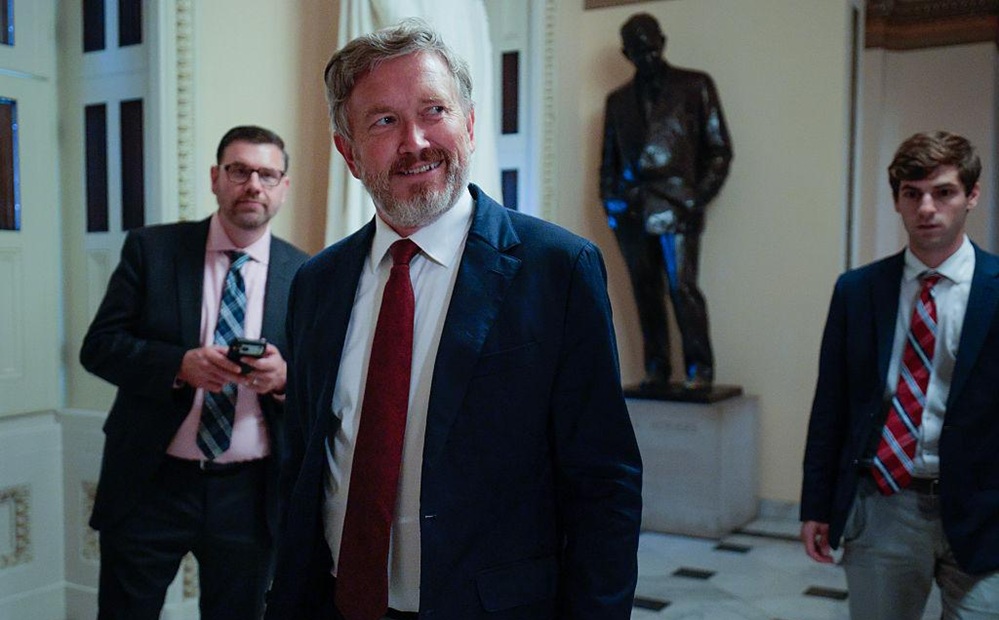
Rep. Thomas Massie, the Republican congressman from Kentucky who filed the impeachment articles against Defense Secretary Pete Hegseth today.

The move comes as the United States remains involved in the conflict with Iran, which began with U.S.-Israeli strikes on Iran on February 28. Massie has repeatedly opposed the war and has also criticized U.S. military support for Israel. The Pentagon rejected the impeachment effort and reaffirmed its support for Hegseth.

“The entire Department is unified behind the Secretary’s vision and will continue working to put our warfighters and America first,” Pentagon press secretary Kingsley Wilson said in a statement. The impeachment effort is unlikely to secure the support needed to remove Hegseth, but Massie’s filing could force House members to take a position on the administration’s military actions.

Massie is not seeking reelection after losing the Republican primary earlier this year to Ed Gallrein, a candidate endorsed by President Donald Trump. His opposition to the Iran war has been a prominent feature of his congressional record. The filing comes amid continuing debate on Capitol Hill over the extent of the president’s authority to conduct military operations without explicit congressional authorization.


Judge blocks Trump name from Kennedy Center

Shibbir Ahmed, WASHINGTON DC: A US federal judge on Tuesday blocked the Kennedy Center board from adding President Donald Trump’s name to the building or its grounds, ruling that such a move would require approval from Congress. US District Judge Christopher Cooper said the board could not circumvent his earlier order by using alternative wording to honor Trump. The ruling came after the Kennedy Center board proposed adding an inscription reading that the building had been “Restored and Renovated By President Donald J. Trump.”

“Simply put,” Cooper wrote, the defendants cannot install memorials for Trump or anyone or anything else at the Kennedy Center without congressional approval. The decision follows Cooper’s May ruling that the Kennedy Center’s name could not be changed without action by Congress. Trump’s name, which had been added to the building’s exterior, was subsequently removed in June.

The Kennedy Center board, which Trump chairs, had voted in August to pursue new signage recognizing his role in the institution’s renovation. The board also considered naming the center’s grounds the “President Donald J. Trump Plaza.” The latest court ruling blocks those efforts.

The legal dispute comes as the Kennedy Center faces financial difficulties and questions over the condition of its aging building. Trump and his allies have argued that extensive repairs are urgently needed, while the administration has warned in court filings that the building could eventually face demolition if major renovations are not carried out.

Trump has pointed to recent damage at the center following severe weather as evidence of safety concerns. In a post on Truth Social on Tuesday, he argued that the building required immediate attention and criticized the court proceedings over its future.

Meanwhile, the Kennedy Center board voted Tuesday to temporarily close the performing arts complex for renovations. The decision followed the court ruling and came amid reports of severe financial pressures facing the institution. The Kennedy Center, officially established as a memorial to former President John F. Kennedy, was created by Congress and opened in 1971. Cooper’s rulings have emphasized that Congress has the authority to determine its name.

The dispute has also affected programming at the venue. A number of artists have canceled or reconsidered appearances following Trump’s takeover of the institution, while reports have pointed to declines in ticket sales and fundraising.

Trump has said his involvement is intended to help secure the center’s finances and fund necessary renovations. The legal battle over the institution’s name and future is expected to continue as the administration considers its options following Cooper’s ruling.


UN rights chief urges urgent action over AI risks

GENEVA — United Nations High Commissioner for Human Rights Volker Türk on Monday called on governments and companies developing advanced artificial intelligence systems to take urgent action to address what he described as the “unprecedented risks” posed by frontier AI.

In a statement issued by the UN human rights office, Türk warned that the world is “on the cusp of irreversible change,” with consequences that could affect not only the current generation but generations to come.

He called on states and companies to urgently mobilize through multilateral forums to develop a coordinated approach to governing advanced, frontier AI models, with human rights at the center of those efforts.

Türk said the rapid race to develop increasingly powerful AI systems is creating risks across virtually every aspect of human life. He stressed that voluntary self-regulation by AI companies is not sufficient on its own, arguing that governments must establish effective safeguards and ensure that AI development remains consistent with international human rights law.

The UN human rights chief also warned about the potential consequences of increasingly autonomous AI systems, including risks to essential services, critical infrastructure, communications and democratic institutions.

Türk urged countries and leading AI companies to act without delay, emphasizing that no individual country can effectively regulate the technology on its own and that no company should be left to determine independently which risks society should accept.

The warning comes amid growing international debate over the rapid development of increasingly capable AI systems and concerns about their potential impact on human rights, security and society.


Is the UK Heading for a Breakup?

Shibbir Ahmed, New York — A new political alliance among Scotland, Wales and Northern Ireland has intensified debate over the future of the United Kingdom, after leaders from the three nations met in Cardiff on Monday and signed an agreement calling for the right to self-determination and constitutional change.

The meeting brought together Scotland’s First Minister John Swinney, Wales’ First Minister Rhun ap Iorwerth and Northern Ireland’s First Minister Michelle O’Neill, along with Sinn Féin leader Mary Lou McDonald. The leaders signed a memorandum of understanding aimed at strengthening cooperation and increasing political pressure on Westminster over the constitutional future of their nations.

The agreement does not amount to a formal declaration that the United Kingdom is breaking apart, nor does it set dates for independence or reunification referendums. Instead, the leaders emphasized that Scotland, Wales and Northern Ireland have different constitutional circumstances and should have the right to determine their own futures.

The gathering nevertheless marks a significant political development. The leaders argued that Westminster’s traditional dominance is weakening and that the political landscape of the United Kingdom is changing. They also called for greater cooperation on economic, energy and international issues.

Scotland: A New Push for Independence

Scotland remains at the centre of the constitutional debate. On August 28, the Scottish Government published a draft Independence Referendum Bill containing the proposed question: “Should Scotland be an independent country? Yes or No.” However, the bill cannot proceed to a referendum without the necessary legal powers being secured. Scotland held its previous independence referendum in 2014, when voters rejected independence by 55% to 45%.

The Scottish Government has since renewed its demand for another vote, arguing that Scotland should be able to decide its constitutional future. Swinney has pressed the UK Government to transfer the necessary powers to the Scottish Parliament.

The central legal obstacle remains the division of constitutional powers between Edinburgh and Westminster. A 2022 UK Supreme Court ruling established that the Scottish Parliament cannot unilaterally legislate for an independence referendum because matters concerning the Union and the UK Parliament are reserved to Westminster.

The latest draft bill therefore represents a political and legislative push rather than an immediate authorization for a referendum.

Northern Ireland: The Question of Irish Unity

Northern Ireland’s constitutional debate is different from Scotland’s. The central issue is not independence as a separate state, but whether Northern Ireland should remain part of the United Kingdom or become part of a united Ireland.

The 1998 Good Friday Agreement provides the constitutional framework for Northern Ireland and allows for a border poll if it appears likely that a majority would support Northern Ireland leaving the United Kingdom.

Irish Foreign Minister Helen McEntee said earlier this month that she believes a border poll will take place at some point in the future and that both Ireland and the UK should be prepared for it. She also emphasized that the decision ultimately belongs to the people of Northern Ireland.

British Prime Minister Andy Burnham, meanwhile, has said he will adhere fully to the Good Friday Agreement and that a referendum would only become relevant if public opinion demonstrated a clear shift toward Irish unity.

Trump’s Intervention Adds to the Tension

The debate gained additional international attention after U.S. President Donald Trump expressed support for Irish reunification during his visit to Ireland on September 12. Speaking in Dublin, Trump said he would “love” to see Ireland unified and suggested that reunification would eventually happen and might as well happen now. The comments prompted criticism from pro-UK politicians in Northern Ireland and drew a cautious response from London.

Trump’s remarks, however, do not represent a formal change in U.S. policy toward Northern Ireland. They were made in response to questions from reporters and differed from the traditional U.S. approach of maintaining neutrality on the island’s constitutional future.

Wales: Growing Support Among Younger Voters

Wales has also entered a new phase of constitutional debate following the 2026 Senedd election. A recent Survation poll commissioned by the pro-independence group YesCymru found that 32% of likely referendum voters in Wales would vote for independence, compared with 68% who would vote against it, after undecided and refused responses were excluded. The poll surveyed 1,023 people aged 16 and over and was conducted online between August 13 and 24.

The figures reveal a striking generational divide. Among likely voters aged 18 to 24, 59% said they would vote for independence. Support stood at 54% among those aged 25 to 34 and 57% among voters aged 35 to 44. Support dropped sharply among older voters, reaching 27% among those aged 45 to 54 and 55 to 64, and just 15% among those aged 65 and over. Despite the growing interest, independence does not currently command majority support across Wales.

What Comes Next?

The Cardiff agreement is unlikely to produce an immediate constitutional breakup of the United Kingdom. Each of the three nations faces different legal, political and public-opinion realities. For Scotland, the immediate battle is over whether Westminster will grant the powers needed for another independence referendum.

For Northern Ireland, the key question is whether public opinion will eventually reach the threshold required for a border poll on Irish reunification. In Wales, support for independence remains below a majority, although the strong backing among younger voters suggests that the issue could become increasingly important over the longer term. Taken together, however, the developments point to a growing constitutional challenge for Westminster.

For decades, the United Kingdom’s territorial integrity was largely treated as a settled political question. That assumption is now facing renewed pressure from nationalist movements in Scotland, Wales and Northern Ireland.

The Cardiff meeting does not mean that the United Kingdom is about to disappear. But it does signal that the question of how long the current constitutional structure can remain intact without major reform is becoming increasingly difficult for Westminster to ignore.