PM discusses skills partnership, innovation city with JICA chief

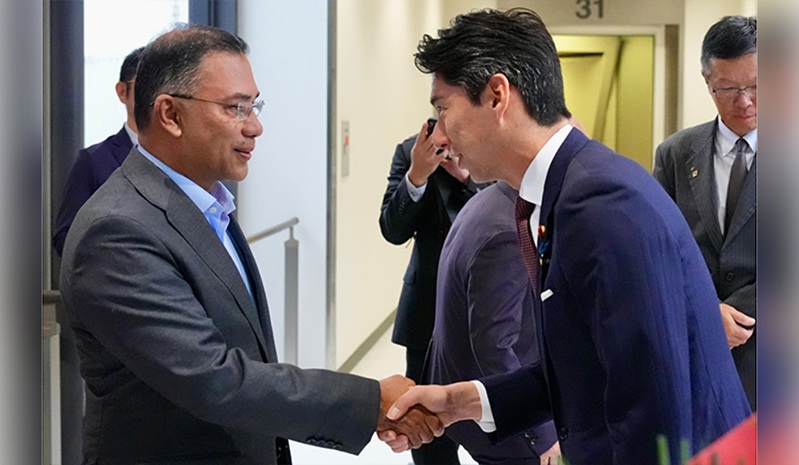
TOKYO, Japan – Prime Minister Tarique Rahman today discussed proposals for a Bangladesh-Japan Skills Partnership and a Technological Village and Innovation City, alongside cooperation in agricultural modernisation, agro-processing and light engineering, with Japan International Cooperation Agency (JICA) President Dr Akihiko Tanaka. The proposals came up during a courtesy meeting between Prime Minister and JICA President at Hotel Imperial here at 5:10 pm local time, said Deputy Press Secretary to the Prime Minister Shahadat Shadhin.

During the meeting, the Bangladesh side placed the proposals for the Bangladesh-Japan Skills Partnership and the establishment of a Technological Village and Innovation City, as well as expanding cooperation in agricultural modernisation, agro-processing and the light engineering sector. At the beginning of the meeting, Tarique Rahman recalled his fruitful meeting with the JICA president in Dhaka during the latter’s visit to Bangladesh in July this year.

The Prime Minister expressed gratitude for Japan’s long standing cooperation and JICA’s significant contributions to Bangladesh’s socioeconomic development. Highlighting Japan’s important role in Bangladesh’s infrastructure development, socioeconomic progress and efforts to realise its development aspirations, the premier said, “It is essential to continue cooperation with Japan to further deepen the longstanding friendly relations between the two countries, advance Bangladesh’s development and improve people’s living standards.”

The meeting also emphasised the need to complete major ongoing development projects supported by Japan within their stipulated deadlines. The two sides also discussed expediting the approval and implementation of priority projects awaiting approval. Tarique Rahman emphasised the need to continue concessional loan assistance and expand technical cooperation in line with Bangladesh’s current development priorities.

In view of the current global energy situation, Bangladesh also requested budgetary support, as provided last year, to meet the country’s energy needs and ensure energy security. The JICA president reaffirmed his commitment to working together to achieve prosperity in Bangladesh. The Prime Minister expressed hope that the initiatives would further strengthen the strategic partnership between Bangladesh and Japan and contribute to the shared prosperity of the two countries. JICA Senior Vice-President Hara Shohei and senior officials of the agency were present at the meeting.

Finance and Planning Minister Amir Khosru Mahmud Chowdhury, Civil Aviation and Tourism Minister M. Rashiduzzaman Millat, PM’s Adviser on Finance and Planning Rashed Al Mahmud Titumir, State Minister for Foreign Affairs Humaiun Kobir , State Minister for Power, Energy and Mineral Resources Anindya Islam Amit, PM’s Adviser on Posts, Telecommunications and Information Technology and Science and Technology Rehan Asif Asad, PM’s Special Assistant for Overseas Employment in the Asia-Pacific region Dr Md Shakirul Islam Khan, Economic Relations Division (ERD) Secretary M Shahriar Kader Siddiky , PM’s Additional Press Secretary Atikur Rahman Rumon, were present among the Bangladesh delegation.



PM arrives in Tokyo on four-day official visit

TOKYO – Prime Minister Tarique Rahman arrived in Tokyo this morning (local time) on a four-day official visit at the invitation of his Japanese counterpart Sanae Takaichi, aiming to deepen bilateral ties, attract investment and expand trade and development cooperation. A Biman Bangladesh Airlines flight carrying the prime minister, his wife Dr Zubaida Rahman, and members of his entourage landed at Narita International Airport at 9:07 am local time.

The prime minister was received at the airport by State Minister for Foreign Affairs Yasutaka Nakasone. A motorcade then escorted him to Tokyo’s Imperial Hotel, where he will stay during his visit. Prime Minister’s Adviser for Posts, Telecommunications and Information Technology and Science and Technology Rehan Asif Asad, Special Assistant to the Prime Minister for Foreign Employment in the Asia-Pacific region Dr Md Shakirul Islam Khan, and senior officials of the Bangladesh Embassy in Tokyo were also present.

Earlier, the prime minister left Hazrat Shahjalal International Airport in Dhaka early today Bangladesh time for Japan aboard a Biman Bangladesh Airlines flight, accompanied by a small delegation. Tarique Rahman is scheduled to hold a high-level bilateral talk with Japanese Prime Minister Sanae Takaichi at her office on October 27, followed by a joint press announcement and a luncheon hosted by the Japanese premier, according to the Prime Minister’s press wing.

During the four-day visit, the prime minister will also meet Japanese government officials, development institutions and business leaders, visit industrial and energy facilities, and deliver the keynote address at the Bangladesh-Japan Economic Forum. The premier’s visit is expected to deepen the existing strategic partnership, attract fresh Japanese investment, expand trade and accelerate ongoing development projects, Foreign Secretary Asad Alam Siam told journalists at a curtain-raiser media briefing at the Foreign Ministry on October 20.

Discussions will focus on the effective implementation of the Bangladesh-Japan Economic Partnership Agreement (EPA), signed in February 2026, expanding access for Bangladeshi products to the Japanese market and strengthening business engagement. The two sides will also explore wider cooperation in renewable energy, agriculture, science and technology, digital transformation, skills development and human resource development.

His tentative programme includes engagements with the Japan-Bangladesh Parliamentary Friendship League and the chairman of the Japan-Bangladesh Committee for Commercial and Economic Cooperation. Meetings are also being planned with the president of the Japan International Cooperation Agency (JICA), the governor of the Japan Bank for International Cooperation (JBIC), the president of the Japan External Trade Organization (JETRO) and the chairman of the Sasakawa Peace Foundation, said the foreign secretary.

The proposed itinerary includes visits to an LNG terminal and power plant in Futtsu City, Chiba, the headquarters of UNIQLO and a Toyota factory in Nagoya. The foreign secretary said the two sides were discussing draft memoranda of understanding and cooperation agreements covering agriculture, fisheries, human resource development, skills enhancement, civil aviation, trade, environmental conservation and local government modernisation.

Prime Minister Tarique Rahman arrived in Tokyo this morning on a four-day official visit. Photo: KHABOR

“We hope that many of these MoUs will be signed during the visit,” he said. Around eight MoUs are under discussion, of which three to four could be signed during the visit. Separate agreements are also being pursued in education and human resource development. Detailed discussions are planned on Japanese support for establishing factories in Bangladesh, generating employment and developing human resources in line with the prime minister’s priorities.

The two sides are also expected to discuss regional and international peace and stability, a sustainable and peaceful solution to the Rohingya crisis, stronger cooperation in addressing the energy crisis and efforts to end international conflicts. The visit follows the prime minister’s participation in an online meeting in April at the invitation of the Japanese premier, during which Bangladesh welcomed a Japan-led initiative to address energy challenges across Asia.

Japan has been a major development partner of Bangladesh since the establishment of diplomatic relations in 1972. Japanese assistance has supported major infrastructure projects, including the Dhaka metro rail, the third terminal of Hazrat Shahjalal International Airport and infrastructure development in Matarbari. Shaheed President Ziaur Rahman visited Japan in 1978 and 1980, while former Prime Minister Khaleda Zia visited the country in 1994 and 2005.


Bijoya Dashami being celebrated with traditional Sindur Khela at mandaps

DHAKA – Bijoya Dashami, the final day of the six-day Sharadiya Durga Puja, is being celebrated across the country today with due religious fervour, traditional rituals and communal harmony. The celebrations are drawing to a close with the observance of Sindur Khela during the day, followed by the immersion (Bisarjan) of Durga idols in nearby rivers, ponds and other water bodies this evening.

Devotees are also exchanging Bijoya greetings, marking the departure of Goddess Durga from her earthly abode. Temples across the country, including Dhakeshwari National Temple, Ramna Kali Mandir, Siddheshwari Kalimandir and Ramakrishna Mission and Math, are witnessing large gatherings of worshippers.

Married Hindu women, dressed in traditional white sarees with red borders, are participating in Sindur Khela, one of the most prominent rituals of Bijoya Dashami. Sindur Khela, meaning the playing with vermilion, is a traditional Hindu ritual observed mainly in Bangladesh and eastern India.

During the ritual, married women offer vermilion and sweets to Goddess Durga following the completion of the final Dashami puja. They then smear vermilion on each other’s foreheads and faces, exchange sweets and pray for marital happiness and prosperity. Although traditionally observed by women, the ritual has increasingly seen the participation of male devotees in recent years, adding to the festive atmosphere.

Dashami puja was performed at temples and temporary mandaps in the morning, followed by Darpan Bisarjan, a symbolic ritual in which the reflection of the Goddess is immersed before the formal immersion of the idol. Following the rituals, colourful processions are making their way through city streets towards nearby water bodies for the immersion of the idols.

The idols, traditionally carried on bamboo structures, are now being transported on decorated trucks and pickup vans, with some taken by boat to the middle of rivers for immersion. Devotees are chanting traditional slogans such as “Aschhe bochhor abar hobe” (It will happen again next year), expressing their hope for the Goddess’s return next year.

In Dhaka, major mandaps at Dhakeshwari National Temple, Ramakrishna Mission and Math, Kalabagan, Banani, Shakhari Bazar and Ramna Kali Mandir have drawn thousands of devotees since morning. The immersion ceremonies in the capital are expected to draw large crowds, while law enforcement agencies are maintaining security and taking measures to ensure smooth traffic movement.

Similar celebrations are taking place in major divisional cities, including Chattogram, Rajshahi, Khulna, Sylhet and Barishal, as well as district towns such as Narayanganj, Faridpur, Dinajpur, Jashore, Kushtia, Netrakona, Tangail and Satkhira.

Following the immersion, younger family members seek blessings from elders by touching their feet, while relatives and friends exchange warm embraces and Bijoya greetings. Traditional sweets, including chomchom, kalojam, sandesh and narkeler naru (coconut and jaggery balls), are being distributed among family members, friends and neighbours as part of the Bijoya celebrations.


Iran Reviews US Hormuz Proposal as Oil Risks Rise

DUBAI — Iran is reviewing Washington’s response to its proposal to reopen the strategically important Strait of Hormuz and says it will communicate its position through intermediaries once the review is complete, as stalled negotiations and escalating Middle East tensions continue to threaten global energy security. Iranian Foreign Ministry spokesperson Esmaeil Baghaei said Monday that Tehran was still examining the US response and remained in contact with Washington through intermediaries. His remarks indicate that diplomatic channels remain open, although major disagreements over the conditions for reopening the waterway and resuming negotiations have yet to be resolved.

The diplomatic impasse comes as oil prices remain elevated amid attacks on shipping and Saudi infrastructure. The Strait of Hormuz is one of the world’s most important energy transit routes, connecting the Persian Gulf with international markets through the Gulf of Oman.

Iran submitted its proposal in mid-September as part of efforts to end the conflict and restore maritime traffic through the Strait of Hormuz. Baghaei said Tehran would send its response to Washington through intermediaries after completing its review. He did not provide a specific timeline for the decision.

Iran’s security leadership has argued that Washington’s response does not adequately address seven conditions Tehran has outlined for reopening the waterway and returning to negotiations.

A central disagreement concerns the order in which the two sides should address outstanding issues. Washington wants Iran’s nuclear programme included at the beginning of negotiations, while Tehran argues that reopening the strait and restoring maritime security should take priority. The disagreement has complicated diplomatic efforts despite continued exchanges of messages between the two sides.

The Strait of Hormuz is a narrow maritime passage linking the Persian Gulf to the Gulf of Oman and the Arabian Sea. Before the current conflict, approximately one-fifth of global oil and liquefied natural gas trade passed through the waterway.

Its importance extends well beyond the Middle East. Major energy-importing economies in Asia, as well as markets in Europe, depend on uninterrupted shipments of oil and natural gas from Gulf producers. Disruptions to the route can increase shipping costs, delay deliveries and create uncertainty for refiners, energy companies and governments planning fuel supplies.

The continuing confrontation has already affected maritime traffic and energy exports. Even a partial recovery in shipping would depend on vessels being able to transit the strait safely and consistently.

Energy markets have reacted to the latest developments in the Middle East, including attacks on Saudi Arabia and incidents involving commercial shipping. Brent crude futures rose to $106.76 a barrel on October 11, while US West Texas Intermediate crude reached $93.69, according to Reuters. Prices were supported by concerns about the security of Gulf energy infrastructure and maritime routes.

Higher oil prices can increase transportation and manufacturing costs, place pressure on household fuel bills and complicate efforts by central banks to control inflation. However, prices also depend on factors beyond the Strait of Hormuz, including global demand, available inventories, production decisions and developments in other oil-producing regions. The longer maritime uncertainty persists, the more difficult it becomes for energy markets to assess the reliability of supplies from the Gulf.

Qatar and Pakistan are among the countries involved in efforts to facilitate communication between Washington and Tehran. Their diplomatic role reflects wider regional concerns about the economic and security consequences of a prolonged confrontation. A negotiated arrangement could potentially restore maritime traffic while creating a framework for addressing other outstanding disputes.

The negotiations nevertheless face substantial obstacles. The United States and Iran disagree on the sequencing of discussions, the conditions for reopening the waterway and the broader issues that should be included in a settlement. Neither side has publicly confirmed a final agreement to resolve the current impasse.

The Hormuz negotiations are unfolding alongside a separate escalation involving Saudi Arabia and Yemen’s Iran-aligned Houthi movement. Recent attacks on Riyadh have disrupted aviation and heightened concerns about the security of civilian infrastructure. Saudi Arabia has been considering its military response, while Washington has weighed whether to become more directly involved in operations against the Houthis.

The overlapping crises are increasing pressure on regional governments to strengthen defenses and prevent further disruption to international trade. Although the Houthi conflict and the US-Iran negotiations are distinct issues, both affect regional stability and the security of important maritime routes. Iran has reiterated that dialogue should be used to resolve the dispute involving Saudi Arabia and the Houthis, while continuing to review Washington’s response to its Hormuz proposal.

The immediate question is whether Iran will formally respond to the US proposal and whether that response can restart substantive negotiations. A breakthrough could help restore confidence in maritime transport and reduce some of the uncertainty affecting oil markets. Failure to reach an understanding could prolong disruptions and increase pressure on governments, shipping companies and energy producers.

Even if an agreement on reopening the strait emerges, a lasting resolution would depend on implementation, reliable maritime security arrangements and progress on the wider issues dividing Washington and Tehran.

For now, Iran says its review is continuing, and no final agreement has been announced. The outcome of the negotiations could have significant consequences for Middle East security, international shipping and the stability of global energy supplies.


Saudi Arabia Attacks Raise Fears of Regional War

RIYADH, Saudi Arabia — A series of deadly attacks attributed to Yemen’s Iran-aligned Houthi movement has intensified security concerns across the Middle East, prompting Saudi Arabia to reinforce its response, suspend operations at its main airport in Riyadh, and assess the risk of a wider regional conflict.

Saudi Arabia faced renewed missile and drone threats on Monday, October 12, following attacks on King Khalid International Airport that killed civilians and disrupted air travel. The escalation comes amid the broader conflict involving the United States and Iran, raising concerns about the security of Gulf states, international aviation, and critical energy and shipping routes.

Saudi authorities reported that an attack on Riyadh’s King Khalid International Airport on Sunday killed one person and injured 11 others. The victim was identified as a Pakistani national. The incident followed a deadly strike on Saturday that killed 12 people and injured more than 300, according to reporting by international news organizations. An Indian national subsequently died from injuries sustained in Saturday’s attack, bringing the reported death toll from that incident to 13.

The attacks targeted the airport complex serving domestic passengers, raising serious concerns about civilian safety and the vulnerability of critical transportation infrastructure. The Houthis claimed responsibility for the strikes, according to Reuters and other media reports.

Saudi authorities extended the suspension of operations at Riyadh’s international airport as officials assessed damage and reviewed security arrangements. The disruption has affected airlines operating between Saudi Arabia and destinations in Europe and Asia. Aviation analytics firm Cirium estimated that approximately 60% of scheduled flights across Saudi Arabia could be cancelled on Monday, while cancellations at Riyadh airport were particularly severe.

The US Federal Aviation Administration also advised American airlines to exercise caution when flying to or over Saudi Arabia. Several international carriers suspended or adjusted services, reflecting the growing operational risks associated with the attacks.

The repeated attacks have increased pressure on the Saudi government to strengthen its defenses and respond to the Houthi campaign. Saudi-led coalition forces have reported renewed missile and drone activity, while Saudi forces have intensified strikes against Houthi positions in Yemen. However, the effectiveness of further military action remains uncertain, and continued exchanges could increase the danger to civilians on both sides.

The Associated Press reported that Saudi Arabia has opened an investigation into how its air defenses failed to prevent the deadly airport attack. The incident has raised questions about the ability of existing defense systems to protect major civilian facilities against coordinated drone and missile strikes.

Turkey, Pakistan, Egypt and Saudi Arabia condemned the attacks in a joint statement, describing them as a dangerous escalation and calling for an immediate halt to the strikes. The four countries expressed support for Saudi Arabia’s efforts to counter the threats and prevent further attacks. Their response reflects concern that continued violence could threaten regional stability and international peace and security.

The United Arab Emirates has also called for stronger cooperation among Gulf states on security and defense. UAE presidential adviser Anwar Gargash warned that attacks against Saudi Arabia undermine the security of the wider Gulf region.

Despite Iran’s longstanding support for the Houthi movement, Tehran has offered to help facilitate dialogue between the Houthis and Saudi Arabia. Iranian Foreign Ministry spokesperson Esmaeil Baghaei said Monday that Tehran was prepared to assist efforts to bring the parties into talks. Whether this offer can lead to a meaningful reduction in violence remains unclear.

The diplomatic development comes as Saudi Arabia confronts renewed attacks and considers its military options. The situation presents a difficult challenge for regional governments seeking to protect critical infrastructure without triggering a broader confrontation.

The conflict also threatens important international trade routes. The Bab el-Mandeb Strait, near Yemen’s coastline, is a strategic passage linking the Red Sea with the Gulf of Aden and the wider Indian Ocean. Any disruption to shipping through the strait could affect the movement of oil, fuel and other commercial goods. The attacks have also raised concerns about Saudi energy infrastructure, a particularly significant issue for one of the world’s largest oil-producing countries.

A wider conflict involving additional regional or international forces could compound existing pressures on energy markets and maritime commerce. However, the scale of any future disruption will depend on developments on the ground and whether the attacks continue.

US President Donald Trump has said Washington is considering joining Saudi Arabia in strikes against the Houthis. As of Monday’s reporting, there was no confirmed announcement that the United States had begun direct military operations against the group in response to the latest airport attacks. Any American intervention could significantly change the conflict’s trajectory. It could increase military pressure on the Houthis, but it could also prompt further retaliation against Saudi infrastructure or international shipping. The possibility of a wider confrontation involving Saudi Arabia, the Houthis, Iran and the United States remains a major concern for regional security officials.

The attacks on Riyadh’s airport represent a serious escalation because they have caused substantial civilian casualties, disrupted international aviation and increased pressure for a military response. Saudi Arabia now faces the challenge of protecting its population and infrastructure while avoiding a conflict that could spread across the region. Diplomatic efforts, including Iran’s offer to mediate, may provide an avenue for de-escalation, but no agreement to halt the attacks has been confirmed in the reporting cited here. The central question is whether regional governments can contain the confrontation before further strikes or outside military intervention turn it into a broader Middle East war.


Riyadh Airport Attack Kills Three in Saudi Arabia as Houthi Rebels Claim Responsibility

Riyadh, Saudi Arabia — Three Saudi citizens have been killed and several others injured in attacks targeting King Khalid International Airport in Riyadh and a Saudia Airlines aircraft, according to Saudi Arabia’s General Authority of Civil Aviation. The incident has heightened concerns over aviation security and the escalating conflict involving Yemen’s Houthi rebels.

Saudi aviation authorities confirmed the fatalities in a statement issued Friday, following attacks on Thursday. The first incident targeted airport facilities in the Saudi capital, while the second struck an aircraft belonging to the kingdom’s national carrier.

Iran-backed Houthi rebels operating in neighboring Yemen claimed responsibility for targeting the airport with a ballistic missile. However, Saudi authorities had not officially identified the perpetrators in their initial statement, and the group’s account should be treated as a claim rather than independently verified fact.

The attacks caused material damage and left several people injured, some of whom required hospital treatment, according to Saudi aviation officials. Authorities said they were coordinating with relevant security agencies to assess the damage and implement measures to protect passengers, airport personnel and aviation infrastructure.

The incident underscores the vulnerability of major civilian transport hubs amid rising regional tensions. Riyadh is a central gateway for international travel, business and religious tourism, making disruptions to its airport potentially consequential for travelers and airlines.

The security situation has prompted several international airlines to suspend or adjust services to Riyadh. Lufthansa and multiple Indian carriers have announced temporary suspensions following the reported attacks, while flight cancellations have disrupted scheduled arrivals and departures.

Airlines are monitoring developments and reviewing operational risks as authorities assess the situation. Passengers traveling to or from Saudi Arabia should confirm their flight status directly with their airline before leaving for the airport.

The scale and duration of the disruption will depend on subsequent security assessments and decisions by aviation authorities and individual carriers.

The attacks come amid renewed hostilities in Yemen, where Houthi forces are fighting Yemen’s internationally recognized government and its regional supporters. The conflict has increasingly threatened critical infrastructure and transport routes, raising concerns about wider regional instability.

Saudi Arabia has been involved in Yemen’s conflict since 2015, supporting the internationally recognized government against the Houthis. Renewed attacks on Saudi territory could further complicate efforts to contain the fighting and protect civilian infrastructure.

The latest incident also highlights the broader risks facing commercial aviation in a region affected by missile threats, military operations and shifting security conditions.

Travelers scheduled to fly through Riyadh should check directly with their airlines for cancellations, rescheduling options and updated airport guidance. Passengers should also follow official announcements from Saudi aviation authorities and their respective embassies.

At this stage, the full extent of the damage, the precise circumstances of the attacks and any further security measures remain subject to additional official updates.

The deaths of three Saudi citizens in attacks targeting Riyadh’s international airport and a Saudia aircraft mark a serious development in the region’s deteriorating security environment. With Houthi rebels claiming responsibility and international airlines reassessing operations, the incident is likely to keep aviation security and the Yemen conflict at the forefront of regional attention.

Further developments will depend on the findings of Saudi investigations, subsequent security decisions and any additional announcements from the parties involved.

Source: Associated Press reporting published October 9, 2026, citing Saudi Arabia’s General Authority of Civil Aviation and statements regarding the Houthi claim of responsibility.


US supports vaccination drive to protect 3.4 million children

Ruma Bhoumik, Dhaka – The United States is supporting Bangladesh’s national measles-rubella catch-up vaccination campaign through UNICEF, with the aim of protecting 3.4 million children aged six to 59 months amid the ongoing outbreak. US Chargé d’Affaires Eric Geelan today visited the vaccination campaign at T&T Field in Korail, Banani, here.

The campaign, launched on September 26, is being supported under the United States’ America First Global Health Strategy, according to a statement attributable to US Mission Spokesperson Poornima Rai.

He was joined by State Minister for Health Dr Mohammad Abdul Muhit, Dhaka North City Corporation Administrator Md Shafiqul Islam Khan and DNCC Chief Health Officer Brigadier General Imrul Kayes Chowdhury.

UNICEF Bangladesh Chief of Communications and Advocacy Miguel Mateos Muñoz and UNICEF Bangladesh Immunization Lead Dr Riad Mahmud were also present. The campaign represents a nationwide effort to vaccinate vulnerable children against measles and rubella as Bangladesh continues to respond to the current outbreak.

The US support, channelled through UNICEF, is aimed at strengthening the government’s immunisation response and expanding vaccine coverage among children in the target age group.


Bangladesh Police Launches Cyber Police Unit for AI-Era Policing

DHAKA — Bangladesh Police has launched a dedicated Cyber Police Unit to strengthen cybercrime investigations, digital security and technology-driven policing as criminal activities increasingly evolve in the era of artificial intelligence. Home Minister Salahuddin Ahmed formally inaugurated the specialised unit at the Hall of Pride at Police Headquarters on Thursday.

Speaking at a press briefing after the inauguration, the home minister said the rapid development of artificial intelligence and changing patterns of crime require law enforcement agencies to move beyond conventional policing and adopt technology- and knowledge-based approaches.

“In the era of artificial intelligence, the nature of crime is changing rapidly. Our policing system must evolve accordingly. The Cyber Police Unit is a major step towards transforming Bangladesh Police into a modern, technology-driven and knowledge-based force,” he said.

The new unit represents a major institutional step toward establishing a technology-led policing framework capable of responding to increasingly sophisticated cyber and digital crimes. The Cyber Police Unit will be headed by an Additional Inspector General of Police (Additional IGP). Mohammad Iqbal Hossain has initially been assigned to lead the unit.

At the divisional level, deputy inspectors general (DIGs) and additional DIGs will oversee cyber-policing activities. At the district level, superintendents of police (SPs) or designated senior officers will be responsible for cyber-related operations.

Dedicated sub-inspectors, assistant sub-inspectors and constables will also be deployed at police stations to provide cyber-related services and assist with investigations. According to the approved organisational structure, the unit will have a total strength of 4,592 personnel. Initially, experienced and trained members of the existing police force will be deployed, while additional recruitment will be carried out to fill the remaining positions.

The government is also creating a specialised technical workforce within the unit through contractual and outsourced recruitment of professionals with expertise in cyber security and digital investigations. The unit plans to recruit specialists in areas including system analysis, financial data analysis, cyber security, network administration, dark-web analysis, cryptocurrency analysis, malware analysis, social-media analysis, emergency response and disaster recovery. These specialists will be recruited under separate competitive remuneration arrangements.

IT-trained members of the regular police force will receive priority for deployment to the unit, while senior officers and technical specialists will undergo advanced training both in Bangladesh and abroad. A modern digital forensic laboratory is also being established under the Cyber Police Unit. The facility will be equipped with advanced technology and specialised tools for cyber investigations.

The laboratory is expected to support investigations involving financial crimes, money laundering, social-media-related offences, misinformation, drug-related crimes and extremist activities conducted through digital platforms. The home minister said the new structure would also bring together cyber-investigation activities that had previously been carried out separately by different police units.

“Cyber investigations were previously carried out in a fragmented manner across different units. The new Cyber Police Unit will bring these activities under a single, coordinated framework, helping us improve investigative efficiency, technological capability and institutional coordination,” he said.

Salahuddin Ahmed expressed hope that the specialised unit would strengthen Bangladesh’s capacity to prevent and investigate cybercrime and address the misuse of cyberspace. Senior Secretary of the Ministry of Home Affairs Manzur Morshed Chowdhury, Inspector General of Police Md Ali Hossain Fakir, and other senior police officials attended the briefing.


US, Bangladesh Reaffirm Strong Defense Ties

DHAKA — U.S. Ambassador to Bangladesh Christensen and Chief of Army Staff General Waqar-Uz-Zaman have reaffirmed the enduring strength of the defense relationship between the United States and Bangladesh. In a statement following the meeting, Ambassador Christensen said he and General Waqar-Uz-Zaman reaffirmed their commitment to the longstanding defense partnership between the two countries.

The ambassador also expressed appreciation for Bangladesh’s substantial contribution to the Haiti Gang Suppression Force, highlighting the country’s role in international security efforts.

“Chief of Army Staff General Waqar-Uz-Zaman and I reaffirmed the enduring strength of the U.S.-Bangladesh defense relationship,” Christensen said.

“I also expressed my appreciation for Bangladesh’s substantial contribution to the Haiti Gang Suppression Force—an example of Bangladesh’s important role as a global security partner,” he added.

Bangladesh has a long-standing record of participation in international peace and security operations. Its contribution to the Haiti mission underscores the country’s continued engagement in multinational efforts to address security challenges. The meeting comes as Washington and Dhaka continue to strengthen cooperation in defense and security, alongside broader bilateral engagement between the two countries.


Tarique Rahman Leaves for New York for UNGA

DHAKA — Prime Minister Tarique Rahman left Dhaka early Monday for New York to attend the 81st session of the United Nations General Assembly (UNGA), where he is scheduled to deliver his first address to the General Assembly as prime minister on September 24.

A Turkish Airlines flight carrying the prime minister, his wife Dr Zubaida Rahman and members of his entourage departed Hazrat Shahjalal International Airport at around 6:05 a.m. The flight is scheduled to transit through Istanbul before arriving at John F. Kennedy International Airport in New York at about 5:55 p.m. local time.

The prime minister will be received at JFK by Bangladesh’s Permanent Representative to the United Nations in New York Irene Zubaida Khan and Bangladesh Ambassador to the United States Tareq Md Ariful Islam before being escorted to the Hyatt Grand Central New York, where he is scheduled to stay.

His official engagements are set to begin on September 22 with a welcome breakfast hosted by UN Secretary-General António Guterres for heads of state and government. He will subsequently attend the opening of the high-level General Debate and a reception hosted by the U.S. president for heads of state and government and their spouses.

On September 23, Tarique Rahman is scheduled to attend meetings on global inequality and climate action. He will also participate in a side event on the Rohingya crisis, where Bangladesh is expected to seek stronger international cooperation for the early repatriation of forcibly displaced Rohingyas to Myanmar.

Bangladesh is also expected to highlight its position as a climate-vulnerable country, focusing on climate finance, adaptation, technology transfer, loss and damage, and climate justice.

On September 24, the prime minister will deliver his General Assembly address. He is also scheduled to speak at a high-level meeting on the threats posed by rising sea levels and attend Bangladesh-hosted events on maternal and newborn health and midwifery.

According to the Foreign Secretary, the prime minister’s UNGA address will cover Bangladesh’s democratic journey, rule of law and accountability, global peace and security, climate change, sustainable development, economic cooperation, youth and women’s empowerment, education and health, the Rohingya crisis, technology and reform of the multilateral system.

On the sidelines of the General Assembly, Tarique Rahman is scheduled to hold bilateral meetings with the Crown Prince of Kuwait and the prime ministers of Croatia, Bhutan, Thailand, Pakistan and Haiti. Discussions are expected to cover political and economic relations, trade and investment, development cooperation and the Rohingya crisis.

He is also scheduled to meet UN Secretary-General António Guterres, the President of the European Council, the President of the World Bank Group, the UN Special Envoy on Myanmar and the UN high commissioners for refugees and human rights.

As part of the government’s economic diplomacy, the prime minister is scheduled to meet senior representatives of Meta, Wall Street firms and other business organisations to discuss investment, manufacturing, infrastructure, technology, skills development and employment opportunities. Tarique Rahman is scheduled to leave New York for Dhaka on the night of September 25.