Tarique Rahman Asks State Minister Ishraque Hossain to Resign

Dhaka: A political controversy has emerged in Bangladesh following reports that Prime Minister Tarique Rahman instructed State Minister Ishraque Hossain to resign from the cabinet. According to media reports, the reported directive came after controversy surrounding Ishraque Hossain’s participation in an anti-drug operation in Dhaka while carrying a firearm.

The issue reportedly came into focus following a cabinet meeting at the Secretariat on Sunday. However, an official government confirmation and confirmation that a formal resignation has been submitted are necessary to establish the latest status of the matter. The reports have sparked discussion in Bangladesh’s political circles. Further clarification is expected if the government or the individuals concerned issue an official statement.


Japan Plans $1.2 Billion Investment in Bangladesh Tourism

DHAKA: Japanese investors have announced plans for an initial investment of $1.2 billion in Bangladesh’s tourism and hospitality sector, signaling potential new opportunities for foreign investment in the country’s tourism industry. The announcement was made during a meeting with Civil Aviation and Tourism Minister M. Rashiduzzaman Millat at the Bangladesh Secretariat on Sunday afternoon.

According to a ministry press release, the Japanese delegation expressed strong interest in investing in Bangladesh’s tourism industry and working with the government to develop tourism infrastructure and hospitality facilities. Welcoming the initiative, Minister Millat assured the investors of the government’s cooperation, saying necessary steps would be taken once formal investment proposals were submitted.

The minister said the government was keen to attract foreign investment through mutually beneficial public-private partnerships (PPPs), ensuring positive outcomes for both investors and Bangladesh. Highlighting the country’s tourism potential, Millat pointed to the Sundarbans, the world’s largest mangrove forest, Cox’s Bazar’s extensive natural sea beach and the scenic tea gardens of Sylhet.

He said international investment, alongside improvements in tourism infrastructure and services, could help unlock the sector’s potential. Describing Japan as a longstanding development partner, the minister highlighted its contributions to Bangladesh’s major infrastructure projects. He expressed optimism that Japanese investment and expertise could support the growth of the country’s tourism industry.

Millat also instructed the relevant authorities to arrange visits for the Japanese delegation to potential tourism destinations so they could assess investment opportunities. A delegation from the Bangladesh Tourism Board (BTB) is expected to facilitate visits to prospective sites and help investors identify suitable projects.

The Japanese representatives reaffirmed their interest in building a long-term partnership with Bangladesh in tourism and hospitality. The proposed $1.2 billion investment will move forward for consideration once the investors submit formal proposals to the government.


Oil Prices Drop as U.S. Considers Easing Sanctions on Russian Tankers

LONDON — Oil prices fell on Thursday as the United States considered easing restrictions on certain oil tankers linked to Russia, raising hopes of lower shipping costs and improved flexibility in global fuel supplies. Brent crude futures fell $2.28, or 2.2%, to $103.78 a barrel, while U.S. West Texas Intermediate (WTI) crude declined $1.34, or 1.4%, to $93.75 a barrel, according to Reuters market data reported at 0729 GMT.

The decline followed reports that the U.S. administration was considering relaxing sanctions on some vessels associated with Russia’s so-called “shadow fleet.” These vessels are used to transport oil and petroleum products outside conventional shipping arrangements and are often linked to efforts to evade international restrictions.

A U.S. official said the proposed measures could help reduce freight costs and provide greater flexibility for transporting diesel and other petroleum products. The discussions come days after President Donald Trump temporarily lifted sanctions on Russian diesel fuel in an effort to ease pressure on global fuel prices.

However, geopolitical tensions continued to pose risks to energy supplies. Attacks on commercial vessels near the Strait of Hormuz and escalating conflict involving Iran and Yemen’s Houthi rebels have raised concerns about the security of one of the world’s most important oil-shipping routes. Two commercial vessels reportedly sank near the strategic waterway after being struck by projectiles, according to maritime officials cited in reports.

Meanwhile, Ukraine resumed attacks on Russian energy infrastructure, including a strike on an oil refinery in the Ryazan region, adding another layer of uncertainty to global energy markets. U.S. crude inventories also fell by 11.1 million barrels in the week ending October 9, according to preliminary data from the American Petroleum Institute. Official inventory figures from the U.S. Energy Information Administration were awaited.

The oil market remains caught between expectations of increased supply flexibility and fears of further disruptions caused by geopolitical conflict. Any decision by Washington to ease tanker restrictions could influence shipping costs and fuel availability, although the overall impact will depend on the scope and implementation of the measures.


PM invites Marubeni to invest in IT, fertilizer and energy sectors

DHAKA – Prime Minister Tarique Rahman today invited Japanese business conglomerate Marubeni Corporation to invest in Bangladesh’s information technology (IT), fertiliser and energy sectors, highlighting his government’s moves to harness the country’s economic potential and attract domestic and foreign investment.

The Premier made the invitation when a high-level delegation led by Marubeni Corporation President and CEO Masayuki Omoto paid a courtesy call on him at his office at the Bangladesh Secretariat this morning, said his Deputy Press Secretary Shahadat Shadhin.

During the meeting, the prime minister highlighted the longstanding business ties between Bangladesh and Marubeni in jute products and stressed the need to expand the existing relationship and strengthen cooperation in new sectors, Shadhin said.

The discussions covered investment opportunities in information technology (IT), artificial intelligence (AI), cybersecurity, fertiliser and energy, as well as the possibility of establishing a second Karnaphuli Fertilizer Company Limited (KAFCO) plant in Bangladesh. The two sides also discussed the potential of Bangladesh’s IT sector, the development of skilled human resources and the country’s prospects for becoming an international service hub.

Tarique Rahman highlighted the government’s plan to enhance the skills of Bangladeshi engineering graduates in IT and cybersecurity. Bangladesh could emerge as a major international service hub by leveraging its skilled workforce, technological capabilities and competitive service offerings, the meeting observed. The possibility of launching an AI-powered data centre in Bangladesh within the next 12 months also came up for discussion, along with potential investment and technological cooperation from Marubeni in the project.

The meeting also discussed expanding the use of modern technologies and AI in agriculture to improve agricultural production and management, including through Marubeni’s potential investment and technical assistance. On fertiliser production, the two sides discussed expanding Marubeni’s existing investment in KAFCO and the possibility of setting up a second KAFCO plant in the country. Marubeni expressed interest in the proposal, Shadhin
said.

The meeting also expressed optimism that the Economic Partnership Agreement (EPA) between Bangladesh and Japan, once implemented, would further strengthen trade and investment ties between the two countries. State Minister for Foreign Affairs Shama Obaed Islam, Prime Minister’s Adviser on Information and Technology Rehan Asif Asad and Special Assistant to the Prime Minister Dr. Md Shakirul Islam Khan were present. Marubeni was represented by its Chief Executive Officer for Southwest Asia Susumu Wakamori and the company’s Country Head in Bangladesh Manabu Sugawara.


PM Backs KUET Waste-to-Fuel Project

DHAKA — Prime Minister Tarique Rahman has assured researchers of government support for a project to produce fuel oil from human waste, sewage, kitchen waste and agricultural residues. The prime minister gave the assurance on Saturday after viewing a demonstration of the technology at his office in Tejgaon, according to his Deputy Press Secretary Md Suzauddhowla (Sujan Mahmud).

Khulna University of Engineering and Technology (KUET) Professor Dr Md Khalekuzzaman briefed the prime minister on the research, its progress and the prospects for commercial production. The researchers have been developing the technology for nearly a decade using Hydrothermal Liquefaction (HTL), a process that converts wet organic waste into biocrude under high temperature and pressure.

Laboratory tests have reportedly achieved biocrude yields of 50 to 55 percent, with further progress in producing diesel-rich biocrude. The next step is to establish a pilot plant capable of processing one to three tonnes of waste daily to evaluate production efficiency, costs and commercial viability. The proposed facility is estimated to cost Tk 100 crore to Tk 120 crore.

According to the researchers, successful commercial-scale implementation could eventually replace 10 to 15 percent of Bangladesh’s imported crude oil and save an estimated Tk 6,500 crore to Tk 13,000 crore in foreign exchange annually.

However, the researchers acknowledged that these projections depend on successful scale-up and assessments of the technology’s economic viability. They said the project could help reduce fuel import dependence, improve waste management, curb environmental pollution and create opportunities for a domestic fuel industry.

Power and Energy Minister Iqbal Hassan Mahmood Tuku, State Minister Aninda Islam Amit, University Grants Commission member Professor Dr Abdullah-Al-Mamun, KUET Vice-Chancellor Professor Muhammad Masud and Bangladesh Petroleum Corporation Chairman Dr Md Rafiqul Islam were also present at the demonstration.


Bangladesh seeks Airbus deliveries before 2030 as Biman moves to buy 10 aircraft

DHAKA– Civil Aviation and Tourism Minister M Rashiduzzaman Millat today stressed the need to begin deliveries of Airbus aircraft before 2030 as Bangladesh set to sign an agreement to purchase 10 aircraft for Biman Bangladesh Airlines on Wednesday.

“We are working towards signing an agreement to purchase 10 Airbus aircraft for the development of Biman Bangladesh Airlines. However, it is essential to bring forward the delivery schedule,” the minister said, emphasing that deliveries should begin before 2030.

He made the remarks when a Lufthansa delegation, led by German Ambassador to Bangladesh Rüdiger Lotz, paid a courtesy call on him at his ministry office at noon.

The meeting discussed air connectivity between Bangladesh and Germany, Biman’s development and other matters of mutual interest.

Millat said the longstanding friendly relations between the two countries provided considerable scope for expanding cooperation in civil aviation.

Describing Lufthansa as a globally renowned aviation company, he invited its investment in establishing maintenance, repair and overhaul (MRO) facilities to support Bangladesh’s ambition to become an aviation hub. He said Lufthansa could also work with Biman to develop skilled aviation personnel within Bangladesh.

The minister sought Germany’s cooperation in securing the withdrawal of the European Union’s High Risk Cargo and Mail (HRCM) designation for cargo originating from Bangladesh, which has remained in place since 2017.

He said the government had taken measures to address all observations since assuming office. Hazrat Shahjalal International Airport and Osmani International Airport each achieved ratings exceeding 90 percent in recently completed security audits, he said, citing the results while seeking German support for lifting the designation.

Both sides expressed interest in deepening bilateral relations, increasing air connectivity and expanding cooperation in tourism. Millat expressed optimism that cooperation between Bangladesh and Germany would become broader and more fruitful in the coming years.


Govt moving ahead to implement promises made to people: PM

DHAKA – Prime Minister Tarique Rahman today said the new government, having received a strong mandate from the people, is moving ahead with a clear action plan to fulfill its commitments over the next five years. “Our priorities are to protect national interests, maintain policy continuity, ensure economic stability and carry out institutional reforms. We are now moving directly from commitments to implementation,” he said.

The prime minister was addressing the inaugural session of the three-day international conference ‘Bay of Bengal Conversation (BOBC) 2026’, organised by the Centre for Governance Studies (CGS), at Pan Pacific Sonargaon Hotel here this morning. This year’s BOBC is being held under the theme “Fragments, Frontiers and Futures: Navigating Power, Technology and Trust in a World Rewritten”. Around 200 speakers, more than 300 delegates and over 1,000 participants from more than 100 countries are taking part in the conference, which is being held from October 3 to 5.

Former Serbian President Boris Tadic, former Maldivian President Mohamed Nasheed and former Malian Prime Minister Moussa Mara, among others, are participating in the conference along with former and incumbent state officials, diplomats, policymakers, researchers, business leaders, technologists and experts from different countries. The prime minister said the government has taken initiatives to make Bangladesh an attractive investment destination and transform the country into a strong hub for production and investment.

“We want to create extensive employment opportunities in production, services, exports and all other sectors,” he said. Emphasising the need for policy certainty for investors, the prime minister said continuity in long-term policies would provide them with the necessary assurance. He said the government’s social protection programmes had been designed to give priority to the most disadvantaged people.

Under the Family Card initiative, financial assistance will reach the hands of mothers in every family, beginning with the poorest and most marginalised communities, he said. The Farmers Card will connect farmers with government incentives, agricultural services and markets, while the Health Card will ensure access to healthcare for all, he said, adding that ultimately the Universal Card would bring integrated government services under one umbrella.

Mentioning the government’s pledge to take healthcare to people’s doorsteps, the prime minister said the government is working to recruit 100,000 health workers, around 80 percent of whom will be women. They will provide primary healthcare, health advice and necessary referral services at the grassroots level, he said, adding that the government is also giving special attention to maternal and child health.

On education reform, the prime minister said education should not be limited to obtaining certificates but should prepare students for real life. “We are working to ensure a joyful learning environment,” he said. He said culture, sports, values and ethics would have an important place in the curriculum to help build children’s character. Students would be given the opportunity to learn a third language, while technical and vocational education would be expanded alongside general education.

The government has taken initiatives to provide free uniforms, schoolbags, midday meals and stipends from the first grade, while expanding free education for girls up to the graduate level, he said. Describing the country’s large young population as one of the key drivers of national progress, the prime minister said skills development and suitable employment opportunities were essential to harnessing the demographic advantage.

“The government is focusing on improving language skills, creating employment opportunities, technological transformation and wider use of artificial intelligence. We are supporting innovation, entrepreneurship and start-ups. We want our young people to compete on the global stage and transform brain drain into brain circulation,” he said Describing agriculture as a mainstay of the economy, Tarique Rahman said access to technology, irrigation, agricultural finance and markets are being made easier.

He said support would be provided to fisheries, livestock and rural entrepreneurs, while agricultural processing and agro-product export industries needed to be developed as a complement to food security.

“A strong rural economy can build a strong Bangladesh,” the prime minister said. Highlighting the importance of water security, he said the government has planned to excavate 20,000 kilometres of canals and waterways over the next five years. The Padma Barrage project is being advanced and a master plan for the Teesta is being prepared for water conservation and management, he said, adding that these initiatives would support agriculture while strengthening climate resilience.

On environmental protection, Tarique Rahman said 250 million trees would be planted over the next five years. He said Bangladesh is also expanding solar power use, promoting waste recycling and taking a leading role in establishing environment-friendly green factories.

“Of the world’s top 100 LEED-certified factories, 53 are now in Bangladesh,” he said. The prime minister said developing clean and environment- friendly cities could reduce waste, strengthen climate resilience and further dynamise the national economy. Stressing institutional reforms, he said strong state institutions were essential for development. “We are strengthening institutional transparency and accountability. Human rights, democratic values and freedom of expression must be protected,” he said.

Emphasising equal application of the rule of law to every citizen, the prime minister said an institutional culture would be developed in which state institutions would genuinely remain dedicated to serving the people of Bangladesh. On the Rohingya crisis, he said Bangladesh was still hosting around 1.2 million Rohingya refugees. “Our main objective is to ensure their swift, voluntary, safe, dignified and sustainable repatriation to Myanmar,” he said.
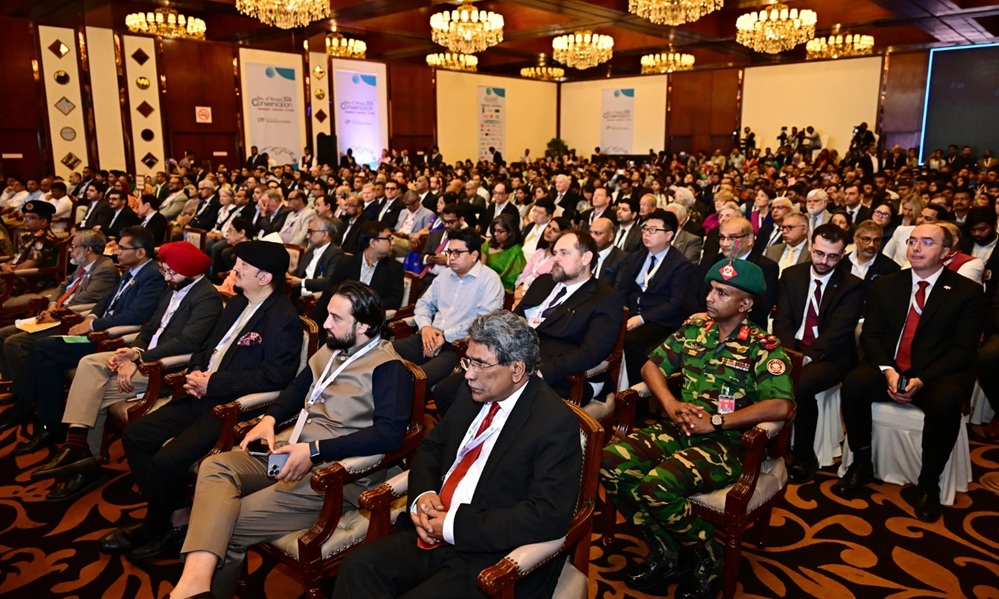
Calling for continued political support and international financing from the global community, he said the root causes of the crisis must also be addressed. “The crisis originated in Myanmar and its solution must also be found in Myanmar,” he said. Referring to the Bay of Bengal as one of the major pillars of Bangladesh’s future economic potential, Tarique Rahman said the Bay had been shaping Bangladesh’s destiny for generations.

Given Bangladesh’s geographic and strategic location, he said, the country had opportunities to become more deeply connected with the world through seaports, waterways and the coastal economy. There is immense potential in shipping, fisheries, tourism, energy and regional supply chains, he said. The prime minister said deeper bilateral and multilateral engagement was needed to transform the region’s shared geography into shared prosperity.

“Cooperation can be further expanded in trade, energy, education, technology, climate and maritime sectors. New markets can be opened and more opportunities can be created for young people. We can build stronger cooperative relations based on equality, fairness and justice,” he said. Stating that Bangladesh believes in dialogue, partnership and mutual respect, Tarique Rahman said the country would continue to work positively with all its regional and global partners while safeguarding national interests and sovereignty. “Because peace and harmony are the foundations of shared prosperity and development,” he said.

The prime minister called for transforming the Bay of Bengal region into an area where every state could prosper together, benefit equally and extend meaningful cooperation to its citizens.

“Bangladesh is fully prepared to play its rightful role in this regard,” he said. The five thematic pillars of this year’s BOBC are geopolitics, security and strategic competition, artificial intelligence, cyberspace and information power, trade, connectivity and strategic growth, and climate, resilience and human security.


bdnews24 Editor-in-Chief Toufique Imrose Khalidi Dies at 59

Dhaka: The voice behind one of Bangladesh’s most consequential journeys into digital journalism has fallen silent. Toufique Imrose Khalidi, editor-in-chief of bdnews24.com, has died at the age of 59. He was taken to St Bartholomew’s Hospital in London on Thursday night after suffering a brain haemorrhage. Doctors pronounced him dead at 2:23pm local time on Friday. Khalidi had been in London on a private visit, his family said, when he suddenly fell ill. His death came just three weeks before bdnews24.com was due to celebrate its 20th anniversary on Oct 23 — an occasion he had been actively planning.

“We were preparing to celebrate our 20th anniversary on Oct 23. Toufique bhai himself was planning everything. Overall, he was incredibly energised and enthusiastic. But everything ended three weeks before that. This is an irreparable loss for us,” a bdnews24.com spokesperson said. The date for bringing Khalidi’s body back to Bangladesh has not yet been decided. His family will announce the time and place of the funeral prayers and burial once arrangements have been finalised. President Mirza Fakhrul Islam Alamgir expressed deep sorrow over Khalidi’s death, describing him as a pioneer in the development of online and digital journalism in Bangladesh.

“Toufique Imrose Khalidi was a pioneer in the development of online and digital journalism in the country. With his death, the country has lost an experienced, gracious and distinguished media personality. His contribution to journalism and the media will be remembered for a long time,” he said in a condolence message. Recalling his personal memories of Khalidi with deep respect, the president added, “Toufique Imrose Khalidi’s death is extremely painful for me.”

Khalidi was born on Jun 14, 1967. He earned a Bachelor’s degree in English Literature from the Dhaka University in 1987, studying political science and international relations as subsidiary subjects. Khalidi would go on to complete a Master’s in English Literature from the same university. He started in population research in 1987 and worked for Save the Children Fund (UK) before entering journalism.

Khalidi worked at a number of publications over the course of a lengthy journalistic career. He was the assistant editor at the Sunday Express from 1989 to 1991, a diplomatic correspondent at The Daily Star from 1991 to 1993, a senior correspondent at The Financial Express from 1993 to 1995, and then as assistant editor and lead writer at the publication while also covering major events as special correspondent.

From 1996 to 1997, he worked for Paris-based Europe, a quarterly journal published by Journalists in Europe Foundation in Paris. He was the assistant editor and head of the Business and Economy Desk at The Daily Star from 1997 to 1998. From 1999 to 2000, he was the news editor of the English daily’s Weekend Edition. During this time, he was also the joint news editor at the newspaper.

Khalidi joined the BBC World Service in 2000 and worked as a producer and presenter of news and current affairs programmes in addition to producing reports and features on business and economic issues until 2005. He was also the anchor of a monthly debate programme.

In July 2006, he became the editor-in-chief and managing director of bdnews24.com, also serving as the director and stakeholder of its owning company Bangladesh News 24 Hours Ltd. Following the takeover by Khalidi, BDNEWS relaunched as Bangladesh’s first free online newspaper and was rebranded as bdnews24.com.


Bangladesh Extends Bir Muktijoddha Enlistment Deadline to October 7

DHAKA — The Ministry of Liberation War Affairs has extended the deadline for submitting applications for fresh gazette enlistment as Bir Muktijoddha (Valiant Freedom Fighter) to October 7, 2026. According to a gazette notification issued Thursday, eligible individuals can submit their applications for enlistment within the extended deadline. The ministry said no new applications will be accepted after October 7.

A memorandum issued by the ministry’s Gazette Branch requested its Information and Communication Technology (ICT) Branch to take necessary steps to publish the public notice on the ministry’s website. The memorandum was signed by Under Secretary Haridas Thakur.

The ministry said applications for enlistment as Bir Muktijoddha had previously been received at various times, followed by verification processes. Under the prescribed procedure, applications are considered for gazette enlistment after verification of an applicant’s role during the Liberation War, along with relevant documents and other supporting information.

The ministry said there are provisions for verifying applications through the National Freedom Fighters Council and the relevant administrative authorities. The extension provides applicants additional time to submit their applications before the process closes for new submissions.


Ferdousi Ahmed’s reserved seat declared vacant

DHAKA- Reserved women’s seat-23 of the 13th Jatiya Sangsad has been declared vacant following the resignation of law maker Ferdousi Ahmed. Jatiya Sangsad Speaker Hafiz Uddin Ahmad Bir Bikram told reporters this afternoon that the lawmaker from reserved women’s seat-23 came to his office and submitted her resignation in writing.

“According to the provisions of the Constitution, the seat became vacant immediately after her resignation,” he said. The Speaker added, “We have sent it for publication in the gazette. Immediately after receiving the gazette, we will inform the Election Commission, and the resignation will take effect from today.”

Meanwhile, a notification signed by Parliament Secretariat Secretary Barrister Md Golam Sarwar Bhuiyan today said that the reserved Women’s seat-23 in the 13th Jatiya Sangsad had fallen vacant following the resignation of Ferdousi Ahmed. The notification said the seat fell vacant on the same date in accordance with Article 67(2) of the Constitution of the People’s Republic of Bangladesh.