Bangladesh Sramik League Holds Protest Outside UN Headquarters in New York

NEW YORK: A protest rally was held outside the United Nations headquarters in New York on Wednesday, with the Bangladesh Sramik League USA chapter calling for the withdrawal of the ban imposed on the Bangladesh Awami League and the Sramik League. The protest was organized at 2 p.m. during the ongoing United Nations General Assembly session. Organizers said the demonstration was aimed at drawing international attention to their demands, including the withdrawal of restrictions on the Sramik League in accordance with the principles of International Labour Organization (ILO) conventions.

Nazmul Alam Romen, an executive member of the central committee of the Bangladesh Sramik League, addressed the rally as the chief guest. The event was chaired by Kazi Azizul Haque Khokon, president of the Sramik League USA, and moderated by Jewel Ahmed, general secretary of the organization. Speakers alleged that following August 5, 2024, the activities of the Bangladesh Awami League and its affiliated and associated organizations were banned through an executive order. They further claimed that the activities of the Bangladesh Sramik League, which they described as affiliated with the International Labour Organization (ILO) and the International Trade Union Confederation (ITUC), were also prohibited in violation of labour laws.

The speakers said the right to form and join trade unions is recognized by the ILO as a fundamental labour right. They said protecting trade union rights is important for ensuring democratic conditions in the workplace and allowing workers to pursue their legitimate demands.

Referring to ILO conventions, the speakers said Convention No. 87 protects freedom of association and the right to organize, while Convention No. 98 provides protection against anti-union discrimination. They alleged that the ban on the Sramik League’s activities through an executive order violates these principles.

The speakers also alleged that the headquarters of the Bangladesh Awami League and the Sramik League at 23 Bangabandhu Avenue in Dhaka had been burned and destroyed, while offices of various trade unions affiliated with the Sramik League had been closed.

They further claimed that thousands of Sramik League activists had lost their jobs and that workers had been killed or injured in attacks, while others were being harassed through what they described as false cases.

The rally called for the withdrawal of the restrictions on the Bangladesh Awami League and the immediate lifting of the ban on the Sramik League’s activities, which the speakers said should be done in accordance with ILO conventions. The speakers also called on the ILO, ITUC, international human rights organizations and the broader international community to take notice of their concerns.

Among those attending the rally were Sramik League USA leaders M.A. Alam Biplob, Laskar Moyzur Rahman Jewel, Abdur Razzak Anwar, Md. Motaleb Hossain and Saidul Islam, among others.


New York City Launches 17 High-Tech Public Toilets in $4M Pilot Program

NEW YORK — New York City has launched a new pilot program to address the long-standing shortage of clean, accessible public restrooms across the city. Under the initiative, 17 high-tech modular public toilets will be installed across all five boroughs as part of a $4 million, one-year pilot program launched by Mayor Zohran Kwame Mamdani. Speaking at a news conference Wednesday, Mayor Mamdani said access to public restrooms is an important part of maintaining clean streets and ensuring dignity for New Yorkers.

“Many New Yorkers and working people—especially delivery workers who spend up to 12 hours on the streets and mothers traveling with children—struggle to find a restroom when they urgently need one,” Mamdani said. “This public health infrastructure will play an important role in keeping our streets clean and ensuring dignity for all New Yorkers.”

Self-contained toilets require no underground utility connections

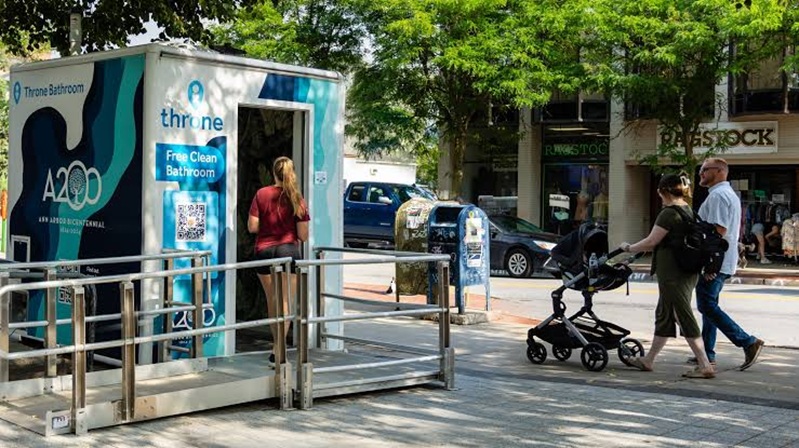
The modular restroom units are being developed by technology company Throne Labs. The units are fully self-contained, meaning they do not require connections to underground water or sewer lines. That design allows the toilets to be installed relatively quickly in busy intersections, plazas and other high-traffic locations. The units can also be relocated when necessary.

A high-tech modular public restroom developed by Throne Labs as part of New York City’s new public toilet pilot program. Photo: KHABOR

Free access and modern amenities

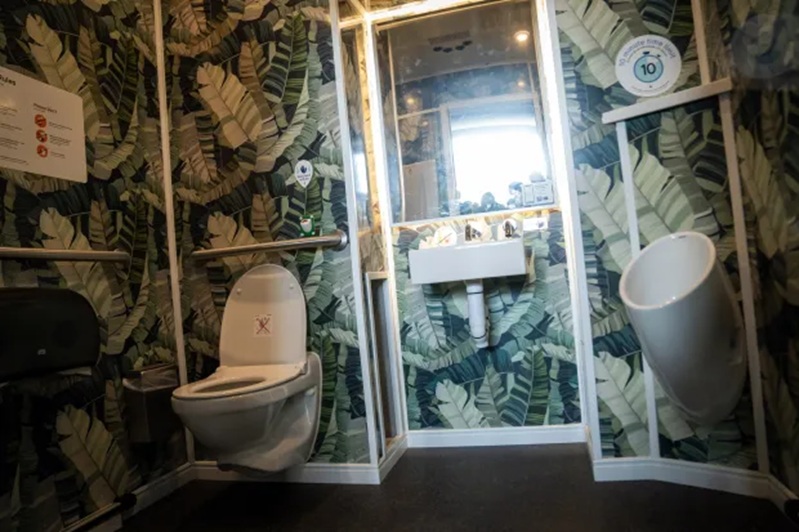
The public toilets will be free to use and available daily from 7 a.m. to 10 p.m. Each unit is equipped with a range of modern features, including a touchless-flush toilet, running-water sink, automated heating and air conditioning, and a baby-changing station. The units are also designed to be ADA-compliant, making them accessible to people with disabilities.

Smartphone, QR code and text-message access

Users will be able to unlock the restrooms through a smartphone app, QR code or text message. For people without smartphones, including unhoused New Yorkers, special tap cards will be distributed through local community organizations.

Ten-minute limit raises eyebrows

One of the program’s most notable features is a strict 10-minute usage limit. Users will receive audio warnings after five and eight minutes inside the restroom. Once the 10-minute limit is reached, flashing lights will activate and the door will automatically unlock. Jessica Heinzelman, chief operating officer of Throne Labs, said the system is designed to prevent individuals from occupying the facilities for extended periods.

A high-tech modular public restroom developed by Throne Labs as part of New York City’s new public toilet pilot program. Photo: KHABOR

“Someone shouldn’t be able to occupy the restroom for a long time,” Heinzelman said, noting that the company estimates a typical restroom visit takes about three and a half minutes.

Initial locations across Manhattan, Brooklyn and the Bronx

The first units are being installed in high-density locations, including Cooper Square in Manhattan, Columbus Park in Brooklyn and the area around Yankee Stadium in the Bronx. City officials say the one-year pilot will help determine how effectively the modular restroom system serves residents and visitors. If the pilot proves successful, the city could consider expanding the public restroom network to additional locations across New York City.