Security heightened nationwide ahead of August 5: Home Minister

DHAKA: Home Minister Salahuddin Ahmed today said the government has placed law enforcement and security agencies on high alert ahead of August 5 to ensure public safety and maintain law and order across the country

“All necessary measures have been taken to ensure a peaceful and secure environment across the country ahead of August 5,” he said while speaking to journalists at the Home Ministry in Bangladesh Secretariat here.

The heightened security measures are part of routine precautionary steps taken in view of the significance of the day and prevailing security considerations, he said.

Ahmed said the Home Ministry has issued specific directives to police and other security agencies to strengthen vigilance and remain fully prepared to respond to any untoward situation.

As part of the instructions, police vehicles have been directed not to remain unattended, while security personnel have been advised to maintain continuous vigilance to ensure uninterrupted monitoring and rapid response capability.

Ahmed said a high-level coordination meeting involving the government, law enforcement agencies and relevant stakeholders will be held to review the overall security situation and finalize necessary arrangements for August 5.

The minister also referred to the recent recovery of bomb-like objects in Motijheel and Ashulia, describing the incidents as attempts to create panic and disrupt social harmony.

He said a coordinated investigation is underway to identify those responsible and determine whether there are any links between the incidents.

Ahmed added that intelligence and law enforcement agencies are closely monitoring the activities of banned organizations and certain groups operating from abroad.

Further details will be disclosed once the ongoing investigations are completed, he said.


Shakib Khan, Bubly and Hridi Haq Honored at New York Bengali Film Festival

New York: The first-ever New York Bengali Film Festival concluded successfully after a four-day celebration of Bengali cinema, drawing enthusiastic participation from the Bangladeshi diaspora and local film enthusiasts. Held at the Jamaica Performing Arts Center, the festival featured a vibrant showcase of films, cultural performances and an awards ceremony.

The festival was jointly organized by Priyojon Films and Lemon Studio, with support from the American Bangladeshi Producers Association. All County Home Care served as one of the event’s principal sponsors.

During the first three days, audiences enjoyed a diverse selection of short films, documentaries and feature films by filmmakers from Bangladesh and North America. The strong turnout reflected the continued passion of expatriate Bangladeshis for Bengali cinema despite living abroad.

The closing ceremony featured a red carpet reception, cultural performances and an awards presentation attended by prominent Bangladeshi entertainment personalities, including actors Zayed Khan, Kazi Maruf, Emon, Sojol and Bindu, as well as popular singer Pratik Hasan. Members of the Bangladeshi community in New York welcomed the opportunity to meet their favorite artists in person.

The festival recognized outstanding achievements in Bengali cinema from 2023 to 2025 across multiple categories.

Actor Shakib Khan won the Best Actor award for his performance in Priyotoma, while Shabnam Bubly was named Best Actress for Deyaler Desh. Hridi Haq received the Best Director award for 1971 Shei Shob Din.

Among the other major winners, Chanchal Chowdhury received the Best Supporting Actor award for Toofan, while Sanjida Preeti won Best Supporting Actress for 1971 Shei Shob Din. Kacher Manush Dure Thuiya, directed by Shihab Shaheen, was named Best Web Film.

Other award recipients included Mamunun Emon (Maya), Afsana Ara Bindu (Unish 20), child actors Kazi Arisha (Green Card) and Nairita Hasin Roudromoyi (Jongli), singers Balam, Pritom Hasan and Avanti Sithi, story writer Dr. Enamul Haque, screenwriters Nazim Ud Daula and Raihan Rafi, cinematographers Suman Sarkar and Sahel Rony, editors Simit Roy Antor and Kamruzzaman Rony, sound recordist Ripon Nath, lyricists Asif Iqbal and Someshwar Oli, composer Prince Mahmud, and music director Imon Saha.

In the film categories, Lost won Best Short Film, while Songs for a Country was named Best Documentary.

Veteran actor Ahmed Sharif received the festival’s Lifetime Achievement Award in recognition of his outstanding contribution to Bengali cinema. Special honors were also presented to Bioscope Films, Star Cineplex, and the streaming platform Chorki for their contributions to the growth and promotion of the Bangladeshi film industry.

According to the organizers, the festival aims not only to screen films but also to strengthen the connection between the younger Bangladeshi diaspora and Bengali cinema while expanding the global reach of Bangladesh’s film industry.

Following the overwhelming success of its inaugural edition, organizers, filmmakers and audiences expressed optimism that next year’s festival will be even larger, with broader international participation and greater opportunities to showcase Bengali cinema on the world stage.


Bangladesh reaffirms multilateral commitment during U.S. Army War College visit

Shibbir Ahmed, UN, New York: Bangladesh has reaffirmed its commitment to multilateralism, UN peacekeeping and international cooperation during a visit by a delegation from the United States Army War College to the Permanent Mission of Bangladesh to the United Nations today.

Welcoming the delegation Bangladesh’s Permanent Representative to the United Nations Ambassador Salahuddin Noman Chowdhury underscored the country’s longstanding engagement with the UN, rooted in its constitutional commitment to international peace and security. He noted that Bangladesh remains one of the largest contributors to UN Peacekeeping Operations, with Bangladeshi peacekeepers serving with distinction in some of the world’s most challenging conflict zones.

The Ambassador briefed the delegation on the activities of Bangladesh’s Permanent Mission including its engagement to build on its legacies in peacekeeping, sustainable development, women empowerment and climate justice. Reaffirming Bangladesh’s strong support for the United Nations, Ambassador Chowdhury stressed that dialogue, compromise and consensus-building remain essential to addressing contemporary global challenges and strengthening international cooperation.


Bangladesh calls for stronger global cooperation on safe migration at UN forum

Shibbir Ahmed, UN, New York: Bangladesh called for stronger global cooperation to curb irregular migration, protect migrant rights and ensure fair recruitment, decent work and fair wages for migrant workers.

Speaking at the General Debate of the Second International Migration Review Forum at United Nations Headquarters, Expatriates’ Welfare and Overseas Employment Minister Ariful Haque Choudhury said Bangladesh was strengthening accountability and expanding migrants’ access to justice through a “whole-of-government and whole-of-society” approach.
He said the country had formed a Migration Compact Taskforce and adopted a National Action Plan for 2026–2030 to advance safe, orderly and regular migration under the United Nations Global Compact for Migration (GCM).

The minister said Bangladesh had fulfilled seven of its 10 commitments made at the first review forum, submitted six new pledges and joined two regional initiatives, while presenting its first Voluntary National Review on GCM implementation. Describing climate change as a growing reason of migration, he called for predictable financing and technical support for climate-affected countries. He reaffirmed Bangladesh’s commitment to working with partners to promote safe migration and dignified return and reintegration of migrants.


Missing USF students: Suspect charged with two counts of first-degree murder

Tampa, Florida: The roommate of a USF doctoral student who went missing last week along with his friend has been charged with two counts of murder, authorities announced April 25. Hisham Abugharbieh, 26, is facing two counts of premeditated murder in the first degree with a weapon for the deaths of Zamil Limon and Nahida Bristy, both 27, the Hillsborough County Sherriff’s Office said.

Abugharbieh was arrested at his family’s Tampa home April. 25 following a standoff with authorities that resulted in the SWAT team’s assistance, but the charges did not include murder. Earlier in the day, the body of Zamil was discovered on the Howard Frankland Bridge. Bristy’s body has not been located.

“Evidence was presented to the State Attorney’s Office, resulting in further charges against Abugharbieh,” the sheriff’s office said in a statement. “At this time, the search for Bristy continues.”

In addition to murder, Abugharbieh is charged with domestic violence, tampering with evidence and unlawfully holding or removing a dead human body. He was interviewed by detectives April. 23, and after initially talking, he ended the interview and left. That was the same day authorities upgraded the case from missing to endangered.

Authorities were called to Abugharbieh’s family’s home for a domestic dispute about 9 a.m. April 24. Investigators were able to get relatives safely out of the home. Abugharbieh then barricaded himself inside and the SWAT team was called to assist. After about 20 minutes, Abugharbieh emerged from the home with his hands raised wearing no shirt and a blue towel around his waist.

“This is a deeply disturbing case that has shaken our community ad impacted many who were hoping for a safe resolution,” Sheriff Chad Chronister said. “While the discovery of Zamil Limon’s remains is heartbreaking, I want the public to know that our detectives are working tirelessly and relentlessly to uncover the truth.”

Limon and Bristy were last seen the morning of Thursday, April 16. A family friend reported both of them missing shortly before 5 p.m. April 17 after not being able to reach either of them. Both University of South Florida Police Department and Hillsborough County Sheriff’s Office documented and processed missing persons reports. Limon was pursuing a degree in geography, environmental science and policy while Bristy was studying chemical engineering.

Both families described Limon and Bristy as hardworking, dedicated, responsible students and said it was unusual for both to go days without talking to family members. They both had summer trips planned to their home country of Bangladesh. Abugharbieh is a U.S. citizen who previously took classes at USF from 2021 to 2023, according to a university spokesperson. He does have a criminal record including a 2023 charge of batter and burglary. Also that year, a relative filed two domestic petitions against him.


Where does garment industry stand now in Bangladesh!

Shaikh Shahrukh: Thirteen years after the Rana Plaza collapse reshaped Bangladesh’s ready-made garment sector, the industry has undergone sweeping changes — safer factories, stricter compliance and global recognition for green manufacturing. Yet beneath these gains lies a more complex reality: workers still face pressure on the factory floor, survivors continue to struggle with long-term hardship, and manufacturers are grappling with rising costs and financial strain. Workers across major industrial hubs say workplace safety has improved significantly since the 2013 disaster.

“Now there are fire exits, and we have regular drills,” said a female worker in Narayanganj. But concerns remain. “The production pressure is still very high. If we fail to meet targets, wages can be deducted,” she added. A worker in Gazipur said union activities remain sensitive in some factories. “There is always fear of losing jobs,” he said. Others noted that while safety awareness has increased, preparedness during real emergencies still needs improvement.

“Before Rana Plaza, we didn’t even know what a fire exit was. Now we get training, but in a real situation, not everyone can respond properly,” another worker said. For factory owners, the transformation has required heavy financial investment. “After Rana Plaza, entrepreneurs had to invest heavily to ensure safety,” said Faiz Ahmed Khan, managing director of Haseen Kayaba Group.

While necessary, he said, these investments have not been matched by higher prices from international buyers. “Many factories took bank loans to upgrade compliance. Those liabilities still remain,” he said.

Ahsanul Russel, managing director of Tua Ha Textile Mills Ltd, echoed the concern. “We carried out extensive renovations to meet compliance standards. But order prices did not increase accordingly,” he said, adding that many factories are still repaying loans taken during that period. Industry insiders say smaller factories were particularly vulnerable, with many unable to survive the financial shock.

One of the most visible outcomes of post-Rana Plaza reforms has been the growth of environmentally sustainable factories. Bangladesh now has more than 210 LEED-certified green garment factories, many with top-tier Platinum and Gold ratings—the highest number in the world. These facilities incorporate energy-efficient systems, water recycling and environmentally friendly designs, marking a shift toward sustainable production. Before 2013, only a handful of factories met such standards.

However, industry leaders say green transformation has also increased production costs without ensuring better returns. “Compliance and sustainability have improved our global reputation,” said Fazlul Hoque, managing director of Plummy Fashions Ltd and former BKMEA president. “But production costs have risen sharply, while buyers continue to negotiate lower prices,” he added.

In the aftermath of the collapse, international initiatives such as the Accord and the Alliance carried out extensive inspections, focusing on structural, electrical and fire safety. Factories were required to reinforce buildings, upgrade electrical systems and introduce modern fire safety measures, including sprinkler systems and emergency drills. These reforms significantly improved safety standards across the sector. But they also raised the cost of doing business.

Industry estimates suggest that between 2,000 and 2,500 garment factories have closed over the past decade. Key factors include high compliance costs, shrinking profit margins, rising utility expenses and intense global competition. A factory owner in Gazipur said compliance upgrades alone cost between $700,000 and $800,000.

“Buyers did not increase prices. Loans went up, profits declined, and many factories could not survive,” he said, requesting anonymity. Manufacturers say pricing pressure from international buyers remains a major challenge, with some buyers continuing to negotiate aggressively despite demanding higher compliance standards.

Compared to the pre-2013 period, the industry now operates under stricter regulations, higher costs and tighter margins. Safety investment has increased, but so have operational challenges—from energy shortages to persistent loan burdens. Thirteen years on, Bangladesh’s garment sector stands as both a success story of reform and a reminder of unresolved pressures. While factories are safer and more sustainable, workers, survivors and business owners alike say the journey toward a fully balanced and resilient industry is still far from complete.




Hospitals fuel measles spread amid bed shortage

Salma Akter Sharmin: Amid a nationwide measles outbreak, concerns are mounting over continued transmission inside hospitals and homes, as shortages of beds and inadequate isolation facilities are forcing infected and uninfected children to share wards, leading to new infections. Health experts say measles, caused by a highly contagious virus, can infect 12 to 18 unvaccinated people through a single infected case.

According to the Directorate General of Health Services (DGHS), one death from measles was reported in the last 24 hours, while four more suspected deaths were recorded during the same period. A total of 1,170 new suspected cases were identified in the last 24 hours.

From March 15 to April 23 (8:00am), suspected cases have reached 28,334, of which 4,059 have been confirmed as measles. So far, 18,845 patients have been hospitalized with suspected and confirmed infections, while 15,728 have recovered and been discharged. Since the outbreak began, 39 confirmed deaths and 194 suspected deaths have been reported.

Data from Dhaka North City Corporation (DNCC) Hospital shows that 426 patients received outpatient care in the last 24 hours, while 100 were admitted. A total of 436 patients are currently undergoing treatment at the facility. One death was reported in the last 24 hours, bringing the total number of deaths at the hospital to 12. So far, 2,107 patients have been admitted there.

Hospitals, including the Infectious Diseases Hospital in Mohakhali and other public and private facilities, are currently facing severe bed shortages. As a result, patients with highly contagious diseases such as measles and chickenpox are being treated in shared wards, contributing to hospital-based transmission, with new infections emerging among already admitted children.

A similar case has been reported in Chapainawabganj, where a one-and-a-half-year-old girl, Tahmina, was initially admitted with fever and later diagnosed with pneumonia. Her family said she developed measles symptoms after being exposed to infected patients in the same ward. Her condition deteriorated, and she was referred to Rajshahi Medical College Hospital and later to Dhaka Shishu Hospital. However, due to a lack of available beds, she is currently receiving treatment at DNCC Hospital.

Public health expert and vaccine specialist Dr. Md. Tajul Islam Bari said measles patients must be strictly isolated. “Whether in hospital or at home, isolation is mandatory. If patient numbers are high, additional beds or even temporary arrangements such as tents should be used,” he said, adding that failure to isolate patients accelerates transmission.

Doctors at DNCC Hospital said transmission from one patient to another within healthcare facilities is known as cross-infection. They added that infections are also spreading rapidly within families, creating what they described as a chain of transmission.

Dr. Shreebas Pal, consultant at the Infectious Diseases Hospital in Mohakhali, said measles, chickenpox, and mumps are all highly contagious diseases. Due to heavy patient loads, maintaining proper isolation is often not possible, leading to rapid spread of infection. He added that around 10 percent of patients admitted for other conditions are found to have contracted measles during treatment.

In response to the worsening situation, the Health Services Division has instructed all public hospitals to increase bed capacity. In a directive issued on Thursday (April 23), signed by Dr. Abu Hossain Md. Moinul Ahsan, Director (Hospitals and Clinics) of the DGHS, hospitals were instructed not to turn away any measles or suspected measles patients due to lack of beds. Instead, hospitals have been directed to arrange additional beds or alternative facilities where necessary.


Ducsu leaders assaulted inside Shahbagh police station by Chhatra Dal

Dhaka: Activists of the Jatiyatabadi Chhatra Dal (JCD) assaulted two Ducsu office-bearers inside Shahbagh Police Station on Thursday evening. The victims are Ducsu Secretary for Literature and Cultural Affairs Musaddiq Ali Ibne Mohammad and Social Welfare Secretary AB Zubair.

Eyewitnesses said JCD activists went to the police station to file a case against Dhaka University student Abdullah Al Mahmud, whom they alleged was linked to Islami Chhatra Shibir (ICS) and had made a Facebook post they considered offensive. The group had earlier announced the move.

At the same time, Abdullah Al Mahmud also arrived at the police station to submit a general diary over concerns for his personal safety. Musaddiq Ali Ibne Mohammad, A B Zubair, and Fatima Tasnim Zuma accompanied him.

Witnesses said tensions escalated when both sides came face to face inside the station, leading to a confrontation between Ducsu representatives and JCD activists that quickly turned violent. Around 20 to 30 JCD activists then attacked Musaddiq and Zubair inside the police station, assaulting them separately, according to eyewitness accounts.

JCD leaders, however, claimed Musaddiq triggered the violence by attempting to strike a joint secretary of the Chhatra Dal’s Dhaka University unit. Senior JCD leaders later intervened and moved the two Ducsu leaders to a secure area inside the police station.

Witnesses also said a group of activists chanted slogans inside the station for around 20 minutes, demanding that the Ducsu leaders be handed over to them. Senior leaders later dispersed the group from the premises, though they remained gathered at the gate for some time.

Later in the evening, Ramna Zone Deputy Commissioner Masud Alam escorted A B Zubair and Fatima Tasnim Zuma to Shahbagh police station Jame Masjid around 9 pm after they were taken to safety.


Bangladesh Pushes Fair Finance, LDC Graduation at UN Forum

Shibbir Ahmed, New York: Bangladesh called for urgent global action to bridge the widening SDG financing gap and to establish a fair, inclusive and responsive international financial system. At the General debate in ECOSOC Financing for Development Forum 2026 held at the UN Headquarters in New York today, Bangladesh’s Permanent Representative Ambassador Salahuddin Noman Chowdhury underscored that geopolitical conflicts, declining ODA, climate shocks, trade barriers and energy uncertainties were shrinking the policy space for developing countries. In this context, Bangladesh had sought an extension of its LDC graduation preparatory period to ensure a smooth and sustainable transition.

The Permanent Representative also highlighted the country’s progress in political and economic recovery with the government focusing on macroeconomic stability, rebuilding business confidence, strengthening the banking sector, promoting investment, and expanding direct support to vulnerable people.

Stressing the need to lower debt costs, avoid inefficient infrastructure-related debt, and channel FDI into productive, job-creating sectors with technology transfer, Ambassador Chowdhury called for a more representative global financial system, climate justice, action on loss and damage, and the return of stolen assets to their rightful owner.


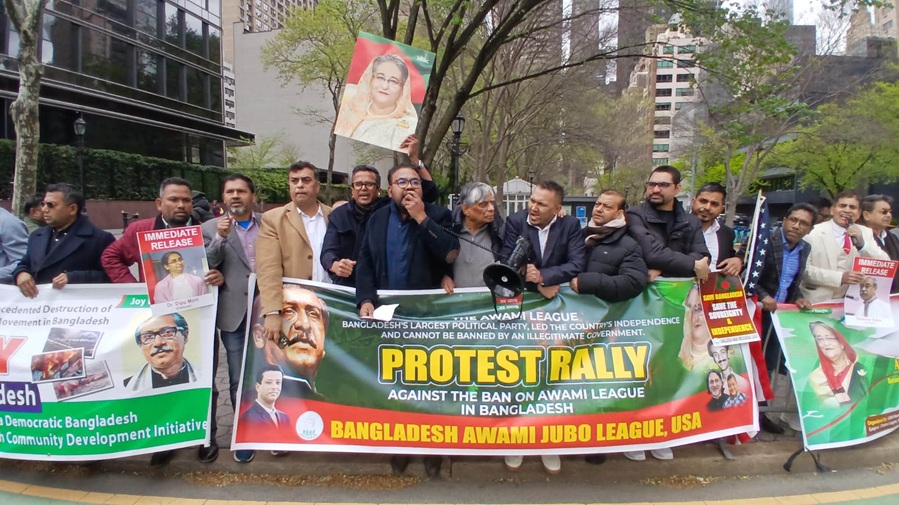
US Awami League Leaders Protest Alleged Conspiracy to Ban Party

New York: Leaders and activists of the United States Awami League have strongly protested what they described as a conspiracy by BNP-Jamaat groups to ban the Bangladesh Awami League, warning of a strong movement if such efforts continue.

Speaking at a rally held on April 5 in Jackson Heights, New York City, party leaders expressed anger and concern over what they called a political conspiracy. They asserted that Bangladesh did not create the Awami League; rather, Bangladesh itself was born under the leadership of the Awami League. According to the speakers, those who do not believe in the red-and-green national flag are capable of engaging in such actions.

The speakers further noted that even Pakistani military rulers had once banned the Awami League, and alleged that BNP-Jamaat are now attempting to repeat that history. They said such efforts would never be allowed to succeed.

Dr. Siddiqur Rahman, President of the US Awami League, stated that the current government should not forget that the February 12 election lacks legitimacy, as it excluded what he claimed to be 55 percent of Awami League supporters. He added that this issue is increasingly coming to light and that similar voices of protest will soon rise across the United States, including New York. He warned that the power structure of what he described as extremist elements would eventually collapse.

The rally began with an opening speech by Dr. Siddiqur Rahman and was conducted by General Secretary Abdus Samad Azad.

Among those who spoke at the event were Sajjad Hossain Sabuj, Press Minister at the Bangladesh Embassy in Washington, D.C.; Imdad Chowdhury, General Secretary of New York City Awami League; Vice President Sakhawat Hossain Chanchal; Dr. Masudul Hasan, Vice President of US Awami League; freedom fighters Sharaf Sarkar and Solaiman Ali; Zainal Abedin; John Sikdar; Organizing Secretary Mohiuddin Dewan; Sharif Kamrul Hira; M.A. Malek; Professor Shahnaz Mumtaz, President of US Mahila Awami League; Sheikh Atik, Vice President of New York State Awami League; General Secretary Shaheen Azmal; Ashraful Uddin, Vice President of US Swechchhasebak League; Bronx Awami League leader Md. Muhit; US Awami League leader Md. Tulon; Jubo League leader Sebul Mia; Chhatra League leaders Hridoy Mia and Zahid Hasan, among others.

Also present were journalist union leader Saban Mahmud, US Awami League Organizing Secretary Abul Hasib Mamun, and Executive Member Shahanara Rahman.